Earning a Training Certificate the Year You Turn 16
Turning sixteen can make an ATV or quad ride legally possible, but the birthday alone does not clear you to ride. Quebec requires young riders to have both a valid driver’s licence and a recognized-federation training certificate. The practical challenge is timing: know which documents must be ready, what kind of machine you can drive, and what to confirm with the federation before heading out.
What changes when you turn sixteen
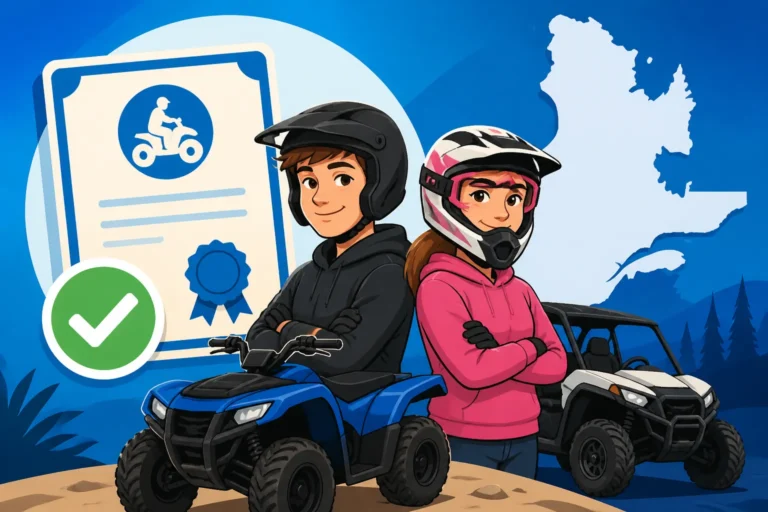
According to the Gouvernement du Québec, drivers aged sixteen or seventeen must hold both a valid driver’s licence and a training certificate issued by a recognized federation to operate an off-road vehicle on a trail, road, public land, or municipal private land. The requirement applies to quad bikes and other off-road vehicles covered by the rules; it is not just a trail-club formality.
That makes the year you turn sixteen a planning year, not a reason to assume you can ride as soon as you complete a course. The rules establish what you need to operate at sixteen and seventeen, but do not, by themselves, settle when a particular federation lets you enroll, complete training, or receive the certificate. Ask the recognized federation directly how it handles course registration and certificate issue around your birthday. Do not assume a certificate completed earlier automatically lets you ride before you meet the age requirement.
The certificate and driver’s licence are separate requirements. A course certificate does not substitute for a valid driver’s licence, and holding a licence does not replace the certificate. Check that both documents will be valid and available before planning a ride. For an overview of the youth requirement, see Quebec Training Certificates for Teen Riders and Quebec ATV Age Requirements.
Also separate permission to operate from permission to use a particular trail or property. A training certificate is not a trail access permit, and it does not make a closed or unauthorized route legal. Patrols may ask riders to show identification with proof of age, a driver’s licence, vehicle registration, proof of insurance, and a valid trail access permit, according to the Gouvernement du Québec. Review What a 17-Year-Old Needs Before Riding a Trail for the documents that can matter during a trail check.
| What you need to check | Why it matters |
|---|---|
| Your age on the planned ride date | The youth rules apply to drivers aged sixteen or seventeen. |
| A valid driver’s licence | It is required alongside the training certificate. |
| A recognized-federation training certificate | The certificate must be issued by a recognized federation. |
| The vehicle type | A side-by-side has a different minimum driver age. |
| Permission and access documents | The certificate does not replace registration, insurance, or a trail permit. |
| The riding location | The youth rule covers specified locations, but does not itself grant access. |
If you are turning sixteen during the riding season, use the date as a checkpoint. Before it, ask the federation about training and certificate timing; before riding, confirm that you meet the age rule and have both required documents. If the answer about certificate timing is unclear, wait for confirmation rather than relying on an assumption based on course completion.
How to plan the certificate and licence
Start with the recognized federation responsible for the type of vehicle you intend to operate. The Gouvernement du Québec identifies the Fédération québécoise des clubs quads as an example of a recognized federation for quad bikes. If you plan to ride a different kind of off-road vehicle, confirm which federation’s certificate applies rather than assuming that a certificate for one machine automatically qualifies you for another.
Ask the federation specific questions before registering:
- Can you enroll or complete the training before your sixteenth birthday?
- When will the certificate be issued, and what date will it show?
- What identification or age information is needed to register?
- Does the certificate apply to the kind of off-road vehicle you plan to drive?
- What document should you carry to show that you completed the training?
These are questions to confirm with the federation, not answers to infer from the age rule. The rules state that the certificate must come from a recognized federation; they do not provide a universal course schedule or a single certificate-issue procedure. For related details, see Quebec Training Certificate Requirements, Quebec Training Course Length, and Quebec FQCQ Training Certificates for Teens.
Plan your driver’s licence separately. The Gouvernement du Québec requires a valid driver’s licence for drivers aged sixteen and seventeen operating an off-road vehicle in the covered locations. The available facts do not specify which licence class or learner status qualifies in every situation. Confirm your licence eligibility with the appropriate official channel before treating it as complete. Do You Need a Licence for an ATV in Quebec? can help you frame that question.
Once you have the documents, keep them easy to access. A patrol may ask for proof of age and a driver’s licence, as well as registration, insurance, and a valid trail access permit. The Gouvernement du Québec says club-appointed trail wardens can stop an off-road vehicle to inspect it and check equipment. A training certificate therefore belongs in your pre-ride document check, but it is only part of the paperwork you may need.
A practical preparation sequence
- Choose the vehicle and riding area. Identify whether you plan to drive a quad, a side-by-side, or another off-road vehicle, and whether the trip uses a trail, road, public land, or municipal private land.
- Confirm the correct federation. Ask which recognized-federation certificate applies to that vehicle and how the federation handles training and certificate issue for someone turning sixteen.
- Check your driver’s licence. Confirm that it is valid and that it meets the requirement for the vehicle and planned use.
- Wait until you meet the age requirement. Do not treat finishing training as a substitute for meeting the minimum age to operate.
- Check the remaining ride requirements. Confirm registration, insurance, trail access, property permission, and any location-specific rules.
- Carry the documents. Have the certificate and other required papers available if a patrol asks to see them.
This sequence helps avoid a common mix-up: being ready to take training is not the same as being ready to drive. The certificate, valid licence, age requirement, vehicle rules, and access permission each answer a different question.
Which vehicles a sixteen-year-old can drive
The youth rule is not a blanket permission to drive every off-road vehicle. Vehicle type matters. In particular, the minimum age for a utility task vehicle, commonly called a side-by-side, is higher than the minimum age for a sixteen- or seventeen-year-old driver of other covered off-road vehicles.
According to the Gouvernement du Québec, a side-by-side driver must be at least eighteen and hold a valid driver’s licence. A sixteen-year-old’s training certificate and licence do not override that age restriction. If your family or group is using a side-by-side, do not assume that a young rider who qualifies for a quad can take the driver’s seat. See Quebec Rules for a Side-by-Side Driver for the separate rule.
There is also a specific rule for an all-terrain motorcycle modified with an add-on seat. The Gouvernement du Québec says the driver must be at least eighteen and hold a training certificate and valid driver’s licence. That means a young rider should not rely on the general youth provision without checking whether the machine has been modified in a way that triggers a different requirement.
| Vehicle or use | What a young rider should confirm |
|---|---|
| Quad bike or other covered off-road vehicle | At sixteen or seventeen, the driver needs a valid driver’s licence and recognized-federation training certificate. |
| Utility task vehicle or side-by-side | The driver must be at least eighteen and hold a valid driver’s licence, according to the Gouvernement du Québec. |
| All-terrain motorcycle modified with an add-on seat | The driver must be at least eighteen and hold a training certificate and valid driver’s licence, according to the Gouvernement du Québec. |
| Any vehicle on a trail or other property | Confirm access, registration, insurance, and location-specific requirements separately. |
The safest way to resolve a machine-class question is to identify the vehicle precisely before the ride. “ATV” may be used casually for different machines, but the legal category and configuration can affect who may drive. If you are unsure whether a machine is a quad, a side-by-side, or a modified motorcycle under the rules, ask the relevant authority or recognized federation before relying on the certificate.
A parent or group leader should make this check before assigning drivers, not at the trailhead. A teen can complete the relevant preparation and still be barred from driving a particular machine because its type has a higher minimum age. Matching the certificate to the vehicle and the vehicle to the rider avoids that last-minute problem.
Before the first ride
After the certificate and licence are sorted out, make a separate pre-ride check. The Gouvernement du Québec says patrols can ask to see identification with proof of age, a driver’s licence, vehicle registration, proof of insurance, and a valid trail access permit. Keep the training certificate with the other ride documents, and ask the federation or trail operator how it expects riders to demonstrate training completion if the certificate is not a card or document you can carry.
Do not mistake a trail permit for a training credential. A permit concerns access to the trail network; the training certificate concerns the young driver’s qualification. Neither replaces the other, and neither removes the need to follow restrictions on the route. For broader trail-access planning, see Quebec Registration and Club Membership and Quebec Pass Checks by Patrols.
Before departure, check the machine’s condition and the route’s current status. The Gouvernement du Québec notes that off-road vehicles must have proper equipment for public roads and trails, and that trail conditions can be consulted through the Fédération québécoise des clubs quads interactive map. Follow signs and any closure notices, and confirm property permission where the route does not provide authorized public access.
Basic riding rules still apply after you qualify. According to the Gouvernement du Québec, drivers and passengers must wear a helmet with a visor, or safety goggles if the helmet has no visor. Drivers must wear shoes or boots that allow them to control the pedals, and the vehicle’s front white headlight and red taillights must remain turned on while operating. These requirements are separate from the certificate, but they belong in the same pre-ride check.
For a teen turning sixteen, the reliable plan is straightforward: confirm the right federation and certificate timing, obtain a valid driver’s licence, wait until you meet the age requirement, and verify that the chosen machine is one you may legally drive. Then check access and ride documents before setting out. If any one part is uncertain, resolve it before the ride rather than assuming the training certificate covers everything.
Sources
- Gouvernement du Québec — Off-highway vehicle trail patrol | Gouvernement du Québec (checked November 3, 2026)
- Gouvernement du Québec — Rules for off-road vehicles | Gouvernement du Québec (checked November 3, 2026)
- Gouvernement du Québec — Safety tips for off-road vehicles | Gouvernement du Québec (checked November 3, 2026)
Disclaimer
This article is for general informational purposes only and does not constitute professional advice. Laws, prices and regulations vary by location and change over time. Consult a qualified professional for guidance on your specific situation.