What the Course Covers
A Quebec ATV training course is meant to build practical riding skills and explain the rules that matter on trails—not simply hand you a certificate. If you’re a teen rider, parent, or new owner, knowing what the instruction covers helps you choose the right course and understand what you still need before riding.
What a Quebec ATV course teaches
A course for young ATV riders typically combines safety instruction with basic operating skills. The exact syllabus, exercises and assessment can depend on the provider, so confirm that the course is recognized for the certificate you need. A course description should make clear which machine type it covers and whether it includes practical training.
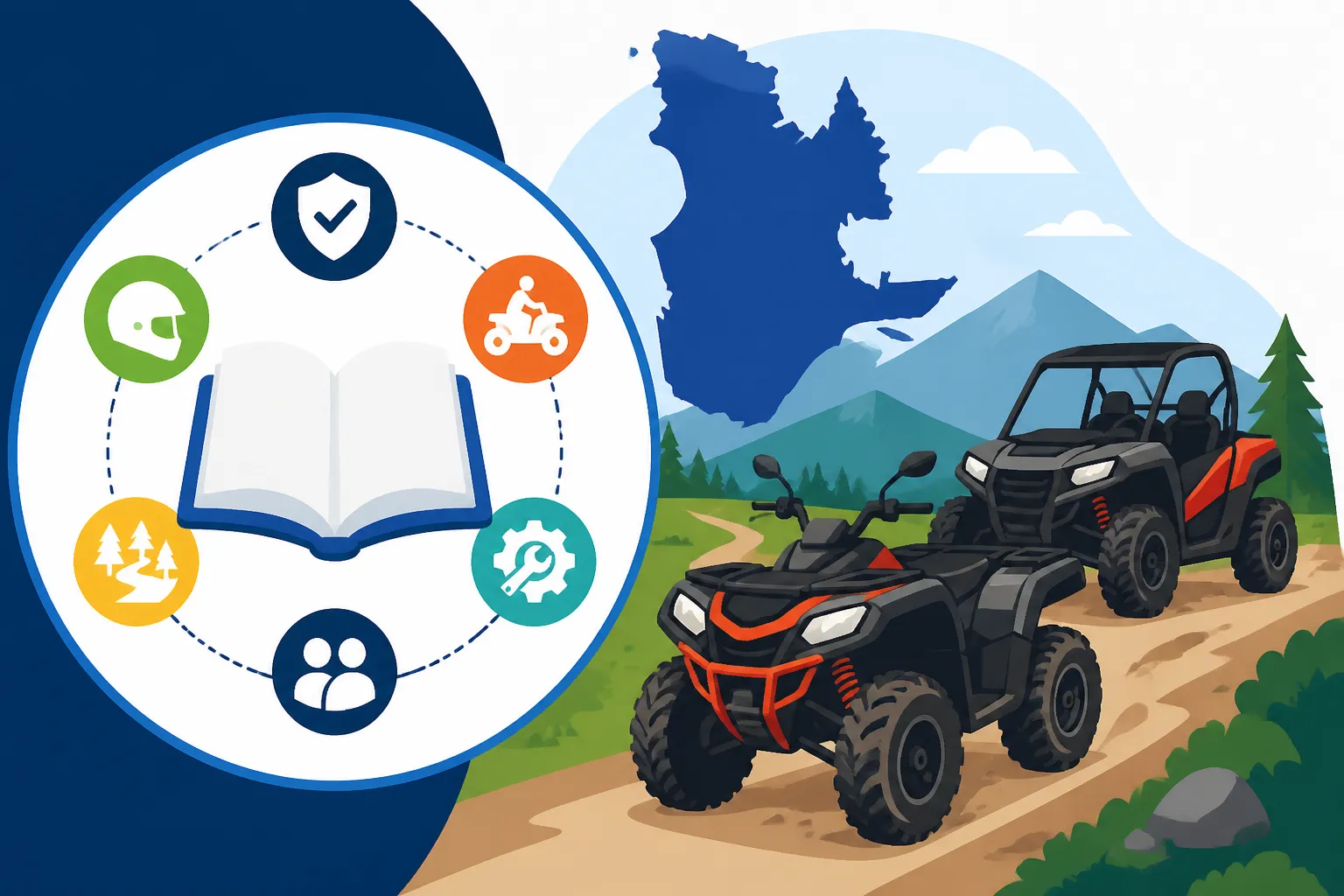
The theory portion helps riders understand how an ATV behaves and why safe operation depends on more than steering and throttle. Topics commonly include:
- Controls and machine operation: Identifying the controls, starting and stopping, shifting where applicable, and using the brakes and throttle smoothly.
- Balance and handling: How rider position affects stability, how to turn without making abrupt movements, and why uneven ground or a sudden change in direction can increase rollover risk.
- Terrain and hazards: Reading the surface ahead, adjusting speed for conditions, and watching for obstacles, ruts, slopes, water, other trail users and limited visibility.
- Protective equipment: The role of a properly fitted helmet and other suitable riding gear. Quebec’s requirements for helmets and visors are a separate legal matter; review Quebec Helmet and Visor Rules before heading out.
- Passengers and machine capacity: Why riders should follow the manufacturer’s seating and capacity limits rather than carrying someone on a machine that is not designed for a passenger.
- Pre-ride checks: Recognizing why basic checks matter, such as looking over the tires, brakes, lights, throttle and general condition of the machine.
- Riding conduct: Keeping a controlled pace, leaving room to react, and sharing trails responsibly with other riders and trail users.
A useful course connects these topics to real decisions. For example, a rider should understand that a machine’s ability to climb a slope does not mean every slope is safe to attempt. The surface, angle, traction, rider experience and route back down all matter. Similarly, a trail that looks clear around a bend may still have an oncoming rider or obstacle beyond the rider’s sightline.
| Course topic | What the rider should take away | What to check with the provider |
|---|---|---|
| Controls and operation | How to use the machine smoothly and deliberately | Whether the practice machine matches the controls you will use |
| Balance and turns | How rider position and speed affect stability | Which handling skills are demonstrated or assessed |
| Terrain and hazards | How to identify changing conditions and ride within your ability | Whether the practical session includes varied terrain |
| Protective equipment | Why appropriate equipment matters and what rules apply | What equipment participants must bring |
| Trail conduct | How to ride predictably and share space | Whether Quebec trail rules are part of the classroom instruction |
| Certificate | Whether successful completion leads to the certificate you need | Recognition, eligibility, assessment and delivery details |
Safe operation is more than memorizing controls
A rider can know where the brake is and still make poor choices. Training should encourage a deliberate routine: scan ahead, select a manageable speed, keep enough space to react, and avoid sudden inputs that can unsettle the machine. It should also make clear that safe speed changes with the surface and visibility. A speed that feels comfortable on a broad, smooth section may be inappropriate on a narrow, rough or slippery one.
Rider position matters because an ATV can shift beneath the rider as it moves over uneven terrain. Instruction may cover how to position the body for different maneuvers and why passengers, cargo or a poorly balanced load can affect handling. Follow the machine manufacturer’s guidance, and do not treat a basic training exercise as permission to attempt advanced terrain without further practice.
Rules belong in the course, but the course is not the rulebook
A course should introduce the legal responsibilities relevant to riding, particularly for young operators. That can include who may ride on a trail, what documentation a rider may need, and why road access is restricted except where permitted. Rules may differ by machine, rider age and location, so classroom instruction is a starting point rather than a substitute for checking current requirements.
For a broader view of the legislation, see Quebec ATV Road Rules Under the LVHR. Age requirements also depend on where and what you are riding: the rules for an ATV are not necessarily the same as those for a side-by-side. Review Quebec ATV Age Requirements and, for a UTV, Quebec Rules for a Side-by-Side Driver before deciding that a course alone makes you eligible to drive.
Practical riding and assessment
The practical portion gives a student a chance to apply basic techniques under instruction. Depending on the course, that may involve learning to start and stop, control speed, turn, change direction or respond to a simple obstacle. Ask what skills are practiced and how the instructor assesses them. A course that includes supervised practice can help a new rider recognize the gap between understanding a concept and applying it while operating a machine.
Do not assume every course provides the same amount or type of hands-on riding. Some instruction may focus more heavily on theory, while another offering may include practical exercises. The course provider can explain whether students ride an ATV, observe demonstrations, complete a skills check or need to bring their own equipment. If you are learning on a family machine, ask whether its type and size are suitable for the session.
A practical session is not a guarantee that a rider is ready for every trail condition. It is a controlled opportunity to learn basic skills and receive feedback. A student who feels uncertain should say so and ask for clarification rather than trying to keep up with faster participants. After the course, continue practicing in an appropriate, permitted setting and build experience gradually.
Before enrolling, confirm these details:
- Machine type: Is the instruction for an ATV, a side-by-side, or another type of off-highway vehicle? Do not assume that training for one automatically qualifies you for another.
- Certificate recognition: Does successful completion provide the specific certificate required for your situation? Ask how the certificate is issued and what proof you receive.
- Minimum age and eligibility: Can the intended rider take the course at their age, and are there any conditions for participation?
- Practical component: How much supervised riding is included, and what skills are practiced or assessed?
- Equipment and clothing: What must the student bring, and what is supplied? Ask about helmet requirements and protective clothing.
- Language and accessibility: Is instruction available in a language the student understands? Can the provider accommodate any relevant learning or mobility needs?
- Course completion: What happens if the student needs additional practice or does not meet the assessment standard on the first attempt?
For teen riders, course completion is particularly important because the certificate may be part of the requirements for riding a trail. The course is not a substitute for checking the specific age rules or carrying the required proof. Quebec FQCQ Training Certificates for Teens explains the teen-certificate context, while Quebec Training Certificate Requirements can help you identify what to confirm before registering. If the rider is 17, review What a 17-Year-Old Needs Before Riding a Trail as well.
What the course certificate does not cover
Passing a course should not be treated as a universal permit to ride anywhere, on any machine, or at any age. A training certificate addresses training requirements; it does not automatically satisfy other obligations. Before a ride, check the rules that apply to the rider, vehicle, route and land.
For example, a certificate does not by itself:
- Register the machine or replace its registration documents.
- Provide liability insurance or prove that the machine is insured.
- Serve as a trail pass or authorize access to a trail that is closed or restricted.
- Give permission to ride on private property.
- Override machine-specific age, passenger or equipment rules.
- Replace a required driver’s licence or other applicable authorization.
- Make riding on a public road lawful where road use is not permitted.
These distinctions matter because riders can be properly trained and still be unprepared administratively. Check the certificate requirement separately from registration, insurance and trail access. For a quick overview of the documents that may be relevant, see Quebec Training Certificates for Teen Riders and Quebec ATV Registration Paperwork Checklist. If you are planning to use a club trail, also confirm pass requirements; a training certificate and a trail pass serve different purposes.
A certificate also does not guarantee that a rider is skilled enough for a particular machine or terrain. Course exercises are limited by the time, equipment and setting available. A new rider may need repeated practice with braking, turning and judging distance before riding a busy or difficult trail. A more powerful machine, unfamiliar controls, a heavy load or a passenger can change how it handles. Start with conditions that match the rider’s ability and the machine’s design.
Parents and guardians can help by asking the young rider to explain what they learned, rather than relying only on the certificate. Ask how they would respond to a blind corner, a sudden change in surface, a machine problem or a rider who needs help. Discuss when to slow down, stop or turn back. A clear answer is more useful than a promise to “be careful.”
Finally, verify current requirements with the course provider and the relevant official source before enrolling or riding. Rules and recognized-course details can change, and a provider can tell you whether its course fits the rider’s intended use. For riders who want to check the length and scheduling of instruction before signing up, see Quebec Training Course Length. The best preparation is to know what the course teaches, what certificate it provides and which separate requirements still apply.
Disclaimer
This article is for general informational purposes only and does not constitute professional advice. Laws, prices and regulations vary by location and change over time. Consult a qualified professional for guidance on your specific situation.