Quebec Training Course Length
If you’re arranging ATV training in Quebec, the main planning question is how much of your day to set aside—and whether the course is actually required for the rider. A youth course commonly takes about five hours, but scheduling and requirements can vary. Here’s what that time usually covers, how to prepare, and what the certificate does and does not allow.
How long the Quebec ATV training course takes
For a young ATV rider, plan for a course lasting roughly five hours. That is a useful estimate for scheduling, not a guarantee that every session will run to the minute. The instructor or training provider can confirm the length of a specific course, including when participants are expected to arrive and whether a break is included.
The course combines classroom-style instruction with practical learning. The theory portion covers safe operation and the rules riders need to understand. The practical portion gives students a chance to apply what they have learned under supervision. The balance between those parts, and the order in which they happen, can depend on the organizer and the training location.
A course advertised as five hours may take up more of your day once you include check-in, equipment setup, breaks, and any time needed to complete an evaluation. If the rider has to travel to the training site, allow extra time on both ends. Ask whether participants need to arrive early and whether the course has a firm finish time before arranging a ride home or other commitments.
| What to plan for | What it means |
|---|---|
| Course time | Allow about five hours for the training session, and confirm the scheduled duration with the provider |
| Course format | Expect both instruction and practical learning |
| Arrival | Check-in or equipment preparation may mean arriving before the official start |
| Equipment | Ask the provider what the rider must bring and what is supplied |
| Completion | Confirm how the provider records successful completion and issues proof |
The course is not simply a short orientation or a quick test. Its purpose is to give a young rider structured instruction before operating an ATV in situations where the training certificate is required. The length reflects a combination of learning and practice, rather than just time spent listening to a presentation.
When comparing available sessions, use the provider’s stated schedule rather than assuming every class follows the same timetable. A course may be offered on a particular date or at a particular site, and the practical portion may depend on conditions at that location. If the rider has accessibility needs, language preferences, or limited experience, ask the provider about those details when registering.
Who needs the course and what the certificate means
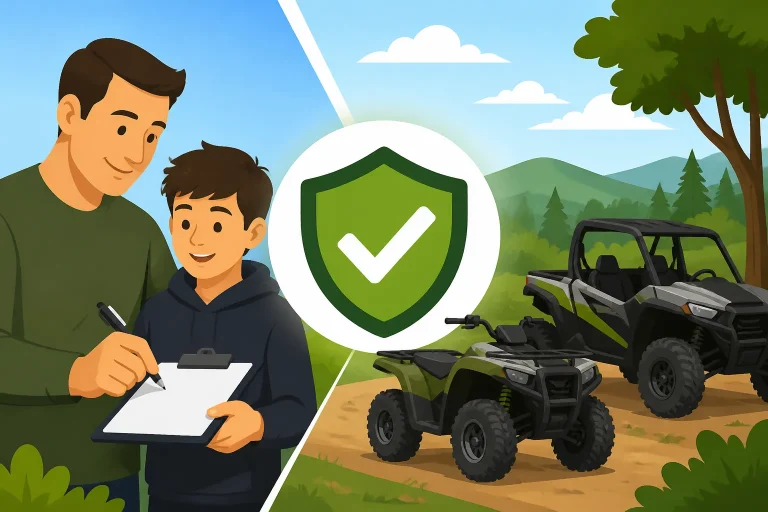
In Quebec, training is especially important for riders aged 16 and 17. A qualifying training certificate is part of the requirements for young riders in situations covered by the rules. The course is associated with training offered through the Fédération Québécoise des Clubs Quads, often shortened to FQCQ. Confirm with the provider that the course and resulting certificate meet the applicable requirement before booking.
The course does not replace other requirements. A training certificate is not, by itself, permission to ride anywhere, and it does not serve as a substitute for a driver’s licence where one is required. It also does not replace a trail pass for federated trails, the machine’s registration, or required liability insurance. For a wider explanation of the youth certificate, see Quebec Training Certificate Requirements and Quebec FQCQ Training Certificates for Teens.
The practical takeaway is to treat training as one part of a rider’s paperwork and preparation—not the whole checklist. Before a ride, confirm that the rider meets the age and licence rules for the type of machine and location, and that the machine and trip meet the relevant registration, insurance, and trail-access requirements. Do You Need a Licence for an ATV in Quebec? explains the licence question separately.
A rider’s age matters. Requirements for a 16-year-old and a 17-year-old can be easier to understand when checked against the rider’s exact situation rather than generalized from another family’s experience. See Quebec Training Certificate for a 16-Year-Old, Quebec Rules for a 16-Year-Old Rider, and Quebec Rules for a 17-Year-Old Rider for related details.
It also helps to distinguish between a training course and informal practice. A parent or experienced rider can teach basic habits, but informal coaching is not necessarily the same as completing an approved course and receiving the certificate required for a young rider. If a rider has already taken a course elsewhere or has an older document, ask the appropriate training provider or authority whether it satisfies the current requirement. Do not assume that any ATV safety class automatically qualifies.
What completion does not automatically authorize
Completing the course does not give a rider permission to use every trail, road, or private property. Access depends on the location, the applicable rules, and permission from the landowner or trail operator where relevant. A certificate also does not make an otherwise unsuitable machine safe for a particular rider.
Parents and guardians should look at the whole riding plan: the rider’s experience, the machine’s size and controls, the route, supervision, protective equipment, and the rules for passengers. A certificate is evidence of training, not a guarantee that a rider can handle every condition or every vehicle.
What the training covers and how to prepare
The exact lesson plan should be confirmed with the course provider, but participants can expect a mix of safety instruction and practical riding fundamentals. The point is to build a foundation for making safer decisions, handling the machine correctly, and understanding responsibilities before riding.
Topics commonly relevant to ATV training include:
- Basic controls and pre-ride checks
- Safe starting, stopping, turning, and managing speed
- How rider position and terrain affect stability
- Awareness of hazards and changing trail conditions
- Protective equipment and safe riding habits
- Responsibilities when operating around other people and vehicles
The practical portion is valuable even for someone who has ridden informally. Familiarity with a family machine is not the same as demonstrating safe habits in a structured setting. A student may discover that a control, technique, or safety check they took for granted needs more attention.
Before the course, read the provider’s instructions carefully. Ask whether the rider should bring an ATV or whether one is provided, and whether a helmet or other protective gear is supplied. If the rider must bring a machine, confirm what type is accepted, whether it needs to be in working order, and what safety checks are expected. Do not arrive assuming that the organizer has equipment available.
A simple preparation checklist can prevent avoidable delays:
- Confirm the course date, start time, expected finish time, and location.
- Ask what identification or documents the participant should bring.
- Check whether the rider needs to bring a machine, helmet, or other gear.
- Find out whether the course is taught in the rider’s preferred language.
- Ask how successful completion is recorded and how the certificate is provided.
- Keep the confirmation and certificate information with the rider’s other ATV documents.
Comfort and fit matter for practical instruction. A helmet should fit securely, and clothing should be appropriate for riding and the weather. If the course provider gives a specific equipment list, follow that list rather than relying on a generic packing checklist.
If the rider has little experience, explain that before the session. The instructor can clarify what level of ability is expected and whether the course is suitable. If the rider has substantial experience, that does not remove the need to complete a required course. It may, however, help the instructor understand what the student already knows and where to focus practice.
Booking, completion, and next steps
Training availability may depend on the provider, location, and season. The safest approach is to contact the organizer directly before making plans. Ask whether the session is intended for the rider’s age and machine category, whether it leads to the certificate needed for the rider’s situation, and what happens if weather or another issue interrupts the practical portion.
It is worth asking how the provider handles completion records. Find out whether the participant receives a document on the day, whether the result is recorded for later verification, and what to do if the certificate is misplaced. Keep the document in a safe place and consider storing a separate copy with the machine’s paperwork. For documents and other items owners may need to have ready, see Quebec Registration Paperwork Checklist.
Do not leave training until the last moment if the rider has a particular trip or season in mind. A course that fits the family’s calendar may not be available immediately, and the rider should not plan to use a certificate requirement as something to sort out after arriving at a trail. Confirm the rules for the intended ride before setting out. A trail pass, machine registration, insurance, licence, and training certificate serve different purposes, so check each one separately.
If the course is for an adult who wants to improve their skills, ask the provider whether it offers a suitable session. Adult training may be useful, but do not assume that a general safety class has the same status as the required youth training. The certificate’s role depends on the course and the rider’s circumstances.
The shortest reliable answer is that Quebec ATV training for a young rider commonly takes about five hours, with both instruction and practical learning. Use that as a planning estimate, then confirm the actual schedule and certificate details with the course provider. Once training is complete, check the remaining requirements for the rider, machine, and route before riding.
Disclaimer
This article is for general informational purposes only and does not constitute professional advice. Laws, prices and regulations vary by location and change over time. Consult a qualified professional for guidance on your specific situation.