Quebec Training Certificate for a 16-Year-Old
A 16-year-old in Quebec may need more than permission from a parent to ride an ATV on a trail. The training certificate, driver’s licence, vehicle paperwork and trail access rules each serve a different purpose. Knowing which requirement applies before setting out helps families avoid a turned-around ride, a citation or confusion at a trail check.
What a 16-year-old needs to ride an ATV
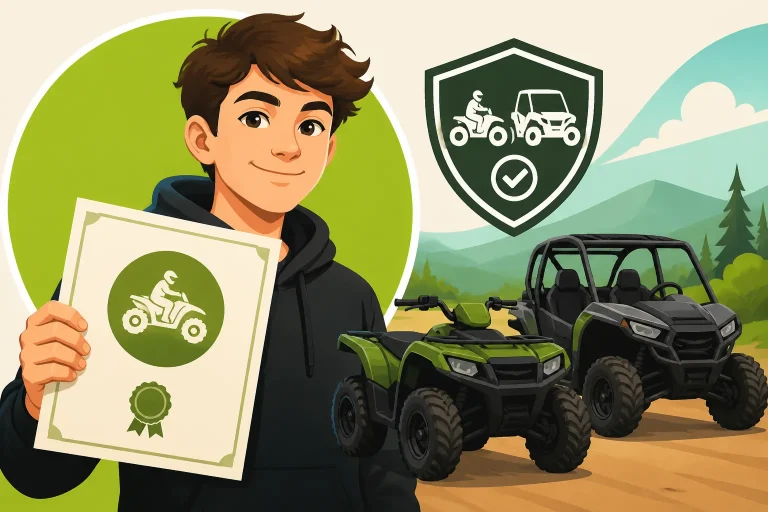
For a 16- or 17-year-old riding an ATV in Quebec, the key point is that a training certificate and a driver’s licence are separate requirements. A certificate confirms that the young rider completed the required competency training; it does not act as a driver’s licence, vehicle registration or trail pass.
Quebec’s rules changed in 2021. Riders in this age group are generally required to hold a driver’s licence and the applicable certificate of competence when operating an ATV in places covered by the rules. Check the current requirements with the Société de l’assurance automobile du Québec (SAAQ) and the Fédération Québécoise des Clubs Quads (FQCQ) before riding, especially if the machine, location or rider’s circumstances are unusual. The linked overview, Quebec Requires a Driver’s Licence Since 2021, explains why a licence is part of the requirements for young riders.
The rules depend on both the rider’s age and the type of vehicle. The minimum age to operate an ATV on a trail is not the same as the minimum age for a side-by-side. A 16-year-old should not assume that an ATV certificate makes them eligible to drive every off-highway vehicle. In particular, the minimum age for driving a side-by-side is higher. See Quebec ATV Age Requirements and Quebec Side-by-Side Age Rule of 18 before choosing a machine.
| Requirement | What it does | What it does not replace |
|---|---|---|
| Certificate of competence | Shows the young rider has completed the applicable training | A driver’s licence, registration, insurance or trail pass |
| Driver’s licence | Meets the licence requirement that applies to the rider | The training certificate or permission to use a particular trail |
| Vehicle registration | Establishes that the machine is registered as required | The rider’s personal qualifications or a trail pass |
| Liability insurance | Provides required liability coverage for the machine | Registration, a trail pass or rider training |
| Trail pass | Provides access to participating federated trails, subject to conditions | A certificate, licence or permission to use a closed or unauthorized route |
The table is a useful starting point, but the exact rules can depend on where the ATV is being operated. Federated trails, roads, private property and other land may have different access and operating conditions. A parent’s approval does not cancel a legal requirement, and a certificate does not grant permission to ride anywhere.
The Quebec Training Certificate Requirements page can help distinguish the certificate requirement from other rules. For a broader look at the age limits, supervision and machine categories, see Quebec ATV Age Requirements.
How the training certificate works
The certificate is a competency document for the rider, not a registration document for the ATV. A 16-year-old needs to complete the applicable training process and keep proof of the resulting certificate available when required. The FQCQ is the relevant federation for ATV training and certificates in Quebec; families should check its current instructions for course availability, eligibility, enrollment and how proof is issued.
Training is not a formality to leave until the day before a trip. A course may require advance registration, and schedules can vary by location and season. Confirm the process directly with the FQCQ or an authorized training provider, including whether the young rider must bring identification, a parent or guardian, or any forms. Do not rely on an old course listing or another family’s experience as proof that the current process is the same.
A practical sequence is:
- Confirm the machine type. Make sure the vehicle is an ATV, not a side-by-side or another class with different age requirements.
- Check the current rules for the riding location. Ask whether the certificate and licence requirements apply to the planned trail, road crossing or property.
- Find an authorized training option. Use current FQCQ information to confirm who provides the course and how to register.
- Complete the required training. Follow the provider’s current instructions and retain the certificate or official proof when it is issued.
- Confirm the driver’s licence requirement separately. Do not assume the training certificate covers it. Check the current SAAQ rules for the rider’s situation.
- Prepare the machine and trail documents. Confirm registration, insurance and trail access before leaving home.
The FQCQ training certificate is personal to the rider. It does not move with a family ATV when the machine is sold, and a parent’s certificate cannot be used by a teenager. The certificate also does not establish that the vehicle is mechanically safe, registered or insured.
Families can use Quebec FQCQ Training Certificates for Teens for more detail about teen training. If a rider has taken training elsewhere or holds a certificate from another jurisdiction, do not assume it is automatically accepted for riding in Quebec. Check directly with the relevant Quebec authority or federation before relying on it. Reciprocity and recognition are separate questions from whether a rider completed a course.
What to check before a first trail ride
The training certificate is only one item in a pre-ride check. A 16-year-old may be qualified as a rider and still be unable to use a particular machine or trail because another requirement has not been met. Check the rider, the ATV and the route as separate parts of the plan.
Confirm the rider’s documents
Before departure, make sure the young rider has the required certificate and driver’s licence, and that the documents are valid and available in the form accepted for checks. A photo on a phone may not be treated the same way as an original or official document in every situation, so confirm what proof is acceptable rather than relying on a screenshot.
For a family ride, adults should check that the teenager is riding the machine they are legally permitted to operate. A certificate is not permission to carry a passenger on a machine that is not designed or approved for one. Follow the manufacturer’s seating capacity and Quebec’s passenger rules. The Quebec Rules for Passengers on a Quad page covers that separate issue.
Confirm the machine and access
Check that the ATV has the registration and liability insurance required for its use. Then confirm that the trail is open and that the machine has the required trail access pass. A pass may be required for federated trails even when the ATV is properly registered and insured. It does not authorize riding on a closed trail, private land without permission or a road where ATV travel is not allowed.
For the paperwork side, see Quebec Registration Before Your First Ride. For trail-pass proof and what may be checked on a route, see Quebec Trail Pass Proof on the Trail. These documents relate to the machine or trail access, while the training certificate relates to the rider.
Also check local trail notices and operating conditions before setting out. A route can be temporarily closed, restricted or affected by local rules. A valid certificate does not override a closure or a landowner’s refusal of access.
Make the ride appropriate for a new or young operator
Legal eligibility is a minimum, not a measure of experience. A 16-year-old who has just completed training may still need practice handling the particular ATV, especially if it is heavier or more powerful than the training machine. Start with a route and conditions that match the rider’s ability. Explain where the group will stop, how to signal, and what to do if the rider loses sight of the group or the ATV develops a problem.
Before leaving, check that:
- The rider understands the controls, braking and safe stopping distance.
- The ATV is suitable for the rider and is in sound working condition.
- The group has a route plan and a way to communicate if separated.
- The rider knows to obey posted signs, trail closures and speed limits.
- The adult supervising the outing knows which documents the rider must carry.
- The plan includes a way to get help if there is an injury or mechanical breakdown.
Training helps build a foundation, but it cannot replace sound judgment on the trail. Riding within the rider’s ability and the ATV’s limits is particularly important on unfamiliar, wet or uneven terrain.
Common misunderstandings and how to avoid them
“The certificate is the same as a licence.” It is not. The certificate and driver’s licence are distinct credentials. Check that the teenager has each document required for the planned use.
“The ATV has a trail pass, so the rider is covered.” A trail pass concerns access to a trail network. It does not establish that the individual rider meets age, training or licensing requirements. Review Quebec Trail Pass Proof on the Trail for the access side of the question.
“A parent can authorize any ride.” Parent or guardian permission may matter in some settings, but it does not make a rider eligible to operate a vehicle where the law sets a minimum age or requires documents. Rules can also differ between private land and public or federated trails. Confirm the requirements for the actual location.
“A certificate earned elsewhere must be accepted.” Do not assume that training from another province, club or provider automatically satisfies Quebec’s certificate requirement. Ask the FQCQ or the relevant authority whether it is recognized before planning a ride.
“The same rules apply to an ATV and a side-by-side.” Vehicle categories can have different age and operating rules. A young rider’s ATV certificate should not be treated as authorization to drive a side-by-side. Check the vehicle’s classification and the applicable age rule.
“A photo of the certificate is always enough.” Proof requirements can depend on the document and the circumstances of a check. Ask the issuing organization what form of proof the rider should keep, and follow its current guidance. If a patrol or official asks for documents, the rider should be prepared to provide what is required.
A little preparation can prevent the most common problems: an incomplete document set, an ATV that does not match the rider’s eligibility, or a route that is closed or requires separate access permission. Before the first ride, verify the current training process with the FQCQ, the licence requirements with the SAAQ, and the trail’s access conditions with the relevant club or land manager.
Disclaimer
This article is for general informational purposes only and does not constitute professional advice. Laws, prices and regulations vary by location and change over time. Consult a qualified professional for guidance on your specific situation.