Quebec Fines for Riding a Public Road
It's a common dilemma for quad and side-by-side owners in Quebec: you're out on the trails, maybe exploring some stunning backcountry, and you realize the quickest way from Point A to Point B, or to that much-needed gas station, involves a short hop on a public road. The temptation can be huge, but for many, the reality of Quebec's strict off-highway vehicle laws hits hard when those tell-tale flashing lights appear. This comprehensive guide is here to shed light on exactly what those rules are, why they're in place, and most importantly, the often-steep fines you could face for riding your ATV or UTV on a public road in Quebec.
The Harsh Reality of Public Road Riding in Quebec
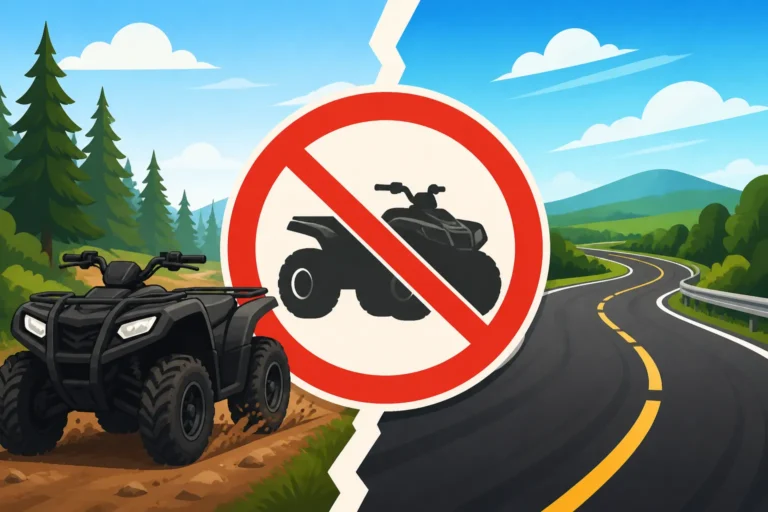
Let's be blunt: in Quebec, the default position is that your ATV or side-by-side is not allowed on public roads. This isn't a suggestion; it's a legal cornerstone of how off-highway vehicles are managed in the province. Many riders, especially those new to Quebec or visiting from elsewhere, are genuinely surprised by how restrictive these rules are. They envision a short, harmless hop between trail sections or a quick jaunt to a roadside diner, not realizing they're potentially breaking the law and setting themselves up for a hefty fine.
Why the Law Is So Strict
Quebec's approach to off-highway vehicles on public roads is rooted deeply in public safety and the distinct differences between these machines and traditional road-going vehicles. ATVs and side-by-sides are designed for off-road conditions, which means their handling, braking, and visibility characteristics are fundamentally different from cars or trucks. They're often heavier, have different tire types, and their suspension systems are built for absorbing bumps, not for precise cornering at road speeds. Putting these machines into a mix with regular traffic creates significant safety risks for the ATV rider, other motorists, and even pedestrians.
The provincial legislative stance, largely enshrined in [Quebec's Off-Highway Vehicle Act and Your Papers], reflects a clear priority: protect the public. The law aims to prevent accidents, reduce road wear and tear from machines not designed for pavement, and ensure peace in residential areas. While it might feel inconvenient for a rider, the government sees it as a necessary measure to maintain order and safety on its vast network of roads. This isn't about singling out quad owners; it's about regulating vehicle types for their intended environments. The public perception of ATVs, sometimes seen as noisy or disruptive, also plays a subtle role, distinguishing them from other utility vehicles that might have different allowances.
The Default Position: Prohibited
Forget about assuming you can just take a road "if it's clear" or "just for a minute." In Quebec, the general rule is crystal clear: ATVs and side-by-sides are prohibited from riding on public roads. Full stop. Any deviation from this rule is a highly specific exception, not a general allowance, and it must be clearly indicated by official signage. This means that if you don't see a sign explicitly permitting ATV access, you should assume it's forbidden.
This default prohibition is a critical point that many riders misunderstand. They might think "no sign saying not to" means it's okay, but it's exactly the opposite. You're looking for signs that say "it is okay." These authorized road sections are typically very limited in length and purpose, often serving as connectors between sanctioned trail segments or providing access to essential services in very specific, designated areas. The temptation to just take a shortcut on a road can be immense, especially when the trail is just on the other side, but without that explicit signage, you're not just taking a shortcut; you're breaking the law, and the legal ramifications can quickly overshadow any perceived convenience.
Understanding Quebec's Municipal Road Access Rules
While the general rule is "no public roads," Quebec does have specific, very limited exceptions that allow ATVs and side-by-sides on certain municipal roads. It's crucial to understand these nuances, as they are the only legal avenues for off-highway vehicles to interact with the public road network. Ignorance of these precise conditions is rarely an excuse in the eyes of the law, and a quick glance at a map or a local's "it's always been done this way" advice won't protect you from a fine.
The 1 Kilometre Rule and Its Conditions
One of the most talked-about exceptions is the 1-kilometre rule, which permits an off-highway vehicle to use a public road for a maximum distance of one kilometre. But it's not a free pass. This rule is designed for very specific situations, primarily to allow riders to access a federated trail or essential services like fuel or food when there's no other reasonable route. However, this exception comes with a strict set of conditions that must be met:
- Signage is paramount: The road segment must be expressly designated and clearly marked by official signage from the municipality or the FQCQ (Fédération Québécoise des Clubs Quads). No sign, no allowance.
- Right angles for crossings: If you're using the road to cross, you must do so at a right angle, meaning as perpendicular to the road as possible, minimizing your time on the roadway itself.
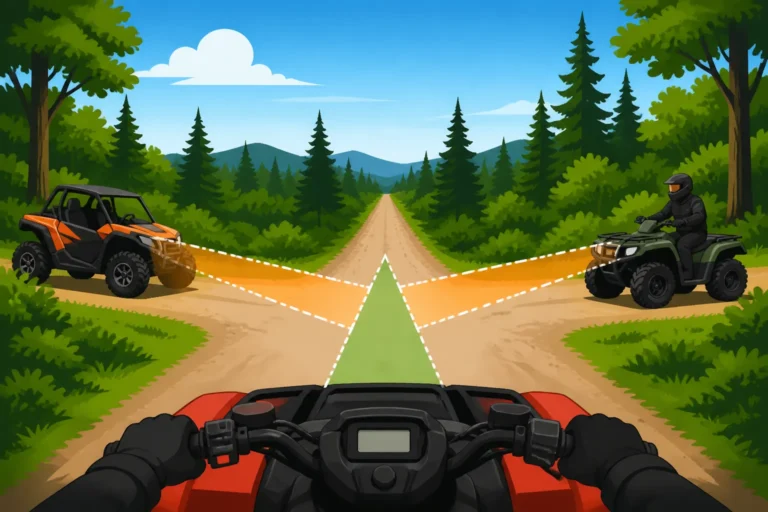
- Adequate sightlines: There must be sufficient visibility in both directions to ensure safety. [Quebec Crossing Sightline Distances] dictates specific sightline requirements depending on the speed limit of the road you're crossing or riding on.
- Speed limits: When on these authorized sections, you must adhere to a strict speed limit, which is typically much lower than the posted limit for cars, often capped at 50 km/h for quads.
- Direct access: The intent must be for direct access to a trail or service, not for cruising along the road.
It's also important to note that while the province allows for the 1-kilometre rule, individual municipalities have the power to enact by-laws that either further restrict or, in rare cases, extend these allowances. So, what's okay in one village might not be okay in the next. Always check local regulations, especially if you're venturing into a new area.
Crossing Public Roads Legally
Beyond the 1-kilometre rule, there are also provisions for simply crossing a public road. This is distinct from riding along a road. Imagine a federated trail that continues on the other side of a provincial highway or a municipal road. You can cross, but again, under very precise rules designed to minimize risk.
When crossing, you must do so at a right angle to the road. This means approaching the road, stopping, checking for traffic, and then crossing directly over to the other side without turning or driving along the shoulder. You must yield to all other traffic and proceed cautiously. Your speed while crossing should be minimal, just enough to safely traverse the road. Remember, the goal is to be on the public road surface for the absolute shortest time possible. Even with a legal crossing point, failing to stop, yielding to traffic, or crossing incorrectly can still lead to a fine.
Signs That Say "It's Okay" (Sometimes)
So, how do you know if you're on one of these rare, authorized road segments? The answer is always: look for the signs. Official signage is your only indication that you're permitted to use a specific stretch of public road. These signs are not subtle; they are explicitly placed by the local municipality or the FQCQ to guide riders.
These signs typically feature an ATV or side-by-side pictogram, often with an arrow indicating the direction of travel, or a sign stating "VTT autorisé" (ATV authorized). Sometimes, they will specify the distance for which the road is authorized. Without these specific, official signs, you are on an unauthorized road, and you are vulnerable to a fine. It's not enough to see a gravel road that looks like a trail, or a road that leads to a gas station. If there's no sign, it's a no-go. Riders should become familiar with what these [Quebec Signage for an Authorized Road Stretch] look like and always err on the side of caution. Relying on GPS apps alone without verifying physical signage on the ground can also get you into trouble, as GPS data might not always reflect the most current legal status of a road.
The Common Fines for Riding on Unauthorized Public Roads
This is where the rubber meets the road, quite literally. Being caught on an unauthorized public road in Quebec can be a costly experience. The fines aren't just a slap on the wrist; they are designed to deter illegal road use and can quickly add up, turning a momentary lapse in judgment into a significant financial burden.
The Basic "Riding on a Public Road" Fine
If you're caught riding your ATV or side-by-side on a public road in Quebec where it's not explicitly permitted, you're likely facing the primary infraction. The fine for this offense, as outlined in the Off-Highway Vehicle Act, is substantial. [Quebec Road Riding Fines From $350] is a starting point, but these figures can quickly climb much higher depending on the specific circumstances, any additional violations, and the discretion of the officer.
It's not just the initial fine either. You'll also likely incur administrative fees and court costs if you choose to contest it and lose. The immediate impact is on your wallet, but there's also the very real possibility of your machine being towed away, adding another layer of expense and inconvenience to an already bad day. Imagine being miles from home, seeing your quad loaded onto a flatbed, and knowing you'll have to pay towing and storage fees on top of your fine. It's a sobering thought that should make any rider think twice before taking an unauthorized shortcut.
Fines for Other Related Offenses
Unfortunately, the "riding on a public road" fine is often just the beginning. Law enforcement officers, whether it's the Sûreté du Québec or municipal police, are trained to check for a full range of compliance issues. If you're already breaking one rule, it's highly probable you might be non-compliant with others. These additional infractions can quickly stack up, creating a truly eye-watering bill.
Here are some common related offenses that can lead to additional fines:
- Lack of registration: Every ATV and side-by-side in Quebec must be registered with the SAAQ and display a valid VHR plate. If your machine isn't registered, that's another fine. [Quebec Penalties for Riding Unregistered]
- No liability insurance: Quebec mandates that every owner carry a minimum amount of liability insurance (currently $1 million). Without proof of this, you're looking at another significant fine. [Quebec Insurance Minimum for an Owner]
- No valid driver's license: You need a valid driver's license (any class) to operate an ATV or side-by-side on any public land or authorized road in Quebec. No license? Another fine. [Quebec Fines for Riding Without a Licence]
- Helmet violations: Not wearing an approved helmet, or wearing one incorrectly, is an easy ticket for an officer to issue. [Quebec ATV Helmet Rules]
- Age restrictions: There are strict age limits for operating ATVs (16+) and side-by-sides (18+) on public land or authorized roads. If you or your passenger is underage, there are fines for the operator and potentially the owner. [Quebec ATV Age Requirements]
- Carrying alcohol or open containers: Just like in a car, open alcohol containers are prohibited on ATVs.
- Illegal modifications: While many aftermarket accessories from companies like SuperATV can enhance safety and performance off-road, if they make your machine unsafe or non-compliant for the specific, limited road uses (e.g., lights not meeting standards), they could lead to fines.
Imagine a scenario where you're caught riding an unregistered quad on a municipal road without a helmet, and you don't have proof of insurance. That's potentially four or five distinct fines, each starting in the hundreds of dollars, plus towing and storage. A "simple shortcut" can very quickly spiral into a financially devastating experience, especially when you factor in court costs if you try to contest multiple tickets.
Impoundment and Towing Costs
One of the most immediate and frustrating consequences of being caught illegally riding on a public road is the impoundment and towing of your machine. When an officer issues a ticket for a serious violation, or if your machine is not properly registered or insured, they have the authority to have it towed from the scene.
The costs associated with impoundment are often underestimated. First, there's the towing fee, which can vary but is generally hundreds of dollars. Then, your machine will be stored at an impound lot, accruing daily storage fees. These fees can add up rapidly, especially if you're not able to retrieve your machine immediately. Before you can even get your quad back, you'll likely have to prove ownership, pay all outstanding fines, and settle the towing and storage bills.
This isn't just a financial hit; it's a huge disruption to your ride, your plans, and your peace of mind. You're left stranded, your machine is gone, and you have a bureaucratic process ahead of you just to get it back, often involving multiple phone calls and trips to various offices. In some cases, if the fines and fees go unpaid, the impound lot can even initiate proceedings to sell your machine to cover the costs. The hassle alone is enough to make most riders strictly adhere to the rules once they've experienced it.
Avoiding the Pitfalls: What to Do Instead
Navigating Quebec's ATV and UTV rules might seem daunting, but it's entirely manageable with the right approach and a commitment to responsible riding. Avoiding those costly fines and frustrating impoundments simply requires understanding the legal framework and making informed choices before you even start your machine.
Stick to Federated Trails and Private Land
The most straightforward way to avoid fines for public road riding is to simply not do it. Quebec boasts an incredible network of [Quebec ATV Trails: The FQCQ Network], meticulously maintained by local clubs and stretching for thousands of kilometres across the province. These are the designated, legal, and safe places to ride your off-highway vehicle.
- Plan your route: Before heading out, use official maps, either physical ones provided by the FQCQ or digital tools like the iQuad app. These resources clearly mark federated trails and any authorized road connectors. Always have a plan that keeps you off unauthorized public roads.
- Secure a trail pass: To access these federated trails, you need a valid [Quebec's Annual FQCQ Trail Pass]. This pass not only grants you legal access but also supports the clubs that maintain the trails, creating a sustainable riding environment.
- Private land permission: If you're riding on private land that isn't part of the federated network, ensure you have explicit, written permission from the landowner. Trespassing is another offense that can lead to fines and legal trouble. Never assume that unused land is fair game.
By focusing on these designated areas, you ensure your ride is legal, safe, and contributes to the thriving quad culture in Quebec.
Legal Modifications for Road Use (Where Permitted)
It's common for riders to want to enhance their machines with accessories, and companies like SuperATV offer a vast array of aftermarket parts, from upgraded lighting to heavy-duty bumpers and improved mirrors. These modifications can significantly improve your machine's visibility, safety, and performance, especially when riding off-road or in challenging conditions.
However, it's absolutely crucial to understand that installing these aftermarket parts, even those that mimic road-legal vehicle components (like turn signals or horns), does not automatically make your ATV or side-by-side street legal on unauthorized Quebec roads. The underlying prohibition on road use remains.
Think of it this way: better headlights or mirrors from SuperATV are fantastic for improving your visibility and safety when you are legally crossing a road, riding on authorized municipal sections, or even just for better vision on the trails. They are not a magic wand that changes the law. While some jurisdictions outside Quebec might allow for "street legal kits," this is generally not the case for ATVs and UTVs on undesignated public roads in Quebec. Always refer to [Quebec Equipment Checks by Patrols] and the specific requirements of the Off-Highway Vehicle Act. Any modifications should be for enhancing safety and performance within the existing legal framework, not for circumventing the core prohibition on public road use.
Education and Awareness
The best defense against fines is knowledge. Quebec's laws are not static; they evolve, as demonstrated by the significant changes introduced in [What Quebec's Off-Highway Vehicle Act Changed for Owners]. Staying informed is a continuous process.
- Read the official act: Take the time to familiarize yourself with the Quebec Off-Highway Vehicle Act (Loi sur les véhicules hors route, or LVHR). It's the definitive guide to what you can and cannot do.
- Check municipal by-laws: Local municipalities can have specific by-laws that affect ATV access. If you're frequently riding in a particular area, check with the local town hall or their website.
- Join a local club: Becoming a member of an FQCQ-affiliated club is one of the best ways to stay current. Clubs are run by dedicated volunteers who know the local trails and rules inside out. They often host informational meetings, distribute newsletters, and are excellent resources for any questions you might have.
- Don't rely on hearsay: Just because "everyone does it" or "my buddy said it was fine" doesn't make it legal. Always verify information from official sources.
Being proactive about your education ensures that you're making responsible decisions and safeguarding yourself from unexpected fines.
Specific Scenarios and Exceptions to Consider
While the general rule against riding on public roads is strict, there are a few very specific and limited exceptions carved out for certain situations. It's crucial to understand that these are exceptions, not loopholes, and they come with their own stringent conditions. Misinterpreting or misapplying these exceptions is a quick route to receiving a fine.
Workers and Farmers
The law recognizes that ATVs and side-by-sides are often essential tools for specific professions. Farmers, for instance, use these machines for tasks such as checking fences, transporting tools, or moving livestock within their agricultural operations. Similarly, workers in forestry, trapping, or utility maintenance might need to use off-highway vehicles to access remote work sites.
For these specific purposes, the Off-Highway Vehicle Act provides limited exemptions. [Quebec Rules for a Worker on a Quad] or [Quebec Rules for a Farmer on a Quad] typically allow for the use of an ATV on public roads for short distances, provided:
- The machine is being used directly for work: This means a farmer riding their quad to check crops is likely covered, but taking the same quad for a pleasure ride to town is not.
- Specific equipment: The machine might need to be equipped with certain safety features (e.g., specific lighting, slow-moving vehicle signs).
- Speed limits: Very strict speed limits usually apply, often well below typical road speeds.
- Direct route: The use must be for the most direct and necessary route to perform the work.
These exceptions are strictly for utilitarian purposes, not for recreational enjoyment. They do not grant carte blanche to farmers or workers to use public roads freely; they are highly conditional.
Riding to a Gas Station or Services
This is perhaps one of the most common reasons riders are tempted to use public roads, and it's a frequent source of fines. You're out on the trail, your fuel gauge is dropping, and you spot a gas station just a kilometre down a public road. It seems logical, convenient, and even necessary to take that road.
However, as discussed, unless that specific stretch of road is explicitly marked with official signage permitting ATV access for that purpose, it is still illegal. [Quebec Rules for Riding to a Gas Station] are clear: you cannot just hop onto a public road because it's convenient or because you need fuel.
What are the alternatives?
- Plan ahead: Always check your fuel range and consult your trail map to identify gas stations located directly on or immediately adjacent to federated trails.
- Carry extra fuel: For longer rides, consider carrying a small, approved jerry can of extra fuel.
- Know authorized access points: Some towns or villages have specifically designated and signed routes that allow ATVs to access services. Use these where available.
The inconvenience of planning for fuel or carrying extra is far less costly and stressful than facing a significant fine and potential impoundment.
Emergency Situations
True emergencies are a different category altogether. If you or someone in your riding group is facing a genuine, life-threatening emergency – a severe injury, a medical crisis, or a dire situation where immediate help is needed – then your priority is safety. In such extreme circumstances, getting to help or summoning assistance might involve temporarily using a public road out of sheer necessity.
However, it's critical to understand that this is not a general allowance. This is an "act of God" or "extreme necessity" scenario. If you find yourself in such a situation, you should:
- Prioritize safety: Do what is necessary to ensure the safety of yourself and others.
- Contact emergency services immediately: Call 911 (or the appropriate emergency number) as soon as possible to report the situation and your actions. Explain why you're on a public road.
- Be prepared to explain: You will likely need to fully explain the emergency and justify your use of the public road to authorities after the fact.
This exception is not for a flat tire, running out of gas, or getting lost; it's for true emergencies where immediate life or limb is at stake. The burden of proof will be on you to demonstrate the absolute necessity of your actions.
What to Do If You're Pulled Over
Despite your best efforts to follow the rules, there might come a time when you find yourself being pulled over by law enforcement or a trail patrol. This can be a stressful experience, but knowing how to react properly can significantly influence the outcome and minimize further complications.
Remain Calm and Cooperative
First and foremost, if you see an officer or a trail patroller signaling you to stop, do so safely and immediately. Pull over to the side of the trail or road in a clear, visible spot. Turn off your engine. Remove your helmet and keep your hands visible, perhaps resting them on the handlebars.
Approaching the interaction with a calm and cooperative attitude is paramount. Officers and patrollers are doing their job, ensuring safety and compliance with the law. Being argumentative, evasive, or disrespectful will only escalate the situation and can lead to additional charges, such as obstruction of justice or contempt. Answer their questions honestly and clearly. [Being Stopped on a Trail] is a normal part of riding, and a polite interaction is always the best path forward. If you disagree with an officer's assessment, express your concern calmly and respectfully, but save any vigorous defense for a potential court appearance.
Required Documents to Carry
When you're stopped, the officer or patroller will almost certainly ask for your documents. Having these readily available and in order is essential. Failing to produce them on demand can result in additional fines. Always carry:
- Your driver's license: A valid driver's license (any class, GDL included) is required to operate an ATV or side-by-side on any public land or authorized road in Quebec. [Carrying a Driver's Licence on a Federated Trail]
- Your vehicle registration certificate: This is the document from the SAAQ proving your machine is registered. It will list you as the owner.
- Proof of liability insurance: As mandated by Quebec law, you must carry proof of your $1 million liability insurance. This is usually a small certificate from the SAAQ or your private insurer. [Quebec Insurance Proof on the Machine]
- Your FQCQ trail pass: If you're on a federated trail, you must have a valid trail pass, either the physical sticker on your machine or proof of purchase.
It's a good idea to keep these documents protected from the elements in a waterproof pouch on your person or securely stored on your machine. While some officers might accept digital photos of documents on your phone, it's not universally accepted, and a dead battery could leave you in a bind. Always have physical copies as your primary backup. Prepare a [Quebec Registration Paperwork Checklist] for every ride.
Contesting a Fine
If you believe a fine was issued in error, or if there were extenuating circumstances that you feel weren't fully considered, you have the right to contest it. This process typically involves notifying the court of your intention to dispute the ticket within a specified timeframe (usually 30 days).
Here's a general overview of what contesting a fine might involve:
- Read the ticket carefully: Understand the specific infraction you're being accused of.
- Gather evidence: If you have photos, witness statements, or other proof that supports your case (e.g., photos of official signage, GPS logs showing you weren't on a restricted road), gather it.
- File your plea: Follow the instructions on the ticket to indicate your intention to plead "not guilty" or to request a court date to explain your situation.
- Prepare your argument: Clearly articulate why you believe the ticket is unjust or incorrect. Stick to the facts and avoid emotional appeals.
- Consider legal advice: For complex cases, especially if multiple tickets or high fines are involved, it might be beneficial to consult with a lawyer specializing in traffic or provincial offenses. They can advise you on your rights and the best course of action. [Contesting a Trail Ticket] can be a lengthy process, and having a clear strategy is crucial.
Remember, contesting a fine means you will have to appear in court, potentially multiple times. It's a commitment of time and effort, so weigh the potential outcome against the effort involved.
Common Road Riding Violations and Consequences Table
To help illustrate the types of infractions and their potential impact, here’s a simplified table summarizing common scenarios and consequences related to riding off-highway vehicles on public roads in Quebec. Please remember that these figures are approximate starting points; actual fines can vary and escalate based on specific circumstances, repeated offenses, and additional violations.
| Violation | Typical Starting Fine Range (CAD) | Additional Consequences |
|---|---|---|
| Riding on unauthorized public road | $350 – $650+ | Towing, impoundment, storage fees, court costs |
| No valid registration (VHR plate) | $300 – $600+ | Towing, impoundment, storage fees, machine cannot be ridden |
| No mandatory liability insurance | $500 – $1,500+ | Towing, impoundment, storage fees, potential civil liability |
| No valid driver's license | $300 – $600+ | Towing, impoundment, storage fees, potential license suspension |
| Not wearing an approved helmet | $250 – $500+ | |
| Underage operation (Operator 16-17 on ATV) | $250 – $500+ | Fines for operator and potentially owner |
| Underage operation (Operator <18 on SxS) | $250 – $500+ | Fines for operator and potentially owner |
| Improper crossing (not at right angle) | $200 – $400+ | |
| Exceeding speed limit on authorized road | $90 – $600+ (variable) | Demerit points possible, depending on speed |
| Carrying open alcohol container | $350 – $800+ | Machine impoundment possible |
| Refusing to provide documents | $200 – $400+ | Potential for more severe charges |
This table is a stark reminder that the risks of riding on unauthorized public roads in Quebec far outweigh any perceived convenience. The best way to enjoy Quebec's incredible ATV and UTV scene is to do so responsibly, legally, and with a full understanding of the rules that protect both riders and the public.
Disclaimer
This article is for general informational purposes only and does not constitute professional advice. Laws, prices and regulations vary by location and change over time. Consult a qualified professional for guidance on your specific situation.