Quebec Crossing Sightline Distances
One of the most nerve-wracking moments for any quad or side-by-side rider in Quebec can be approaching a road crossing. It's not just about stopping and looking; there are very specific legal requirements for how far you need to see traffic approaching from either direction. Getting these "sightline distances" wrong can lead to dangerous situations, hefty fines, or worse. This guide will meticulously break down exactly what Quebec law demands regarding visibility at road crossings, helping you understand the rules and stay safe and compliant on the trails.
The Legal Imperative for Safe Road Crossings
Quebec's off-highway vehicle regulations aren't just suggestions; they are the law of the land, designed to keep everyone safe. When you're out enjoying the vast network of trails, you're bound to encounter public roads, and the way you interact with them is strictly governed. This isn't just about common sense; it's about specific statutes that detail your responsibilities.
The Off-Highway Vehicle Act (LVHR) Refresher
The heart of these regulations lies in Quebec's Act respecting off-highway vehicles, often referred to by its French acronym, LVHR (Loi sur les véhicules hors route). This act governs everything from registration and insurance to speed limits and, crucially, how ATVs and side-by-sides interact with public roads. Since its significant update, especially in 2021, the LVHR has sharpened its focus on rider safety and responsible operation. It outlines the conditions under which you can even be on a public road, which, for ATVs, is generally limited to crossing it at a right angle, or riding for a maximum of [Quebec Municipal Road Access Up to 1 Kilometre] in specific, signed areas. The rules around road crossings are particularly stringent because these are high-risk points where off-highway machines meet much faster and larger road vehicles. Understanding [Quebec ATV Road Rules Under the LVHR] is foundational for safe riding.
Why Road Crossings Are So Regulated
Imagine the scenario: you're enjoying a beautiful, winding trail, and suddenly, you're at the edge of a busy provincial highway. The potential for a serious collision is incredibly high. Road crossings are regulated so heavily because they represent a significant interface between two very different types of traffic operating at vastly different speeds and with different expectations. Car and truck drivers on a highway aren't always expecting an ATV to appear suddenly, and ATVs, while nimble, are often slower to accelerate and stop than road vehicles. These regulations exist to minimize the element of surprise and give both road users and off-highway vehicle operators ample time to react. It's about ensuring clear visibility for everyone involved, reducing the blind spots, and minimizing the risk of an accident where an ATV might come off significantly worse. This focus on clear lines of sight is a cornerstone of preventing serious incidents.
The Role of Municipalities and Signage
While the LVHR sets the provincial baseline, municipalities also play a significant role, especially in local road access. They can, for instance, pass by-laws that allow ATVs to ride on certain municipal roads for more than the typical one-kilometre limit, provided proper signage is in place. However, even with municipal authorization, the fundamental safety requirements, including sightline distances, usually remain paramount. You'll often see specific signage indicating authorized crossing points or short road segments where ATVs are permitted. These signs aren't just for decoration; they communicate crucial information about where you can and cannot ride, and often, what precautions you need to take. It's vital to respect [Quebec Signage for an Authorized Road Stretch] as ignoring them can lead to fines and dangerous situations. Always look for these visual cues, especially when approaching a road that might require a crossing.
Understanding the Core Concept of Sightline Distances
When we talk about "sightline distances," it might sound like technical jargon, but it's really quite simple and incredibly important for your safety and the safety of others. It’s about how far you can see and be seen from a crossing point, which directly impacts reaction time.
What "Sightline" Actually Means for an ATV Rider
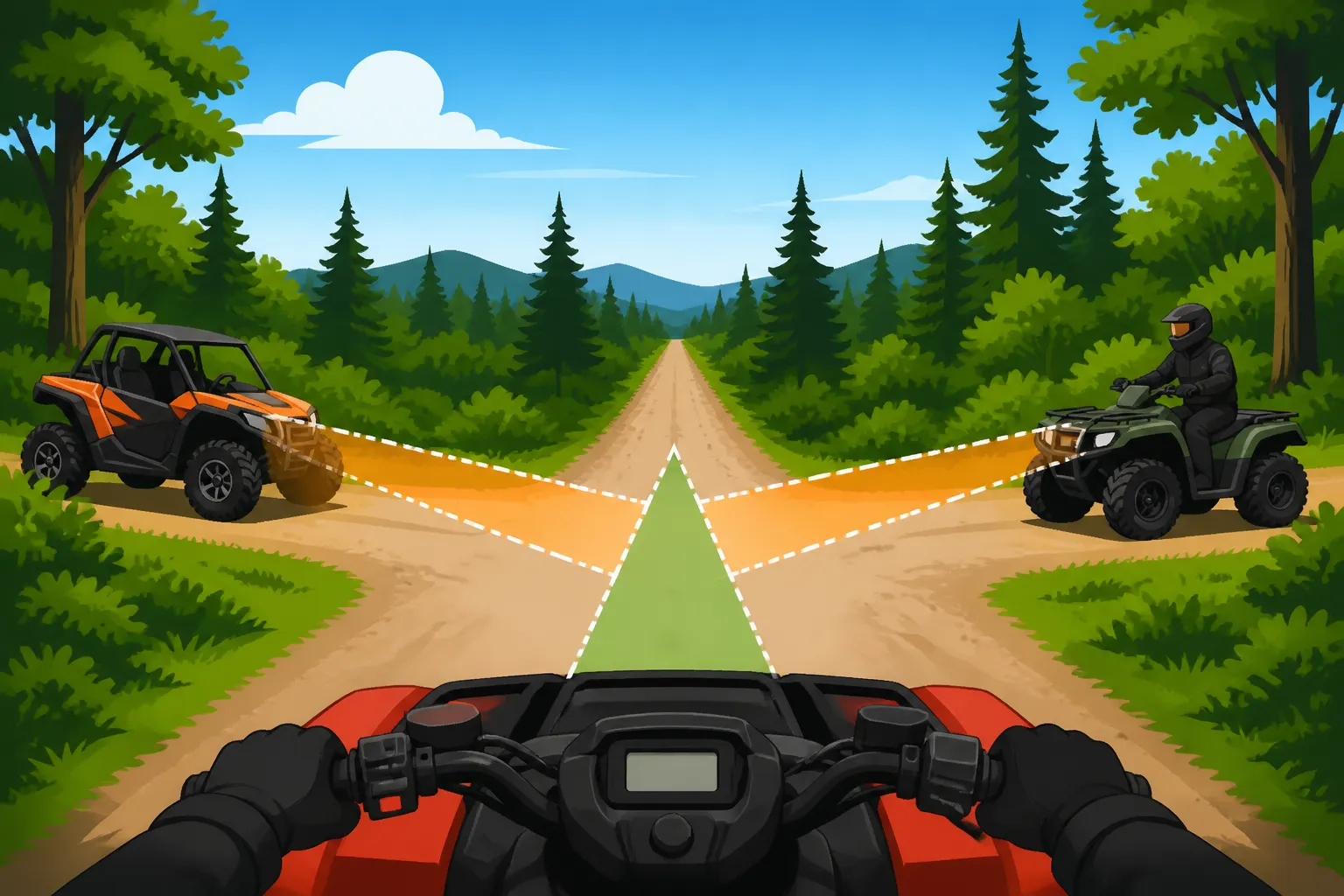
For us, as ATV or side-by-side riders, "sightline" means the unobstructed view you have of oncoming traffic from both directions when you're preparing to cross a public road. It's not just about your view, though; it's also about how far road traffic can see you. Think of it as a clear, unbroken line of vision extending down the road in both directions from your intended crossing point. If there's a hill, a sharp curve, dense trees, or a building blocking your view, or if your machine is obscured, then your sightline is compromised. The LVHR mandates minimum sightline distances because these distances correlate directly with the time and space needed for both you and an approaching road vehicle to see each other and react safely. It’s about ensuring that by the time you commit to crossing, you have confirmation that the way is clear, and that any approaching driver has seen you. [Crossing a Quebec Road at a Right Angle] is often part of ensuring the best possible sightline.
Why Impaired Visibility is a Major Hazard
Riding your machine is all about having fun and enjoying the outdoors, but that fun can turn serious in a heartbeat if visibility is poor at a road crossing. When your sightline is impaired, you're essentially playing a dangerous game of peek-a-boo with oncoming traffic. You can't see them, and they might not see you until it's too late. This could be due to natural elements like fog or heavy rain, but often it's about physical obstructions near the crossing – think tall bushes, buildings, or even parked vehicles. Without adequate sightlines, your ability to judge the speed and distance of an approaching car, and their ability to see you in time to slow down or react, is severely compromised. This drastically increases the risk of a collision, making it one of the primary hazards associated with road crossings. It’s why aftermarket accessories like high-visibility flags, bright LED lights (even from brands like SuperATV), and proper mirrors are not just extras, but crucial safety enhancements.
The Physics Behind Stopping Distances
Understanding sightline distances requires a basic grasp of the physics of stopping. It’s not just about how quickly your ATV can stop; it's about how quickly a car or truck on the road can stop, too. When a driver sees a hazard, there's a "perception-reaction time" – the time it takes for them to see you, process the information, and then apply the brakes. After that, the vehicle travels a certain distance while braking, which depends on its speed, the road conditions, and the vehicle's braking capability.
A car traveling at 90 km/h will cover a significant distance before it can even begin to slow down, let alone come to a complete stop. For example, at 90 km/h, a vehicle travels about 25 meters per second. If a driver’s perception-reaction time is 1.5 seconds, they've already covered 37.5 meters before even touching the brakes! Add the braking distance, and you need a long, clear sightline. The sightline distances mandated by the LVHR are calculated to provide this crucial buffer – enough distance for both you and the road user to perceive each other, react, and take evasive action if necessary. This is why attempting to cross a road where you can't see far enough down in both directions is incredibly risky.
Specific Sightline Requirements by Speed
Quebec's regulations are quite precise when it comes to the minimum sightline distances you need at a road crossing. These distances are directly tied to the speed limit of the public road you are about to cross, which makes a lot of sense when you consider the physics of stopping. Always remember, these are minimums; more visibility is always better.
The 50-Metre Rule for Lower Speeds (30 km/h)
If you're approaching a public road where the posted speed limit is 30 km/h or less – think quiet rural roads, residential streets, or narrow village lanes – the law requires you to have a clear and unobstructed sightline of at least 50 metres in both directions. This means that from your position at the edge of the road, preparing to cross, you must be able to see at least 50 metres down the road to your left and 50 metres to your right, and likewise, any driver on that road should be able to see you from at least 50 metres away. This [50 Metres of Sightline at 30 km/h] rule accounts for the reduced speeds and generally shorter stopping distances on such roads, but it still provides a critical safety buffer. Even at 30 km/h, a vehicle covers about 8.3 metres per second, so 50 metres gives both parties several seconds to react. Don't assume that because the speed limit is low, you can be less vigilant; every crossing carries a risk.
The 100-Metre Rule for Standard Trail Speeds (50 km/h)
The most common speed limit you'll encounter on many Quebec roads and certainly on most trails is 50 km/h. When you're crossing a public road with a speed limit of 50 km/h, the required sightline increases significantly. You need a minimum of 100 metres of clear, unobstructed vision in both directions. This [100 Metres of Sightline at 50 km/h] doubles the required distance compared to the 30 km/h rule, reflecting the increased speed and therefore the greater stopping distances for vehicles. At 50 km/h, a vehicle covers nearly 14 metres per second. If you misjudge or if a driver is distracted, those extra metres of visibility are absolutely vital. This is the standard sightline rule that riders will most frequently apply, and it's essential to be able to accurately estimate this distance. Sometimes, it might mean inching forward carefully until you achieve that clear line of sight, even if it feels a bit slow.
The 200-Metre Rule for Higher Speed Roads (90 km/h)
Now, let's talk about the more intimidating crossings – those on roads with speed limits of 70 km/h, 80 km/h, or even 90 km/h. These are often busier highways or provincial routes where traffic moves very quickly. For these high-speed crossings, the LVHR mandates a substantial sightline of at least 200 metres in both directions. This [200 Metres of Sightline at 90 km/h] is the longest required distance, and for good reason. At 90 km/h, a vehicle travels 25 metres every second. This means that an approaching car or truck can cover 200 metres in just 8 seconds. Factor in perception-reaction time and actual braking distance, and you realize how absolutely crucial that 200-metre sightline is. You must be able to see that far, and any vehicle on the road must be able to see you from that distance. If you cannot achieve this 200-metre clear view, you simply cannot make the crossing legally or safely. It might mean finding an alternative route or seeking another designated crossing point.
Here's a quick summary table of these critical sightline requirements:
| Road Speed Limit | Minimum Sightline Distance (Each Direction) | Approximate Vehicle Travel Time (for sightline distance) |
|---|---|---|
| Up to 30 km/h | 50 metres | 6 seconds |
| 50 km/h | 100 metres | 7 seconds |
| 70-90 km/h | 200 metres | 8 seconds |
Note: Travel times are approximations for a vehicle moving at the maximum speed limit, not including reaction or braking time.
Practical Application: How to Assess and Cross Safely
Knowing the numbers is one thing, but actually applying them on the trail is another. Assessing sightlines in real-time, especially in unfamiliar territory, requires a good eye, patience, and a commitment to safety.
Assessing a Crossing Before You Commit
Before you even think about putting a tire onto a public road, you need to conduct a thorough assessment of the crossing. Slow way down as you approach the road. Stop well before the pavement, or at the very edge if necessary to get the best view without entering traffic. Look left, look right, and look left again. Try to estimate 50, 100, or 200 metres. How far is that visually? Think about common benchmarks: a football field is roughly 100 metres long, so 50 metres is half a field, and 200 metres is two fields. Are there any obstructions? Trees, buildings, parked vehicles, or even a dip in the road can all hide oncoming traffic. If your view is blocked, even partially, you do not have the required sightline. This is where patience is key. Don't rush. If you're with a group, communicate clearly about the assessment. Sometimes, you might need to dismount and walk a few steps to get a better vantage point, if it's safe to do so. Remember, if you can't clearly see the required distance, then you cannot cross.
Approaching and Executing the Crossing Safely
Once you've assessed the sightlines and determined they are clear, the actual crossing needs to be executed with precision. [Quebec Rules for Crossing a Highway] stipulate that you must cross at a right angle (90 degrees) to the road, as directly as possible, without lingering. This minimizes your time on the road and presents the broadest profile to any potential oncoming traffic, making you more visible. Engage a low gear, get ready to accelerate smoothly, and ensure your path across is clear. Check again – left, right, left – before you begin to move. Once you commit, accelerate steadily across the road without hesitation, and keep your focus on the other side. Do not attempt to turn onto the road (unless specifically signed for an allowed short distance) or ride along the shoulder. The goal is to traverse the road as quickly and safely as possible, minimizing your exposure to faster traffic.
Riding Gear and Visibility Enhancements
Your personal gear and machine setup also play a role in safety at crossings, even if they don't directly change the legal sightline distance. Brightly coloured helmets and clothing, especially high-visibility vests, make you stand out. While not specifically mentioned in sightline rules, having a well-maintained machine with proper lighting is crucial. Headlights should be on, even in daylight, to make you more noticeable. Consider adding aftermarket lights from a reputable brand like SuperATV if your stock lighting feels inadequate, especially for those dusk or dawn rides. Mirrors are also incredibly helpful, allowing you to monitor behind you without constantly turning your head, and some riders also use flags or whips, particularly on side-by-sides, to increase their vertical profile and overall visibility to road users. These enhancements contribute to overall safety and help ensure that road users can see you as clearly as you can see them. [Quebec Equipment Checks by Patrols] might include ensuring your lights are functional.
Exceptions and Special Cases for Sightlines
While the sightline rules are generally strict and apply broadly, there are a few specific scenarios or historical contexts that introduce nuances or exceptions. It's important to be aware of these so you don't inadvertently misinterpret the law.
The 500-Metre Terrain Exception
One specific, and somewhat rare, exception to the rigid sightline rules is the [500 Metres Where Terrain Forces It] clause. This applies in very particular circumstances where the terrain itself makes it utterly impossible to achieve the standard 100-metre or 200-metre sightline, even at low speeds. For example, if you're in a deeply cut valley or coming off a trail onto a road that immediately disappears behind a severe, blind hill, and there's absolutely no other way to cross, the LVHR acknowledges that you might not be able to meet the standard. In such cases, the law allows a crossing only if the road speed limit is 50 km/h or less, and you approach with extreme caution, slowing to a crawl and being prepared to stop immediately. This is not a carte blanche to cross whenever you have poor visibility; it's a very specific exception for unavoidable terrain limitations and requires an even higher degree of vigilance and responsibility from the rider. Essentially, you're expected to use even more caution when the natural environment impedes your visibility.
When Workers Are Exempt from Signage
Another nuanced area involves off-highway vehicle operators who are using their machines for work purposes. [Quebec Workers Riding a Kilometre of Road] are generally exempt from the requirement for specific signage if they are riding on a public road to get from one work site to another, or to access a work area. For example, a forestry worker using an ATV to patrol a specific area of forest might need to briefly use a public road segment. In these cases, while the need for signage might be relaxed, the underlying safety principles, including the need for adequate sightlines at crossings, still apply with full force. Their employer might have specific safety protocols in place, but the onus is still on the operator to ensure a safe crossing. The exemption is about the presence of signage for road access, not about waiving the fundamental safety requirements of sightlines.
Older Trails (30-Metre Grandfathered) and Public Assemblies
There are also some historical considerations that affect how setbacks and, by extension, sightlines are handled. For trails that existed before January 2012, there's a [30 Metres on an Older Trail] grandfather clause. This typically applies to the distance a trail must be from a dwelling, not directly to road crossings. However, it highlights that older infrastructure might have different rules. Similarly, [How a Public Assembly Can Shorten the 100-Metre Setback] refers to instances where municipalities can reduce the 100-meter setback from dwellings for certain public assemblies. These are often about noise or general proximity, not road crossings. It’s critical to understand that these specific historical or assembly-related clauses generally do not alter the fundamental sightline requirements for crossing public roads. Those rules, tied to vehicle speeds and reaction times, remain steadfast for your safety.
Consequences of Non-Compliance
Ignoring Quebec's sightline rules for road crossings isn't just about cutting corners; it can lead to severe penalties, serious accidents, and long-term implications for your riding privileges and financial well-being. The authorities take these regulations very seriously for a reason.
Fines and Penalties for Violations
If you're caught violating the sightline requirements or other road crossing rules, you're looking at a fine. These aren't minor infractions; they reflect the high-risk nature of the violation. For instance, if you're found to be crossing a public road where you clearly didn't have the required visibility, or if you failed to cross at a right angle, you could face significant financial penalties. While specific amounts can vary, [Quebec Road Riding Fines From $350] gives you an idea of the starting point for such infractions. These fines are often accompanied by demerit points on your driver's license (since [Quebec Requires a Driver's Licence Since 2021] to ride a VTT on public lands), which can lead to license suspensions if you accumulate too many. A patrol officer, whether it's a Sûreté du Québec officer or a club patrol working with local authorities, has the right to stop you and issue a citation if they observe non-compliance. Don't risk it; a ticket for a dangerous crossing is a sure way to ruin your day and lighten your wallet.
Insurance Implications After an Accident
Beyond fines, the most serious consequence of non-compliance is the potential for an accident. If you're involved in a collision at a road crossing where you failed to meet the sightline requirements, the insurance implications can be devastating. Your mandatory [Quebec Insurance Minimum for an Owner] (which is part of your SAAQ registration and generally provides [The $1 Million Liability Floor Every Owner Carries]) is designed to protect you from financial ruin in case you cause damage or injury. However, if an investigation determines that you were negligent by not adhering to the sightline rules, your insurer may deny coverage, or significantly increase your premiums in the future. You could be held personally liable for significant damages, medical costs, and legal fees. [Quebec Accident Reporting Rules] require you to report any incident, and any evidence of non-compliance with the LVHR will be thoroughly examined. Your safe riding habits directly impact your insurance standing and your ability to be fully protected.
Safety First: Avoiding Preventable Collisions
Ultimately, all these rules and regulations boil down to one thing: safety. The LVHR's sightline requirements are not arbitrary hoops to jump through; they are carefully crafted guidelines based on real-world accident data and vehicle dynamics. By consistently adhering to these rules, you are actively participating in preventing collisions. A collision involving an ATV or side-by-side and a car or truck can be catastrophic for the off-highway vehicle operator, given the disparity in size and protection. Always prioritize safety over convenience. If a crossing feels unsafe, or if you can't be absolutely certain you meet the sightline criteria, don't attempt it. Find an alternate route, even if it adds a few kilometres to your ride. Sometimes, the safest decision is to turn back or wait for conditions to improve. Taking that extra moment to ensure a clear sightline could literally save your life or prevent a life-altering injury.
Disclaimer
This article is for general informational purposes only and does not constitute professional advice. Laws, prices and regulations vary by location and change over time. Consult a qualified professional for guidance on your specific situation.