Why Quebec Roads Are Closed to Quads by Default
It can be incredibly frustrating to roll out your quad, ready for a day of adventure, only to feel restricted by invisible lines on a map, especially when those lines include paved roads right in front of you. Many new and even seasoned riders in Quebec scratch their heads, wondering why they can't simply take their off-highway vehicle on public roads like they might a car. This guide will meticulously break down why Quebec roads are, by default, closed to quads and other off-highway vehicles, and exactly under what specific conditions you might legally share the asphalt.
The Core Principle: Why Quebec Roads Are Generally Off-Limits to ATVs
The idea that you can't just hop on your ATV and cruise down any road in Quebec often comes as a surprise to riders, particularly those new to the province or those accustomed to different rules elsewhere. It's a foundational principle embedded deeply in Quebec's legislative approach to off-highway vehicles. This isn't just about making things difficult; it's rooted in specific safety concerns and a long-standing legal framework designed to regulate how these powerful machines interact with traditional road traffic.
The Legislative Foundation: Quebec's Off-Highway Vehicle Act
At the heart of this "closed by default" rule is Quebec's Act respecting off-highway vehicles, often referred to as the LVHR (Loi sur les véhicules hors route). This legislation clearly distinguishes off-highway vehicles (VHRs, or véhicules hors route in French, which includes ATVs or VTTs – véhicules tout-terrain – and side-by-sides) from conventional road vehicles. Unlike a car or truck, which is designed and regulated for road use from the factory, an ATV is primarily intended for off-road environments – trails, fields, and rugged terrain. The LVHR sets out comprehensive rules for the registration, insurance, equipment, and operation of these machines, with a strong emphasis on where they can be operated.
Before the changes introduced by [Quebec's 2021 Law and What Changed], there were similar restrictions, but the updated legislation brought even greater clarity and, in some cases, stricter enforcement. The overarching philosophy of the LVHR is that public roads, which are designed for motor vehicles operating at higher speeds and within a predictable flow of traffic, are generally unsuitable for the unique characteristics of ATVs. This legislative framework is not a suggestion; it is a legally binding set of rules that all riders in Quebec must adhere to. Understanding [What the LVHR Replaced] can offer further context into the historical progression of these rules.
Prioritizing Safety: The Rationale Behind the Restrictions
So, why the strict separation? It boils down to safety – for ATV riders, for other road users, and for pedestrians. ATVs and side-by-sides handle very differently from cars. They have a higher center of gravity, different braking characteristics, and are generally less visible than larger vehicles. Their tires, often designed for maximum traction on loose terrain, can behave unpredictably on hard, paved surfaces, especially when wet.
Imagine a busy two-lane highway where cars are travelling at 90 km/h. An ATV, with its factory-mandated speed limit of 50 km/h in Quebec even on authorized road sections, would create a significant speed differential, increasing the risk of collisions. Furthermore, ATVs lack many of the safety features common in cars, such as crumple zones, advanced airbags, or enclosed cabins (though side-by-sides offer some enclosure). In an accident involving a car and an ATV, the ATV rider is significantly more vulnerable. The legislation aims to mitigate these inherent risks by keeping ATVs off general public roads unless very specific, controlled conditions are met. This preventative approach is a cornerstone of Quebec's road safety strategy.
What "Closed by Default" Truly Means for Riders
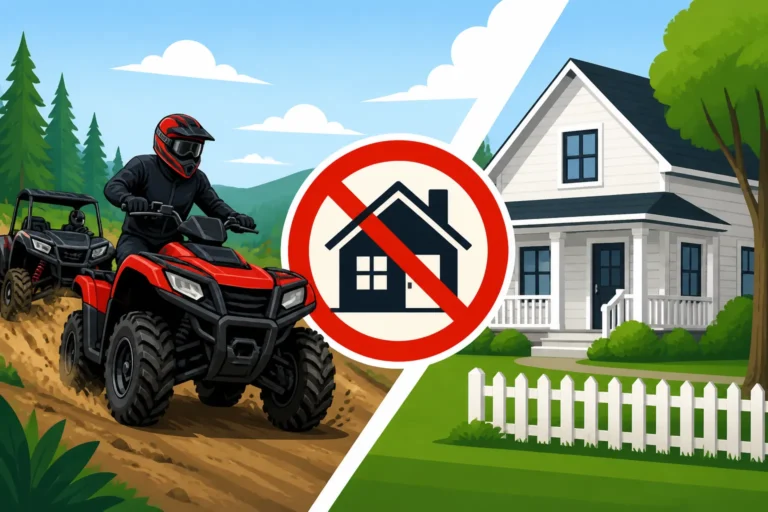
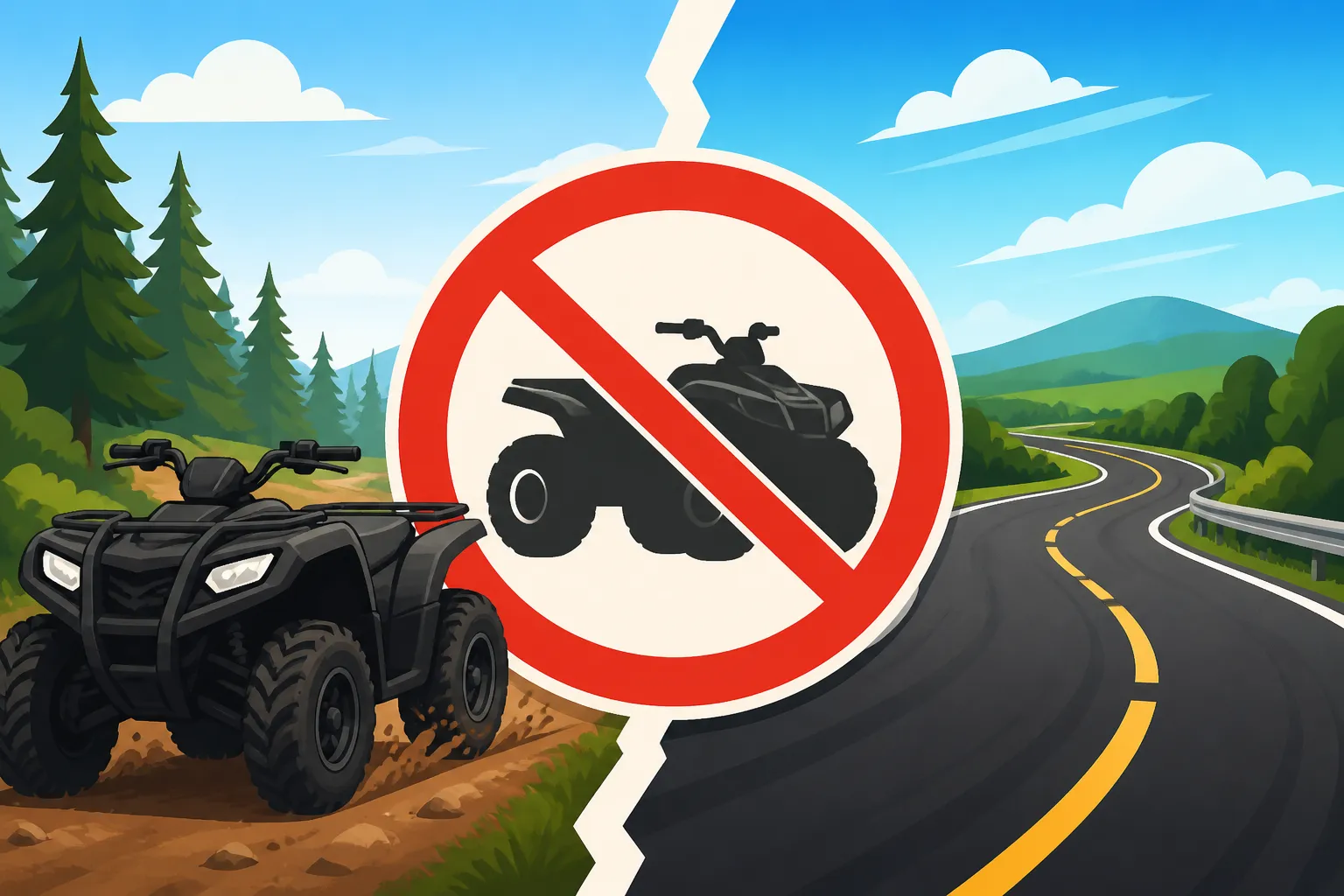
The phrase "closed by default" means exactly what it implies: unless a specific section of road is explicitly designated and signed as open to off-highway vehicles, it is illegal to ride your quad on it. You cannot assume permission based on local custom, lack of enforcement, or the absence of "No ATV" signs. The burden of proof is on the rider to know and respect the rules. This means you must assume every road is off-limits until you see clear, official signage indicating otherwise.
This default closure affects everything from getting to a gas station just down the road to connecting two segments of a trail. It dictates how you must transport your machine (often on a trailer) to reach an authorized trail network. It means that riding from your cottage to a nearby convenience store, even if it's only a few blocks, is prohibited unless that specific route has been legally opened by a municipality or falls under a specific exception. This principle underpins [Can You Ride an ATV on the Road in Quebec?] and is fundamental to safe and legal riding in the province.
Understanding the Exceptions: When Can You Ride on a Quebec Road?
While the default position is that roads are closed to ATVs, Quebec's Off-Highway Vehicle Act (LVHR) does recognize that sometimes, brief or specific road use is necessary or beneficial. However, these exceptions are tightly regulated and come with their own set of conditions and responsibilities. It's not a free pass; it's a privilege granted under strict circumstances.
The "1 Kilometre Rule" for Access and Passage
One of the most common exceptions allowing ATVs on public roads is the "1 kilometre rule," also known as [Quebec Municipal Road Access Up to 1 Kilometre]. This rule permits ATV riders to use a public road for a distance not exceeding one kilometre under very specific conditions. The primary purpose of this allowance is to:
- Access an authorized trail: If the official ATV trail network requires you to briefly use a public road to connect to the next segment, you can do so for up to one kilometre.
- Cross an obstacle: Sometimes, a natural barrier or private property makes it impossible to continue on a trail, requiring a short detour on a road.
- Access services: This could include reaching a gas station, a repair shop, or lodging directly adjacent to the trail, again, within that one-kilometre limit.
It's absolutely crucial to understand that this one-kilometre limit is strict. It's not "about a kilometre" or "if it feels like a kilometre." If your detour requires 1.2 kilometres on a public road, you are technically in violation for that extra 200 metres. Furthermore, this rule only applies if there is no other reasonable way to achieve your objective (e.g., another trail segment, a different access point). When using these road segments, all [Quebec ATV Road Rules Under the LVHR] still apply, including speed limits (typically 50 km/h for ATVs on roads), helmet use, and possessing a valid driver's licence. Remember, the road must be identified by specific signage permitting this use.
Municipal Authority: When Local By-Laws Open Up Roads
Beyond the one-kilometre rule, some municipalities in Quebec have the authority to open specific public roads or sections of roads to off-highway vehicles through local by-laws. This is not a widespread practice but can be found in certain regions, often in more rural areas where ATV riding is a significant part of the local culture or economy. These municipalities must follow a precise process, including notifying the Ministry of Transport and installing specific signage.
For example, a small village might open a 5-kilometre stretch of road to connect a trail system around the town, allowing riders to access local businesses like restaurants or hotels. In such cases, the local by-law defines the exact roads, the permitted hours of operation, and any other specific conditions. It's vital for riders to be aware of and respect these local rules. You can't just assume a road is open because you saw another quad on it; you need to look for the specific signage posted by the municipality. Information on [Quebec Municipalities That Opened Roads] might be available from local tourism offices or ATV clubs. It's also important to note that these municipal allowances typically still require the machine to be registered and insured, and the rider to have a valid licence. While you might consider robust aftermarket accessories from companies like SuperATV for any machine you plan to ride on these sections, like enhanced mirrors or lighting for better visibility, the core legal requirements remain paramount.
Specific Exemptions for Workers and Farmers
The LVHR also provides specific exemptions for certain occupational uses. Workers performing tasks like forestry operations, land surveying, or maintaining power lines might be allowed to use ATVs on public roads when it's necessary for their work. Similarly, farmers often have exemptions that permit them to use their ATVs on roads adjacent to or connecting their farmland for agricultural purposes.
These exemptions are not blanket permissions and usually come with strict conditions. For instance, the machine might need to be equipped with specific safety features, and the rider must be actively engaged in their work, not just pleasure riding. These exemptions are usually defined within the LVHR itself or through specific regulations, acknowledging that ATVs are essential tools for certain industries. If you are a worker or farmer planning to use your ATV on public roads for professional duties, it's critical to thoroughly understand the precise conditions that apply to your situation. This often involves specific equipment requirements, like warning lights or specialized tires. For those using their machines for demanding farm work, ensuring the machine is equipped with durable components, perhaps from a reputable brand like SuperATV, can be a smart move, but these are considerations after understanding the legal framework. Further details can be found regarding [Quebec Workers Riding a Kilometre of Road] or [Quebec Registration for a Farm Machine].
Navigating the Rules: Practical Advice for Quebec Riders
Understanding the legislative framework and the exceptions is one thing, but putting it into practice on the ground is another. Navigating Quebec's road rules for ATVs requires vigilance, proper preparation, and a commitment to safety and legality. Failing to do so can lead to significant consequences that no rider wants to face.
Essential Equipment and Road-Specific Requirements
When you are legally permitted to ride your ATV on a public road in Quebec, whether for a one-kilometre stretch or on a municipally opened section, your machine needs to meet specific equipment standards beyond what might be acceptable for trail-only riding. These requirements are in place to ensure your visibility and safety when sharing space with cars and trucks.
- Headlights and Taillights: Your ATV must have operational headlights (high and low beam) and taillights, which must be on at all times, even in daylight.
- Brake Lights: A functioning brake light is essential to signal your intentions to traffic behind you.
- Mirrors: You must have at least one mirror securely affixed to the left side of your handlebars, providing a clear view of the rear. Many riders opt for two for better visibility.
- Horn: A working horn is mandatory for signaling.
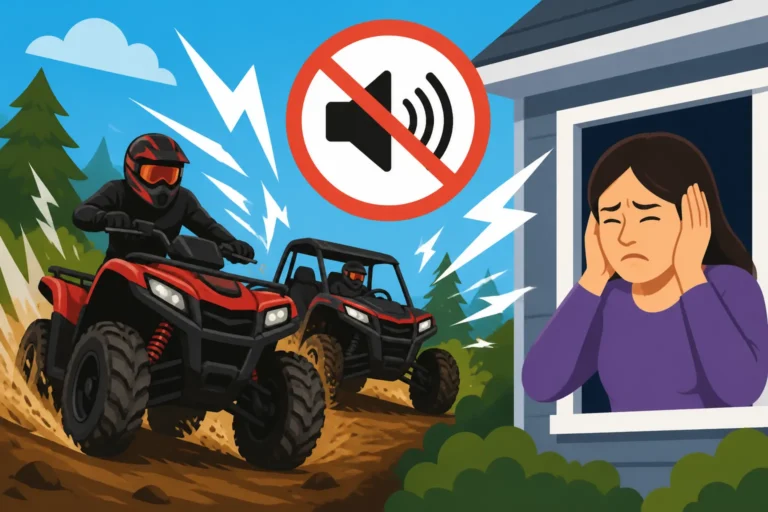
- Muffler: The muffler must be in good working order and meet noise level regulations. Modifications that make the machine excessively loud are not permitted.
- Tires: Tires must be in good condition, without excessive wear, and appropriate for the machine's intended use.
- Registration and Plate: Your ATV must be properly registered with the SAAQ, and the [Quebec VHR Plates Explained] must be affixed and clearly visible.
- Liability Insurance: Quebec mandates a minimum of $1,000,000 in third-party liability insurance for all off-highway vehicles. This is usually purchased with your registration. [Quebec's Liability Insurance Rule] is non-negotiable.
Beyond these mandatory items, consider enhancing your visibility. Reflective tape, bright clothing, and even aftermarket LED light bars (used responsibly and not to blind oncoming traffic) can make a significant difference, especially when visibility is poor. While SuperATV is known for its rugged off-road components, they also offer lighting solutions and other accessories that could help meet or exceed these road-specific requirements, adding a layer of safety for those brief moments on pavement.
Identifying Authorized Road Sections and Signage
Knowing when and where you can ride on a road is paramount. The primary indicator is signage. Always look for official road signs that explicitly permit ATV access. These signs are standardized and leave no room for ambiguity.
- Specific Signage: For the one-kilometre rule, you'll typically see signs indicating a specific path or crossing for ATVs, often with an ATV pictogram and an arrow. If a municipality has opened a longer stretch of road, there will be signs marking the beginning and end of the authorized section. These signs are usually distinct from standard road signs. You can learn more about [Quebec Signage for an Authorized Road Stretch].
- Trail Maps: Always consult current, official ATV trail maps, such as those provided by the Fédération Québécoise des Clubs de Quad (FQCQ). These maps clearly delineate authorized trail sections, including any approved road crossings or stretches where road use is permitted. Using apps like iQuad can also help you stay on designated routes.
- Local Clubs: Connecting with local ATV clubs in the area you plan to ride is an excellent way to get up-to-date information on trail conditions, temporary closures, and any specific local road access rules. These clubs are the backbone of the trail network and are invaluable resources for riders.
Never rely on hearsay or the presence of tire tracks as proof that a road section is open. Always confirm with official sources and look for the proper signage. When in doubt, assume the road is closed.
Consequences of Non-Compliance: Fines and Legal Ramifications
The penalties for riding an ATV on an unauthorized public road in Quebec are not trivial. Enforcement patrols, including police and authorized trail wardens, take these violations seriously, and fines can be substantial.
- Fines: Riding an ATV on a public road where it is prohibited can result in significant fines. These fines can range from hundreds to thousands of dollars, depending on the nature and severity of the infraction. For instance, [Quebec Fines for Riding a Public Road] can start around $350. These are just the base fines; additional fees and administrative costs can quickly inflate the total.
- Vehicle Seizure: In certain cases, especially for repeat offenders or egregious violations, your ATV could be seized. This involves impoundment fees, which can be very costly, in addition to the fines.
- Insurance Implications: Riding illegally can nullify your insurance coverage in the event of an accident. If you cause damage or injury while operating your ATV unlawfully on a public road, your insurance company may refuse to cover the costs, leaving you personally liable for potentially massive expenses.
- Criminal Charges: More severe infractions, such as impaired riding on any public thoroughfare (even an unauthorized one) or dangerous operation, can lead to criminal charges, significant licence demerit points, and even imprisonment. [Quebec Impaired Riding Penalties] are strict, regardless of where the machine is operated.
- Loss of Privileges: Repeated violations can lead to the suspension or revocation of your driver's licence and your ATV registration, effectively preventing you from riding legally in Quebec.
It's clear that the risks associated with unauthorized road riding far outweigh any perceived convenience. Adhering to the rules protects not only your wallet and your riding privileges but, most importantly, your safety and the safety of others. Always ensure you have your [Quebec Insurance Proof on the Machine] and a valid driver's licence to present to any enforcement officer.
| Condition for Road Use | Maximum Distance | Requires Signage? | Examples | Penalties for Violation |
|---|---|---|---|---|
| Default | 0 km | No | Any public road without explicit permission | Significant fines, possible seizure, insurance void |
| 1-Kilometre Rule | 1 km | Yes | Connecting trail segments, accessing services | Significant fines if exceeding limit or no signage |
| Municipal By-Law | Varies | Yes | Designated roads opened by local authorities | Fines if outside designated zones or hours |
| Worker/Farmer Exemption | Varies | Sometimes | Agricultural tasks, utility maintenance | Fines if not performing eligible work |
Disclaimer
This article is for general informational purposes only and does not constitute professional advice. Laws, prices and regulations vary by location and change over time. Consult a qualified professional for guidance on your specific situation.