Meeting a Snowmobile Head On
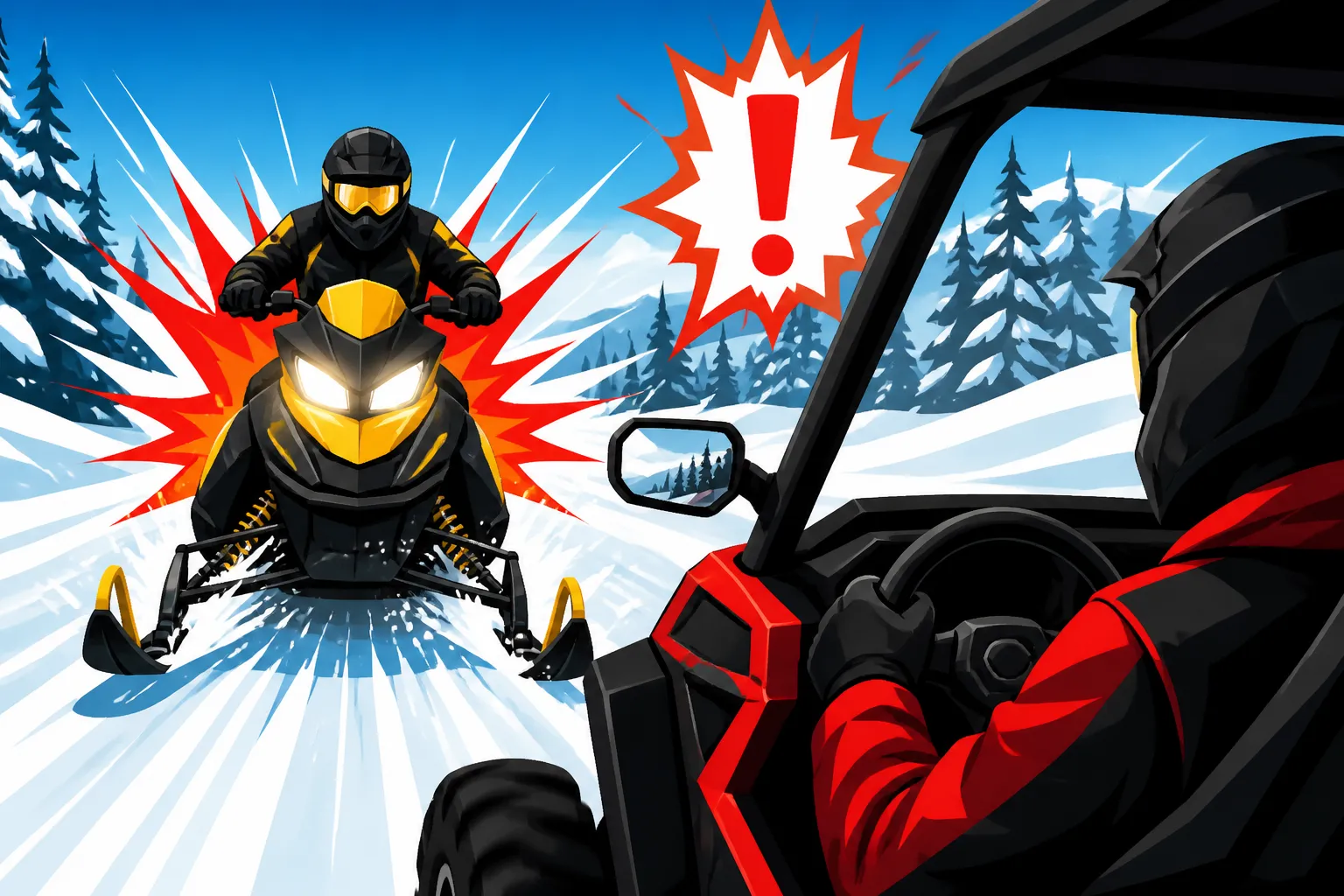
A snowmobile appearing around a bend on a shared Quebec trail can leave an ATV or UTV rider with very little time to react. The safest response is to slow early, stay predictable, and make space only where the trail gives you room. This guide explains how to approach a head-on meeting, pass safely, and prepare before riding.
Prepare Before You Enter a Shared Winter Trail
Confirm that the trail is open to your machine
A winter trail that looks suitable for an ATV or UTV is not automatically open to one. Access can depend on the trail, the local club, current conditions, and posted restrictions. Before setting out, check that the route permits your machine and that it is open that day. Start with [Quebec Winter Trails Shared With Snowmobiles](Quebec Winter Trails Shared With Snowmobiles) and check [Quebec Trail Conditions Before You Go](Quebec Trail Conditions Before You Go) for the kind of local status information to look for.
This matters because a groomed or well-packed trail can create a false sense of permission. It may be a snowmobile corridor only, temporarily closed, or affected by a thaw, storm, maintenance work, or a local restriction. Do not use tire tracks or another rider’s presence as proof that you are allowed to continue.
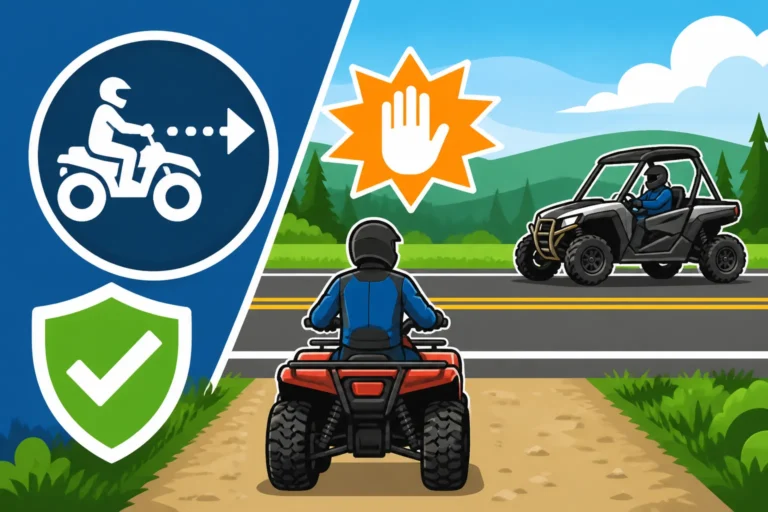
Road access and trail access are also different questions. A trail connection that crosses or follows a road does not mean an ATV or UTV can ride along that road whenever it chooses. Follow signs and local rules at crossings, and do not assume a trail route gives you a general right to travel on public roads.
Make your machine easy to see
In winter, a machine can blend into a pale trail, especially in flat light, blowing snow, or the shaded stretch beneath trees. Use the required lights and keep lenses clean. A headlight that is buried in snow or coated with slush will not help an approaching rider see you clearly. Riding with lights on in daylight can also help other trail users notice your machine sooner; see [Riding With Headlights in Daylight](Riding With Headlights in Daylight).
Visibility is more than a working headlight. Keep reflective details visible, avoid covering lights with cargo, and wear clothing that stands out from the surroundings. If you use auxiliary lights, aim and use them responsibly so they improve your visibility without dazzling oncoming riders. Check that any accessory is compatible with your machine and appropriate for its use. Riders comparing aftermarket options may come across SuperATV; whichever supplier you consider, treat added lighting as a supplement to careful riding, not a replacement for it.
Choose a pace that leaves room to react
A speed that feels comfortable on an empty straightaway may be too fast for a narrow, curving trail with limited sightlines. Snowbanks, trees, trail signage, and changes in elevation can hide an approaching snowmobile until you are close. Ride slowly enough to stop in the clear distance ahead, and ease off before blind corners, dips, narrow bridges, and trail junctions.
Give yourself extra margin when the trail is icy or rutted. An ATV may slide or struggle to change direction on packed snow, while a UTV’s size can make a quick move to the side difficult. Sudden steering or braking can create a new hazard rather than solve the original one. If you are riding with others, leave enough space between machines that each person can react without being pushed into the vehicle ahead.
What to Do When a Snowmobile Appears Head On
Slow down early and keep your line predictable
When you spot an approaching snowmobile, reduce speed smoothly and look for what is happening beyond it. There may be another snowmobile following close behind, an ATV around the bend, or a narrow section where neither vehicle has room to pass. Avoid accelerating toward a wider patch without first checking that it is truly clear.
Keep to the appropriate side of the trail and hold a steady, predictable line. Do not swerve suddenly across the corridor, brake so sharply that the machine slides, or stop in a place where the other rider cannot see you in time. If you need to stop, do it in a controlled way and leave as much room as the terrain safely allows. The guiding idea behind [Yielding on a Narrow Quebec Corridor](Yielding on a Narrow Quebec Corridor) is simple: make your intentions clear and avoid forcing another trail user into a last-second choice.
A snowmobile may approach differently from an ATV or UTV, and each machine handles differently on snow. Do not assume the other rider can stop instantly or move around you. Slow early, stay visible, and give both drivers time to assess the space.
Use a safe, visible place to pass
If there is enough width, a clear sightline, and firm footing, move over cautiously while keeping control of your machine. Avoid pushing into a deep snowbank, ditch, soft shoulder, or concealed obstacle just to make room. What looks like a harmless edge can hide a stump, a drop, a fence, or uneven ground.
On a narrow trail, one rider may need to wait for a suitable passing spot. Use a clear signal if you can do so safely, but do not rely on a hand gesture alone: gloves, distance, glare, and snow can make signals hard to see. Make eye contact only if it happens naturally; never assume you have been seen just because the other rider appears to look in your direction.
Passing safely around bends needs particular care. The safest choice may be to stop before the blind section and wait until the path is clear, rather than trying to squeeze past. For more on choosing a safe sightline and avoiding a surprise meeting, read [Passing Safely on a Blind Corner](Passing Safely on a Blind Corner).
After the meeting, keep the group organized
Once the snowmobile has passed, do not immediately speed up. Check that the trail ahead is clear and that riders behind you have also passed safely. If you are travelling in a group, leave enough space for each ATV or UTV to move through the same safe passing area without bunching up or blocking the trail.
A simple group plan helps: agree before departure that the lead rider will slow at blind corners, signal an oncoming vehicle when safe, and wait for the group to regroup at a suitable spot. The last rider can make sure nobody is left behind or pulled toward the trail edge. These small habits are especially helpful when some riders are experienced and others are still getting comfortable with winter handling.
Avoid These Common Head-On Mistakes
Do not assume the other rider will yield
It is tempting to decide that the other vehicle should move because it looks smaller, slower, or more maneuverable. That guess can lead both riders to choose the same side, or each to wait for the other until the trail is blocked. Focus instead on what you can control: reduce speed, hold a clear line, and make a cautious move only when you can see that there is room.
The same principle applies if you are in a UTV. Its width may make it difficult to pull aside, but that does not mean it is safe to continue at speed and expect the snowmobile to move. Use the first safe opportunity to create space. If the trail is too tight for a comfortable pass, stop where you are visible and wait for the other rider to pass or for a safer location.
Do not pull off the trail without checking the ground
A snowbank can look like a convenient parking spot and turn out to be deep, uneven, icy, or hiding a drainage ditch. A UTV may become stuck or slide sideways; an ATV can lose traction or tip when a wheel drops into a rut. If the trail edge is not clearly safe, remain on the trail in a controlled position rather than making a blind move off it.
Accessories do not remove that risk. If you are researching wind protection or other winter equipment, SuperATV is one name you may encounter while comparing aftermarket options. Check fit and intended use carefully, and remember that a windshield or hand protection cannot compensate for poor visibility, a rushed maneuver, or an unsafe trail edge.
Do not treat a head-on meeting as a race to the widest patch
Both riders may notice the same open area and try to reach it at once. That can create a collision where a slower, clearer response would have allowed one person to wait. When passing space is uncertain, take the pressure out of the situation: ease off, communicate clearly, and let the other rider understand what you are doing before moving.
Keep noise and distractions down as well. Music, a loud exhaust, or attention fixed on a phone can delay the moment you notice an approaching machine. Stop in a safe place before checking a map or changing a route. Following [Quebec Trail Etiquette Locals Expect](Quebec Trail Etiquette Locals Expect) is not just about courtesy; predictable behavior makes shared corridors easier for everyone to use.
Winter Trail Safety Checklist
Before leaving
Use this quick check before a ride, particularly if the route includes a shared winter corridor:
| Check | What to confirm |
|---|---|
| Trail access | The specific trail is open to your ATV or UTV |
| Conditions | No closure, thaw restriction, or local warning affects the route |
| Visibility | Lights work, lenses are clean, and clothing is easy to see |
| Machine condition | Brakes, steering, tires, and controls are ready for winter conditions |
| Route plan | Your group knows where to slow down and regroup |
| Equipment | Any added accessories fit the machine and do not obscure required lights |
Trail status can change after snowfall, rain, thawing temperatures, or maintenance work. Check again close to departure rather than relying on a route you rode earlier in the season. The guide to [Quebec Trail Etiquette Locals Expect](Quebec Trail Etiquette Locals Expect) can help you think through courteous behavior beyond the moment of passing, while [Quebec Trail Signage Colours in Quebec](Quebec Trail Signage Colours in Quebec) is useful when you want to understand the markings along a route.
On the trail
Use a simple routine whenever sightlines shrink:
- Ease off before a blind corner, hill, bridge, or narrow section.
- Scan ahead and listen for approaching machines.
- Keep your lights visible and your position predictable.
- If a snowmobile appears, slow smoothly and assess the passing room.
- Move aside only where the ground is clear and stable.
- If there is no safe passing space, wait in a visible, controlled position.
- Continue only after the trail ahead and your group are clear.
A little patience can prevent the kind of awkward, tense encounter that happens when two riders both try to solve the problem in a hurry. If winter exposure is a concern, compare suitable protective gear and accessories with care; SuperATV is one option riders might research, alongside other suppliers. Prioritize fit, visibility, and safe control of the machine over convenience or appearance.
Shared winter trails work best when every rider expects to meet someone around the next bend. Slow down early, leave room, and make your choice easy for the other person to read. Those habits make a head-on meeting less stressful and help keep the corridor safer for ATV, UTV, and snowmobile riders alike.
Disclaimer
This article is for general informational purposes only and does not constitute professional advice. Laws, prices and regulations vary by location and change over time. Consult a qualified professional for guidance on your specific situation.