Quebec Signage for an Authorized Road Stretch
It can be incredibly frustrating to be out on your quad, enjoying the beautiful Quebec landscape, and suddenly find yourself questioning if that next stretch of pavement is fair game or strictly off-limits. The rules around riding off-highway vehicles on public roads in Quebec have always been a bit of a maze, and honestly, it often feels like you need a law degree just to figure out where you're allowed to go without risking a hefty fine. This guide is here to untangle that confusion, specifically diving deep into what official signage for an authorized road stretch means for you, where to find it, and what else you need to know to ride legally and safely.
Navigating Quebec's Roads: Understanding the Default "No" for ATVs
Let's face it, Quebec isn't like some places where you can just zip your ATV down any old road. Here, there's a very clear default position when it comes to off-highway vehicles and public roads: you're generally not allowed. This can be a tough pill to swallow, especially when you're looking for a quick connection between two trails or need to access a service in a nearby village. But understanding this fundamental principle is the first step to riding responsibly and legally.
The Fundamental Principle: Off-Limits Until Officially Marked
The overarching rule in Quebec is that ATVs and side-by-sides are prohibited on public roads and highways unless a specific section has been explicitly designated and marked for their use. It's not a matter of "innocent until proven guilty" where you can ride until told otherwise; it's the opposite. The road is off-limits for your off-road machine unless there's an official sign giving you permission. This can feel restrictive, especially for those of us who just want to enjoy our machines without constant worry.
This prohibition isn't arbitrary; it stems from the inherent differences between off-highway vehicles and standard road-going vehicles. ATVs and UTVs often lack the same safety features, visibility, and handling characteristics designed for typical road traffic speeds and conditions. The legal framework is designed to protect both off-highway vehicle riders and other motorists, preventing potential conflicts and accidents. It’s about ensuring that when these machines do share the road, it’s done in a controlled, predictable, and safe manner.
Ignoring this foundational rule can lead to more than just a stern talking-to. Riding on an unauthorized public road stretch can result in significant fines, and in some cases, your machine could even be impounded. Beyond the legal ramifications, there's the very real danger of an accident involving faster-moving road traffic. It's simply not worth the risk to yourself, your machine, or others to assume access where it hasn't been clearly granted by official signage.
How the 2021 Law Reshaped Road Access
The landscape for off-highway vehicles in Quebec saw some pretty significant changes with the passing of the [Quebec's 2021 Law and What Changed]. This legislation aimed to modernize the rules, address evolving riding practices, and improve safety. While it did introduce some greater flexibility in certain areas, particularly around age limits and specific scenarios, it also firmly cemented the importance of official signage for road access.
The changes didn't open the floodgates for ATVs on every road. Instead, they clarified the conditions under which municipalities could grant access and reinforced that this access must be communicated clearly to riders. The intent was to create a more consistent and safer environment, moving away from a patchwork of local rules that could be confusing to navigate. If anything, the 2021 law made official signage an even more critical component of legal road riding.
Therefore, for us riders, the new law underscored a vital point: we can't rely on word-of-mouth or outdated information. Any authorized use of a public road by an off-highway vehicle must be explicitly backed by the presence of official signage. This commitment to clear communication helps reduce ambiguity and ensures that both riders and law enforcement know exactly what's permitted.
The Green Light: Official Signage for Authorized Road Stretches
So, if the default is "no," how do we get to a "yes"? The answer lies squarely with official signage. These signs are your legal permission slip to traverse what would otherwise be forbidden territory for your quad. Understanding who puts them there and what they look like is absolutely crucial for any responsible rider in Quebec.
The Mandate of Municipalities: When and How They Can Open Roads
In Quebec, it's typically the local municipalities that have the authority to designate specific sections of their roads for off-highway vehicle use. This isn't a casual decision; it's a formal process. A municipality can't just slap up a sign; they need to follow provincial guidelines and often conduct public consultations to assess the impact on local residents and traffic flow. This deliberate process ensures that any designated road stretch is chosen with safety and community considerations in mind.
Once a decision is made, the municipality must formally notify the Ministry of Transport of Quebec. This involves providing details about the specific road segments, the conditions of access, and the type of signage that will be installed. This mandatory notification, often referred to as [Quebec's 15-Day Notice to the Ministry], ensures that the provincial authorities are aware of and can track these designations, maintaining a consistent provincial framework for road access. It's a key part of the official chain of command that legitimizes the signage you see.
The culmination of this entire process is the installation of specific, standardized signs. These aren't temporary banners or homemade placards; they are official road signs recognized by provincial law. For riders, this means that the presence of these signs is your ultimate, undeniable authority to be on that road segment. Without them, even if you heard from a local that it's "okay," you're still in violation of the rules.
Recognizing the Authorized Off-Highway Vehicle Sign
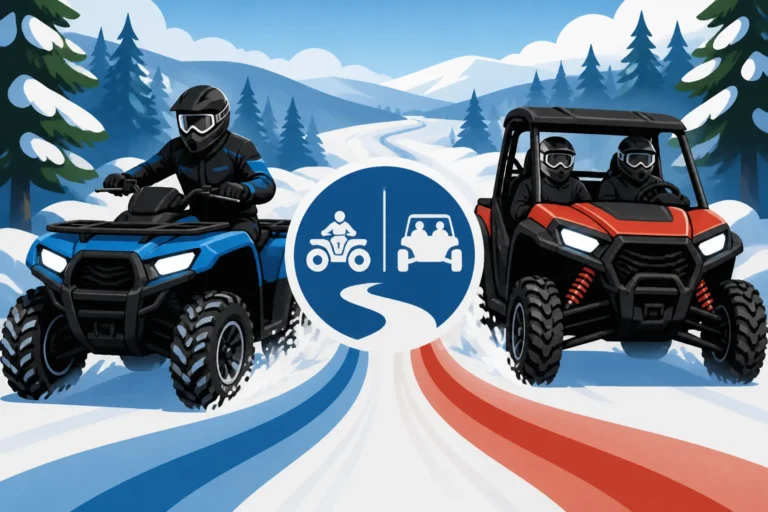
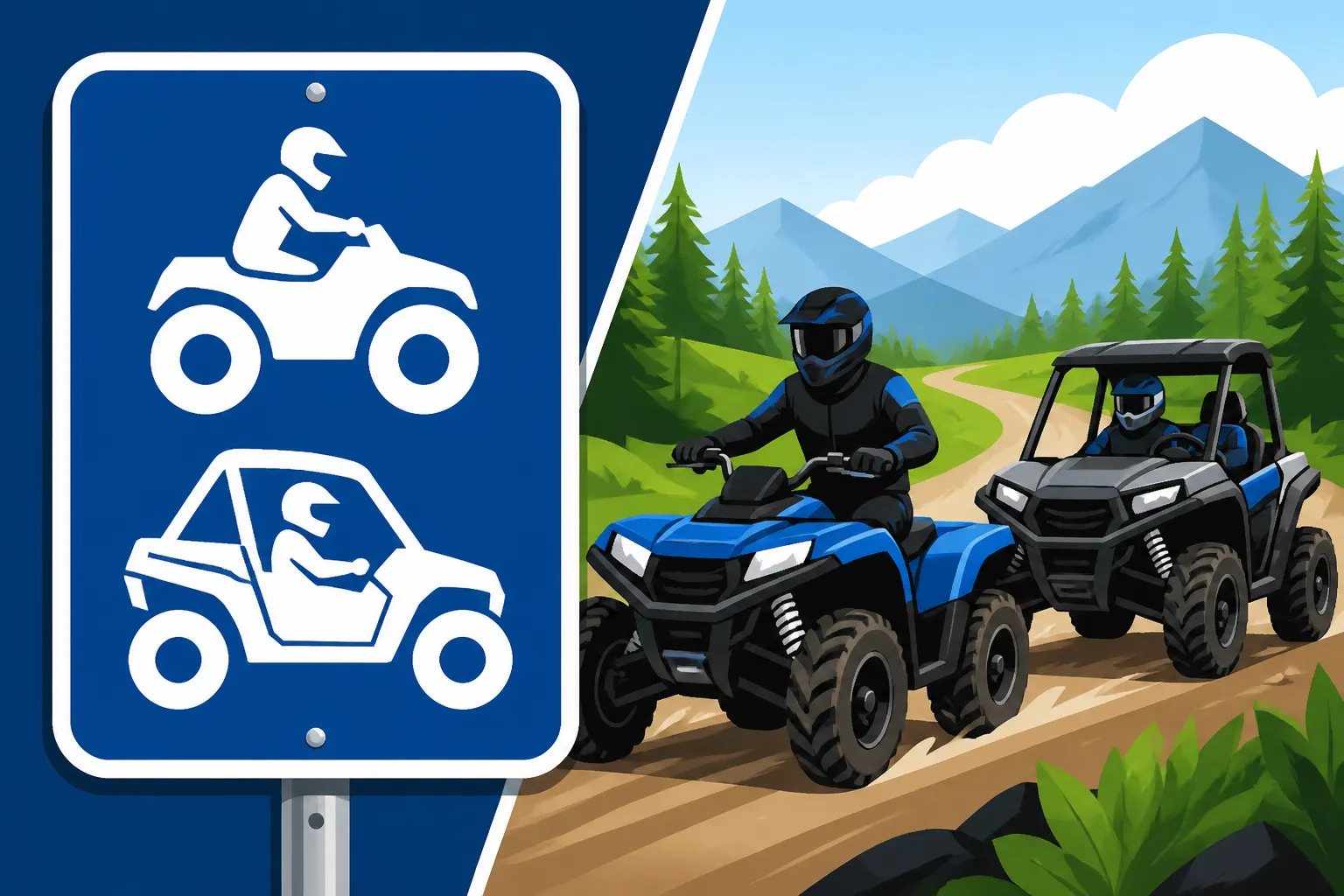
When you're out on the trails, eyes peeled for that crucial sign, what exactly are you looking for? The official off-highway vehicle sign that permits road access in Quebec has a distinct look. It's typically a square or rectangular white sign with a clear black pictogram of an ATV or side-by-side, often accompanied by text or a green border. Sometimes, it explicitly states "VTT/VHR Autorisé" or indicates a specific distance. This unambiguous design is meant to be instantly recognizable and leave no room for misinterpretation.
It's vital to distinguish these official signs from other types of markers. You might see signs indicating a nearby trail, or perhaps a private landowner's sign about property access. These are not the signs that grant you permission to ride on a public road. An official sign for road access will always be a standardized, government-issue road sign, usually found at the very beginning of the authorized road segment. If it doesn't look like an official road sign for vehicles, it likely isn't permission for road riding.
Therefore, the absence of this specific, official sign means the road remains off-limits for your off-highway vehicle. You can't assume access because a trail ends near a road, or because you see tire tracks on the shoulder. Always, always look for the explicit, clear, and official signage. It's your ultimate visual cue and your legal permission to proceed.
Standard Signage for Permitted Sections: What to Expect Visually
When you encounter an authorized road stretch, the signage will typically be placed strategically to inform riders entering and exiting the segment. You'll usually see the "Off-Highway Vehicle Authorized" sign prominently displayed at the point where the trail meets the road, or where a road segment officially begins for off-highway use. This is your initial confirmation that you can legally enter the pavement.
Often, these signs will include additional information. For instance, they might specify a distance, like "1 KM," indicating the maximum length of the road you're permitted to travel. Other signs might have arrows pointing to the direction of travel, especially if only one side of the road or a specific lane is authorized. This detail is crucial for ensuring you not only enter the correct segment but also understand the limits of your permission.
While the core elements of the sign (the ATV pictogram, white background, black symbols) remain consistent, minor variations in text or specific graphic layout can occur between municipalities, reflecting local nuances in their by-laws. However, the fundamental message of authorized access will always be clear. Always pay close attention to any supplementary text, as it may outline specific conditions or further restrictions on your travel along that particular road stretch. This consistent approach ensures that whether you're riding in the Laurentians or the Gaspésie, you can understand the local regulations.
Decoding the Details on Road Signage for Your Quad
Just seeing a sign isn't enough; you need to understand what that sign is telling you. There's often more to the message than just a simple "go." Specific distances, conditions, and even the type of crossing are all communicated through these signs, and misinterpreting them can lead to problems.
Understanding Distance and Time Limitations Displayed
Many signs designating road access for off-highway vehicles will include a specific distance. This is most commonly associated with the rule allowing [Quebec Municipal Road Access Up to 1 Kilometre]. This isn't a suggestion; it's a hard limit. If a sign says "1 km," it means you can legally travel for that distance, and no more. It's your responsibility as the rider to know your route, be aware of your odometer, and exit the public road onto an authorized trail or private property before you exceed that limit.
This distance is usually measured from the point where the sign is installed. For example, if you enter a signed road stretch for 500 meters to get gas and then turn around to rejoin the trail, that 500 meters counts towards your limit. You can't go 1 km, then turn around and go another 1 km back the way you came if the sign explicitly refers to a 1 km segment. It's about connecting points efficiently and safely, not for extended road touring.
While less common for general road access signs, some municipal by-laws might include time restrictions, such as "Riding Permitted 6 AM – Midnight." These are usually posted in areas with particular noise concerns. If you encounter such a sign, these time limits are just as binding as distance limits. Always read the sign carefully, as breaking these rules can still result in a fine, even if you're technically on an "authorized" stretch.
The Nuance of the 1-Kilometre Rule and Its Exceptions
The 1-kilometre rule is a cornerstone of Quebec's off-highway vehicle regulations concerning road use. It permits short transitions on public roads, designed primarily to bridge gaps between trail segments, access essential services like fuel or food, or reach specific lodging, provided the segment is properly signed. It acknowledges that sometimes, a brief stint on pavement is unavoidable to maintain the flow of a ride.
However, there can be specific exceptions where a municipality, through a properly adopted by-law, may authorize a longer stretch of road for off-highway vehicles. These situations are rare and are usually found in more remote areas where trails are sparse, or where the road itself serves as a critical link in the trail network. When such an exception exists, the signage will explicitly state the longer distance, usually accompanied by clear indications that this is a municipal designation. You'll never see this longer distance authorized without a very clear sign.
For example, a small, isolated village might have a by-law permitting a 3-kilometre stretch through its main street to connect two major trail systems. This would be clearly signed at both ends, indicating the specific allowed distance. Without such explicit signage, always default to the 1-kilometre guideline if you're only seeing a general authorization sign. Always check the specific signage for that particular section, as general rules don't override explicit local instructions.
Signage for Crossing Public Roads: The "Right Angle" Rule
Riding along a road is one thing, but simply crossing a public road also has its own set of rules and, often, specific signage. You can't just cross anywhere you like. The law dictates that off-highway vehicles must cross public roads at a right angle (90 degrees) to minimize the time spent in active traffic lanes. This is critical for safety, giving you the shortest possible exposure to oncoming vehicles.
Additionally, there are strict rules regarding visibility at these crossing points. [Quebec Crossing Sightline Distances] ensure that both the rider and approaching motorists have enough time to see each other and react. These distances vary based on the speed limit of the road you're crossing, but the general principle is always clear visibility. Again, this isn't left to guesswork; authorized crossings are often designated.
You'll frequently find signs specifically indicating an authorized crossing point, particularly where a federated trail intersects a public road. These signs might not give you permission to ride along the road, but rather to safely cross it to continue on the trail network. Look for signs that complement the "right angle" rule, sometimes with a pictogram showing a quad crossing. Always follow these rules meticulously, as a highway crossing is one of the most hazardous parts of any ride. Equipping your machine with bright lights and a horn (accessories from companies like SuperATV can help here) is always a smart move for increased safety at these intersections.
Beyond the Sign: Complementary Rules for Road Sections
While signage is your green light, it's not the only rule you need to follow when venturing onto an authorized road stretch. A valid sign doesn't exempt you from other critical regulations concerning who can ride, what gear you need, and the consequences of not following all the rules.
Driver Licensing and Age Requirements on Public Roads
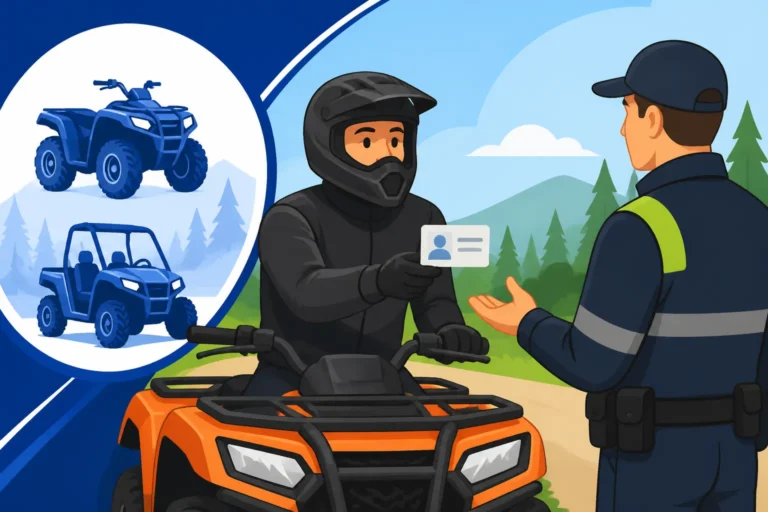
Even on a clearly signed and authorized road stretch, the person operating the off-highway vehicle must meet specific legal requirements. First and foremost, you need a valid driver's license. [Quebec Requires a Driver's Licence Since 2021] for anyone operating an ATV or side-by-side on any public road, including those signed for OHV use. This means a standard car license (Class 5) or equivalent is required. Your trail pass is not a driver's license.
Age requirements are also strictly enforced. [Quebec's Minimum Age of 16 for ATV Riders] applies, and for side-by-sides, the driver must be [Quebec Requires 18 for a Side-by-Side]. These age limits are non-negotiable, even if a parent is supervising or the stretch of road is very short. These rules are in place for safety, recognizing the maturity and experience needed to safely operate these machines, especially when sharing space with road traffic.
So, before you even think about entering a signed road segment, ensure that not only is the segment authorized, but also that you, as the operator, are legally allowed to drive the machine. It’s not just about the machine being on the road, but about the operator meeting the necessary legal qualifications. Any patrol officer will check your licence as well as your machine's compliance.
Helmet and Equipment Requirements When Using Road Sections
Your helmet is not optional, ever, when riding an off-highway vehicle in Quebec, and this absolutely extends to any authorized road stretch. [Quebec Helmet and Visor Rules] mandate that you must wear an approved helmet, securely fastened. Many riders prefer helmets with an integrated visor for comfort and protection, but goggles are also acceptable. The bottom line is your head must be protected.
Beyond your helmet, your machine itself needs to meet certain equipment standards for road use. This includes having functional headlights and taillights, even during the day, for visibility to other road users. Mirrors are also essential; ensuring you have quality, well-adjusted mirrors (accessories from SuperATV are popular for this) allows you to monitor traffic behind you. Your machine should also be in good mechanical order, with working brakes and a properly functioning exhaust system.
Crucially, your machine must be properly registered with the SAAQ, and you must carry proof of registration. Your [Quebec VHR Plates Explained] must be affixed and clearly visible. Furthermore, you must carry proof of [Quebec's Liability Insurance Rule], which mandates a minimum of $1,000,000 in liability coverage for off-highway vehicles. A patrol officer on a signed road stretch will almost certainly ask to see your [Carrying Papers on a Long Ride], so have your driver's license, registration, and insurance readily accessible.
Consequences of Ignoring Signage and Rules
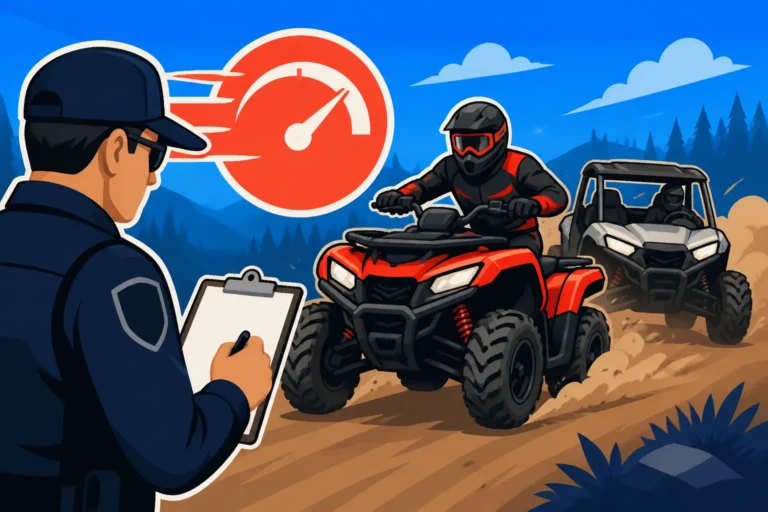
The province of Quebec takes off-highway vehicle regulations seriously, and ignoring authorized signage or other rules on public roads can lead to significant repercussions. Riding on an unsigned road stretch or exceeding the distance permitted by a sign can result in substantial [Quebec Fines for Riding a Public Road]. These aren't minor tickets; they can put a serious dent in your wallet and ruin your riding day.
Beyond monetary fines, there's the possibility of your machine being seized or impounded. This is a far more serious consequence, involving additional fees for towing and storage, not to mention the massive inconvenience of retrieving your quad. Repeated offenses or dangerous driving behavior could lead to even more severe penalties, including suspension of your driving privileges.
To avoid these headaches, the message is clear: respect the signage and adhere to all accompanying rules. Always ensure your [Quebec Plate Placement on a Quad] is correct, and that you have all your necessary paperwork in order. The small effort of checking for a sign and understanding its limitations is infinitely preferable to dealing with the stress and expense of a violation.
Practical Tips for Riding on Signed Road Stretches
Being informed is the first step, but putting that knowledge into practice on the trail is where it truly counts. Here are some practical tips to ensure your rides that include authorized road stretches are always safe, legal, and stress-free.
Always Confirm and Double-Check Signage
The most fundamental piece of advice is to never assume road access. Always, always look for the official, authorized signage before you put a tire on public pavement. If you don't see that specific, government-issued sign, then that road is off-limits. It's better to turn back, find an alternative route, or seek clarification than to risk a fine or, worse, an accident. Trust your eyes, not hearsay.
Before embarking on a ride, especially if you anticipate needing to use road stretches, consult official sources for route planning. Many local clubs, often affiliated with the FQCQ (Fédération Québécoise des Clubs Quads), provide [Quebec Road Signage for Quad Routes] and maps that clearly indicate where authorized road segments exist. The iQuad app is also an invaluable tool for planning your routes and seeing these designations. Taking a few minutes to plan can save hours of frustration or potential penalties.
It's also crucial to remember that signage can change. Municipalities can update their by-laws, and authorized segments can be added, removed, or modified. Even if you've ridden a particular route many times before, it's wise to stay updated and quickly re-confirm any road access. A quick check of a club's website or the iQuad app before you leave can prevent an unwelcome surprise.
Equipping Your Machine for Road Legibility and Safety
When you anticipate even a short stint on a public road, ensuring your machine is highly visible to other traffic is paramount. This means making sure all your factory lighting – headlights, taillights, and brake lights – are fully functional and clean. Consider adding reflective tape to your machine or wearing high-visibility gear, especially if riding in low light conditions. Some riders even add aftermarket turn signals or mirrors from trusted brands like SuperATV to improve their machine's road legality and overall safety profile.
Visibility isn't just about being seen from behind or the front. Good mirrors are critical for monitoring road traffic when you're riding on pavement. Make sure your mirrors are properly adjusted and provide a clear view of what's behind and to the sides of you. Having a horn is also a good idea for alerting other drivers or pedestrians to your presence, although always use it judiciously.
Lastly, ensure your [Quebec Plate Placement on a Quad] is correct and the plate is clean and unobstructed. This makes it easy for law enforcement and other drivers to identify your machine. A legible plate, combined with proper lighting and reflective elements, significantly reduces the risk of being mistaken for an unauthorized vehicle or being involved in an incident.
Staying Informed About Local By-Laws and Updates
While provincial laws establish the overarching framework for off-highway vehicle use, municipalities often have the power to enact specific local by-laws that further define or restrict riding within their jurisdiction. This means that [Quebec Municipalities That Change Riding Hours] or permit extended road access (beyond the standard 1 km) may exist. These local rules can sometimes be more restrictive or, conversely, offer specific permissions not found elsewhere.
To stay truly compliant, it's a good practice to be aware of the by-laws in the specific regions you plan to ride. Information can often be found on municipal websites, local tourism office sites, or by contacting the regional ATV club. These clubs are usually well-versed in local regulations and can be an excellent resource for riders. Many [Quebec Road Signage for Quad Routes] maps will also incorporate these local details.
Remember, ignorance of a by-law is not a valid defense if you're stopped by a patrol officer. Taking the time to educate yourself on the specific rules of an area—even a quick phone call or website visit before you trailer your machine—is a small investment that can save you from a significant fine and a lot of frustration.
Authorized Road Stretch Considerations
To help you keep track of the distinctions, here's a quick comparison of what to expect when riding on an officially signed road stretch versus an unsigned public road.
| Feature | Officially Signed Road Stretch | Unsigned Public Road |
|---|---|---|
| Legal Status | Permitted for off-highway vehicles under specific conditions | Prohibited for off-highway vehicles |
| Signage | Clear, official road signs (VTT/VHR Autorisé, distance, etc.) | No official signs granting OHV access |
| Typical Distance | Often 1 km (or more if explicitly signed by municipality) | N/A (any distance is illegal) |
| Purpose | Connecting trails, accessing services, reaching lodging | Not intended for OHV use |
| Required Paperwork | Driver's license, registration, proof of insurance (all carried) | Driver's license, registration, proof of insurance (all carried, but riding is still illegal) |
| Minimum Age | ATV: 16, Side-by-Side: 18 | ATV: 16, Side-by-Side: 18 (but riding is still illegal) |
| Helmet Requirement | Mandatory | Mandatory (but riding is still illegal) |
| Risk of Fine/Impoundment | Low (if all rules followed) | High |
| Safety Concerns | Shared with road traffic, requires vigilance | High risk of collision with road traffic |
Disclaimer
This article is for general informational purposes only and does not constitute professional advice. Laws, prices and regulations vary by location and change over time. Consult a qualified professional for guidance on your specific situation.