Riding a Shared Winter Trail
A winter ride can feel very different when a narrow Quebec trail is shared with fast-moving snowmobiles, groomers, and other ATV or side-by-side riders. The safest approach is to confirm that the route is open to your machine, prepare for changing snow and visibility, and know how to pass, yield, and cross roads without assuming every snowmobile trail is also an ATV trail.
Confirm the trail is open to ATVs
Shared does not mean every trail is open
A trail used by snowmobiles is not automatically available to ATVs. Access depends on the route, the local club’s permissions, posted signs, and current conditions. A corridor might allow both types of machine on one section but restrict ATVs on another. It may also close temporarily because of weather, maintenance, a landowner issue, or a seasonal restriction.
Before leaving home, check a current trail map and the local club’s updates. Look for wording or symbols that specifically show ATV access, not just a general winter-trail label. If a route is unclear, contact the club rather than relying on an old screenshot or a rider’s recollection from last season. [Quebec Winter Trails Shared With Snowmobiles] explains why shared access needs to be checked rather than assumed.
That extra check matters when you are hauling machines to a trailhead outside a town such as Saint-Raymond, Mont-Laurier, or La Tuque. Finding a trail closed to ATVs after unloading is frustrating, but carrying on anyway can create a more serious problem: you may be trespassing, damaging the trail surface, or putting future access at risk.
Check the conditions again on ride day
A trail that was open yesterday may be unsuitable today. Fresh snow can hide ruts, ice, branches, water, and damaged culverts. A thaw followed by a hard freeze can leave a corridor uneven and slick, while wind can reduce visibility or push drifting snow across the track. Grooming work can also mean a section is temporarily occupied or altered.
Check local trail-condition information before setting off, and pay attention to notices at the trailhead. [Quebec Trail Conditions Before You Go] is a useful companion when deciding whether the route is appropriate for your machine and group. A map helps with route planning; it does not replace a same-day conditions check.
If a trail is posted closed, turn around. Avoid riding around a barrier or onto the soft shoulder to get past a closure. That can widen the damaged area and create a hazard for the next rider or the person maintaining the trail. Respecting a closure is part of keeping shared access available.
Prepare your ATV or side-by-side for winter
Make the machine visible and easy to control
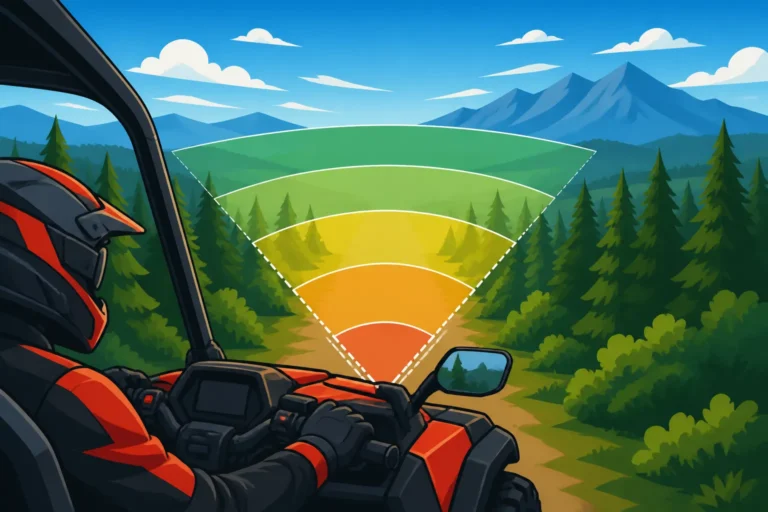
Winter trail riding reduces contrast. A dark machine can blend into trees and snow shadows, and snow kicked up by the vehicle ahead can make it harder to judge distance. Check that lights work, lenses are clean, and the machine is easy to identify from both the front and rear. Keep any plate, required equipment, and visibility features unobstructed.
Cold weather can also affect starting, battery performance, tire pressure, and how the machine responds to the controls. Do a basic inspection before you leave: check the brakes, steering, throttle return, tires or tracks, and the condition of belts and fluids according to the owner’s manual. Carry a small repair kit and a way to contact help where service is available. On a remote route, a minor mechanical issue can turn into a long wait in the cold.
If you are considering aftermarket windshields, handguards, or other cold-weather accessories, brands such as SuperATV may appear in your research. Treat any accessory as a fit-and-safety decision, not an automatic upgrade. Confirm compatibility with your exact machine, and make sure the accessory does not block lights, mirrors, controls, or your view of the trail. A windshield that protects from wind but fogs over or limits sightlines can make riding less safe.
Dress for the stop, not just the ride
Wind chill can become a problem quickly when a group stops to regroup, deal with a stuck machine, or wait for a trail groomer. Dress in layers that can be adjusted, and protect your hands, feet, neck, and face. Keep spare gloves and dry layers in a sealed bag. A phone battery may drain faster in the cold, so carry it somewhere warm and bring a backup power option if you depend on it for navigation or communication.
Wear a helmet that meets the applicable requirements and suits the conditions. A visor can help keep wind and snow off your face, while goggles may be more practical for some riders or machines. Either way, you need a clear view without fogged lenses or snow-covered eye protection. Review [Quebec Helmet and Visor Rules] before the ride, particularly if you are unsure whether your helmet setup meets the rules for the route.
Cab accessories and hand protection can make a long winter ride more comfortable, but they do not replace proper clothing or safe riding. If you compare options from a supplier such as SuperATV, check whether the accessory affects access to the brake, throttle, mirrors, or seat belts. Comfort is useful; being able to see, steer, and stop reliably is essential.
Ride predictably around snowmobiles and other users
Keep right, manage speed, and leave room
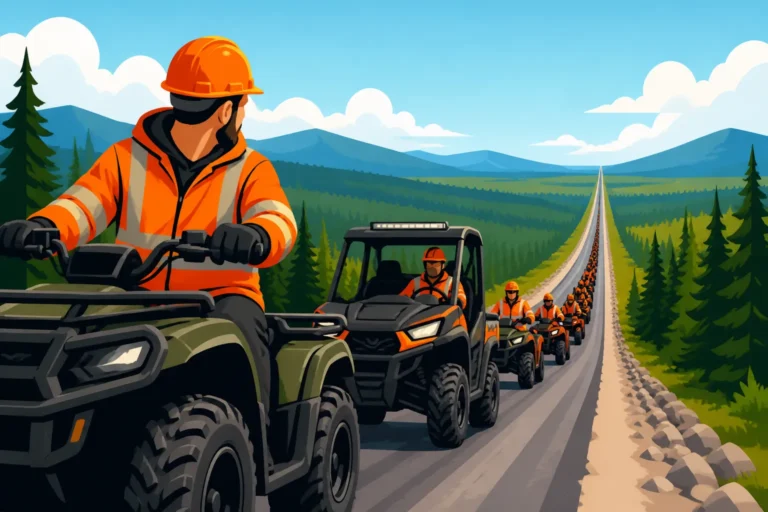
A shared trail is not a place to assume that every other user can see you or stop quickly. Ride at a speed that lets you respond to the surface, sightlines, and traffic. Slow down before blind corners, narrow bridges, trail intersections, and steep or icy sections. Leave enough space behind the machine in front to stop without sliding into it if the trail suddenly narrows.
Stay on the travelled portion of the trail unless signs or local direction say otherwise. The edge may look like firm snow but can conceal a ditch, soft shoulder, or drop-off. Avoid sudden swerves to dodge ruts or snowbanks, especially when another machine is approaching. [Quebec Trail Etiquette Locals Expect] offers useful context for sharing a corridor without creating avoidable conflict.
Passing should be deliberate, not a contest. If you come up behind a slower machine, wait for a clear, wide section and make sure the other rider knows you are there. Do not pass near a crest, sharp bend, bridge, or place where oncoming traffic might appear. If the trail is too narrow for a safe pass, stay back until there is room.
| Situation | Safer response |
|---|---|
| A snowmobile approaches on a narrow trail | Slow down, hold a predictable line, and create space where possible |
| You catch up to a slower ATV | Wait for a clear, wide section before passing |
| Visibility drops in blowing snow | Reduce speed and increase following distance |
| You see a groomer or maintenance vehicle | Slow down, follow posted directions, and give the operator room |
| The trail surface looks soft or damaged | Avoid the edge and follow local closure or detour instructions |
Meet oncoming traffic with extra caution
When you meet a snowmobile head-on, avoid abrupt movements. Reduce speed early, stay predictable, and use the available width without forcing the other rider toward a bank or ditch. On a narrow corridor, one rider may need to stop or move to a safe, firm place so both machines can pass. Do not assume a snowmobile can brake or turn sharply on packed snow.
A snowmobile may approach faster than you expect, especially where a straight section opens up. Keep a lookout well ahead, use lights as required, and avoid stopping in a blind spot. If you are travelling as a group, leave room between machines so each rider can respond individually instead of bunching up at a corner.
For more on that specific situation, see [Meeting a Snowmobile Head On] and [Yielding on a Narrow Quebec Corridor]. The practical rule is simple: make your movement easy to understand. A sudden stop or last-second move across the trail can surprise the other rider and turn a routine meeting into a collision.
Understand the legal and practical details before you go
Trail access is separate from road access
A trail pass, registration, insurance, and permission to use a trail are not interchangeable. A machine may be registered and insured but still lack permission to use a particular trail. Likewise, having access to an authorized trail does not automatically make it legal to ride along a public road to reach it.
Check the trail organization’s requirements and carry the documents or proof that apply to your ride. [Quebec Trail Pass Proof on the Trail] and [Quebec Liability Insurance Rule] can help clarify what riders may need to have available. If you are travelling with a rented machine, ask the operator which documents and trail permissions are included and what remains your responsibility.
Road crossings deserve their own attention. Follow posted signs and use only authorized crossings or road sections. Do not treat a road shoulder as a convenient connector just because a snow-covered trail appears to lead that way. For the wider rules around public roads, read [Quebec ATV Road Rules Under the LVHR]. Local restrictions can affect which roads or sections are open, so check the signs and applicable municipal rules on the route.
Plan the route around people, daylight, and breakdowns
Choose a route that fits the least experienced rider in your group and the conditions you expect. A long loop that feels manageable in summer may become tiring in deep snow, cold wind, or low light. Share your plan with someone who is not riding, including your intended route and expected return. Agree on a regrouping point before you start, and decide what the group will do if a machine becomes disabled.
Carry enough warm clothing, food, water, basic tools, and emergency supplies for an unplanned stop. Keep the group together without crowding. If someone falls behind, stop in a visible, safe location rather than continuing until the group is widely separated. Make sure every rider knows how to signal a problem and where the group will wait if separated.
Accessories can help solve specific comfort or protection problems, but assess them against the route. If you are comparing a windshield or handguard from SuperATV with other options, consider whether it suits your machine, riding position, and cold-weather use. A product that works well on a broad trail may be inconvenient on a tight corridor or difficult to adjust with winter gloves. Choose equipment that supports safe operation instead of distracting from it.
Winter riding should feel rewarding, not like a test of who can push through the worst conditions. Confirm the route is open to ATVs, check the trail report again, prepare for cold and reduced visibility, and give other users predictable space. If conditions or access are uncertain, choosing a different route—or postponing the ride—is often the best decision.
Disclaimer
This article is for general informational purposes only and does not constitute professional advice. Laws, prices and regulations vary by location and change over time. Consult a qualified professional for guidance on your specific situation.