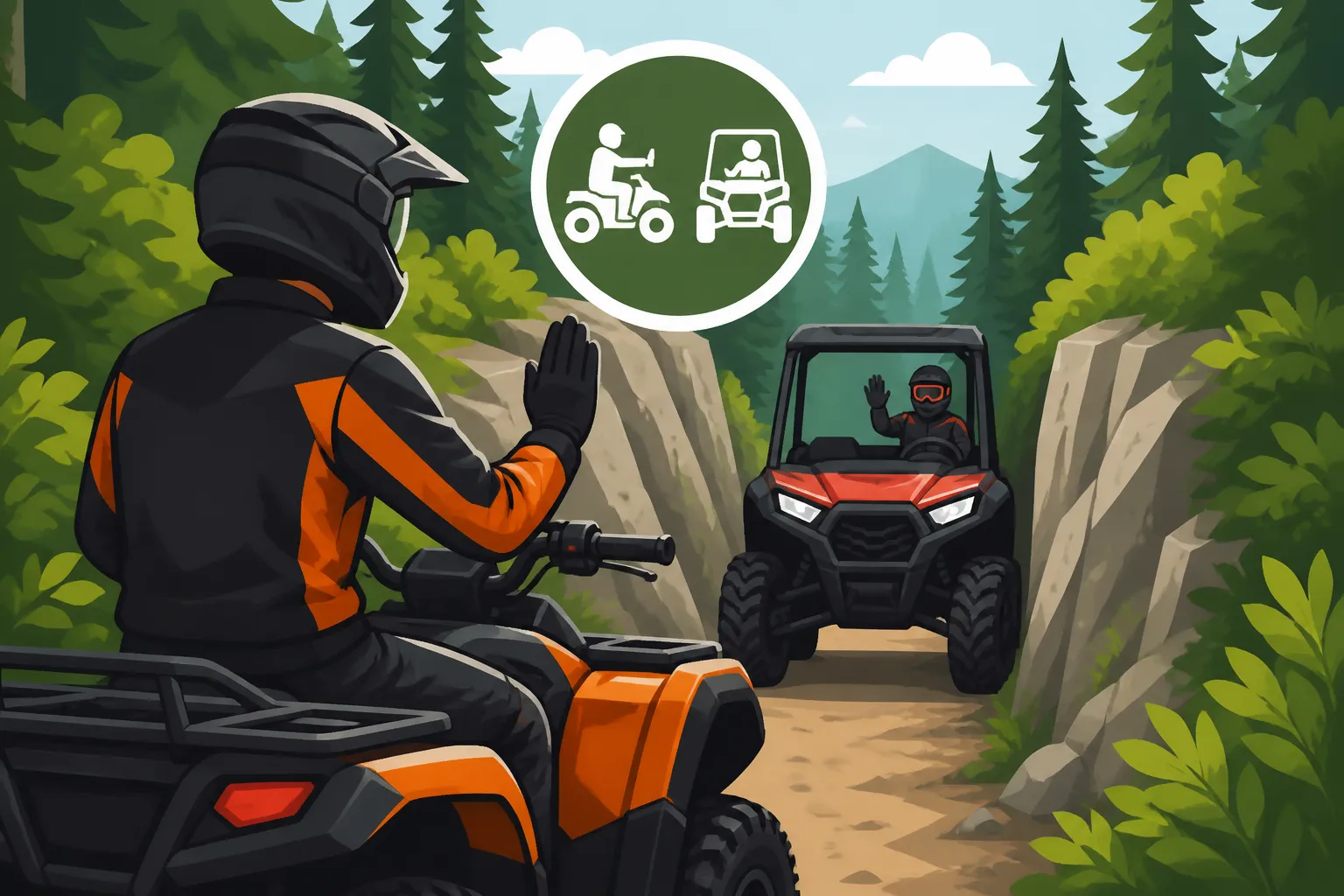
Yielding on a Narrow Quebec Corridor
A narrow Quebec trail can turn an ordinary ride into an awkward standoff: two machines meet around a blind bend, there’s barely room to pass, and neither rider is sure who should move. This guide explains how to yield calmly, protect people and equipment, and handle tight corridors without assuming that trail etiquette is the same as road law.
What yielding means on a narrow Quebec corridor
Treat a meeting as a shared-space problem
On a narrow corridor, the goal is not to prove who has priority. It is to avoid a collision while leaving the trail, its edges, and nearby land undamaged. Slow down as soon as you see another machine, make eye contact if you can, and communicate with a clear hand signal or a brief verbal exchange. If there is room for only one machine to move safely, agree on who will do it before either rider starts reversing or edging aside.
A corridor may be narrow because it follows a forest road, cuts through a wooded section, crosses a bridge, or squeezes between a ditch and a bank. In places such as the Laurentians or Charlevoix, a route can change from a broad gravel stretch to a tight wooded passage within a short distance. A rider who approaches every section at the same speed may not have enough time to stop when another quad or side-by-side appears.
Yielding does not mean driving onto any open ground that looks convenient. Trail edges can conceal soft shoulders, drainage ditches, roots, rocks, or private property. A machine that slips off the packed surface may get stuck, damage the corridor, or put its occupants at risk. If there is no safe passing space, stop where you are visible and coordinate instead of forcing a pass.
For broader context on the shared etiquette expected on Quebec routes, see [Quebec Trail Etiquette Locals Expect] and [Sharing a Federated Corridor With Snowmobiles]. The same basic courtesy applies whether you meet another ATV, a side-by-side, a snowmobile on a shared route, or a trail-maintenance vehicle.
Do not assume there is one universal right of way
A corridor can have signs, markings, barriers, or local instructions that affect how riders should proceed. Follow those directions and any instruction from an authorized patrol or trail representative. Where no clear sign or direction settles the situation, use a cautious, cooperative approach rather than assuming that the larger machine, faster rider, or uphill rider automatically has priority.
Riders sometimes arrive at a tight section from opposite directions and both believe the other should back up. In practice, the safest choice often depends on the ground immediately around each machine. One rider may be close to a wider turnout; the other may be on a slope with a poor view behind. Pause, assess the surroundings, and decide together who can move to a safer place with the least risk.
A simple signal can prevent a confusing exchange. Point toward a safe pull-off, then wait for the other rider to acknowledge. If you cannot hear each other over engines, keep your movements slow and predictable. Avoid waving someone forward while you are still changing position or while your machine is partly in their path.
How to pass safely when there is room
Slow down early and choose a visible place
Reduce speed before the corridor becomes tight, especially near bends, crests, bridges, wooded pinch points, and places where brush blocks the view. A narrow trail can hide an approaching rider until the last moment. Keeping a speed that lets you stop within the visible distance gives both riders time to make a calm decision.
If a safe passing area is close, one rider can move onto the wider section while the other waits on the main line. Choose firm, level ground where the machine will remain stable. Do not pull into a ditch, onto a steep side slope, across a trail marker, or into vegetation simply because there appears to be extra space. If the corridor is shared with other trail users, leave enough room for them to pass as well.
Once both machines are stationary, confirm which rider will move first. Keep a generous gap between handlebars, mirrors, tires, and bodywork. Then pass slowly, without revving hard or making a sharp turn. Dust, mud, loose gravel, and snow can reduce visibility or traction, so a pass that seems easy in dry conditions may need extra space when the surface is slick.
| Situation | Safer response | Avoid |
|---|---|---|
| You see an approaching machine on a straight, narrow stretch | Slow down, stop in a visible place if needed, and agree on who will move | Continuing at speed while expecting the other rider to make room |
| A wider turnout is nearby | Use it only if the surface is firm and the turnout is safe to enter and leave | Pulling onto an unstable shoulder or damaging vegetation |
| The meeting point is on a blind bend | Stop before the bend if possible and communicate before proceeding | Passing at the blind point or creeping around without a clear view |
| One machine is on a steep or soft edge | Let the rider in the safer position assess whether moving is practical | Pressuring the other rider to back toward a hazard |
| A groomer or maintenance vehicle approaches | Stop well clear when safe and follow any directions given | Trying to squeeze past while the vehicle is working |
Keep a predictable line and leave room
When you pass, move only as far as the safe surface allows. A rider who makes a sudden turn toward the edge can surprise the person coming the other way. Make your intention visible, keep your speed low, and avoid stopping with a tire hanging over a drop or rut. If you need to reposition, do so deliberately and only after the other rider has seen what you are doing.
Accessories such as mirrors can help you check behind before reversing or repositioning, but they do not replace a direct look around the machine. SuperATV is one example of an aftermarket brand riders may encounter when looking at mirrors or other ATV and UTV accessories. Before adding any accessory, confirm that it fits the machine and does not obstruct the rider’s view or interfere with safe control.
SuperATV accessories do not resolve a poor passing decision by themselves. A mirror may help you notice a machine behind you, but it cannot show every blind spot, and it does not make a narrow shoulder stable. Check your surroundings directly, use a spotter when appropriate, and move only when you can see that the route is clear.
For another practical perspective on blind sections, see [Passing Safely on a Blind Corner]. When you reach an especially tight or exposed passage, it may be safer to stop at a wider point and wait than to attempt a pass that depends on perfect timing.
What to do at a blind bend, bridge, or steep section
Stop before the pinch point when you can
If you see a bend, bridge, or steep cut where two machines may not fit, approach slowly enough to stop before entering it. Use headlights as appropriate for visibility, but do not treat lights as a substitute for a clear view. On a blind bend, the other rider may already be partway through the turn and unable to see you.
If you are first at the obstacle, pause in a place where an approaching rider can see you without having to enter the narrow section. Avoid stopping directly at the crest of a hill or in the middle of a turn. If you are travelling with a group, make sure the riders behind you know you have stopped; otherwise, they may continue forward and crowd the meeting point.
On a bridge or narrow crossing, wait until the other machine has fully cleared the constrained area before proceeding. Do not assume that there is enough room to squeeze alongside it. A tire slipping off a bridge edge or onto a raised lip can have serious consequences, particularly with a passenger aboard or a loaded cargo rack.
Useful preparation includes reading route information, observing trail signs, and keeping your group together enough to share warnings. [Quebec Trail Conditions Before You Go] can help riders think ahead about the condition of a route, while [Quebec Trail Signage Colours in Quebec] is useful background for understanding the markings riders may encounter. Conditions and access can vary, so check the route details before setting out rather than relying on a memory from a previous ride.
Handle reversing and group rides carefully
Backing up on a narrow or uneven corridor can be harder than it looks. A passenger, cargo, a steep grade, deep ruts, or poor visibility can make it difficult to steer and judge distance. Before reversing, check behind the machine directly. If another rider offers to spot you, agree on simple signals and make sure the spotter stays out of the machine’s path.
Do not ask a passenger to step into traffic or stand between two machines to guide a pass. If the passenger needs to get off, choose a stable place away from moving machines and make sure they are visible. Keep children and other bystanders well clear of the manoeuvre. A group ride can feel crowded quickly when several machines stop on a narrow section, so leave space between riders and avoid bunching up at the obstacle.
When a group meets another group, have one lead rider communicate with the other group’s lead rider. Decide which group will move to a safe turnout, then let the machines pass in an orderly way. Avoid having everyone move at once; several machines shifting position together can create confusion and increase the chance of a collision.
Etiquette, equipment, and the difference between trails and roads
Keep the corridor passable for everyone
Yielding is also about what happens after the machines pass. Do not leave a vehicle parked across the trail, block a gate, or stop in a spot where another rider cannot see around you. If you need to adjust gear, check a map, or wait for someone in your group, move to a safe, wider area first.
Respect trail edges, signs, private property, and barriers. If a corridor is muddy or soft, do not widen it by driving around a puddle through the vegetation. Riding around obstacles can damage the trail and create a wider, less stable surface for everyone. If the trail appears blocked by a fallen branch or another hazard, do not take an unauthorized detour. Report the issue through the appropriate club or trail contact when practical.
Quiet, considerate riding matters especially near cottages and communities. A sudden burst of throttle or repeated revving while two machines negotiate a pass can disturb nearby residents and make conversation harder. Keep engines at a controlled speed and give other trail users room to stop, signal, and move.
Some riders equip their machines with mirrors, lights, or other accessories from brands such as SuperATV. Treat add-ons as part of a broader safety setup, not as permission to ride faster or closer to the edge. Check that equipment is secure before the trip, and make sure it does not interfere with the machine’s controls, visibility, or the rider’s ability to communicate.
Do not confuse trail courtesy with permission to use a road
A narrow trail corridor and a public road are not interchangeable. Trail etiquette helps riders share space; it does not grant permission to ride along a road or shoulder where access is restricted. Quebec road access for off-highway vehicles depends on applicable rules, signs, and local authorizations. Before using a road segment, confirm that it is permitted and follow the posted directions.
If your route includes a road crossing, stop and use the designated crossing procedure and signage. Do not treat a narrow roadway shoulder as a convenient passing lane, and do not assume that an oncoming road vehicle will yield because you are on an ATV. The guide [Quebec ATV Road Rules Under the LVHR] offers related background, and [Quebec Road Signage for Quad Routes] is relevant when checking authorized road sections.
A roadside encounter can be more demanding than a trail meeting because vehicles may approach faster and have less room to avoid a machine. Stay out of the roadway unless the route and rules allow you to be there. If you are unsure whether a road segment is authorized, stop in a safe location and verify the route rather than guessing.
A courteous yield is usually straightforward: slow down, make yourself visible, find stable ground, communicate clearly, and move only when both riders understand the plan. On a tight corridor, taking an extra moment is not wasted time. It is often the simplest way to keep a small inconvenience from becoming a damaged machine, an injured rider, or a conflict with other trail users.
Disclaimer
This article is for general informational purposes only and does not constitute professional advice. Laws, prices and regulations vary by location and change over time. Consult a qualified professional for guidance on your specific situation.