50 Metres of Sightline at 30 km/h
It’s a common scenario out on the Quebec trails: you're enjoying a fantastic ride, the scenery is amazing, and suddenly you see a sign indicating a public road crossing ahead. Many riders get a little anxious at these moments, and for good reason. Navigating these crossings safely and legally, especially when you need to assess your sightlines at a specific speed like 30 km/h, can feel like a real challenge. This guide will walk you through exactly what Quebec’s 50-metre sightline rule means when you’re approaching a road at 30 km/h, why it's so important, and how you can ensure you’re always riding safely and within the law.
Understanding Quebec's Sightline Rules for ATVs
Riding an ATV or UTV in Quebec offers an incredible sense of freedom, but that freedom comes with a significant responsibility, especially when off-road machines interact with public roads. The rules around road crossings are in place for everyone's safety, and misunderstanding them can lead to dangerous situations and hefty fines.
Why Sightlines Are Critical for Off-Road Machines
Think about it: when you're on a trail, you're often navigating winding paths, dense forests, and uneven terrain. Your focus is on the trail immediately ahead, and your speed is generally lower than road traffic. Suddenly transitioning from this environment to a paved road, where cars might be traveling at 90 km/h or more, creates a stark contrast in conditions and speeds.
ATVs and UTVs are also designed differently from cars. They often have a higher centre of gravity, can be narrower, and sometimes have different blind spots depending on your seating position and machine type. This makes a clear view of approaching traffic absolutely paramount. Limited visibility, whether due to a blind corner, dense vegetation, or even parked vehicles, drastically increases the risk of a collision. For this reason, Quebec's [Off-Highway Vehicle Act and Your Papers] has very specific stipulations to protect riders and other road users.
The 50-Metre Rule at 30 km/h Explained
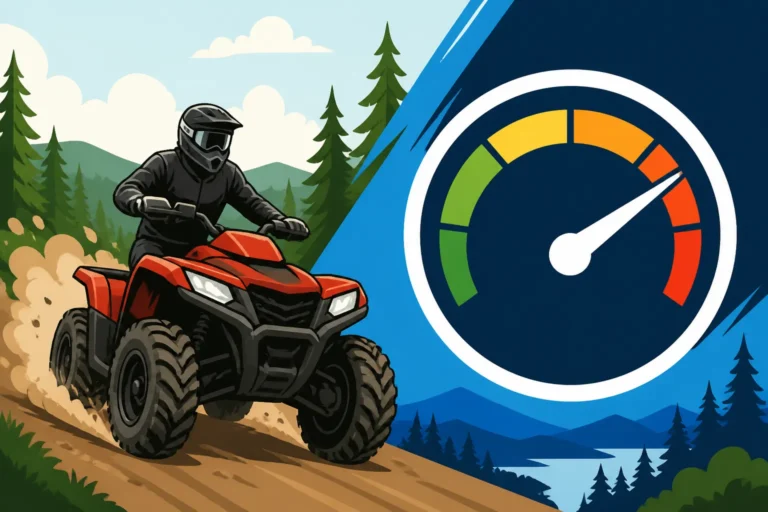
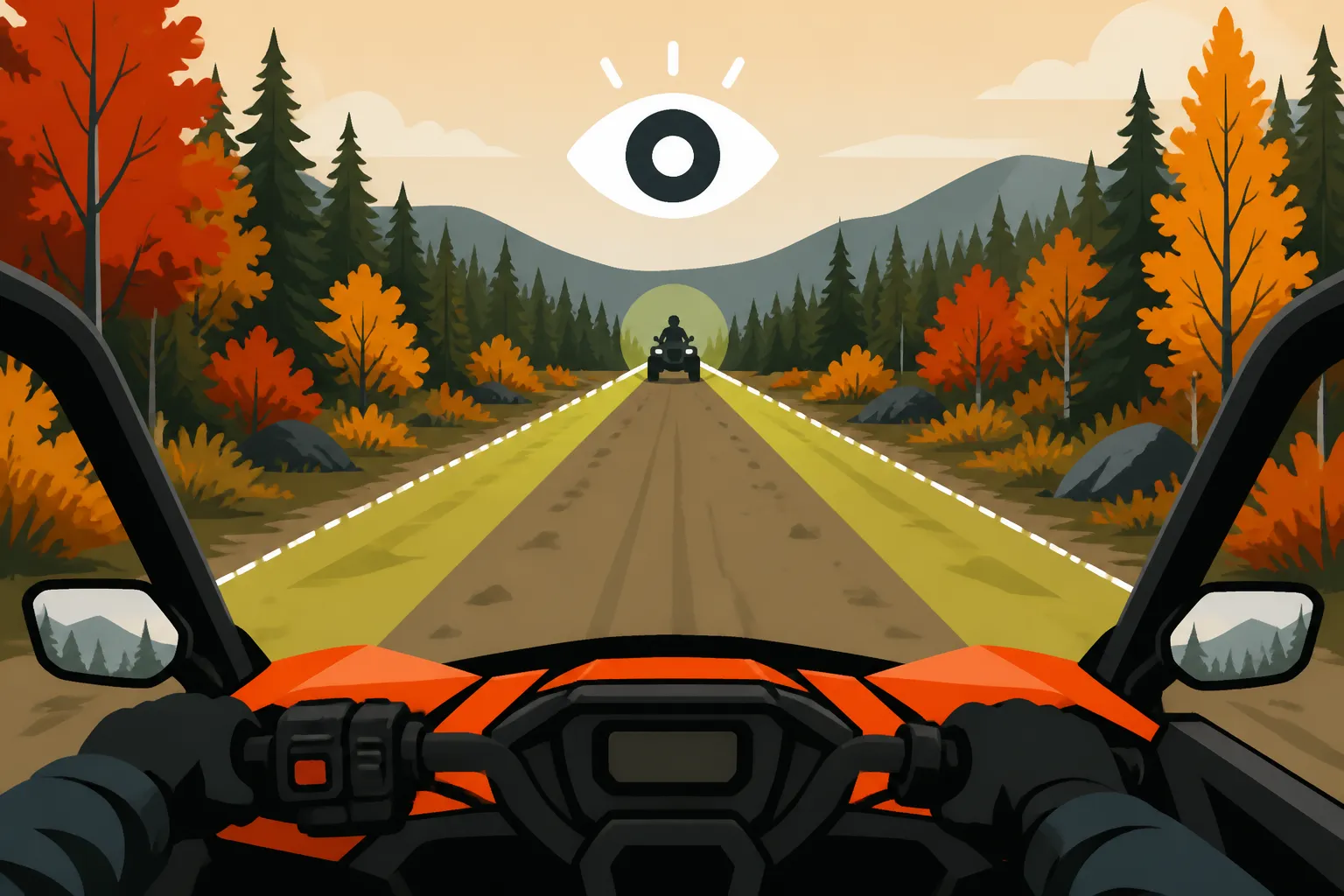
So, what exactly does "50 metres of sightline at 30 km/h" mean in the real world? It's pretty straightforward, but crucial to grasp. When you're approaching a public road crossing on your quad, if the speed limit of the road you are crossing is 30 km/h or less, you need to have an unobstructed view of at least 50 metres in both directions of that road. This means you must be able to see any approaching vehicle, and they must be able to see you, for at least 50 metres down the road in either direction from your crossing point.
The "30 km/h" part refers to the speed limit of the road you are crossing, not your speed on the trail. While you should always slow down significantly (and often come to a complete stop) before entering a public road, the sightline requirement is directly tied to the potential speed of other vehicles on that road. These are often quieter, residential roads or minor access routes where traffic moves at a slower pace. The logic is simple: slower road traffic gives both you and the driver more time to react if there's an issue. However, even at 30 km/h, a collision can be serious, which is why that 50-metre clear view is non-negotiable.
The Broader Context of Crossing Public Roads
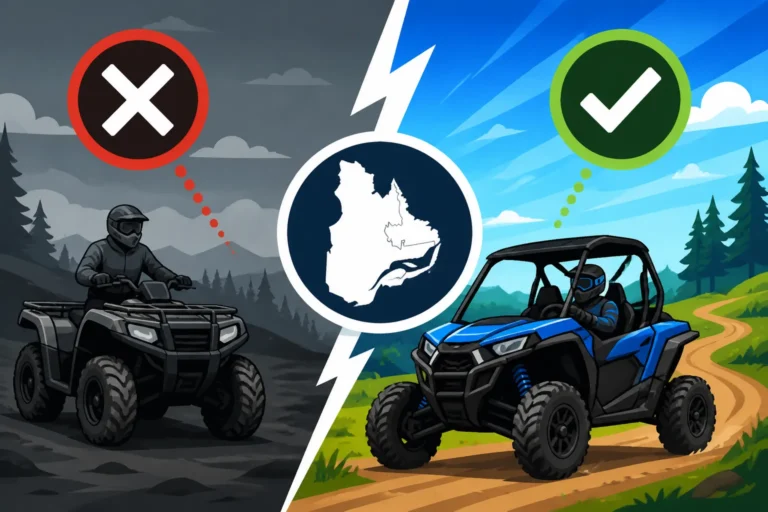
The 50-metre rule for 30 km/h roads is just one piece of a larger puzzle when it comes to [Quebec ATV Road Rules Under the LVHR]. Quebec's regulations are quite clear about how and when off-road vehicles can interact with public roads. Generally, ATVs are not permitted to ride on public roads, with very specific exceptions. These exceptions typically include:
- Designated Crossings: Where an authorized trail explicitly crosses a road.
- Short Access Sections: For limited distances (often up to 1 kilometre) to connect two trails or access services like fuel or lodging, provided the municipality has designated it and put up proper signage. You can read more about this in [Quebec Municipal Road Access Up to 1 Kilometre].
- Specific Road Types: Certain forest roads or private roads may have different rules, but federated trails crossing public roads are the main concern here.
For higher speed roads, the sightline requirements increase dramatically. For example, if you're crossing a road with a 50 km/h limit, you'll need 100 metres of sightline. On a road with a 90 km/h limit, it jumps to a full 200 metres. This is why understanding [Quebec Crossing Sightline Distances] is so vital for every rider. Always assume traffic on the road has the right-of-way, and your responsibility is to ensure the crossing is completely safe before proceeding.
Practical Application: How to Gauge 50 Metres on the Trail
Knowing the rule is one thing, but actually applying it out on a muddy trail or in a dense forest can feel like a guessing game. Estimating distances accurately is a skill that comes with practice, but there are some helpful techniques to make sure you're getting it right.
Visual Cues and Estimation Techniques
Fifty metres might not sound like much, but it's longer than you think, especially when you're sitting on a quad looking down a road. Here are some ways to help you visualize and estimate:
- Length of a Standard Tractor-Trailer: A typical tractor-trailer unit is about 15-20 metres long. So, 50 metres is roughly 2.5 to 3 of these units.
- Hydro Poles: The distance between hydro poles can vary, but in many rural areas, they are spaced roughly 40-60 metres apart. If you see two poles down the road, you're likely in the ballpark. However, this isn't a precise measure and can differ by region.
- Building Sizes: Think about common building sizes. A small house might be 10-15 metres wide. You'd need a clear view past at least three or four of them.
- Your Own Machine: Know the length of your ATV or side-by-side. If your machine is, say, 2.5 metres long, then 50 metres is equivalent to twenty times its length. This is a tough one to eyeball quickly, but helpful for initial mental calibration.
The key is to train your eye. When you're walking around, try to pick out objects and guess the 50-metre mark, then pace it out to check your accuracy. Over time, you'll develop a better intuitive sense of this distance.
Factors That Obscure Sightlines
It's not just about a straight line; many things can drastically reduce your effective sightline, turning what looks like a clear path into a dangerous blind spot.
- Dense Vegetation: Trees, shrubs, tall crops, and even thick snowbanks can block your view of an approaching vehicle. This is especially problematic in summer and fall when foliage is at its fullest.
- Topography: Hills, dips, or sharp curves in the road can hide vehicles until they are very close. A slight rise might give you a false sense of security.
- Structures: Buildings, fences, or large signs near the intersection can be significant obstructions.
- Parked Vehicles: A truck or car parked just around a corner or near the crossing point can obscure your view, forcing you to move further into the road to see.
- Weather Conditions: Fog, heavy rain, or even low sun glare can reduce visibility for both you and oncoming drivers, making an already tricky crossing even more hazardous.
Always approach any road crossing with extreme caution, slowing down well in advance. And remember, the 50-metre rule is about unobstructed sightline. If any of these factors block your view, you need to find a way to gain that clear sightline, which often means stopping further back and creeping forward slowly.
The Importance of a Full Stop and Look
Even if you're confident you have a 50-metre sightline, the safest approach is always to come to a complete stop before entering the public road. This isn't just a suggestion; it’s often an implied expectation for off-road vehicles transitioning to a road, even if not explicitly marked with a stop sign on the trail.
A full stop allows you to:
- Look in both directions: Take your time. Scan left, then right, then left again. Check for traffic, pedestrians, cyclists – anything that might be approaching.
- Listen for traffic: Sometimes, you'll hear a vehicle before you see it, especially around blind corners or over hills.
- Assess road conditions: Is the pavement wet? Are there potholes? Is there loose gravel at the edge that could affect your traction?
- Signal your intentions (if in a group): If you're riding with others, a clear stop indicates to them what you're doing, and allows you to communicate if the path is clear.
Rushing a crossing, even on a seemingly quiet road, is simply not worth the risk. Take that extra moment. It could save your life or prevent a serious accident. For more on safe riding, consider the general principles in [Quebec ATV Age Requirements] and [Quebec Helmet and Visor Rules], which all contribute to overall safety on and off the trails.
Consequences of Failing to Meet Sightline Requirements
Ignoring the sightline rules isn't just about bending a minor regulation; it has serious implications, ranging from immediate safety risks to potential legal and financial headaches.
Safety Risks and Accident Prevention
The most critical consequence of failing to meet sightline requirements is, without a doubt, the heightened risk of a collision. Imagine this scenario: You're approaching a crossing on a rural road that you assume has a 30 km/h limit. You glance quickly, don't see anything, and start to cross. Suddenly, a pick-up truck comes over a rise you didn't account for, traveling at 50 km/h. You both react, but it's too late. Even at those speeds, a collision between a large vehicle and an ATV or UTV can be devastating.
Unlike in a car, where you're often surrounded by a protective cage of steel, on most ATVs or open-cab UTVs, you're far more exposed. Injuries can be severe, potentially life-altering, or even fatal. Adhering to the sightline rule is a direct measure to prevent these kinds of catastrophic outcomes. It's not just about protecting yourself; it's also about protecting the occupants of the other vehicle and avoiding putting them in a traumatic situation. Every rider has a responsibility to minimize risk at these critical intersections.
Penalties and Fines for Non-Compliance
Quebec takes its off-road vehicle laws seriously, and for good reason. Violations of the [Quebec ATV Road Rules Under the LVHR], including improper road crossings or failure to yield, can result in significant fines. While specific amounts can change, you could be looking at fines that are substantial, especially when combined with administrative fees and other penalties. For example, general [Quebec Road Riding Fines From $350] can apply if you're found to be improperly on a road.
Beyond monetary penalties, a traffic violation on your ATV could lead to demerit points on your driver's license, affecting your insurance premiums for your car or truck as well. A serious incident could even result in the suspension of your driving privileges. Patrol officers, whether from the Sûreté du Québec or local municipal police, and even trail club wardens, have the authority to enforce these rules. They understand the importance of these safety regulations and are trained to spot non-compliance. When they stop you, they will likely ask to see your driver's license and registration, as detailed in [What a Patrol Can Ask to See].
Impact on Insurance and Liability
This is where things can get particularly complicated and costly. Every ATV and UTV registered in Quebec must carry [Quebec's Liability Insurance Rule], with a minimum coverage of $1 million. This insurance is designed to protect you financially if you're found at fault for an accident involving property damage or bodily injury to others.
However, if you're involved in an accident and it's determined that you were violating the Off-Highway Vehicle Act – for example, by failing to ensure a proper sightline before crossing a road – your insurance company might deny coverage or refuse to pay for damages. This means you could be personally responsible for hundreds of thousands, or even millions, of dollars in medical bills, property repairs, and legal fees.
Consider the ripple effect: a collision, an investigation that reveals non-compliance, insurance denial, and then a lawsuit. This can wipe out your savings, put your assets at risk, and create a financial burden that lasts for years. The minimal effort it takes to ensure a 50-metre sightline, or to stop completely and assess, is a tiny price to pay compared to the potential financial ruin of an accident where you are deemed negligent. Always protect yourself and your assets by strictly following the rules.
Enhancing Visibility and Safety: Beyond the 50-Metre Rule
While the 50-metre sightline rule is a crucial legal requirement, smart riders understand that safety on trails and roads is an ongoing commitment that goes beyond mere compliance. It involves proactive measures, good habits, and sometimes, even upgrading your machine.
Machine Setup for Improved Road Visibility
Your ATV or UTV comes from the factory with certain safety features, but there's often room for enhancement, especially when considering road interactions.
- Mirrors: Ensure your machine has robust, well-adjusted mirrors. While factory mirrors are a start, some riders opt for aftermarket solutions from brands like SuperATV for increased durability or a wider field of view. Having a clear view behind and to the sides is invaluable when trying to establish that critical 50-metre sightline, and for knowing what's approaching on the road once you've crossed.
- Lighting: Always ensure your headlights and taillights are clean and fully functional. Even during the day, running your lights can make you more visible to oncoming road traffic, particularly in shaded areas or during overcast weather. If you frequently ride in conditions with reduced visibility, considering auxiliary lighting can also be a smart move.
- Flags/Whips: In some jurisdictions or specific riding environments (like dunes), a safety flag on a whip antenna is mandatory. While not a universal requirement for Quebec road crossings, a brightly colored flag can significantly increase your vertical profile, making you more visible to drivers of larger vehicles, especially if there's a slight dip in the terrain.
- Horn: A loud, functioning horn is essential. It's not just for signaling to other trail riders; it's a critical safety device for alerting inattentive road users if you find yourself in a tricky spot.
These aren't just "nice-to-haves"; they are fundamental tools that contribute to your ability to safely interact with public infrastructure.
Rider Habits and Defensive Riding
Ultimately, the most important safety equipment is between your ears. Developing good riding habits and adopting a defensive mindset will serve you better than any piece of gear.
- Anticipate: Always be looking ahead on the trail for signs of upcoming road crossings. Don't wait until you're right at the edge of the asphalt to start assessing the situation.
- Slow Down Early: As soon as you see a road crossing sign, begin to reduce your speed. This gives you more time to react, to spot potential hazards, and to make a full stop if necessary.
- Scan Aggressively: When you stop at a crossing, don't just glance. Take a full head turn, looking far down the road in both directions. Repeat the scan multiple times. Remember that vehicles, especially motorcycles, can approach very quickly and be harder to spot.
- Assume the Worst: Always assume there's a vehicle coming that you haven't seen yet. This mindset keeps you alert and cautious, preventing complacency.
- Group Communication: If you're riding in a group, establish clear hand signals or verbal communication protocols for road crossings. The lead rider should signal "stop" or "clear" only after a thorough assessment.
- Know Your Machine: Understand your ATV's braking distance on different surfaces, its turning radius, and how it handles when you need to make quick maneuvers. This knowledge is crucial for safe operation. For more on safe operation, consider understanding [Quebec's 50 km/h Speed Limit for ATVs] and adhering to it.
Understanding Local By-Laws and Road Designations
While the provincial Off-Highway Vehicle Act sets the overarching rules, municipalities in Quebec have some leeway to implement their own by-laws, especially concerning road access. What's allowed in one municipality for connecting trails might be different in another.
- Municipal Road Access: Some municipalities have chosen to open certain sections of public roads for ATVs to connect trails, often within the 1-kilometre provincial limit or with specific signage. Always look for these signs. If there are no signs, assume road access is prohibited.
- Trail Maps and Apps: Use official FQCQ trail maps or the iQuad app. These resources often indicate road crossings and sometimes even specific municipal access points. They are invaluable for planning your ride and knowing what to expect.
- Check Local Club Information: Your local ATV club is an excellent source of information for hyper-local rules and conditions. They can tell you about specific challenges or unique regulations in their area.
- Temporary Closures: Sometimes roads are temporarily closed due to construction, events, or environmental reasons. Always be aware of local conditions.
Relying solely on what "everyone else does" or "what I heard" can be a recipe for trouble. Take the time to be informed about the specific rules that apply to your route. Whether you're a long-time resident or a [Quebec ATV Registration for Newcomers], staying informed is part of being a responsible rider.
| Sightline Distance | Maximum Road Speed Limit | How to Visualize (approx.) | Safety Implication |
|---|---|---|---|
| 50 metres | 30 km/h | ~2-3 tractor-trailers | Shorter reaction time needed for road users |
| 100 metres | 50 km/h | ~5-6 tractor-trailers | Moderate reaction time needed, typical urban speed |
| 200 metres | 90 km/h | ~10-12 tractor-trailers | Significantly more reaction time needed for fast-moving traffic |
Disclaimer
This article is for general informational purposes only and does not constitute professional advice. Laws, prices and regulations vary by location and change over time. Consult a qualified professional for guidance on your specific situation.