Quebec Rules for a Visiting Maine Rider
Planning an ATV or side-by-side trip from Maine to Quebec can feel a bit like trying to solve a puzzle written in a different language, especially when you're used to your home state's straightforward rules. Many riders assume that if their machine is legal in Maine, it'll automatically be good to go across the border, only to find out Quebec has a completely distinct system for off-highway vehicles. This guide is here to untangle the specific requirements and regulations you, as a visiting Maine rider, need to understand to ensure a smooth, legal, and enjoyable experience on Quebec's incredible trail network.
Navigating Quebec's Distinct Off-Highway Vehicle Landscape as a Maine Rider
Stepping into Quebec's off-highway vehicle (OHV) world as a rider from Maine means leaving behind some of the assumptions you might have about registration, insurance, and trail access. Quebec operates under its own unique framework, and understanding these differences is paramount to avoiding fines and ensuring your trip is hassle-free. It's not just a matter of showing up; it's about preparing your machine and yourself for a different set of rules.
Understanding Quebec's Registration and Insurance Mandates
One of the biggest eye-openers for visitors is Quebec's unique approach to OHV registration and insurance. Unlike many jurisdictions where you might have separate insurance providers and a different government agency handling registration, in Quebec, it's largely managed by one entity: the Société de l'assurance automobile du Québec, or SAAQ. This means your current Maine registration simply won't cut it for riding on Quebec's federated trails or even designated public land access points.
You absolutely need to obtain a Quebec VHR (Véhicule Hors Route, or off-highway vehicle) plate and registration for your ATV or side-by-side. This process can be done at any SAAQ service counter, and it's something you need to factor into your pre-trip planning. You'll need proof of ownership, identification, and a current valid driver's licence. The SAAQ will issue you a unique Quebec-specific plate and registration papers. Along with this registration comes mandatory liability insurance. In Quebec, all off-highway vehicles must carry a minimum of $1 million in civil liability insurance. While you might have your own insurance policy from Maine, the SAAQ's component is automatically included with your Quebec registration. It’s crucial to understand this system, as it's a fundamental difference from what many [Quebec's SAAQ Is Registrar and Insurer] are used to. Make sure you understand [Quebec's Liability Insurance Rule] before you ride.
Driver's Licence and Age Requirements for Visitors
Quebec has specific rules regarding who can operate an off-highway vehicle, and these apply equally to visitors. Since September 10, 2021, Quebec has mandated that all ATV and side-by-side operators on federated trails and authorized access roads must hold a valid driver's licence. This isn't just a suggestion; it's a legal requirement that will be checked by trail patrols. For Maine riders, this means your valid driver's licence from home is acceptable, but you absolutely must have it with you. [Quebec Requires a Driver's Licence Since 2021] means no temporary permits or learner's permits will suffice on the trails.
Beyond the licence, age restrictions are also strictly enforced. To operate an ATV in Quebec, you must be at least 16 years old. If you're 16 or 17, there are additional requirements: you'll need to hold a valid driver's licence and also possess an off-highway vehicle safety certificate issued by the Fédération Québécoise des Clubs Quad (FQCQ) or an equivalent recognized organization. For side-by-sides, the minimum age to operate is 18 years old. These age limits are non-negotiable, and patrols are vigilant in ensuring compliance. If you're planning a family trip, especially with younger riders, it's vital to check [Quebec ATV Age Requirements] beforehand to avoid disappointment or fines.
The All-Important Quebec Trail Pass
This is another significant point of departure from Maine's system. While Maine has its own trail pass system, there is no reciprocity between Quebec and Maine. This means your Maine trail pass, no matter how current, does not grant you access to Quebec's vast network of federated trails. To ride legally on any of the FQCQ's 25,000+ kilometres of trails, you must purchase a Quebec trail pass.
The FQCQ offers several types of passes: annual, summer, three-day, and daily. For a planned visit, a three-day or daily pass is often the most practical option, depending on the length of your stay. These passes are generally purchased online through the FQCQ website. It's crucial to purchase your pass before you hit the trails and display the sticker prominently on your machine where it's easily visible to trail patrols. Forgetting this step is a common mistake for visitors, and it can lead to significant fines. Remember, [Quebec Ended Reciprocity With Ontario] (and all other provinces/states), so assume no inter-jurisdictional agreement exists. Detailed instructions on [How to Buy a Quebec Trail Pass] are readily available on the FQCQ website.
Key Quebec Riding Rules to Know Before You Cross the Border
Once your machine is properly registered, insured, and you've got your trail pass in hand, you're nearly ready to hit the Quebec trails. However, understanding the specific operating rules is just as important as the paperwork. Quebec has distinct regulations concerning equipment, speed limits, operating hours, and how you interact with public roads. Familiarizing yourself with these will ensure your adventure is both exciting and compliant.
Equipment Requirements for Your Machine
Quebec has a clear set of equipment standards for all off-highway vehicles, including those visiting from out of province. Your ATV or side-by-side must be equipped with functional headlights and taillights, even if you plan to ride exclusively during daylight hours. This is especially important as lighting can be a requirement for specific trail sections or in certain weather conditions. A working brake light is also mandatory.
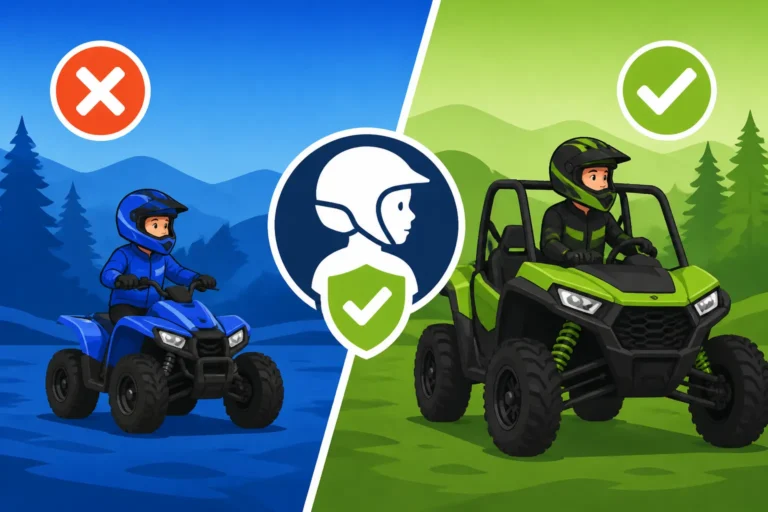
Mirrors are another key piece of equipment. Your machine must have at least one mirror that allows the driver to see behind the vehicle. Muffler systems are also regulated; excessive noise is a common complaint, and machines must have a muffler that effectively reduces engine noise without modification that would make it louder than factory specifications. If you've upgraded your machine with aftermarket parts, such as those from SuperATV, ensure they still meet Quebec's noise and safety standards. Always double-check your tires, brakes, and general mechanical condition before a long trip. Don't forget, helmets are mandatory for all riders and passengers, and they must be Canadian Department of Transportation (DOT) approved, or equivalent such as Snell or ECE. Often, the helmet must be equipped with a visor, or you must wear goggles to protect your eyes. It's worth reviewing [Quebec Helmet and Visor Rules] before you pack your gear.
Speed Limits and Operating Hours on Quebec Trails
Quebec's trail network operates under specific speed limits and hours. On federated trails, the maximum speed limit for ATVs is 50 km/h (approximately 31 mph). While this might feel slower than what you're used to in some areas of Maine, it's a limit strictly enforced by trail patrols and is designed to ensure safety given the varied terrain and shared nature of many trails. Side-by-sides typically follow the same speed limits on federated trails. Being aware of [Quebec's 50 km/h Speed Limit for ATVs] is crucial to avoid fines.
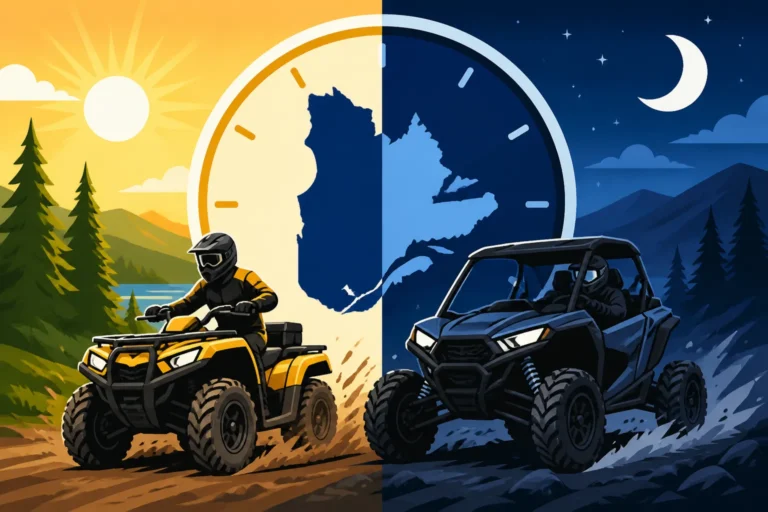
Operating hours are also defined. Generally, off-highway vehicles are permitted on federated trails between 6 a.m. and midnight. Riding outside these hours, especially after midnight, can lead to substantial fines. While it might be tempting to extend a ride under a clear night sky, it's best to respect these regulations. Always verify if any local club or municipality has specific variations to these hours, but the 6 a.m. to midnight rule is the general standard. For more details on these rules, check out [Quebec Riding Hours From 6 a.m. to Midnight].
Road Access and Crossing Regulations
This is an area where Quebec's rules often differ significantly from other jurisdictions, including Maine. Generally speaking, ATVs and side-by-sides are not permitted on public roads in Quebec. There are very limited exceptions, and these are often strictly controlled and clearly marked.
One common exception allows for crossing a public road at a right angle, after stopping and ensuring the way is clear, without lingering on the roadway. Another specific exception permits riding on the shoulder of certain public roads for a maximum distance of 1 kilometre (about 0.6 miles) to connect two sections of a federated trail, or to access a service like a gas station or lodging. This 1-kilometre stretch must be explicitly authorized by signage. Any longer distance or deviation without proper signage is illegal and subject to fines. [Quebec Municipal Road Access Up to 1 Kilometre] is a good resource to clarify these rules. Never assume you can ride on any road just because it seems like a shortcut or leads to your destination. Always look for official signage confirming permission.
| Feature / Rule | Maine (General) | Quebec (Visiting Riders) |
|---|---|---|
| Registration | Maine registration required for public lands. | Quebec VHR plate & SAAQ registration mandatory. |
| Liability Insurance | State minimums vary, usually lower. | $1 Million minimum civil liability through SAAQ registration. |
| Trail Pass | Maine trail pass required for state-managed trails. | Quebec FQCQ trail pass mandatory, no reciprocity. |
| Driver's Licence | Age restrictions apply; licence not always required for trails. | Valid driver's licence required (16+ for ATV, 18+ for SxS). |
| Age (ATV) | 10+ with direct adult supervision. | 16+ (16-17 requires safety certificate and licence). |
| Age (Side-by-Side) | 16+ in many cases. | 18+ with valid driver's licence. |
| Speed Limit (Trails) | Varies, often 45 mph (72 km/h) or posted limits. | 50 km/h (31 mph) maximum on federated trails. |
| Operating Hours | Varies; some areas 24/7 or specific closures. | 6 a.m. to Midnight on federated trails. |
| Road Access | Limited access/crossings, depends on municipality. | Very limited, 1 km max with explicit signage for connections/services. |
| Helmet | Mandatory for all riders/passengers. | Mandatory, DOT/Snell/ECE approved, with visor or goggles. |
| Mirrors | Usually one required. | At least one required. |
Planning Your Trip: Practicalities for Maine Quad Enthusiasts
Preparing for a Quebec quad adventure involves more than just understanding the rules; it's about practical planning to ensure a smooth and enjoyable journey. From finding a place to rest your head to knowing what to do if you encounter a trail patrol, a little foresight goes a long way. Quebec's expansive trail network offers incredible scenery and riding experiences, but it also demands respect for its unique operational environment.
Finding Accommodation and Fuel Along Quebec Trails
Quebec's OHV trail network is well-developed, and many regions cater specifically to quad and snowmobile enthusiasts. This means you can often find lodging options that are "quad-friendly," offering direct trail access, secure parking for your machine or trailer, and sometimes even amenities like wash stations. However, it's not universal, especially in more remote areas. When planning your route, use the FQCQ's interactive map or their iQuad app to identify villages and towns along your chosen circuit. These resources often highlight accommodations and fuel stops.
It's a smart idea to call ahead to your chosen lodging to confirm their policies regarding OHVs and to check for availability, especially during peak seasons like summer or fall foliage. Similarly, plan your fuel stops carefully. While many towns have gas stations, some remote stretches of trail might mean longer distances between fill-ups than you're used to in Maine. If your machine isn't equipped with extra fuel capacity, or if you're exploring a particularly long or remote circuit, consider carrying a small, approved auxiliary fuel container. Some riders also consider adding accessories like extra storage or durable skid plates from manufacturers like SuperATV to better prepare their machines for longer, more rugged Quebec expeditions.
What to Expect from Quebec Trail Patrols
Quebec's federated trails are actively patrolled by dedicated officers, often volunteers from local clubs, as well as Sûreté du Québec (provincial police) officers. These patrols are there to ensure rider safety, maintain the trails, and enforce compliance with the Off-Highway Vehicle Act (LVHR). As a visiting Maine rider, you should expect to be stopped and asked to present your documents.
When stopped, remain calm, polite, and cooperative. You will need to present your valid driver's licence, your Quebec VHR registration papers (showing proof of Quebec's mandatory liability insurance), and your Quebec FQCQ trail pass. It's a good practice to keep these documents readily accessible in a waterproof bag on your person or securely on your machine. A cell phone photo might be accepted in some circumstances for secondary proofs, but physical documents are always preferred and legally required. Don't carry original ownership papers on your person; keep copies with you. If you are found riding without the proper registration, insurance, or a trail pass, you can face significant fines. For a complete list of what documents to have on hand, review [Carrying Papers on a Long Ride].
Respecting Local Customs and Trail Etiquette
Riding in Quebec is an immersion in a different culture, even if it's just across the border. Many trail signs will be in French, the official language of Quebec. While many Quebeckers are bilingual, especially in tourist areas, a basic understanding or a translation app can be helpful.
Beyond language, respecting local etiquette is crucial for maintaining good relations between riders and the communities that host the trails. Always stay on marked trails; deviating onto private land without explicit permission is trespassing and can lead to trail closures. Leave gates as you found them, whether open or closed. Yield to oncoming traffic and slower riders. Keep your speed in check, particularly when passing near residences or other trail users. Excessive noise is generally frowned upon, especially near homes or sensitive natural areas. Remember that these trails often cross private land, and the continued goodwill of landowners is essential for the trail network's existence. Being a considerate and respectful visitor ensures that the trails remain open and welcoming for everyone.
Disclaimer
This article is for general informational purposes only and does not constitute professional advice. Laws, prices and regulations vary by location and change over time. Consult a qualified professional for guidance on your specific situation.