Quebec Rules for Riding to a Gas Station
It’s a scenario every off-road enthusiast in Quebec dreads: you’re out on a fantastic trail ride, the sun is shining, the air is crisp, and then you glance down at your fuel gauge only to see it hovering precariously close to empty. Panic starts to set in. There’s a gas station just a kilometre up the road from the trail exit, easily visible. The question immediately pops into your head: can I just hop on the road for that short stretch to fill up, or am I asking for a ticket? This guide is here to untangle the complexities of Quebec’s rules for ATV and UTV riders when that gas light comes on and the nearest pump is just off the pavement.
Understanding Quebec's Default Stance on ATVs on Public Roads
Let's be clear right from the start: generally speaking, Quebec has strict rules about where you can and cannot ride your ATV or side-by-side. The default assumption under Quebec's Off-Highway Vehicle Act (LVHR) is that public roads are off-limits for these machines. This isn't just a suggestion; it's a legal framework designed to keep off-road machines off roads shared with cars, trucks, and motorcycles, primarily for safety reasons. It can be incredibly frustrating when you’re just trying to get from point A (trail) to point B (gas station) and the asphalt stands in your way. You bought your machine for adventure, not to be stuck miles from fuel!
This general prohibition means you can't just cruise down any street or highway whenever it's convenient. Imagine you're deep in the Laurentians, and you suddenly realize you’re in a low-fuel situation. Your instinct might be to take the shortest route to salvation, which often involves a paved road. However, unless specific conditions are met, doing so could land you with a hefty fine, completely ruining your day and your budget. It’s not just about avoiding traffic; it’s about having the proper authorization. The province wants to ensure that these vehicles, which are designed for challenging terrain, don't pose an undue risk on surfaces they aren't primarily built for.
The law is in place to protect riders and other road users. Off-road machines typically have different braking distances, tire compounds, and visibility profiles than street-legal vehicles. Even if you have the most advanced lighting from a brand like SuperATV, you're still navigating a machine that isn't inherently designed for high-speed road travel or sharing lanes with fast-moving automobiles. So, while it feels like an inconvenience, the underlying principle is safety first.
The "1-Kilometre Rule" for Accessing Services
Now, for the good news – there is an exception, but it comes with very specific conditions. Quebec’s Off-Highway Vehicle Act allows municipalities to pass by-laws that permit off-road vehicles to use certain public roads for short distances to access services. This is commonly known as the "1-kilometre rule," though it's crucial to understand it's not a blanket right. It’s not a given that every municipality will have such a by-law, and even if they do, it's not a free pass to ride on any road.
What the 1-Kilometre Rule Actually Means
This specific allowance is designed for situations exactly like needing gas, grabbing a quick bite at a restaurant, or finding lodging when you're on a multi-day trip. It specifically states that an ATV or side-by-side can use a public road, or a shoulder of a public road, for a distance of up to one kilometre to reach these services if the road is designated for such use by municipal by-law and clearly marked with appropriate signage. This signage is your key. Without it, the exception doesn't apply.
Think of it like this: you're riding a fantastic trail circuit in the Chaudière-Appalaches region, following the [Quebec Circuits in Chaudière-Appalaches] map. You hit a designated access point, see the official signage indicating ATV access to the nearby gas station just down the road, and then you can proceed. If there's no sign, even if the gas station is only 500 metres away, you're not allowed to use that road stretch. It's a critical distinction that many riders miss, leading to unfortunate encounters with law enforcement. The onus is on the rider to know and observe the local rules.
Why Signage is Non-Negotiable
The importance of this official signage cannot be overstated. It's not enough to think a road might be open or to assume a small town allows it. The law explicitly requires visible signage, often a specific symbol indicating off-road vehicle access along with the distance allowed. This signage acts as official notification from the municipality that they have exercised their right to permit this limited road access. Without it, you are considered to be riding illegally on a public road, subject to the [Quebec Fines for Riding a Public Road].
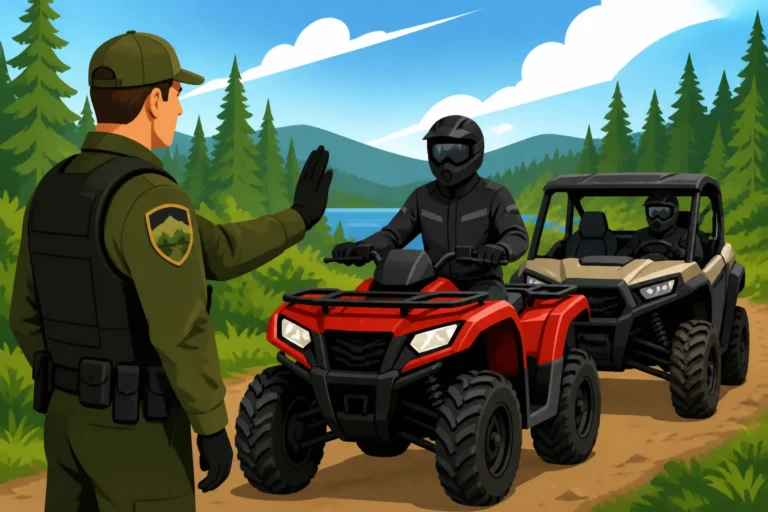
Imagine pulling up to a provincial police officer after a short road ride to the gas station. If you can point to the official sign that authorized your brief detour, you're likely in the clear. If not, even if your intentions were good and you were only going a short distance, you're on shaky legal ground. This is why knowing your route, consulting [Quebec Trail Maps and the iQuad App], and understanding local by-laws before you head out are absolutely essential. Don't rely on guesswork or what another rider said was allowed.
Legal and Safety Requirements for Temporary Road Use
Even when you are legally allowed to use a public road for that short dash to the gas station, you're not suddenly exempt from all other provincial rules. In fact, you're now operating in a mixed environment, and certain regulations become even more critical to observe for your safety and to comply with the law.
Driver's Licence, Registration, and Insurance are Paramount
First and foremost, you absolutely need a valid driver's licence. [Quebec Requires a Driver's Licence Since 2021] for anyone operating an ATV on a trail or a public road section. This isn't just for cars; it's for quads too. If you're 16 or 17, you also need an FQCQ training certificate. For side-by-sides, the driver must be at least 18 years old ([Quebec Requires 18 for a Side-by-Side]).
Your machine must also be properly registered with the SAAQ ([Quebec ATV Registration With the SAAQ]) and have the proper VHR plate mounted visibly. This registration comes with mandatory liability insurance. Remember, [Quebec's Liability Insurance Rule] mandates a minimum of $1 million in coverage. You must carry proof of this insurance with you, as a trail patrol or police officer can ask to see it. [Carrying an Insurance Certificate on Every Ride] is not just good practice, it's the law.
Essential Equipment and Speed Limits
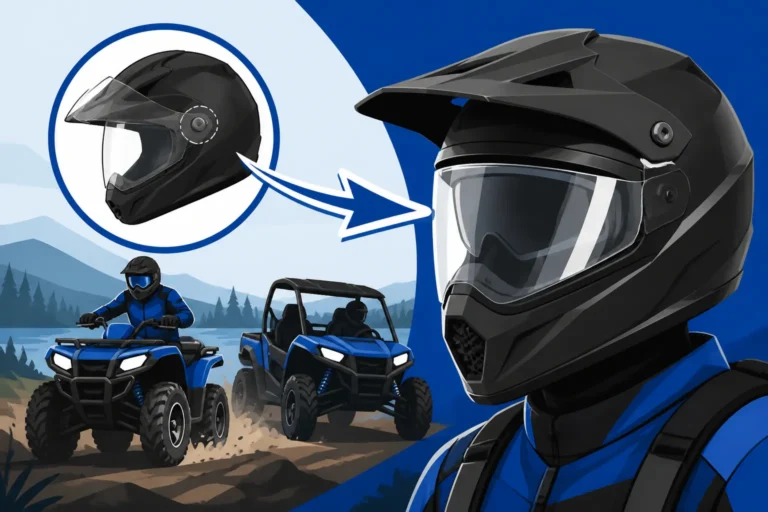
When you're on any public road, even for a kilometre, your machine must meet specific equipment requirements to be visible and safe. This includes working headlights and taillights, brake lights, and at least one mirror on the left side, or two mirrors if your machine allows. And, of course, a properly fitted helmet is non-negotiable ([Quebec ATV Helmet Rules]).
The speed limit is another critical factor. While you might be used to varying speeds on the trail, the moment you hit that authorized road section, you are subject to the [Quebec's 50 km/h Speed Limit for ATVs]. This speed limit is strictly enforced and is significantly lower than typical road speeds. It's there to ensure you have enough time to react to unexpected road hazards or traffic, which behave very differently from trail obstacles. Trying to keep up with highway traffic will not only be unsafe but will also lead to a speeding ticket.
Table: Key Rules for Riding on Designated Road Sections
| Rule Category | Requirement | Why It Matters |
|---|---|---|
| Road Access | Only on designated roads/shoulders, up to 1 km, with clear municipal signage. | Legal authority for access; without signs, it's illegal. |
| Driver | Valid driver's licence (16+ for ATV, 18+ for Side-by-Side), FQCQ certificate for 16/17-year-olds. | Ensures driver competence and legal authorization. |
| Vehicle | SAAQ registration, VHR plate, minimum $1M liability insurance, working lights, mirrors. | Legal operation, financial protection, and visibility to other road users. |
| Safety Gear | Approved helmet for all occupants. | Protects against head injury; mandatory by law. |
| Speed Limit | Maximum 50 km/h (or posted limit if lower). | Reduces accident risk, allows for safe reaction times with road traffic. |
| Visibility | Stay to the far right, ride in single file, use headlights. | Increases your visibility to other vehicles and helps maintain traffic flow. |
| Paperwork | Carry driver's licence, registration, and insurance proof. | Essential for verification by law enforcement. |
When you are on a road, even for a short distance, you are sharing that space with drivers who might not be expecting an off-road vehicle. Be extra vigilant. Use appropriate hand signals for turns if your machine doesn't have indicator lights, and always assume other drivers don't see you. Equipping your machine with bright, visible flags or even LED whip lights from a brand like SuperATV can significantly enhance your presence on the road, making you more noticeable to traffic.
What Happens When There's No Designated Access or You Go Too Far?
This is where planning truly becomes your best friend, and ignorance of the law offers no excuse. If you find yourself needing gas and there’s no signage indicating an authorized road access to the station, you are, unfortunately, out of luck. Riding on an undesignated public road, even for a short distance, is a violation of the Off-Highway Vehicle Act.
The Consequences of Unauthorized Road Riding
The penalties for riding an unregistered or uninsured ATV, or riding on an unauthorized public road, can be severe. We're not talking about a slap on the wrist. [Quebec Fines for Riding a Public Road] can start in the hundreds of dollars, plus court costs and administrative fees. These fines can escalate significantly if you're also caught without proper registration, insurance, or a helmet. Imagine a $350 fine just for a quick 500-metre hop to the gas station – it's a very expensive tank of fuel!
Beyond the immediate financial hit, there are other repercussions. If you're involved in an accident while riding illegally on a public road, your insurance company might deny coverage, leaving you personally liable for damages and injuries. This could be financially devastating. The SAAQ's compulsory insurance is tied to legal operation, and if you're operating outside the law, you're outside their protection. So, while that short cut might seem tempting when you're low on fuel, the risks far outweigh the momentary convenience.
The Frustration of Limited Options
It’s completely understandable to feel frustrated in such a situation. You’ve responsibly ridden your machine on trails, and now a vital service like fuel is tantalizingly close but legally out of reach. This is a common pain point for riders, especially those exploring less-travelled regions or new trail systems. Some municipalities have been more proactive than others in developing by-laws and signage for off-road vehicle access, which can lead to inconsistencies across the province. You might find ample, well-marked access points in one area, and none at all in another, equally populated region.
This is where the importance of community involvement comes into play. If you find consistent gaps in access to services like fuel in areas where it would be logical and safe, consider reaching out to your local ATV club or municipal council. Clubs like those within the FQCQ network often advocate for better infrastructure and clearer rules for riders. They can work with local authorities to identify safe routes and get the necessary signage installed.
Planning Ahead and Smart Alternatives for Fueling Up
Given these rules and potential pitfalls, proactive planning is truly the cornerstone of a stress-free quad or side-by-side adventure in Quebec. Don't let a simple fuel stop become a legal headache.
Mapping Your Route and Fuel Stops
Before you even load your machine onto the trailer, make sure you know your planned route like the back of your hand. Use detailed trail maps, official club resources, and apps like iQuad to identify designated fuel stops along the trail or at points where legal road access is explicitly permitted and signed. The [Quebec Trail Maps and the iQuad App] are invaluable tools for this, as they often highlight services available directly from the trail or via short, authorized road connectors. Look for routes like the [Quebec Circuits in Lanaudière] or the [Quebec Circuits in the Outaouais] which often have services integrated into the planned itinerary.
It's also a good idea to factor in a safety margin for your fuel. Don't push your tank to the absolute limit. When you see a fuel opportunity, even if you're not critically low, it might be wise to top up, especially if you're heading into a more remote section of trail.
Carrying Extra Fuel Safely
A very common and highly recommended strategy for longer rides or exploring remote areas is to carry extra fuel with you. This can be a literal lifesaver (or at least a ride-saver!). However, there are rules around how you transport fuel on your machine:
- Approved Containers: Always use certified, spill-proof fuel containers designed for transport. These are typically red plastic jugs that meet specific safety standards.
- Secure Mounting: The fuel container must be securely mounted to your machine, ideally on a cargo rack or in a dedicated fuel caddy. You don't want it bouncing around or, worse, falling off and creating a hazard. Companies like SuperATV offer robust cargo racks and specialized fuel can mounts that are perfect for this, ensuring your extra gas stays put no matter how rough the trail gets.
- Location: Mount it away from hot exhaust components and where it won't interfere with your riding or visibility.
- Quantity: Don't overdo it. Carry enough for a reasonable safety margin, but remember that fuel is heavy and can affect your machine's handling.
By carrying an extra gallon or two, you give yourself peace of mind and significantly extend your range, allowing you to bypass those risky road-to-gas-station scenarios entirely.
Alternative Strategies for Fuel Access
Sometimes, no matter how much you plan, you might find yourself in a tight spot. Here are a couple of other strategies:
- Group Support: If you're riding with a group, one rider with extra fuel might be able to help out. Or, if you have a support vehicle following along (for longer expeditions), they could meet you at an accessible point with a refuel.
- "Bail-out" Points: Familiarize yourself with "bail-out" points or alternative access roads on your map. These might be sections where you could legally exit the trail system to meet a pre-arranged pick-up, rather than risk an illegal road ride.
- Local Knowledge: Don't hesitate to ask locals or club members for advice on fuel stops in an unfamiliar area. They often have insights into which gas stations are easily accessible directly from the trail or via approved routes.
By combining thorough pre-ride planning, smart equipment choices like sturdy cargo solutions from SuperATV, and an understanding of Quebec's specific regulations, you can enjoy your off-road adventures without the nagging worry of running on fumes or encountering fines. Stay safe, stay legal, and keep those adventures going!
Disclaimer
This article is for general informational purposes only and does not constitute professional advice. Laws, prices and regulations vary by location and change over time. Consult a qualified professional for guidance on your specific situation.