Quebec Rules for Crossing a Highway
Navigating Quebec's vast network of roads and trails with your ATV can sometimes feel like trying to decipher a secret code, especially when it comes to crossing busy highways. It's a common frustration for riders, as the rules aren't always intuitively clear, and a simple mistake can lead to hefty fines or, worse, a dangerous situation. This guide is here to untangle the complexities of Quebec's Off-Highway Vehicle Act, specifically focusing on how you can legally and safely cross a highway with your off-road machine, ensuring you stay compliant and confident on your rides.
The Basics of Crossing a Highway in Quebec
When you're out exploring the fantastic trails Quebec has to offer, you'll inevitably encounter moments where a trail might be bisected by a public road, including major highways. It's not like you can just zip across whenever you see a gap in traffic; there are very specific rules in place to protect riders and other road users. Understanding these foundational principles is crucial before you even think about putting a tire on pavement.
Why Highway Crossings are Strictly Regulated
The reason for such strict regulations around highway crossings isn't to make your life difficult, but to ensure safety. Highways are high-speed environments, and ATVs, or VTTs as they're known in Quebec, are fundamentally designed for off-road use. They handle differently on asphalt, accelerate slower, and are much less visible than cars and trucks, especially to drivers travelling at highway speeds. A moment of inattention or a misjudgment of speed by either the ATV rider or a motorist can have catastrophic consequences. The law, therefore, puts a strong emphasis on minimizing the time an ATV spends on or even near a highway, and demanding maximum visibility and quick execution for any permitted crossing. This is why you'll find explicit guidelines in [Quebec ATV Road Rules Under the LVHR].
The "Right Angle" Rule for ATV Crossings
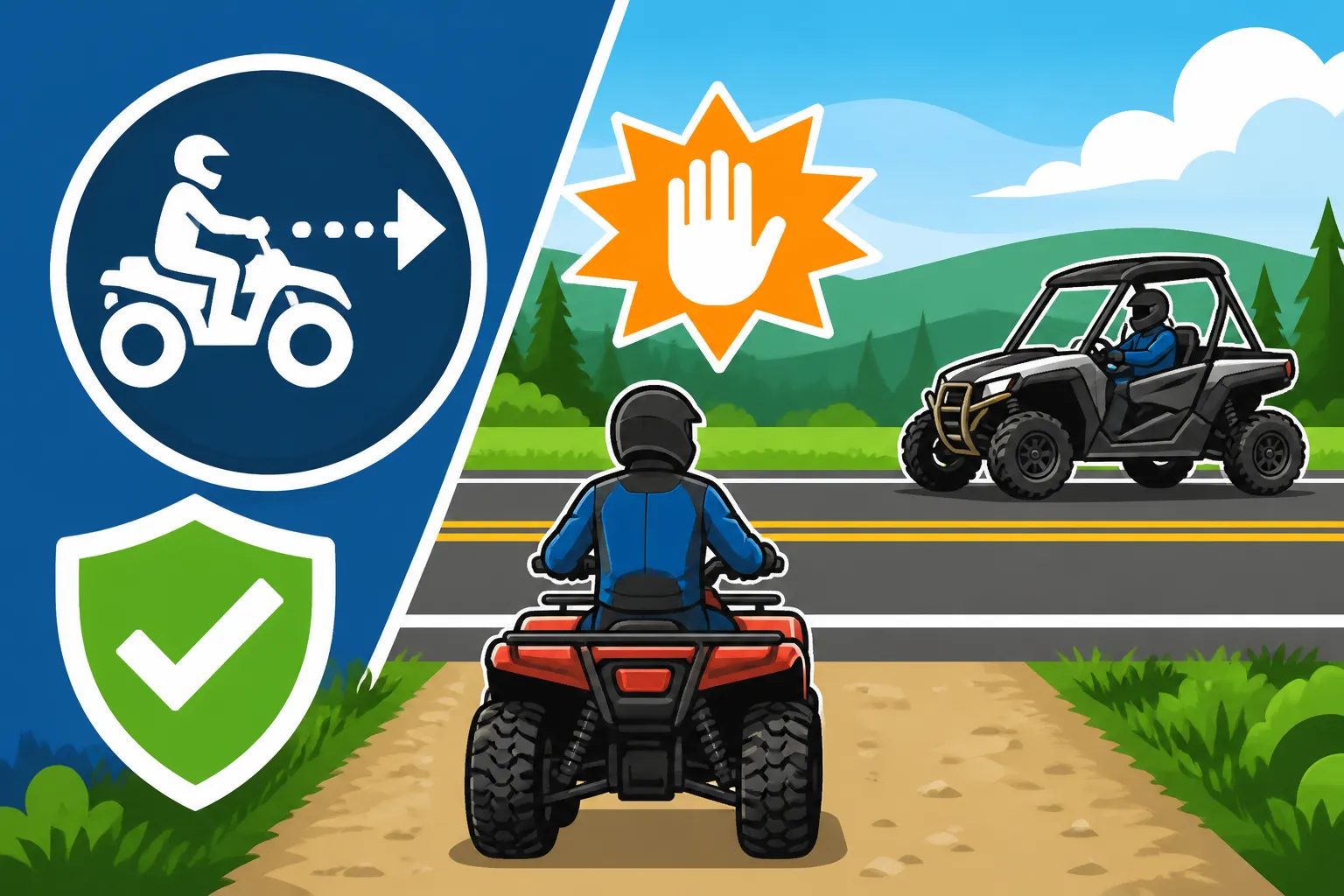
This is perhaps one of the most fundamental rules you need to engrave in your mind: when crossing a public road, including a highway, you must do so at a right angle. Imagine a letter 'T' – your trail is the top bar, and the road you're crossing is the vertical line. You must approach the road, stop, and then proceed directly across to the other side of the trail, forming a 90-degree angle with the road's flow of traffic.
You cannot ride parallel to the highway even for a short distance, nor can you cut a diagonal path across it. The intent behind the right-angle rule is to minimize your exposure time on the paved surface and make your intentions as clear as possible to oncoming traffic. It reduces the chance of confusion, as drivers will know you're not attempting to merge or drive along the road. It's a simple rule, but absolutely critical for your safety and legal compliance.
Visibility and Sightline Requirements
Beyond the physical act of crossing at a right angle, you also need to ensure you have adequate visibility, and equally important, that other drivers can see you. The law specifies certain sightline distances you must maintain when preparing to cross a road. This means you need to be able to see far enough in both directions, and be seen by, any approaching vehicle, long before you even consider entering the roadway.
The required sightline depends on the speed limit of the road you're crossing. For example, if you're crossing a road with a speed limit of 30 km/h, you need a minimum sightline of 50 metres in both directions. For a 50 km/h road, it jumps to 100 metres, and for higher-speed roads like highways, you're looking at 150 to 200 metres, sometimes even more depending on the specific circumstances. This isn't just a suggestion; it's a legal requirement. If your line of sight is obstructed by a hill, a curve, or dense foliage, you cannot cross at that point. You must find an alternative, safer crossing, or simply avoid that section entirely. It's about exercising extreme caution, recognizing the dangers of high-speed roads, and ensuring everyone has ample time to react.
Here's a quick summary of the general sightline requirements:
| Road Speed Limit | Minimum Sightline Required (in each direction) |
|---|---|
| 30 km/h | 50 metres |
| 50 km/h | 100 metres |
| 70 km/h | 150 metres |
| 90 km/h+ | 200 metres (or more, depending on circumstances) |
Remember, these are minimums. More visibility is always better. It’s a good practice to even carry a small set of binoculars if you're exploring new routes to check for sightlines on tricky crossings.
Understanding Permitted Road Segments for ATVs
While crossing a highway at a right angle is a specific maneuver, there are also general rules about when and where ATVs are allowed on public roads in Quebec. It’s a nuanced topic, and confusion often arises because people sometimes conflate "crossing" with "riding on" a road. The vast majority of the time, ATVs are strictly prohibited from driving along public roads, especially highways, unless very specific conditions are met.
The One-Kilometre Rule for Municipal Roads
The most common allowance for ATVs on public roads applies to municipal roads, and even then, it's highly restricted. The law states that an ATV may use a public road for a maximum distance of one kilometre if that segment is specifically designated and signed by the municipality, or if it's necessary to access a trail or services (like a gas station) and no other off-road alternative exists. Even then, this typically applies to lower-speed municipal roads, not major highways.
The "one-kilometre rule" is designed for practical short transfers, not for general road travel. It's a lifeline to connect trail segments or reach essential services, but it comes with strings attached: speed limits, specific signage, and often, time restrictions. Don't assume that because you can ride a kilometre on a town road, you can do the same on a provincial highway. Those are entirely different beasts, and the rules are far stricter. If you’re ever unsure, always err on the side of caution.
Exceptions and Municipal By-Laws
While the general rule is no ATVs on highways, there are extremely rare and highly specific exceptions. These usually come in the form of municipal by-laws that have gone through a rigorous process of approval, involving the Ministry of Transports and specific signage requirements. Some municipalities, particularly in remote regions, might designate a specific, limited section of a provincial road for shared use, but this is always clearly marked. You would never stumble upon such a section without seeing explicit signs indicating ATV access.
It’s imperative that you do not assume any stretch of highway is open to ATVs unless you see specific, official signage. Relying on "local knowledge" or outdated information can be a costly mistake. Always check current trail maps and local municipal regulations if you plan a route that might involve any road segments, especially in areas unfamiliar to you. A good example of where this might apply is a very small village where a highway acts as the main street, and local by-laws permit short crossings or segments to link up trails. However, this is far from the norm on most major highways. You'll find more detail on such situations in [Quebec By-Laws Beyond 1 Kilometre].
Signage and Notification Requirements
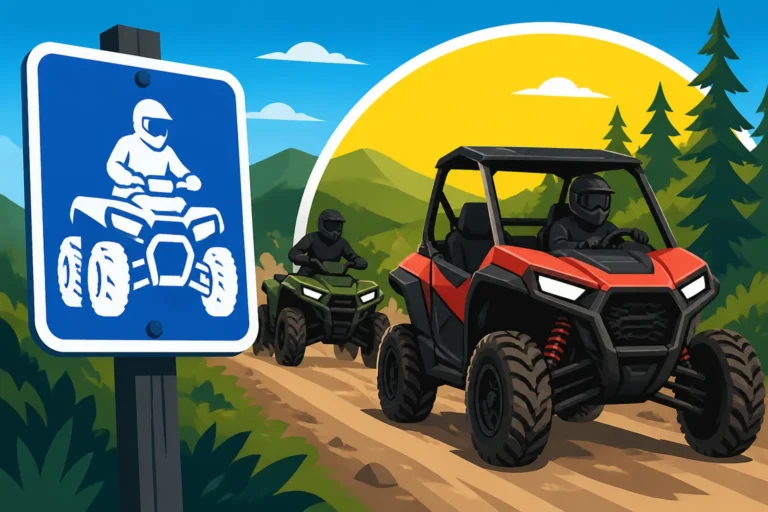
This ties directly into the previous point: if an ATV is permitted to cross or use any section of a public road, including a highway, it must be clearly indicated by official signage. These signs aren't small, subtle markers; they are prominent and unmistakable. They will show an ATV symbol and indicate where the crossing is, or where a permitted road segment begins and ends. Without these signs, you should assume that ATV use on that road is prohibited, even for crossing.
Furthermore, for municipalities to enact by-laws allowing ATVs on certain road segments, they must follow a specific process, including giving 15 days' notice to the Ministry of Transports. This ensures that any such exceptions are formally acknowledged and that appropriate safety measures, including signage, are in place. As a rider, your responsibility is to look for and obey these signs. If you don't see them, don't ride there. It's a fundamental aspect of [Quebec Road Signage for Quad Routes] that every rider should be familiar with.
Equipment and Driver Requirements for Road Access
Just because you might find a legal spot to cross a highway or use a designated road segment, it doesn't mean you can do it in your everyday trail gear. When your ATV touches public pavement, even briefly, it's subjected to certain equipment and driver requirements that are designed to bring it closer to the standards of other road vehicles, enhancing safety and visibility. These aren't optional; they are mandatory under the law.
Essential Equipment for Road Segments
When you're crossing a road or riding on a permitted segment, your ATV needs to be equipped for the road environment. This includes:
- Headlights and Taillights: Your machine must have working headlights and taillights, and these must be on, even during the day, when on a public road. This vastly improves your visibility to other motorists.
- Brakes: Your braking system must be in excellent working order.
- Mirrors: You must have at least one rearview mirror, typically mounted on the left handlebar, to see traffic approaching from behind. Some riders choose to install two mirrors for maximum rear visibility, and companies like SuperATV offer robust mirror kits that can handle both trail abuse and road vibration.
- Muffler: Your exhaust system must be equipped with a muffler that meets noise standards. Loud, modified exhausts are a quick way to draw unwanted attention and fines.
- Tires: While not always explicitly stated as "road tires," your tires must be in good condition, and not so aggressive that they damage the road surface.
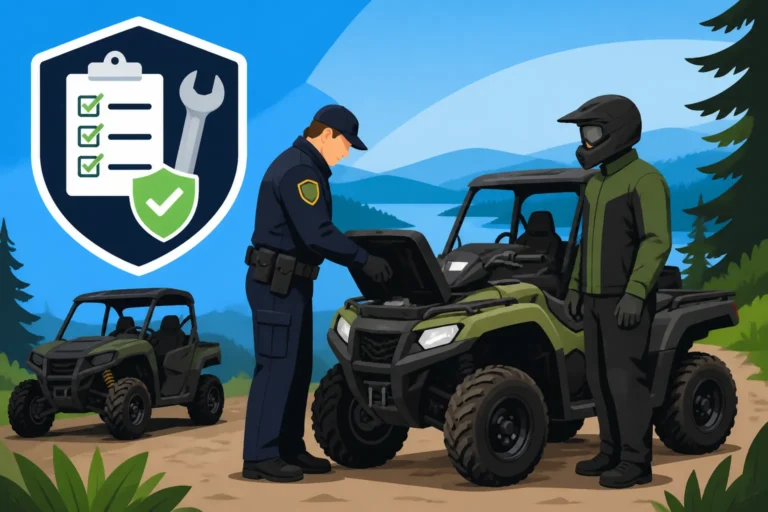
These equipment rules are in place because you're momentarily sharing space with vehicles that are typically much faster and heavier. Anything that increases your visibility and control is paramount. For more on what your machine needs, check out [Quebec Equipment Checks by Patrols].
Driver's Licence and Age Requirements on Roads
When you're on a public road, even for a brief crossing, you are operating a motor vehicle on a public thoroughfare, and that means you need a valid driver's licence. Specifically, in Quebec, you need at least a Class 5 probationary or full driver's licence to operate an ATV on any public road segment or crossing. A learner's permit is generally not sufficient, and you absolutely cannot operate an ATV on a public road without a valid licence. This rule has been in effect since 2021 and is a critical point for all riders.
Furthermore, there are age restrictions. The minimum age to operate an ATV on a public road or federated trail in Quebec is 16. However, for a side-by-side (Côte-à-côte), the minimum age increases to 18. If you're 16 or 17, you also need to hold a valid FQCQ training certificate. These rules are in place to ensure that anyone operating these machines on public roads has demonstrated a basic level of competence and understanding of road safety. Ignoring these rules can lead to severe penalties, as outlined in [Quebec Fines for Riding Without a Licence].
Impaired Driving and Penalties on Roads
It should go without saying, but it bears repeating: operating an ATV while impaired by alcohol or drugs on any public road, even for a short crossing, is just as illegal and dangerous as driving a car while impaired. The same laws, penalties, and consequences apply. Police patrols, including those specifically targeting off-road vehicles, are vigilant about impaired driving.
Penalties for impaired driving can include significant fines, licence suspension, vehicle impoundment, and even criminal charges. Your trail machine is no exception to these rules. Always ensure you are sober and alert when operating your ATV, especially when you are anywhere near public roads or crossing them. The same rules apply on federated trails as well, so always make responsible choices. More on this can be found in [Quebec Impaired Riding Penalties].
Common Misconceptions and Safety Tips
Even with the rules laid out, there are still common misunderstandings that can trip up even experienced riders. Knowing the precise boundaries of what's allowed and what's not, along with adopting a few smart safety practices, can make all the difference when you're dealing with highways and your off-road machine.
The Difference Between Crossing and Riding Along a Highway
One of the biggest areas of confusion is mistaking a permitted crossing for a license to ride along a highway. Let's be unequivocally clear: Quebec law does not generally permit ATVs to ride along the shoulder or travel lane of a highway, even if it's for a very short distance, unless there are explicit, highly visible signs created by a municipal by-law specifically designating that segment for ATV use. These are exceedingly rare on highways.
A crossing means going straight across. It does not mean riding for 100 metres on the shoulder to get to a better crossing point, or taking a shortcut along the highway to the next trail entrance. That's a direct violation of the Off-Highway Vehicle Act and carries significant fines. The intention is to get your machine off the high-speed road surface as quickly and safely as possible. [Quebec Fines for Riding a Public Road] are substantial for those who misuse these limited road access permissions.
Preparing Your Machine for Brief Road Use
Even for a crossing that might take only seconds, a quick check of your machine is a good habit. You're transitioning from a forgiving trail environment to a hard, high-friction road, potentially with high-speed traffic.
- Tires: Ensure your tire pressure is appropriate. While lower pressure is good for traction on trails, if you have to ride any distance on pavement (even a short one), too low pressure can make your machine handle sluggishly.
- Lights: Double-check that your headlights and taillights are clean and functioning. Visibility is paramount. If you have any additional lighting, ensure it's not blinding to oncoming traffic. SuperATV offers great LED light bar options for trails, but always be mindful of road-legal lumen output when on public roads.
- Mirrors: Make sure your mirror is clean, adjusted, and free of cracks, providing a clear view of what's behind you.
- Brakes: Give your brakes a quick test before approaching the road. You need maximum stopping power if an unexpected situation arises.
- Cleanliness: While not a legal requirement, a machine caked in mud can reduce the effectiveness of your lights and make you less visible. A quick wipe down of lights and reflective surfaces before hitting a road crossing isn't a bad idea.
Situational Awareness and Defensive Riding
Ultimately, your safety on or near a highway crossing rests heavily on your own situational awareness and defensive riding skills.
- Stop, Look, Listen: Before every crossing, come to a complete stop. Look both ways multiple times. Listen for approaching traffic. Don't be in a rush.
- Make Eye Contact: If possible, try to make eye contact with approaching drivers to ensure they've seen you.
- Assume You're Invisible: Ride with the mindset that drivers may not see you. This will encourage you to be extra cautious and proactive in your movements.
- Choose Your Moment: Wait for a clear, safe gap in traffic that allows you to cross completely without rushing. Never try to beat traffic.
- Be Predictable: When you do cross, do so smoothly and directly, maintaining your right-angle path. Avoid sudden movements.
These aren't just good suggestions; they're vital practices that can genuinely save your life. The road environment is inherently more dangerous for an ATV than a dedicated trail. By understanding and respecting the rules for [Quebec Crossing Sightline Distances] and practicing extreme caution, you can enjoy Quebec's beautiful trail network safely and responsibly.
Disclaimer
This article is for general informational purposes only and does not constitute professional advice. Laws, prices and regulations vary by location and change over time. Consult a qualified professional for guidance on your specific situation.