Supervision Away From Family Land
A minor riding an ATV or side-by-side on private land away from family property may need more than an adult nearby. Quebec’s rules make parental authorization and active supervision important when the young rider lacks a licence and training. Here’s how to understand that requirement, how it differs from trail rules, and what to agree on before a ride begins.
When supervision is required away from family land
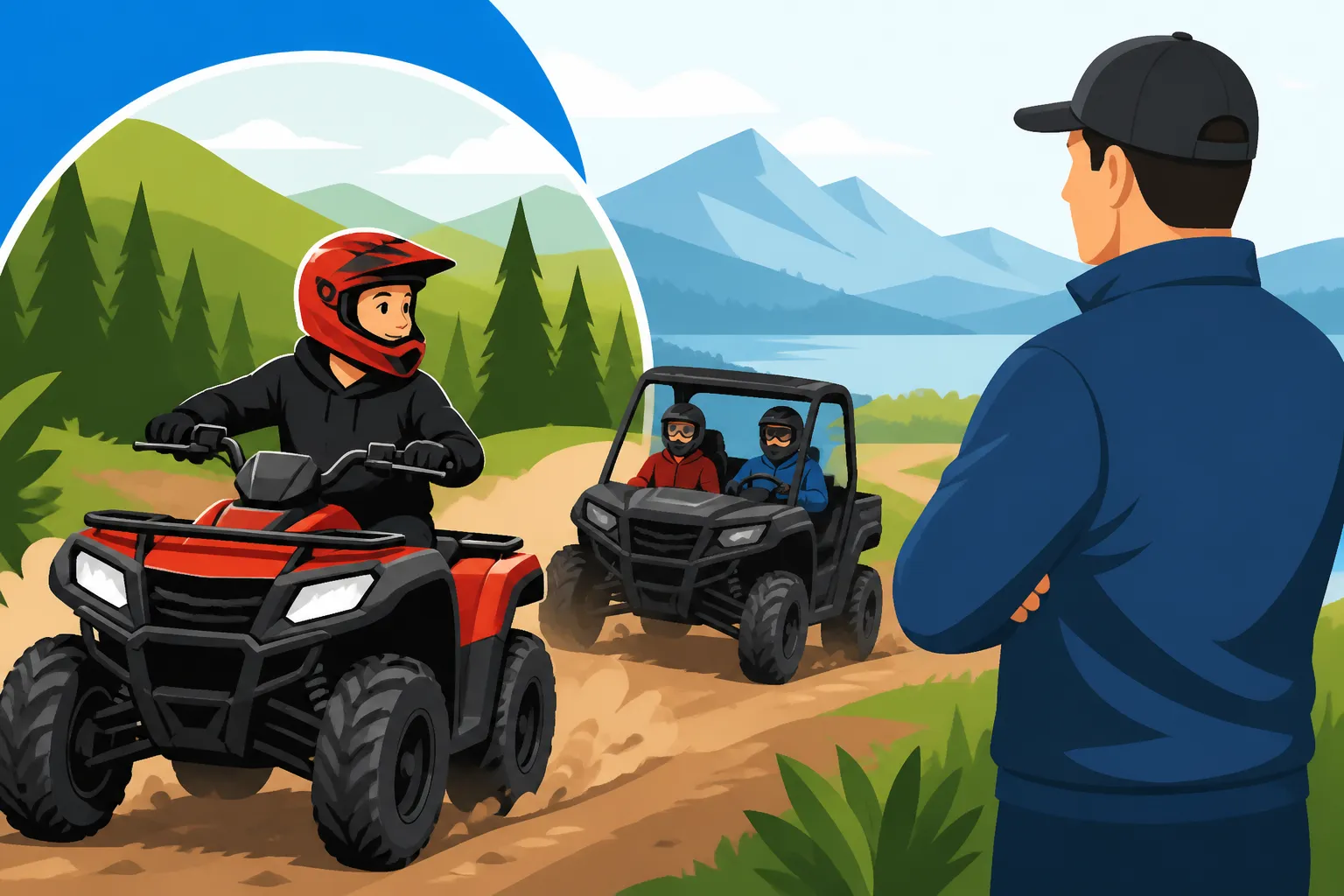
Quebec’s rule applies to a minor under 18 who operates an off-road vehicle on private property without a driver’s licence and training course. According to the Gouvernement du Québec, the minor must have parental authorization and be accompanied by an adult authorized to operate an off-road vehicle. That adult must stay close enough to provide rapid assistance if there is an accident or difficulty.
The rule is about more than having an adult somewhere on the property. The supervisor needs to be near enough to respond promptly. If the young rider is out of sight, far from the supervising adult, or riding in terrain where help would be difficult to reach, the arrangement may not meet the practical purpose of the requirement. Plan for supervision that remains effective throughout the ride, not just at the starting point.
There is an exception when the minor rides on property owned by their parent, legal guardian, or a family member. According to the Gouvernement du Québec, the supervision requirement described above does not apply in that situation. That exception concerns this particular supervision rule; it should not be treated as a blanket exemption from every safety obligation or restriction that could apply to the machine or the land.
A useful way to distinguish the situations is:
| Riding situation | What the rule says |
|---|---|
| Private property away from property owned by a parent, legal guardian, or family member | According to the Gouvernement du Québec, a minor under 18 who has neither a driver’s licence nor a training course must have parental authorization and ride accompanied by an adult authorized to operate an off-road vehicle. |
| Property owned by a parent, legal guardian, or family member | According to the Gouvernement du Québec, the supervision requirement described for that minor does not apply on this property. |
| Trail, road, public land, or municipal private land | According to the Gouvernement du Québec, a driver aged 16 or 17 must have a driver’s licence and a training certificate from a recognized federation to drive an off-road vehicle in these locations. |
The phrase “away from family land” can cover different arrangements: a friend’s property, a rented place, a camp, or land where the family has permission to ride but does not own it. The ownership exception is specific. Permission to use land does not, by itself, make it property owned by a parent, guardian, or family member.
It is also helpful to separate the landowner’s permission from the minor’s authorization. A landowner or tenant may control whether riders can use the property, while parental authorization concerns the young person’s riding under the circumstances described by the Gouvernement du Québec. Do not assume one kind of permission replaces the other. For broader context on permission, see Quebec Parental Authorization on Private Land and Quebec Private Land Permission.
If a ride will take place on land the family does not own, establish the plan before unloading the machine. Confirm that the landowner or tenant permits the ride, that the parent or guardian has authorized the minor to take part, and that an eligible adult will accompany the rider closely enough to help quickly. Those checks make it easier to avoid relying on a vague understanding such as “an adult will be around.”
What counts as supervision in practice
The official rule gives a functional standard: the adult must be close enough to provide rapid assistance in an accident or difficulty. It does not reduce supervision to a headcount or a promise to check in later. The right arrangement depends on the land, the vehicle, the rider’s ability, and the kind of riding planned.
Before the ride, talk through the route and boundaries with the young rider and supervisor. Identify areas the rider must avoid, such as steep or unstable ground, water, obstacles, or property beyond the permitted riding area. Agree on how the rider will signal for help and what the adult should do if the machine stops or the rider does not return as expected. These are practical safety steps, not a substitute for the legal conditions.
The supervisor should be able to keep track of where the rider is and reach them without delay. If the adult is operating another vehicle, make sure that does not leave the minor effectively unsupervised. If the adult cannot see or hear the rider, consider whether the layout still allows a quick response. A large property or difficult terrain can make “near enough” a real planning question, even when both people are on the same land.
Choose conditions that let the young rider focus on control rather than pressure. A beginner may need a simple area with room to stop and turn, while a familiar rider may be ready for a more involved route. Keep the machine appropriate to the rider’s skills, explain how to stop it, and make sure the rider knows not to continue if something feels unsafe. The adult should be prepared to end the ride if conditions change.
Vehicle type matters too. An ATV, an all-terrain motorcycle, and a utility task vehicle are all treated as off-road vehicles under the Gouvernement du Québec’s rules, but age and qualification requirements can differ by location and vehicle. For example, the Gouvernement du Québec requires drivers to be at least 18 and hold a valid driver’s licence to drive a utility task vehicle. Do not assume that a rule for a quad automatically applies to a side-by-side. See Quebec ATV Age Requirements and Quebec Rules for a Side-by-Side Driver for related distinctions.
Make the safety briefing specific to the machine. Show the rider the controls, how to stop, and which safety equipment must be used. According to the Gouvernement du Québec, drivers and passengers must wear a helmet with a visor, or safety goggles if the helmet has no visor. Drivers must wear shoes or boots that allow easy control of the pedals. These requirements are not replaced by the presence of a supervisor.
The adult’s role is also different from simply accompanying the group as another rider. A supervisor should be ready to notice trouble, communicate clearly, and respond. If the adult is distracted, too far away, or unable to help because they are occupied with another task, the arrangement may fail the practical test of rapid assistance. Keep the riding plan manageable for the adult as well as for the minor.
For a family borrowing or visiting someone else’s land, it can help to confirm a few points in advance:
- Who has permission to use the property, and where riding is allowed?
- Has a parent or guardian authorized the minor to ride?
- Is the accompanying adult authorized to operate an off-road vehicle?
- Can that adult stay close enough to help quickly for the full ride?
- Does the young rider know the boundaries, stopping procedure, and signal for help?
- Is the vehicle suitable for the rider and the planned terrain?
This checklist is a planning aid, not an official form or substitute for the legal rule. The core conditions remain parental authorization and accompaniment by an adult authorized to operate an off-road vehicle, with that adult close enough to provide rapid assistance when the minor falls within the rule.
Why private land is not the same as a trail
A private property ride and a ride on a public or authorized trail can trigger different requirements. The private-land supervision rule concerns a minor without a driver’s licence and training course riding away from property owned by a parent, legal guardian, or family member. Trail qualifications are a separate matter.
According to the Gouvernement du Québec, drivers aged 16 or 17 must hold a driver’s licence and a training certificate from a recognized federation to drive an off-road vehicle on a trail, road, public land, or municipal private land. An adult accompanying a young rider does not replace those requirements. Likewise, parental authorization for a private-property ride does not automatically qualify a minor to ride on a trail.
This distinction matters when a private ride connects to a trail, crosses public land, or moves onto a road. Do not assume the whole route is covered by the rules for the starting property. Before leaving private land, identify whether the next section is a designated trail, a public road, public land, or another kind of property, and check the requirements for that location. Quebec ATV Road Rules Under the LVHR and Quebec FQCQ Training Certificates for Teens provide related information.
The same care applies to a side-by-side. According to the Gouvernement du Québec, a driver must be at least 18 and hold a valid driver’s licence to drive a utility task vehicle. A parent or supervisor should not treat close supervision as a way around a vehicle-specific age or licence rule. If the young person is not eligible to drive the machine, having an adult nearby does not make them eligible.
Before setting out, make sure you know what kind of vehicle is involved and where it will be driven. Check that the planned land use is permitted, that any required authorization is in place, and that the minor meets the rules for the machine and location. When the answer depends on a specific property or route, confirm the situation with the relevant landholder or official source rather than relying on a general assumption that “private land” has one set of rules.
If the ride stays on qualifying family-owned land, the stated supervision requirement does not apply under the exception described by the Gouvernement du Québec. That still does not mean that every other rule disappears. Use the right equipment, keep the rider within their ability, and confirm that the landowner’s conditions are respected. For more on the difference between a young rider’s circumstances, see Quebec Rules for a 15-Year-Old on Family Land and What a 17-Year-Old Needs Before Riding a Trail.
The safest approach is to treat the ride as a planned activity rather than an informal handoff. Confirm the property, permission, rider’s qualifications, machine type, and supervisor before the engine starts. Keep the adult close enough to help, and choose a route where the rider can be monitored and assisted. That makes the legal distinction easier to apply and gives everyone a clearer understanding of who is responsible for what.
Sources
- Gouvernement du Québec — Off-highway vehicle trail patrol | Gouvernement du Québec (checked November 3, 2026)
- Gouvernement du Québec — Rules for off-road vehicles | Gouvernement du Québec (checked November 3, 2026)
Disclaimer
This article is for general informational purposes only and does not constitute professional advice. Laws, prices and regulations vary by location and change over time. Consult a qualified professional for guidance on your specific situation.