Dirt Bike Riders and Their Own Certificate
Dirt-bike riders in Quebec can be unsure whether they need a special certificate, a driver’s licence, or both. The answer depends largely on the rider’s age and the machine: an all-terrain motorcycle is an off-road vehicle, but its training certificate is not the same as a licence or trail access permit. Here’s how to tell what applies before you ride.
Which dirt-bike riders need a training certificate
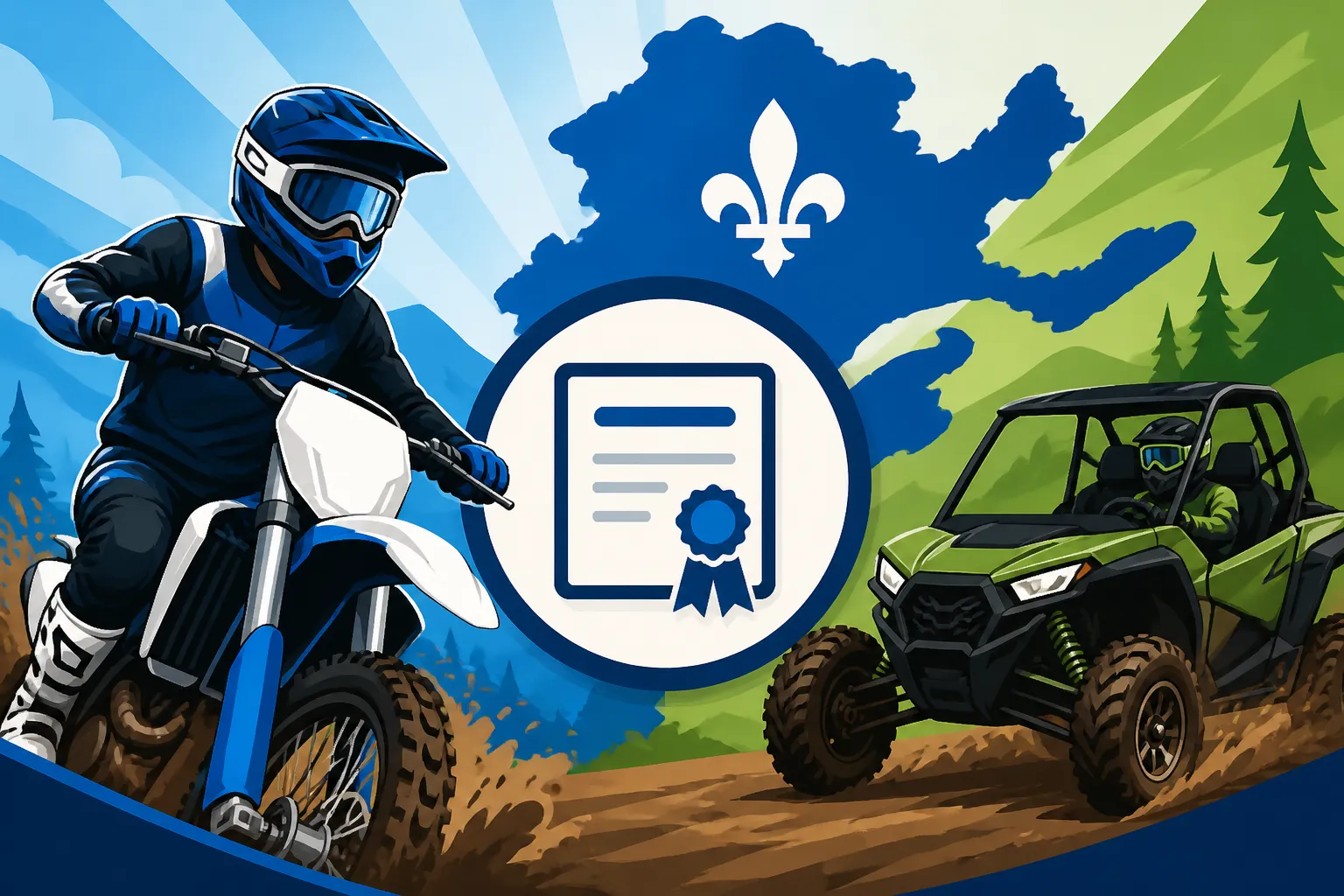
Quebec treats all-terrain motorcycles, including motocross bikes, as off-road vehicles under the Act respecting off-highway vehicles. That means a dirt bike used in the places covered by the rules is not exempt just because it has two wheels or is called a motocross bike. The key requirement for riders aged 16 or 17 is to carry both a valid driver’s licence and a training certificate issued by a recognized federation.
According to the Gouvernement du Québec, riders aged 16 or 17 need both documents to drive an all-terrain motorcycle on public trails, roads, public lands, or municipal private land. The training certificate must come from an authorized organization, such as the Fédération québécoise des motos hors route. For a closer look at the youth requirement, see Quebec Training Certificates for Teen Riders.
| Rider and machine | Training certificate required? | What the Gouvernement du Québec says |
|---|---|---|
| Dirt-bike rider aged 16 or 17 | Yes | A valid driver’s licence and a training certificate from a recognized federation are both required in the covered riding locations. |
| Dirt-bike rider aged 18 or older | No, provided the rider has a valid driver’s licence | A training certificate is not required for this rider if they hold a valid driver’s licence. |
| Rider of an all-terrain motorcycle modified with an add-on seat | Yes, with age and licence conditions | The rider must be at least 18 and hold a training certificate and a valid driver’s licence. |
The table reflects the requirements described by the Gouvernement du Québec. It does not mean that every rider can use every trail or road; location-specific rules, trail access requirements, and other operating rules may still apply.
For a younger rider, the certificate is not an optional extra or a substitute for a licence. Both are required. The Gouvernement du Québec specifies that the certificate must be issued by a recognized federation, and identifies the Fédération québécoise des motos hors route as an example of an authorized organization. Check with the federation about how to obtain the certificate and what documentation it expects.
Riders aged 18 or older generally do not need this training certificate to ride an all-terrain motorcycle, as long as they have a valid driver’s licence. That exemption is specific to the training-certificate requirement: it does not remove the licence requirement, make a closed trail accessible, or replace a trail pass when one is required. For additional detail on the distinction between age groups, see Quebec Training Certificate Requirements, Quebec Training Certificate for a 16-Year-Old, and Quebec Training Certificate for a 17-Year-Old.
What the certificate does and does not replace
It helps to think of the certificate, driver’s licence, registration, insurance, and trail access permit as separate documents that answer separate questions. A certificate addresses the training requirement for certain riders. A valid driver’s licence is a separate legal requirement. Registration and insurance relate to the vehicle and its operation, while a trail access permit is about using a permitted trail network.
A certificate does not turn an unlicensed rider into a licensed one. It also does not give permission to ride wherever a dirt bike can physically travel. The Gouvernement du Québec says riders may be asked to show a driver’s licence, vehicle registration, proof of insurance, and a valid trail access permit during a patrol. Riders may also be asked for identification with proof of age. Details on what patrols may check are covered in What a Patrol Can Ask to See.
This distinction matters when planning a ride with a younger person. If the rider is aged 16 or 17, confirm that they have both the required licence and federation-issued certificate before heading out. Then check whether the chosen trail or riding area is open to the vehicle and whether a valid trail permit is needed. A training certificate alone does not establish that the trail is open or that the rider has permission to use it.
Trail wardens appointed by an off-highway vehicle club or an association of clubs patrol within their assigned areas, and club-appointed wardens may stop a vehicle to inspect it and check its equipment, according to the Gouvernement du Québec. Association-appointed wardens patrol a larger area. A rider should be ready to show the documents that apply rather than assuming that a certificate is the only proof a patrol may request.
The same practical separation applies to insurance. The Gouvernement du Québec requires off-road vehicle owners to maintain at least $1,000,000 in liability insurance. That insurance obligation is not met by holding a training certificate, and carrying a certificate does not establish that the machine has the required coverage. For the separate trail document, see Quebec Trail Pass Proof on the Trail.
A note about modified machines
A dirt bike that has been modified with an add-on seat has a distinct rule to consider. According to the Gouvernement du Québec, a driver of an all-terrain motorcycle modified with an add-on seat must be at least 18 and hold both a training certificate and a valid driver’s licence. This is different from the ordinary rule for an unmodified all-terrain motorcycle, where a rider aged 18 or older does not need a training certificate if they have a valid licence.
Do not assume that a seat modification is harmless from a paperwork perspective. If the bike has an added seat or has been altered in another way, check how the machine is classified and what requirements apply before carrying another person or riding on a trail. The specific add-on-seat rule should not be confused with the general passenger rules for other off-road vehicles.
How to prepare before riding
A little preparation can prevent a rider from reaching a trailhead only to find out that a required document or permission is missing. Start with the rider’s age, the exact type of machine, and the intended riding location. Then verify the licence and certificate requirements, confirm the trail’s access conditions, and make sure the bike and its paperwork are in order.
- Identify the machine. Quebec considers all-terrain motorcycles, including motocross bikes, to be off-road vehicles under the Act respecting off-highway vehicles. If the machine has been modified, particularly with an add-on seat, confirm whether the specific modified-machine rule applies.
- Check the rider’s age and licence. According to the Gouvernement du Québec, a rider aged 16 or 17 needs a valid driver’s licence and a recognized-federation training certificate to drive an all-terrain motorcycle in the covered locations. A rider aged 18 or older still needs a valid driver’s licence.
- Confirm whether a certificate is required. The Gouvernement du Québec says riders aged 18 or older do not need a training certificate for an all-terrain motorcycle if they have a valid driver’s licence. The separate add-on-seat rule requires a certificate, a licence, and a minimum age of 18.
- Check trail access. A certificate does not itself authorize trail use. Verify that the route is open to the machine and that the rider has any required trail access permit. Trail conditions can change, so check them before setting out.
- Carry the relevant documents. Keep the licence, certificate when required, registration, proof of insurance, and trail permit available for inspection. Patrols may also ask for identification that proves age, according to the Gouvernement du Québec.
- Check equipment and operating rules. The Gouvernement du Québec requires drivers and passengers to wear a helmet with a visor, or safety goggles if the helmet has no visor. Drivers must wear footwear that allows them to control the pedals, and the vehicle’s lights must be on while operating it. Other rules depend on where the vehicle is being used.
This list is a practical check, not a replacement for confirming requirements for a specific machine and route. For broader age-related rules, see Quebec ATV Age Requirements. Although that topic focuses on ATVs, it can help clarify why age rules should be checked by vehicle type rather than assumed to be identical across all off-road machines.
Location still matters
Having the right certificate and licence does not override trail restrictions. Quebec’s off-road vehicle rules include operating-hour limits, restrictions near dwellings and health care facilities, and limits on where off-road vehicles may travel. The Gouvernement du Québec says off-road vehicles are permitted on roads and trails between 6 a.m. and midnight, and failure to respect the allowed hours carries a minimum fine of $250. Check local requirements as well as general rules before choosing a route.
Trail access is another separate issue. A valid training certificate is not a trail pass, and a trail pass does not replace the rider’s certificate or licence. If a route is closed, restricted, or not authorized for the machine, the rider’s training status does not change that. For more on the separate trail document, read Quebec Training Certificates for Teen Riders alongside Quebec Trail Pass Proof on the Trail.
Common misunderstandings to avoid
“A motocross bike is not an off-road vehicle.” The Gouvernement du Québec includes all-terrain motorcycles, including motocross bikes, in its off-road vehicle classification. The label on a machine does not by itself remove the rider from the applicable rules.
“The certificate is the same as a driver’s licence.” It is not. A rider aged 16 or 17 needs both documents to drive an all-terrain motorcycle in the locations covered by the rule. For riders aged 18 or older, the training certificate is not required if they have a valid driver’s licence, but the licence remains necessary.
“Adults never need a certificate.” That is too broad. The ordinary rule for an all-terrain motorcycle does not require a training certificate for an adult who has a valid driver’s licence. But the Gouvernement du Québec sets a separate requirement for an all-terrain motorcycle modified with an add-on seat: its driver must be at least 18 and hold a training certificate and a valid driver’s licence.
“A certificate means I can ride on any trail.” The certificate deals with a training requirement, not trail permission. Riders still need to follow access rules and carry any required permit. Trail wardens may inspect a vehicle and ask to see documents, including a valid trail access permit.
“The same certificate rule applies to every off-road vehicle.” The requirements depend on the type of vehicle and the rider’s circumstances. A side-by-side, for example, has its own age and licence rule. According to the Gouvernement du Québec, a side-by-side driver must be 18 or older and hold a valid driver’s licence. Check the rule for the machine you actually plan to operate rather than transferring a requirement from another vehicle category.
The safest approach is to identify the machine accurately, confirm the rider’s age and licence status, and ask an authorized federation about certificate issuance when a certificate is required. Then check trail access and carry the documents that may be requested. That keeps the training certificate in its proper role: important for the riders who need it, but not a substitute for the rest of the rules.
Sources
- Gouvernement du Québec — Lieux pour circuler en véhicule hors route | Gouvernement du Québec (checked November 3, 2026)
- Gouvernement du Québec — Off-highway vehicle trail patrol | Gouvernement du Québec (checked November 3, 2026)
- Gouvernement du Québec — Rules for off-road vehicles | Gouvernement du Québec (checked November 3, 2026)
- Gouvernement du Québec — Off-road vehicle riding areas | Gouvernement du Québec (checked November 3, 2026)
- Gouvernement du Québec — Types of off-road vehicles | Gouvernement du Québec (checked November 3, 2026)
Disclaimer
This article is for general informational purposes only and does not constitute professional advice. Laws, prices and regulations vary by location and change over time. Consult a qualified professional for guidance on your specific situation.