Quebec Parental Authorization on Private Land
It's a common scenario: you've got a quad, some land in Quebec, and an eager teenager or even a younger child who desperately wants to experience the thrill of riding. Naturally, as a parent, your first thought might be, "It's my land, so they can ride, right?" But the reality in Quebec isn't always that simple, and navigating the nuances of the law, even on your own property, can feel like trying to read a map printed in a language you don't quite understand. This guide will meticulously break down what "Quebec Parental Authorization on Private Land" truly means for ATV and side-by-side owners, clearing up the confusion so your family can ride safely and legally.
Understanding the Legal Landscape: Private vs. Public Land
When it comes to off-road vehicles (ORVs) in Quebec, the rules aren't a one-size-fits-all situation. The critical distinction lies in where you plan to ride. While owning private land offers more freedom than public trails, it doesn't automatically mean a complete absence of regulation, especially when minors are involved.
The Core Distinction: LVHR and Private Property
Quebec's Act respecting off-highway vehicles (often referred to as the LVHR) is the primary legislative framework governing ATVs and side-by-sides. This act outlines requirements for registration, insurance, safety equipment, and rider conduct. For many, the assumption is that if you're on private land, these rules somehow magically disappear. However, the LVHR still holds sway in several areas, even within your property lines, particularly concerning rider age and supervision. The intent of the law is to ensure a baseline of safety for everyone, regardless of where they're riding. Think of it less as a strict enforcement arm on your backyard and more as a set of fundamental safety principles.
When you think about [Quebec's Off-Highway Vehicle Act and Your Papers], it’s not just about what you carry on the trail; it's also the legal foundation that defines who can operate these machines in the first place. The provincial government, through the SAAQ, is heavily invested in public safety, and while they respect private property rights, they also set minimum standards that parents need to be aware of. It's about balancing freedom with responsibility, especially when young riders are involved who might not fully grasp the risks.
Why "Private Land" Isn't Always a Free-for-All
While you might envision your private land as a completely unregulated playground, there are limits. For instance, if your property is easily accessible to the public, or if there's an incident that draws attention, the lines can blur. Moreover, the fundamental age restrictions for operating specific types of machines generally apply across the board, even if the enforcement might differ between your back forty and a federated trail. The law generally makes specific allowances for private land, but these are often contingent on direct adult supervision and explicit parental consent. This isn't just about avoiding a ticket; it's about safeguarding your children and those around them.
Consider a scenario where a neighbor complains about noise or dangerous driving, even if it's on your land. While authorities might not be able to issue a trail-specific fine, they can still investigate safety concerns if they deem a situation to be genuinely reckless or dangerous, especially if a minor is involved. The idea that "anything goes" on private land is a dangerous myth that can lead to serious consequences. It's about being a responsible landowner and, more importantly, a responsible parent.
The Importance of Explicit Permission
Even if your child meets the age requirements, having explicit parental permission is paramount. This isn't just a suggestion; it’s a legal protection for both the child and any supervising adult. Without clear authorization, any incident could lead to complications regarding liability, insurance, and even legal repercussions for the adult in charge. This permission essentially transfers responsibility from the state's broad regulations to the parents' direct oversight, acknowledging that parents are best positioned to assess their child's readiness and ensure appropriate supervision.
For anyone under 16, specifically, this explicit permission forms the bedrock of their ability to ride on private property. It essentially acknowledges that while they may not be old enough for public trails, their parents have made a conscious decision about their safety and capability. It’s also crucial if other adults are supervising your child on your land, or if your child is riding on someone else’s private land. A verbal "it's okay" might feel sufficient in the moment, but a more formal approach can prevent headaches down the line.
Who Can Ride What: Age Rules and Machine Types
Quebec's off-highway vehicle laws are quite specific about who can ride, what they can ride, and where they can ride it. These age restrictions are in place for good reason, reflecting the power and potential hazards of these machines. Understanding these thresholds is crucial for any parent.
General Age Requirements for Off-Road Machines
Generally, the LVHR establishes a minimum age of 16 to operate an ATV on a public or federated trail. For side-by-sides, this age is raised to 18. However, there's a significant exception that directly addresses private land use for younger riders. [Quebec ATV Age Requirements] are clearly laid out, but the details for private land are where it gets interesting.
For children under 16, the rules are more flexible when confined to private property. A 15-year-old, for example, can operate an ATV on private land if they have parental authorization and are under adult supervision. This doesn't mean a 5-year-old can jump on a full-sized quad, however. Common sense and machine size appropriateness still apply. The law acknowledges that children develop at different rates and that a controlled, private environment allows for supervised learning that isn't feasible on public trails. It's about providing a space for experience building, but always with a watchful eye.
Specific Rules for Youth Machines
While the LVHR doesn't explicitly define "youth machines" by engine size, the spirit of the law, combined with common industry practices, suggests that smaller, less powerful ATVs are appropriate for younger riders. For these smaller machines, often restricted in speed and power, the general principle on private land is that a minor can ride with parental authorization and adult supervision.
This is where accessories and modifications come into play. Many parents will purchase smaller displacement machines for their children, often equipped with safety features like speed limiters. Some might even upgrade components for better control and stability. For example, using specialized tires, suspension upgrades, or even wider A-arms from a brand like SuperATV can significantly improve the handling and stability of a youth machine, making it safer for younger riders on varied private terrain. Investing in the right gear, both for the rider and the machine, is just as important as the authorization itself.
Side-by-Sides and Passenger Considerations
Side-by-sides (SxS or UTVs) typically have higher age requirements for drivers due to their size, weight, and often greater speed capabilities. While the general rule for public trails is 18 years old to drive a side-by-side, the private land allowance for ATVs doesn't automatically extend to these larger machines in the same way. The law is primarily concerned with ATVs when discussing the 16-year-old rule with parental authorization.
However, passengers are a different story. If a side-by-side has manufacturer-designated passenger seating and seatbelts, and it's being operated on private land by an authorized driver (who could be a minor if meeting other criteria for private land ATV use, though this is less common for SxS), then passengers are generally permitted. [Quebec Rules for a Child Passenger] highlight the importance of manufacturer guidelines for passenger capacity and appropriate restraint systems. It’s vital to ensure any child passenger meets the machine's specific safety requirements, including height and weight, and is secured properly. Never allow more passengers than the machine is designed for, and always ensure everyone is buckled up.
The Role of Parental Authorization: What It Is and How It Works
So, you understand that parental authorization is key for your younger rider on private land. But what exactly does that authorization entail? Is it a handshake, a formal document, or just you standing by the window while they ride?
What Constitutes Valid Authorization
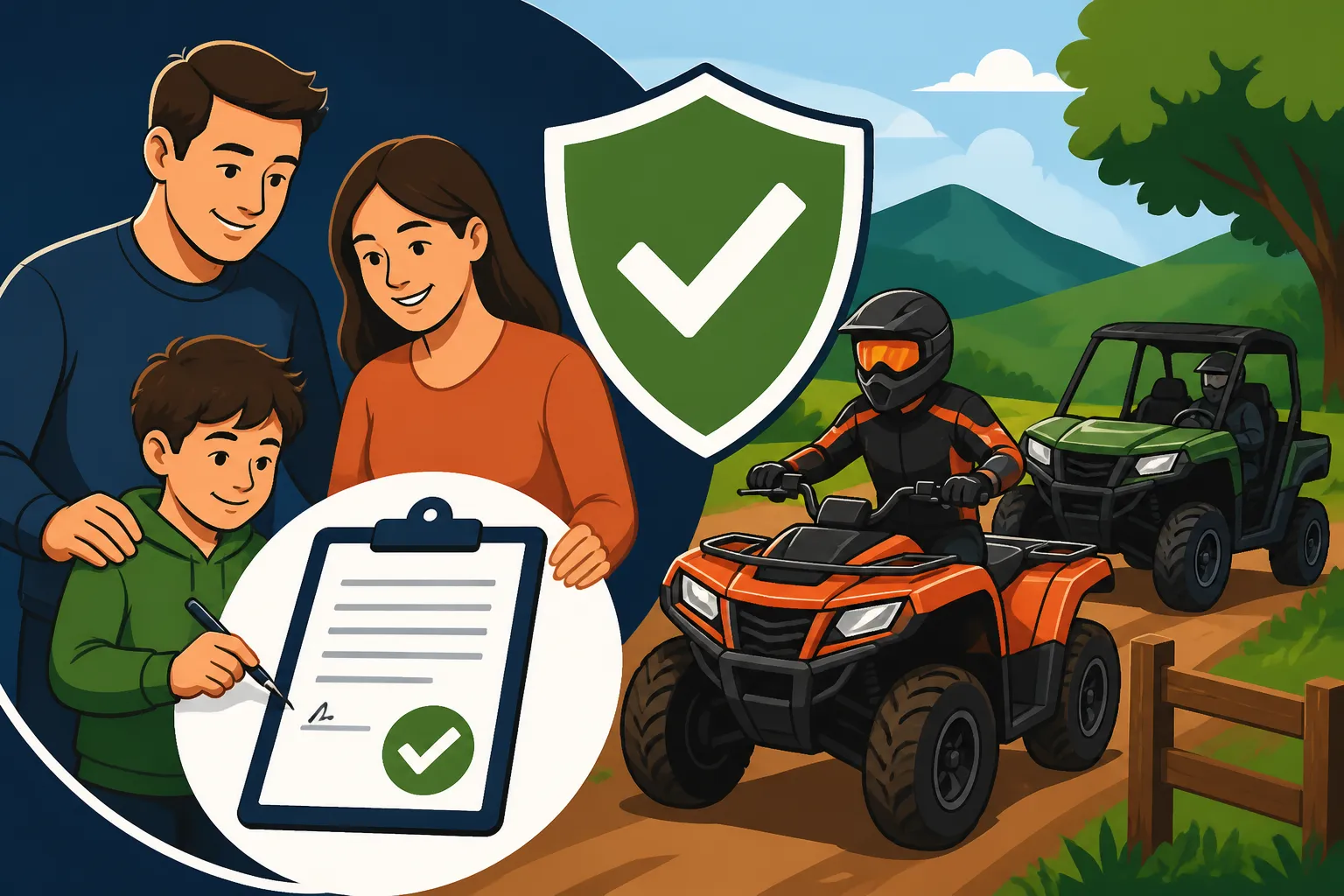
In Quebec, for a rider under 16 to operate an ATV on private land, they must have the express consent of a parent or legal guardian. While the LVHR doesn't specify a particular "form" that must be used, having something in writing is always the best practice. This written authorization should clearly state that the parent or guardian grants permission for their minor child (named) to operate an ATV on specific private property (address or clear description) under adult supervision. This acts as a legal record and clarifies intent, protecting both the child and any supervising adult.
Consider using a template or creating your own form that includes essential details. [Quebec Parental Authorization Forms] are a great resource to get started, ensuring you cover all the bases. This written consent demonstrates that you, as the parent, have consciously agreed to allow your child to ride, taking on the responsibility for their actions and safety within that controlled environment. It’s not just a formality; it’s a commitment.
Supervision Requirements on Private Land
Parental authorization almost always comes hand-in-hand with adult supervision. The law typically requires that a responsible adult (often 18 years or older, though not always explicitly defined as such for private land in the same way it is for public trails) must be present and capable of overseeing the minor rider. This isn't about sitting in the house while they ride out of sight; it's about active, direct supervision. The supervising adult should be able to intervene quickly if necessary, guide the rider, and ensure safety rules are followed.
This direct supervision is critical not only for safety but also for the legal validity of the authorization. If an incident occurs and it's determined that the child was not adequately supervised, the parental authorization might not fully shield you from liability. It's about providing a safe learning environment, where skills can be developed gradually and risks managed effectively. A responsible adult acts as an immediate safety net, ready to step in at any moment.
Best Practices for Documenting Permission
Even though a specific form isn't legally mandated, creating one is a smart move. Here’s what a good parental authorization document might include:
- Full name of the minor child: Clearly identify who has permission.
- Date of birth of the minor child: Establishes their age.
- Full name(s) of parent(s) or legal guardian(s) giving consent: Clearly identifies who is authorizing.
- Contact information for parents/guardians: In case of emergency.
- Description of the private land: Address or detailed description where riding is permitted.
- Type of off-road vehicle(s) permitted: (e.g., "ATV 90cc," "Side-by-side," etc.).
- Name of supervising adult (if different from parent) and their signature: Formalizes the supervision arrangement.
- Statement acknowledging understanding of risks and responsibility.
- Date of authorization and signature of parent(s)/guardian(s).
This document serves as proof of your due diligence and can be invaluable if questions arise. It’s particularly important if your child will be riding on private land that isn’t yours, or if they’ll be supervised by someone other than yourself. Sharing this document with anyone supervising your child ensures everyone is on the same page.
Ensuring Safety and Responsibility on Private Land
Parental authorization allows younger riders to enjoy ATVs and side-by-sides on private land, but it doesn't absolve parents of the responsibility to ensure their safety. In fact, it places an even greater emphasis on diligent oversight and proper preparation.
Prioritizing Safety Gear and Machine Condition
Regardless of age or location, proper safety gear is non-negotiable. This includes a DOT-approved helmet (with a visor or goggles), sturdy boots, gloves, long pants, and a long-sleeved shirt. These items protect against impact, abrasions, and flying debris. Just because it's private land doesn't mean tree branches, rocks, or unexpected obstacles disappear.
Furthermore, the machine itself must be in good working order. Regularly check tires, brakes, lights, fluid levels, and controls. For youth machines, ensure any speed limiters or safety features are functioning correctly. Maintaining the machine, perhaps even installing aftermarket safety parts like robust bumpers or brush guards from SuperATV, can provide an extra layer of protection, particularly when learning to ride. It's about minimizing risks wherever possible, and a well-maintained, appropriately equipped machine is fundamental to that.
Setting Ground Rules: Speed, Boundaries, and Risk
Even on private land, establishing clear ground rules for riding is essential. These rules should cover:
- Speed limits: Appropriate to the rider's skill level and the terrain.
- Boundaries: Clearly define the areas where riding is permitted and forbidden.
- No-go zones: Areas with hidden hazards, steep inclines, or bodies of water.
- Riding buddies: Encourage riding with another person (if age/machine appropriate) and never alone, especially in remote areas.
- Time limits: Preventing fatigue, which can lead to accidents.
These rules should be communicated clearly and consistently. For example, if you have a larger property with varied terrain, you might designate specific loops for beginners and more challenging areas for experienced riders. The goal is to build skills incrementally in a controlled environment. Consistent enforcement of these rules, along with leading by example, helps instill a strong safety culture in your young rider.
The Role of Insurance, Even on Private Property
It's a common misconception that if you're riding on private land, you don't need insurance. In Quebec, liability insurance is mandatory for all off-highway vehicles, regardless of whether they're ridden on public trails or private property. This liability insurance covers damages your machine might cause to property or injury it might inflict on others. [Quebec Insurance Minimum for an Owner] explains that this coverage is designed to protect you from financial ruin if an accident occurs.
Even if your child is riding on your own land and has an accident that results in injury to a friend or damage to a neighbor's fence, your liability insurance would be crucial. Without it, you could be personally responsible for significant costs. Always confirm with your insurance provider that your ATV or side-by-side policy covers private land use and that your child, as an operator, is included. This is not an area to cut corners, as the consequences of being uninsured can be devastating.
Common Misconceptions and Clarifications
The world of Quebec ATV rules can be a bit of a maze, and parental authorization on private land is no exception. Let's clear up some common misunderstandings.
"My Backyard, My Rules" – The Limits of Private Property
While owning private land does grant you more autonomy, it doesn't create an absolute legal vacuum. The "my backyard, my rules" mentality can be dangerous. As discussed, liability insurance is still mandatory, and fundamental age restrictions, even with parental consent, imply a level of maturity and machine appropriateness. You can't, for example, authorize a five-year-old to operate a 1000cc side-by-side on your land without facing serious legal scrutiny if an accident occurs.
The law is designed to prevent gross negligence. While provincial patrol officers are unlikely to be cruising your private fields looking for infractions, serious incidents resulting in injury or significant property damage can and will lead to investigations where parental responsibility and adherence to safety principles will be thoroughly examined. It’s about being responsible, not just legally compliant. Remember [Quebec Machines Used Only on Private Land] still have certain expectations of their owners, especially regarding insurance.
Confusion with Federated Trails and Public Access
It's crucial to understand that parental authorization for private land use does not extend to federated trails or public lands. The rules for these areas are much stricter. For instance, a 16-year-old on a federated trail needs a valid driver's license (car or motorcycle class) and may need an FQCQ training certificate. [Quebec FQCQ Training Certificates for Teens] are required for 16 and 17-year-olds on trails, demonstrating a level of formal training that simply riding on private land doesn't confer.
The allowance for younger riders on private land is specifically because it's a controlled environment under direct parental supervision. Once you venture onto a public trail, you enter a regulated space with specific age limits, licensing requirements, and often speed restrictions. Attempting to use parental authorization as an excuse on a public trail will lead to fines and potential legal issues. The distinction between the two types of riding environments could not be clearer.
The Difference Between Authorization and Training Certificates
Parental authorization on private land for a minor rider is fundamentally about parental consent and supervision. It is not a substitute for a formal training certificate issued by the FQCQ (Fédération Québécoise des Clubs Quads). As mentioned, these certificates are a requirement for 16 and 17-year-olds who wish to ride on federated trails. While such training is highly recommended for all riders, regardless of age or location, it is only a legal requirement in specific contexts for specific age groups.
A parent might authorize their 15-year-old to ride on their farm, but that same 15-year-old could not then ride on a federated trail, even with a training certificate, because they have not yet met the minimum age of 16 for trail access. The authorization simply grants permission within the private land context; it does not confer the legal right to access public or federated trails. For those aspiring to ride federated trails, understanding [What a 17-Year-Old Needs Before Riding a Trail] is essential, and it goes far beyond simple parental consent.
Summary of Key Distinctions
To help clarify the differences between riding on private land with parental authorization versus riding on public or federated trails, here’s a quick overview:
| Feature/Requirement | Riding on Private Land (with Parental Authorization for Minors) | Riding on Federated/Public Trails |
|---|---|---|
| Minimum Age to Ride | Flexible for minors with consent/supervision, depends on machine and parent discretion. | 16 years old for ATVs, 18 years old for Side-by-Sides. |
| Parental Authorization | Crucial for minors, ideally written. | Not applicable; specific age/licensing/training requirements override. |
| Adult Supervision | Mandatory for minors, direct and active. | Generally implied for minors (if permitted) but formal requirements (e.g., driver's license). |
| Driver's License | Not explicitly required for minors, though recommended for older youth. | Mandatory (car or motorcycle class) for 16+. [Quebec Requires a Driver's Licence Since 2021] |
| Training Certificate | Not legally required for private land, but highly recommended. | Required for 16 and 17-year-olds (FQCQ). |
| Liability Insurance | Mandatory. | Mandatory. |
| Registration (SAAQ) | Mandatory for all ORVs, even if only used on private land. | Mandatory. |
| Safety Gear (Helmet) | Mandatory. | Mandatory. |
| Fines/Penalties | Primarily for negligence or lack of insurance in case of incident. | For all infractions (age, license, pass, speed, equipment, etc.). |
Understanding these distinctions is paramount for any parent or guardian in Quebec. While private land offers a fantastic opportunity for young riders to develop skills and enjoy the outdoors, it must always be done with careful planning, strict supervision, and an unwavering commitment to safety.
Disclaimer
This article is for general informational purposes only and does not constitute professional advice. Laws, prices and regulations vary by location and change over time. Consult a qualified professional for guidance on your specific situation.