What Happens When a Patrol Checks Your Sticker
A trail patrol stop can be unsettling if you are unsure whether the sticker on your quad is the right permit or what else you may be asked to show. In Quebec, the sticker is only one part of the check. Knowing who may stop you, which papers and equipment matter, and how to respond calmly can make the interaction straightforward.
Who may check your trail sticker
Peace officers and trail wardens patrol Quebec snowmobile and ATV trails, according to the Gouvernement du Québec. A trail warden is appointed by an off-highway vehicle club or an association of clubs. A warden appointed by a local club patrols within a defined territory; a warden appointed by an association may cover a larger area.
The distinction matters because a club-appointed trail warden has specific authority to stop an off-highway vehicle to inspect it and check its equipment, according to the Gouvernement du Québec. A patrol stop may therefore involve more than a glance at the sticker. The warden may ask to see documents and confirm the machine meets applicable requirements.
| Who is patrolling | What the role means for you |
|---|---|
| Peace officer | Patrols off-highway vehicle trails and may check whether riders are complying with applicable rules. |
| Local club trail warden | Patrols a defined territory and may stop an off-highway vehicle to inspect it and check equipment. |
| Association-appointed trail warden | Patrols a larger area; the appointment comes from an association of clubs. |
The exact powers and responsibilities can depend on the person’s role. If you are unsure who has stopped you, ask politely for their identification and role before you hand over documents. Stay in a safe place, keep your machine under control, and follow reasonable safety directions while you clarify what is being checked.
For a closer look at a trail warden’s role, see What a Club Trail Patroller Can Make You Do. Being Stopped on a Trail also covers the practical side of responding to a stop.
What a patrol may ask to see
The trail access permit is not the only document that may come up. According to the Gouvernement du Québec, riders may be asked for identification showing proof of age, a driver’s licence, vehicle registration, proof of insurance, and a valid trail access permit.
Those documents answer different questions. The permit relates to access to the trail network. Registration identifies the vehicle for registration purposes, while insurance is a separate requirement. A sticker does not, by itself, establish that you have every document or requirement needed to ride.
That distinction is easy to miss when a sticker is visible on the machine. Keep the permit and the rest of your paperwork accessible rather than treating the sticker as a substitute for documents. For more on how these requirements fit together, see Quebec Registration and Trail Pass Together and Quebec Trail Pass Proof on the Trail.
A patrol may also ask to inspect the vehicle and its equipment. According to the Gouvernement du Québec, an off-road vehicle must have proper equipment for public roads and trails. The requirements vary with the vehicle and where it is being used, so a document check is not necessarily the whole inspection.
Keep each document easy to identify
Before a ride, check that you have the documents that apply to you and your machine, and that you can tell which is which. If you are carrying digital copies, do not assume that a phone image will be accepted in place of a required document; the facts available here do not establish that a photo counts as proof. For the specific question of what to carry, see Carrying a Driver’s Licence on a Federated Trail and Quebec Insurance Proof on the Trail.
Make sure the permit you present is valid for the trail access you intend to use. If you are unclear about what your pass covers, confirm the current details with the relevant provider before setting out. Quebec Trail Passes Cover Every Club can help explain the network-wide aspect of access, while Quebec VHR Plates Explained covers the separate vehicle-plate concept.
What usually happens during a stop
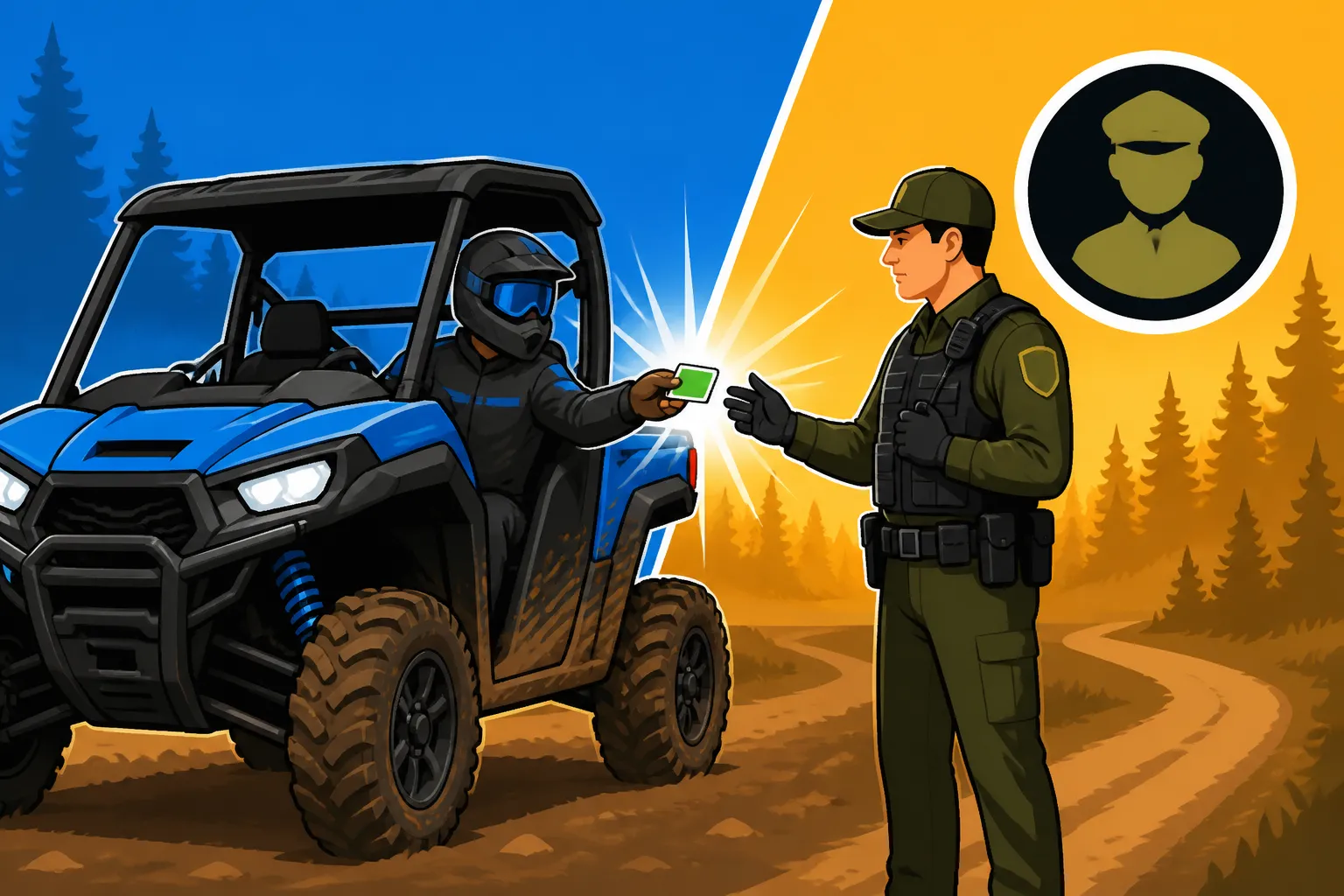
A patrol check is easier to manage when you treat it as a short, practical conversation rather than an argument about the sticker. The warden may ask you to stop, look at the permit, request documents, and check equipment. The purpose is to assess whether the rider and vehicle meet the requirements for that trail.
A sensible sequence is:
- Stop somewhere safe. Slow down, move clear of other trail users where possible, and switch off the vehicle if it is safe to do so.
- Listen to the request. The patrol may ask for a permit or other documentation, or may want to inspect the vehicle and equipment.
- Show the requested items. Provide the relevant identification, licence, registration, insurance proof, or permit. If you are uncertain about a request, ask what is needed and why.
- Answer clearly and calmly. If a document is not with you or you do not know whether the sticker is valid, say so rather than guessing.
- Clarify any issue before leaving. If the patrol identifies a problem, ask what needs to be corrected and whether you may continue. Do not assume that a visible sticker settles the matter.
A stop can be routine, but it may reveal a missing document, a permit problem, or an equipment issue. The Gouvernement du Québec says vehicle owners, operators, and passengers can face fines for non-compliance. The applicable consequence depends on what the issue is; the available facts do not establish a specific fine for every possible sticker or permit problem.
If you are given a notice or told that you cannot continue, take note of the stated reason and follow the instructions provided. Avoid trying to resolve a disagreement by continuing onto the trail while the issue is unresolved. If you believe the check or decision was mistaken, get clear information about the next step rather than escalating the discussion on the trail.
Avoiding sticker and paperwork problems
The best time to find a permit problem is before reaching a trail. Build a quick check into your departure routine: confirm that the permit is the one you intend to use, that it is accessible, and that you have the other documents that may be requested. Then check the vehicle and the trail conditions.
Do not confuse a vehicle plate with a trail access permit. They serve different purposes, and a patrol may ask for both the vehicle’s registration and a valid trail permit. The articles Quebec Registration and Proof of Ownership and Quebec Pass Proof on the Trail explain these separate sides of the paperwork.
Also make sure the machine and rider meet the requirements for the trip. For example, the Gouvernement du Québec says off-road vehicles may travel on roads and trails from 6 a.m. to midnight, and failure to respect the permitted operating hours carries a minimum fine of $250. A sticker cannot make a ride lawful if another rule is being broken.
Other requirements can apply even when the pass is in order. The Gouvernement du Québec requires drivers and passengers to wear a helmet with a visor, or safety goggles if the helmet has no visor. It also says drivers and passengers must wear suitable footwear, and that drivers must keep the required front white headlights and red taillights turned on while operating an off-road vehicle. Check the rules that apply to your machine and route before riding; do not rely on a sticker check as a complete safety or compliance review.
If a sticker is hard to see, damaged, or its status is unclear, sort that out before riding rather than waiting for a patrol to raise the question. Keep the permit information and supporting paperwork together, and check current permit instructions with the provider. For equipment-related checks, Quebec Equipment Checks by Patrols offers a useful companion.
The practical takeaway is simple: a visible sticker helps, but it is not the entire proof of compliance. Be ready to show the permit and other requested documents, and expect that an authorized club warden may inspect the vehicle and its equipment. A calm response and a pre-ride check are the easiest ways to keep a patrol stop from disrupting your ride.
Sources
- Gouvernement du Québec — Lieux pour circuler en véhicule hors route | Gouvernement du Québec (checked November 3, 2026)
- Gouvernement du Québec — Off-highway vehicle trail patrol | Gouvernement du Québec (checked November 3, 2026)
- Gouvernement du Québec — Rules for off-road vehicles | Gouvernement du Québec (checked November 3, 2026)
- Gouvernement du Québec — Off-road vehicle riding areas | Gouvernement du Québec (checked November 3, 2026)
Disclaimer
This article is for general informational purposes only and does not constitute professional advice. Laws, prices and regulations vary by location and change over time. Consult a qualified professional for guidance on your specific situation.