Quebec Group Size on Club Trails
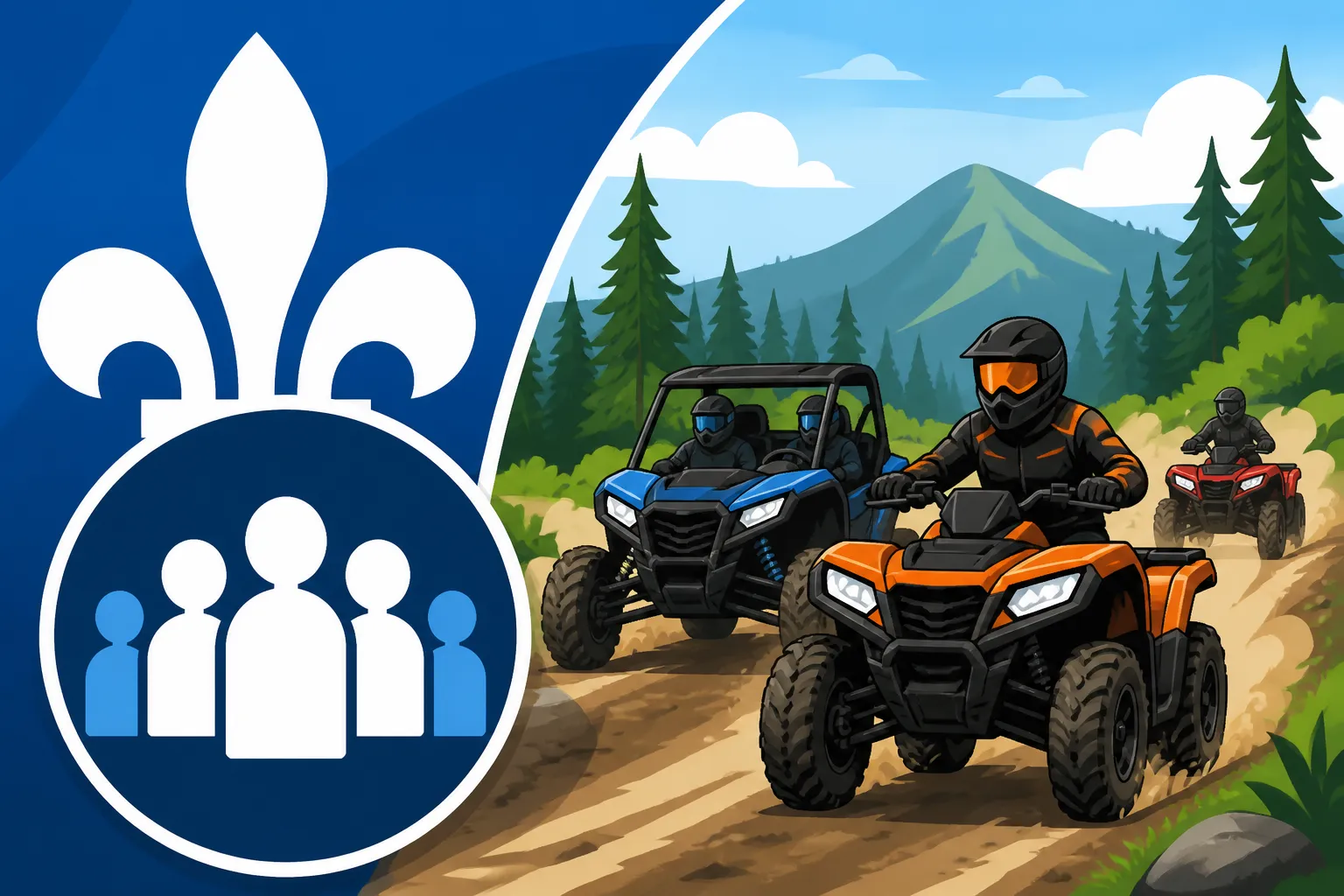
A large ATV or UTV group can be harder to manage than it looks: machines spread out, intersections split the convoy, and a busy trail leaves little room to regroup. Quebec does not appear to set one universal group-size limit for every club trail. The practical limit depends on trail conditions, club or event instructions, and your group’s ability to ride safely without blocking others.
Is there a legal group-size limit on Quebec club trails?
A group size can mean the number of riders, the number of machines, or the number of machines travelling together as one convoy. Those are not always the same thing: some machines carry more than one person, while a club ride may count each vehicle when it sets a limit.
For ordinary recreational riding, do not assume that a single province-wide maximum applies to every informal group on every federated trail. A club, event organizer, land manager, or operator may set its own conditions for a particular ride or section. Trail closures, temporary restrictions, posted instructions, and patrol directions matter even when your group is within a limit set for a different event.
This distinction is useful when planning. A number that works for an organized ride may not be a legal limit for all riders. Conversely, the absence of a general numerical maximum does not mean any convoy size is appropriate in any place. A crowded, narrow, wet, or low-visibility section can make a large group unsafe even if no sign names a maximum.
If you are joining a club event, check the event’s instructions rather than relying on what a friend remembers from another ride. Ask whether the organizer has a maximum number of machines, whether the group will be split into smaller riding units, and whether there are requirements for guides or ride leaders. For an informal outing, check for current trail notices and local club guidance before departure.
Group size also does not replace the normal requirements for each rider and machine. Riders still need to meet applicable age, licence, and equipment rules, and each vehicle must be properly registered and insured for its use. Federated trails also have access requirements, including a valid trail pass where one is required. The pass is not a group permit that covers every machine in the convoy; confirm what each vehicle needs before setting out. Quebec Trail Passes Cover Every Club explains the pass’s network coverage, while Quebec Pass Proof on the Trail covers what to have available during a ride.
If you are uncertain whether an event’s limit is a club condition, a permit condition, or a general legal requirement, ask the organizer to clarify. A limit may apply only to a particular trail, date, event, or guided activity. Do not transfer it automatically to an unrelated ride.
Why group size changes how safely you can ride
A group that is easy to manage on a wide, straight corridor may become difficult on a narrow trail, at a road crossing, or where the surface is loose. The larger the convoy, the more important it is to avoid long gaps, sudden stops, and riders trying to catch up by speeding.
A long line can also make it harder for other trail users to pass or for oncoming machines to get through. On shared corridors, courteous spacing and clear communication help prevent the group from taking over the trail. Keep the convoy moving at a pace suitable for the least experienced rider and the conditions, not at the pace of whoever is most eager to get ahead.
Several practical factors should shape your decision:
- Trail width and visibility: Narrow paths and blind corners leave less room to pass or regroup. A convoy that fits comfortably on one section may need to break into smaller units elsewhere.
- Surface and weather: Mud, loose gravel, standing water, or recent rain can make it harder to stop or keep a consistent distance. Check local reports before riding; Quebec Trail Conditions Before You Go can help with that planning.
- Experience: Newer riders may need more room and more frequent stops. Pairing them with calm, experienced riders is generally more useful than placing everyone by machine speed.
- Machine type: A UTV may take more trail width than a quad, and a larger machine may affect sightlines and passing space. Do not assume a trail’s capacity is identical for every combination of vehicles.
- Distance between stops: A long route with limited services or cell coverage calls for more careful planning than a short local loop. Agree in advance on places to stop and what to do if the group separates.
- The presence of other users: Club trails may be shared with other riders or with different types of traffic depending on the route and season. Follow local signs and give other users room.
The goal is not to find the biggest convoy a trail can physically hold. It is to choose a group size that lets every rider see what is happening, respond to hazards, and stop without forcing others into an unsafe manoeuvre. Quebec Trail Etiquette Locals Expect has more on sharing the corridor respectfully.
How to organize a group without creating a trail bottleneck
If your group is large, divide it into smaller riding units before reaching a narrow or busy section. Each unit should have a leader who knows the route and a designated last rider who can confirm that nobody has been left behind. This is often called a sweep rider. Everyone should know who these people are before the machines start moving.
A staggered formation can help riders keep space while remaining visible to one another, but riders should not treat it as a reason to close gaps or crowd the machine ahead. Leave enough room to stop safely for changing conditions. On a narrow section, a blind corner, or a place where the trail is rough, ride in the position that gives each person adequate control and visibility. Never assume the formation is safe simply because it is common in a different setting.
Before departure, agree on a simple regrouping plan:
- Choose meeting points. Use a trailhead, signed junction, or another safe place with room to pull off. Avoid stopping just beyond a blind corner or in the middle of a crossing.
- Set a pace and spacing expectation. Make clear that the group should ride at a controlled speed and should not pressure a slower rider to catch up.
- Explain what to do if separated. Riders should know whether to continue to the next agreed stop or wait at a safe location. Avoid plans that depend on every rider having cell service.
- Confirm the route. Review the map and any current closures or detours. The Quebec Trail Maps and the iQuad App article can help with route-following, but a phone should not be the group’s only navigation plan.
- Check everyone’s readiness. Confirm that riders have the required documents and equipment, and that each machine is suited to the planned route.
- Make a stop plan. Schedule breaks where the entire convoy can pull clear of the trail. A large group that stops unexpectedly at a junction can obstruct traffic and confuse riders approaching from behind.
At intersections, have riders follow the trail signs and ride through only when it is safe. Do not assume the entire convoy can cross together just because the first machine has reached the other side. A junction can separate the group quickly, especially if traffic, visibility, or the road layout requires riders to wait. The lead rider should not move so far ahead that the rest of the group is forced to rush.
If a machine has a problem, move off the travelled portion of the trail when it is safe to do so. The group should not form a wall around a disabled vehicle. Decide who stays to help and who continues to a safe regrouping point, based on the situation and the number of riders available. Keep other users’ passage in mind.
For additional planning ideas, see Quebec Group Ride Planning. A short pre-ride briefing can prevent confusion later: identify the leader and sweep, review the route, explain regrouping points, and remind everyone that trail signs and patrol instructions take priority over the group’s preferred pace.
What to check before a club trail ride
A well-managed group still needs to meet the conditions for the trail and the machines it brings. Before leaving, confirm that each vehicle is eligible for the route, has the necessary registration and insurance, and carries the required trail-access proof. Do not assume that one person’s documents or pass cover the whole convoy. For related details, see Quebec Equipment Checks by Patrols and Quebec’s Liability Insurance Rule.
Check the trail’s current status with the relevant club or official trail information. Federated trails can be affected by closures, maintenance, weather, seasonal conditions, and land-access issues. A route shown on a map is not proof that it is open today. Some trails cross private land, where continued access depends on permission and local conditions; Quebec Trails That Cross Private Land explains why staying on the authorized corridor matters.
For a group using several machines, it helps to keep a simple ride roster. Record who is coming, which machine each person is riding, and at least one contact person who is not on the trail. This is not a substitute for required documents, but it makes it easier to confirm attendance and deal with a late arrival or a breakdown. For a rented machine, check the rental operator’s instructions as well as the trail rules. Rental conditions may address who can drive, passenger arrangements, permitted routes, or group departures.
A checklist can keep the basics from being overlooked:
| Before the ride | What to confirm |
|---|---|
| Group instructions | Any event, club, operator, or land-manager limit or condition |
| Trail status | Open route, closures, detours, and relevant local notices |
| Access documents | Required registration, insurance, and trail-pass proof for each machine |
| Rider readiness | Applicable licence, age, training, and safety requirements |
| Machine capacity | Permitted seating and passenger arrangements for each vehicle |
| Route plan | Map, meeting points, fuel or service needs, and a way to handle separation |
| Group roles | Lead rider, sweep rider, and who can make decisions if plans change |
| Ride conditions | Weather, visibility, surface, and whether the route suits the least experienced rider |
The safest group size is ultimately the one that suits the route and can be managed without blocking the trail or pressuring riders into mistakes. For an organized ride, follow the event’s specific conditions. For an informal outing, break a large convoy into smaller units when the trail, visibility, or traffic makes that sensible. If local instructions are unclear, ask the club or organizer before riding rather than trying to settle the question at a trailhead.
Disclaimer
This article is for general informational purposes only and does not constitute professional advice. Laws, prices and regulations vary by location and change over time. Consult a qualified professional for guidance on your specific situation.