Quebec Fire Restrictions in Dry Summers
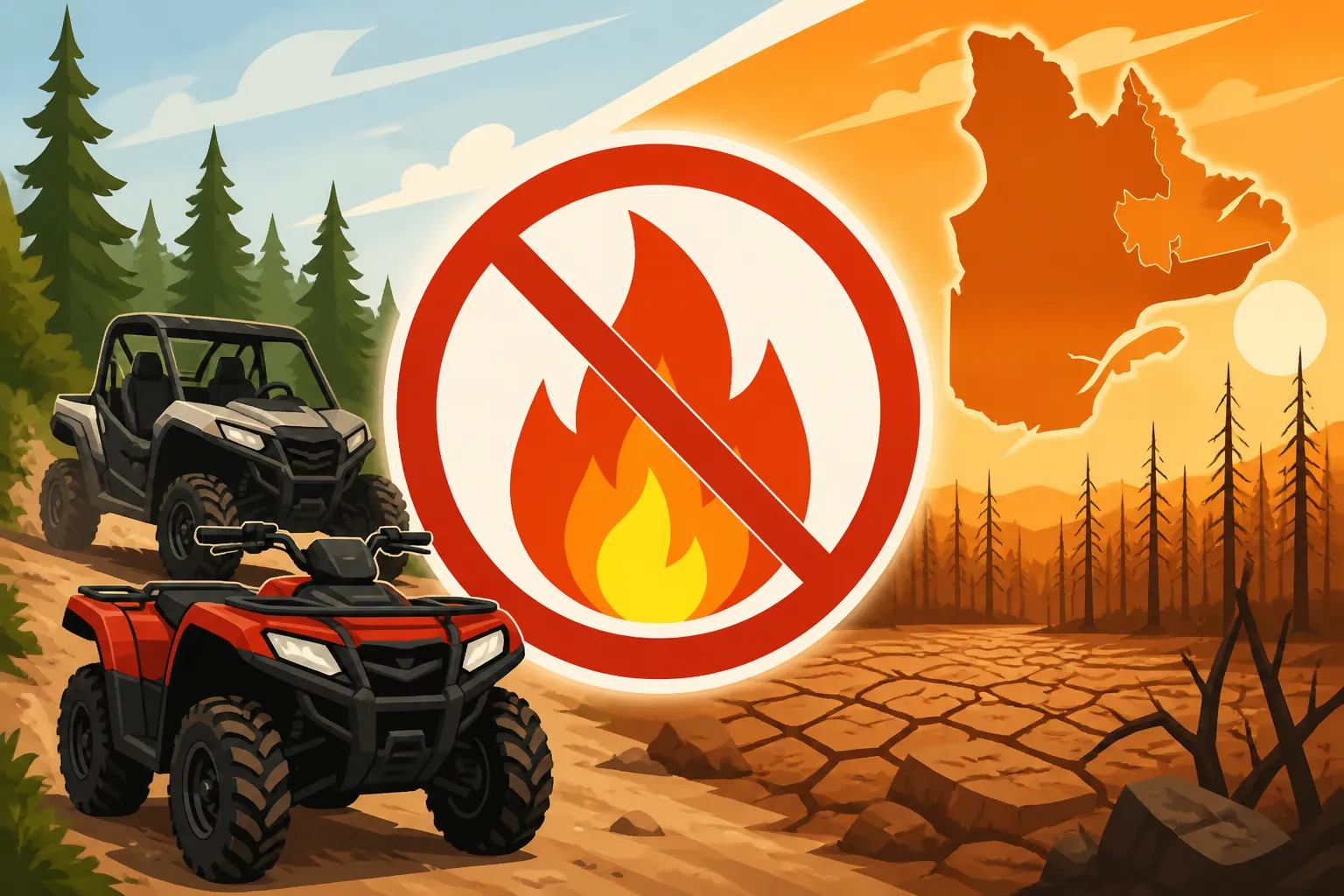
Dry weather can turn a routine Quebec ATV ride into a decision about whether the trail is open, whether a fire is allowed, and what precautions are sensible. Fire restrictions can change by region and may not automatically close every trail. Check the current rules for your route, then ride in a way that limits the chance of starting a fire.
What fire restrictions can mean for ATV riders
“Fire restriction” is not one single rule. During dry conditions, authorities or land managers may restrict open fires, close access to certain forest areas, or limit activities that could start a fire. A restriction may cover a broad region or a specific territory, and its conditions can change as weather and fire risk change.
A ban on campfires does not necessarily mean every ATV trail in the area is closed. The reverse is also true: an open trail does not mean you can make a fire at a rest stop or campsite. Treat fire rules and trail access as separate questions, and check both before setting out.
SOPFEU, Quebec’s wildfire prevention organization, provides information about fire danger and restrictions. Also check notices from the relevant municipality, park, outfitter, land manager or trail club. Each may have information that applies to a specific route or property. For general route planning, Quebec Trail Conditions Before You Go can help you build in a check for closures, but current fire notices still need to be verified separately.
| Notice or restriction | What it may mean for a rider | What to confirm |
|---|---|---|
| Open-fire prohibition | You may not be allowed to light a campfire or use other types of outdoor fire covered by the notice | Which fires and locations the notice covers |
| Forest access restriction or closure | Entry into a named area may be prohibited, including for recreation | The exact boundary, dates and permitted uses |
| Trail closure | A particular trail or section is unavailable, whether because of fire danger, damage or another reason | The club or land manager’s current status |
| High fire danger without a closure | Riding may remain permitted, but conditions call for extra care | Whether additional local restrictions apply |
| Municipal or property-specific rule | A local rule may differ from a broader regional notice | The municipality, park or property’s current directions |
These categories are not interchangeable. A fire-danger rating describes conditions; it is not automatically a legal closure. A closure or prohibition is a direction to follow. If a sign, official notice or land manager says not to enter or not to light a fire, do not assume a trail pass, prior permission or an online map overrides that direction.
Visitors from another province should take the same approach as Quebec residents. Reciprocity or a pass arrangement concerns trail access; it does not exempt a visitor from local fire rules, closures or landowner directions. If you are coming from Ontario, Quebec Visitors From Ontario is a useful starting point for planning the trail-access side of the trip, but fire restrictions still need a separate check.
How to check restrictions before and during a ride
A quick search for a general fire-danger rating is not enough to confirm that your planned route is open. The most reliable approach is to check the sources that control different parts of the trip.
- Check current wildfire information. Look at SOPFEU’s current notices for the region you plan to visit. Read the details of any prohibition rather than relying only on a map colour or a brief headline.
- Check access and closure notices. Review information from the municipality, park, outfitter, land manager or other organization responsible for the territory. A closure may apply to a particular road, trail, forest area or facility.
- Check the trail itself. Contact the local club or check its current trail updates. Federated trail access can change independently of a regional fire notice. Quebec ATV Trails: The FQCQ Network explains the trail network; for a particular ride, use the club’s latest information.
- Check again close to departure. Conditions can change after you plan a trip. Confirm the route on the day of the ride, especially after hot, dry or windy weather.
- Keep checking while travelling. Watch for posted signs and barriers, and take directions from patrols or land managers seriously. If a route is closed, turn back rather than trying to find an unofficial bypass.
For a multi-day ride, make the check part of each day’s planning. A trail that was open when you left home may be restricted later, and a dry-weather notice may affect only one part of your route. Save contact details for your group, share the intended route and agree on a safe alternative before setting out.
Do not use a map, GPS track or old social-media post as proof that a route remains open. Maps can help with navigation, but they may not reflect a new closure. Riding permission on private land is also distinct from permission to use fire: an owner’s earlier approval to ride does not cancel a current restriction. See Quebec Private Land Permission for the separate question of access rights.
If notices are unclear, do not guess. Ask the organization responsible for the trail or property whether riding is permitted and whether any conditions apply. If you cannot confirm access, choose a different route. A pass or registration does not grant permission to enter a closed area.
Reduce the chance of starting a fire
An ATV can create a fire risk even when its rider never lights a campfire. Hot exhaust components may ignite dry grass or other vegetation if the machine is parked over it. A damaged exhaust, dragging part, poorly secured load or mechanical problem can add risk. The sensible response is to avoid unnecessary exposure, keep the machine in good condition and leave dry vegetation undisturbed.
Before departure, inspect the machine for loose parts, leaks and debris around hot components. Pay attention to grass, leaves or mud packed around the exhaust and engine area. If you find a problem that could create heat, sparks or a fuel leak, deal with it before riding; do not assume it will be safe because the route is short.
On the trail:
- Stay on the authorized route. Do not cut across dry brush or make a new path around a closure.
- Avoid stopping or parking in tall, dry grass. Choose a clear, durable surface well away from vegetation that could touch hot parts.
- Do not let a group idle in one spot unnecessarily. If a machine needs attention, move to a suitable safe place first.
- Secure loads so straps, chains or other items cannot drag or contact hot components.
- Stop if you smell fuel, see smoke, hear an unusual scrape or notice a mechanical fault. Move to a safe location and shut down the machine when it is safe to do so.
- Follow any signs about smoking, cooking or other ignition sources. A rule about open fires may not describe every activity restricted in a particular place.
Bring the equipment appropriate to the ride and your machine, but do not treat a small extinguisher or a bottle of water as permission to enter a closed area or ignore a ban. Carrying fire-response equipment can be useful, but the first priority is to avoid causing a fire and to get help if one starts. Do not try to fight a fire that is spreading or puts people at risk.
If you see smoke or flames, alert your group, move away from danger and contact emergency services. Give the clearest location you can, including the trail name, nearby signs, junctions or a map position if available. Do not ride toward the fire to investigate, and do not block access for responders. If your group has no reliable way to communicate from the trail, identify a plan for reaching help before you leave.
A clean machine and safe stopping habits matter, but they are not substitutes for checking restrictions. A rider can take sensible precautions and still be required to stay out of an area that has been closed. For broader trip preparation, Quebec Crown Land Riding Rules can help with the access side of riding on public land; confirm any temporary fire or access notice with the responsible authority.
Trail access, passes and fire rules are separate
One common mistake is treating a trail pass as a general permit to ride anywhere or to use facilities in any way. It is not. A pass gives access only under the conditions that apply to the trail network, and temporary closures or property-specific rules still matter. Quebec Trail Passes Cover Every Club explains the scope of the trail-pass system, but a pass does not override a fire prohibition or reopen a closed trail.
The same distinction applies to registration, insurance and permission from a landowner. These may be important for legal riding, but they do not replace current fire notices. Before heading out, ask four separate questions:
- Is the machine properly registered and insured for the intended use?
- Do you have the pass or permission required for the route?
- Is the trail and surrounding territory open today?
- Are fires or other ignition sources restricted where you plan to stop?
A “yes” to the first two does not settle the last two. Keep the route flexible enough to avoid closed areas, and do not assume a restriction applies only to people camping. It may limit access or activities more broadly, depending on the notice.
Be especially cautious about informal advice from another rider. Someone may have ridden the same trail recently, but conditions and restrictions can change. A club volunteer, outfitter or landowner can be helpful, yet confirm any important direction against the current notice from the authority responsible for the area.
If you discover a closure during the ride, stop before entering the restricted section. Follow the posted detour only if it is an authorized route and is open. If no safe, permitted detour is clear, turn back. Do not cross a barrier, remove a sign or use a private driveway as a shortcut. Staying out protects people and property, and it helps prevent damage to trails and access agreements.
Dry-summer planning is mostly about checking reliable information and being willing to change plans. Verify wildfire restrictions and trail status before departure, keep checking during the trip, and avoid parking or riding in ways that could ignite dry vegetation. When in doubt about a notice, ask the responsible authority or choose another route.
Disclaimer
This article is for general informational purposes only and does not constitute professional advice. Laws, prices and regulations vary by location and change over time. Consult a qualified professional for guidance on your specific situation.