Quebec Group Ride Planning
Planning a Quebec ATV group ride can get complicated fast: trail access changes, riders have different experience levels, and one missing pass or breakdown can slow everyone down. A little preparation helps the group choose a suitable route, understand what to carry, and agree on a plan for delays or separation—whether you’re riding near the Laurentians, Charlevoix, or closer to home.
Start with the people and the purpose of the ride
Match the route to the least experienced rider
A route that feels easy to one person may be stressful to someone who has only ridden a few times. Before choosing a destination, ask about each rider’s experience, comfort with hills and mud, and familiarity with their machine. Be specific: “Have you ridden a narrow, rocky trail?” is more useful than “Are you comfortable off-road?”
Build the day around the least experienced rider, not the most confident one. A group with a first-timer, a young rider, or someone on a new-to-them machine will usually be happier on a shorter, more straightforward route with obvious stopping points. That isn’t a lesser ride. It means fewer rushed decisions and a better chance everyone finishes feeling good about the day.
Also check who is actually eligible to ride the route. Quebec requirements can depend on the rider’s age, licence, machine type, and the kind of trail. Review [Quebec ATV Road Rules Under the LVHR] and the relevant age and licence rules before inviting someone to join. Don’t assume that a youth rider who can ride on private land can automatically ride a federated trail.
Agree on the ride’s style and pace
A group ride can mean a relaxed outing with long lunch breaks, a destination-focused day, or a longer circuit where the group wants to cover ground. Decide what kind of day you’re organizing before you pick a route. It’s frustrating when some riders expect a leisurely scenic ride and others are impatient to keep moving.
Talk through the basics in advance: when to meet, when the group will depart, how often you’ll stop, and whether everyone is expected to stay together. Agree that no one rides ahead of the leader or falls behind the designated sweep rider without telling the group. If someone needs a break, the group pauses in a safe place rather than leaving them to catch up alone.
For mixed-ability groups, choose a pace that allows space between machines and time to respond to changing trail conditions. A steady, predictable ride is usually safer and more enjoyable than trying to keep up with the fastest rider. If people want different speeds, consider splitting into two groups only when there are enough experienced riders to lead and sweep each group—and everyone understands the meeting point.
Choose a route that fits the day
Check access, conditions, and closures before you go
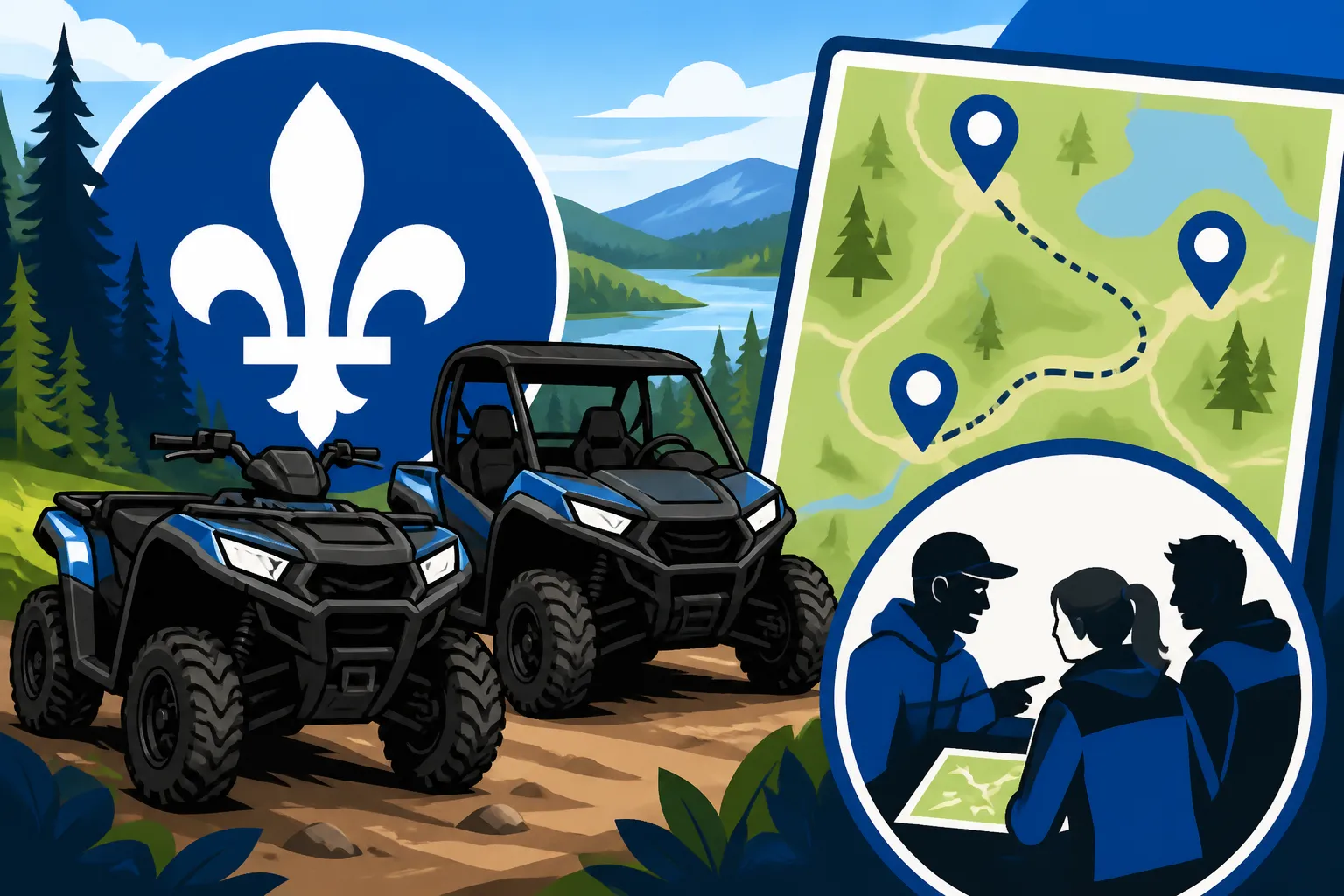
Start with a current trail map and information from the relevant club or trail authority. A route that appears connected on an older map may be closed, temporarily unavailable, or unsuitable for the machines in your group. Spring thaw, heavy rain, hunting activity, maintenance work, and local access arrangements can all affect whether a trail is open.
The [Quebec ATV Trails: The FQCQ Network] guide can help you understand the broader federated trail system. For a specific ride, check club updates and trail conditions close to your departure date, then check again on the morning of the ride if conditions may have changed. Never treat a saved map or a familiar route as proof that a trail is open today.
Mapping tools can help you sketch a route and understand the surrounding area. Some riders use onX Offroad to review route options and keep track of a planned ride, but compare any app information with current local trail notices and authorized access details. An app should support your planning, not replace confirmation that a trail is open and legal to ride.
Choose a realistic distance and destination
Distance on a map doesn’t tell the whole story. A route can take much longer than expected if it has rough sections, frequent stops, poor weather, slower riders, or a fuel stop that requires leaving the trail. Choose a plan with room for those delays rather than scheduling the day so tightly that the group feels pressured to ride faster.
A sensible way to plan is to choose a main route and a shorter fallback. Mark places where the group can safely stop, refuel, or turn back. If the ride starts near Saint-Hippolyte, Baie-Saint-Paul, or another trail access point, confirm parking and staging arrangements before the group arrives. A cluster of trailers at a busy trailhead can create a headache if everyone assumes there will be space.
| Planning question | What to confirm | Why it matters |
|---|---|---|
| Is the trail open? | Club or trail authority updates and local notices | Maps may not reflect temporary closures |
| Is the route suitable? | Surface, difficulty, machine fit, and rider experience | A difficult section can divide or delay the group |
| Where can we stop? | Safe pull-offs, fuel options, and regrouping points | Stops are easier when the group plans them |
| What if we turn back? | Shorter return route or clear turnaround point | Gives the leader a practical alternative |
| Does everyone have access permission? | Required trail pass and any local access conditions | Registration alone may not provide trail access |
If the ride uses federated trails, confirm that each machine has the required trail pass and that riders understand what it covers. [Quebec Trail Passes Cover Every Club] explains the role of a pass within the club network. Don’t assume a pass overrides a closure or grants permission to use an unrelated private road or trail.
Get the group ready before departure
Confirm documents, equipment, and machine readiness
Ask each rider to handle their own paperwork before ride day. Depending on the ride, that may include registration documents, proof of insurance, a valid trail pass, and required rider credentials. The group leader can remind everyone, but should not be left trying to solve missing paperwork at the trailhead. For a practical starting point, share [Quebec Registration Paperwork Checklist] and [Quebec Insurance Proof on the Trail] with the group.
A brief pre-ride check can catch simple problems before they become trail problems. Ask riders to inspect tires, brakes, lights, fuel, and any parts that have been acting up. On a longer ride, make sure people know how to access basic tools and recovery equipment. A machine that starts easily in the driveway may still have a weak battery, loose fastener, or tire issue that shows up after an hour on rough ground.
Agree on what the group will carry collectively and what each person should bring. A group kit might include a first-aid kit, tire repair supplies, basic tools, a tow strap, and a way to contact help where service is available. Each rider should have water, weather-appropriate layers, food for the planned duration, and any personal medication they may need. For ideas on preparing for a longer outing, see [Packing for a Multi-Day Ride].
Set communication and regrouping rules
Cell service can be unreliable on remote routes, so don’t make a phone the group’s only communication plan. Before departure, exchange phone numbers, identify the leader and sweep rider, and agree on simple signals or a radio channel if the group uses radios. Keep the plan easy to remember. A complicated set of signals is unlikely to help when riders are tired, wearing helmets, and trying to communicate over engine noise.
Choose regrouping points before the ride begins. These might be trail junctions, established rest areas, or other safe places where the whole group can wait without blocking the trail. If someone loses sight of the group, the agreed rule should be to stop at the next safe location and wait—not to speed up and try to catch the others. The leader and sweep rider can then account for everyone and decide what to do.
A quick briefing at the trailhead is worth the few minutes it takes. Cover the planned route, expected stops, fuel plan, hand signals, following distance, and what to do if a machine breaks down. If the group uses a route-tracking app such as onX Offroad, make sure everyone knows how to access the route and what the group’s fallback plan is if a phone battery dies or a device loses signal. A digital route is helpful, but it doesn’t replace staying together and making deliberate decisions.
Ride responsibly and handle changes calmly
Keep trail access and local conditions in mind
Quebec trails can pass through varied landscapes and near farms, cottages, villages, and private land. Stay on authorized routes, follow posted signs, and respect closures. Taking a tempting side trail or cutting across a field can put access at risk for future riders. If the trail crosses private property, the group’s permission to ride depends on the authorized route and its conditions—not on whether the land looks unused.
Quiet, considerate riding matters, especially near homes and shared-use areas. Avoid unnecessary revving, give other trail users room, and leave gates as you found them. If the trail is muddy or damaged, don’t assume that pushing through is harmless. Turn around when conditions make it unsafe or when you could worsen the trail. [Staying on a Federated Corridor] offers a useful reminder of why route discipline matters.
Weather can also change the ride. Rain can make a familiar section slippery, and a cold evening can feel much harsher after a long day outdoors. The leader should be comfortable shortening the route when conditions or the group’s energy call for it. Changing the plan is not a failure; it’s part of responsible group riding.
Make a simple breakdown and separation plan
Before the ride, decide what happens if a machine can’t continue. The group should stop somewhere safe, move out of the way of other trail users, and avoid leaving the rider alone while the situation is assessed. If the machine can be repaired safely, the group can decide whether to wait, split with clear roles, or return together. Don’t let the group scatter without agreeing who is staying and where everyone will meet.
For a rider who becomes separated, use the regrouping rules discussed at the trailhead. The leader and sweep rider should account for the group at planned stops and avoid assuming a missing rider has simply gone ahead. If someone has a serious injury or there is an immediate emergency, prioritize getting appropriate help rather than trying to continue the ride.
Leave someone at home a basic version of the plan: where you expect to ride, when you expect to return, and whom to contact if the group is delayed. This is especially useful for a remote route or an outing with limited phone coverage. Once the ride is over, let that person know the group is safely back.
A well-planned Quebec group ride doesn’t need to feel rigid. The point is to make the important decisions before you’re on the trail, so everyone can focus on riding, scenery, and spending a good day together. Confirm access, choose a route that suits the group, and give yourselves permission to slow down or turn back when the conditions call for it.
Disclaimer
This article is for general informational purposes only and does not constitute professional advice. Laws, prices and regulations vary by location and change over time. Consult a qualified professional for guidance on your specific situation.