Quebec Certificates for 16 and 17-Year-Olds
A 16- or 17-year-old in Quebec may be old enough to operate certain ATVs, but age alone is not enough. The required training certificate is easy to confuse with a driver’s licence, trail pass or permission to ride. Here’s what the certificate is for, how to get it and what it does not allow.
What the certificate means for 16- and 17-year-olds
Quebec requires a 16- or 17-year-old who operates an ATV to hold a certificate of competence and knowledge. The certificate shows that the young rider has completed the required training and demonstrated the knowledge needed to operate the vehicle. It is a qualification for the rider, not a registration document for the ATV.
The certificate requirement is part of Quebec’s rules for off-highway vehicles, often called VHRs. A quad is commonly referred to as a VTT in Quebec; the terminology can vary, but the relevant rules depend on the vehicle and where it is being operated. For a fuller explanation of the legal framework, see Quebec’s Off-Highway Vehicle Act and Your Papers and Quebec ATV Age Requirements.
A certificate is not the same thing as a driver’s licence. It does not become a general licence to drive on public roads, and it does not override other requirements that apply to a particular route or vehicle. The conditions for operating a vehicle on a public road can differ from those for a club trail or private land. Check the current rules for the route you plan to use, including Do You Need a Licence for an ATV in Quebec?.
The certificate also does not replace the machine’s registration, required liability insurance or a trail pass where one is required. These are separate obligations:
| Requirement | What it is for | What it does not replace |
|---|---|---|
| Training certificate | Confirms the 16- or 17-year-old has completed the required training and assessment | Registration, insurance or a trail pass |
| Registration | Identifies the vehicle for legal use under Quebec requirements | The rider’s training certificate |
| Liability insurance | Provides required liability coverage for the machine | Registration or training |
| Trail pass | Provides access to federated trails when required | Permission to ride a closed trail or a rider’s certificate |
For registration and insurance details, start with Quebec ATV Registration With the SAAQ and Quebec’s Liability Insurance Rule. For the separate trail-access requirement, see Quebec’s Annual FQCQ Trail Pass.
The key practical point is that the certificate belongs to the young rider. Having an adult’s certificate, a parent’s driver’s licence or the vehicle’s papers does not satisfy the teen’s own training requirement. A young rider should be able to show their own valid proof when asked.
What vehicles and riding situations the certificate covers
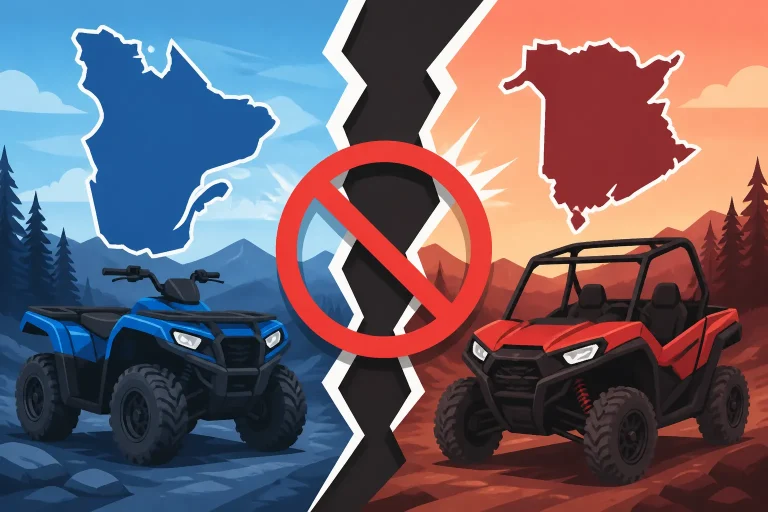
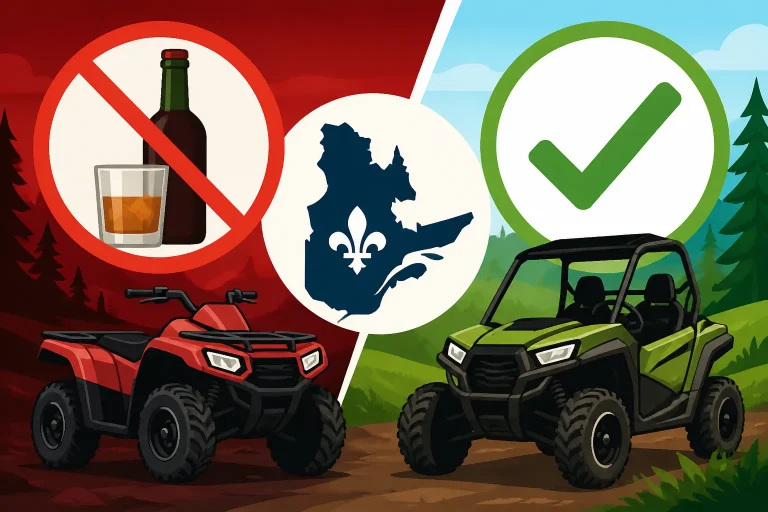
The certificate is relevant to a 16- or 17-year-old operating an ATV within the limits set by Quebec law. It does not make every off-road vehicle available to a teen. In particular, a certificate does not lower the minimum age for driving a side-by-side. Quebec sets a separate age rule for these machines, so a 16- or 17-year-old should not assume that ATV training qualifies them to drive a UTV. See Quebec Requires 18 for a Side-by-Side for that distinction.
This matters because the terms “quad,” “ATV,” “VTT” and “side-by-side” are sometimes used loosely in conversations or advertisements. The legal classification of the machine matters more than what a seller or family member calls it. If you are not sure which category a machine falls into, check the vehicle documents and confirm the classification with the appropriate official source before booking training or allowing a teen to ride.
The certificate also does not provide blanket permission to ride anywhere. The young rider still needs to follow the rules for the land or route in question. A federated trail may have access conditions, closures, patrol checks and pass requirements. A public road has its own restrictions, and a private landowner’s permission applies only to that property. A certificate cannot make a prohibited route legal or grant permission to cross land.
For example, a young rider who has completed training still needs to respect posted closures, stay within the machine’s permitted capacity and follow applicable helmet and equipment rules. They must also understand who may ride as a passenger and when. A training certificate is one part of lawful and safe operation, not a substitute for checking the whole trip.
The distinction between an ATV and a side-by-side is especially important when a family shares machines. A teen may be trained and qualified for a quad but not eligible to drive the family’s side-by-side. The fact that both vehicles are used off-road, or that the teen has ridden as a passenger, does not change the driver age requirement. Review Quebec Rules for a Side-by-Side Driver before planning a ride in a UTV.
Parents and guardians should also consider whether the machine is suitable for the rider’s size, ability and experience. Legal eligibility is a minimum threshold, not a recommendation that every teen is ready for every machine or trail. A learner’s confidence, ability to control the vehicle and judgment around other riders all matter. Begin on appropriate terrain and avoid treating a certificate as proof of advanced riding skill.
How to earn the certificate
The certificate is obtained through the approved training process for young ATV riders. In Quebec, the FQCQ is the federation associated with quad safety training and certificates. Course availability, registration steps and the way proof is issued can change, so confirm the current process directly with the federation or an authorized training provider. The overview at Quebec Training Certificates for Teen Riders can help put the requirement in context.
A practical sequence looks like this:
- Confirm the machine type. Make sure the young person intends to operate an ATV covered by the teen certificate rules, not a side-by-side with a higher minimum driver age.
- Check eligibility and current course details. Ask the training provider about age, registration, course format, assessment requirements and what identification the learner should bring.
- Complete the required instruction and assessment. The course is intended to build knowledge and test competence, not simply provide a form to carry.
- Receive and keep the certificate. Check that the name and other identifying details are correct, and find out what to do if the document is delayed or needs correction.
- Confirm the rules for the planned ride. Check the vehicle’s registration and insurance, trail-pass requirements, route access and any local restrictions before departure.
Do not assume that watching videos, reading a manual or having a parent teach the teen at home counts as the required certificate process. Those steps can be useful preparation, but they do not necessarily replace an approved course and assessment. Ask the provider what is formally required before treating any instruction as complete.
The course should be approached as practical safety training, not as an administrative hurdle. A teen needs to understand how to inspect the machine, use controls, manage speed and braking, recognize hazards and respond to changing trail conditions. The exact curriculum is set by the applicable training program, so use the provider’s current course information rather than relying on an old checklist or a friend’s recollection.
It is sensible to ask questions before paying or booking:
- Is this course accepted for the certificate required of a 16- or 17-year-old ATV operator?
- What are the attendance and assessment requirements?
- What identification or consent documents are needed?
- How and when will proof of successful completion be issued?
- Who should be contacted if the certificate contains an error or does not arrive?
For a broader look at youth training and age restrictions, see Quebec FQCQ Training Certificates for Teens and Quebec Training Certificate Requirements. Because administrative details may change, verify the current course process with the organization offering the training rather than relying on an old registration page or an informal recommendation.
Carrying and showing proof while riding
Once issued, the certificate should be kept accessible whenever the teen rides. A rider may be asked to show documents during a check, and having the certificate available can make it easier to establish that the young operator meets the training requirement. The teen should know where the document is and be able to produce it without depending on a parent to retrieve it later.
Keep the certificate protected from water, mud and tearing. A secure document sleeve or a small waterproof pouch in a riding pack can help. Avoid placing the only copy loose in a pocket where it can fall out. If the issuing organization offers a digital record or replacement process, confirm how that proof is accepted before relying on a phone alone.
A photograph of a certificate may be convenient as a backup, but do not assume that a photo will be accepted in every situation. Requirements for carrying or showing proof can depend on the document and the rules in force. When uncertain, carry the original or the form of proof specifically accepted by the issuing organization and relevant authorities. The same common-sense approach applies to vehicle documents: Carrying an Insurance Certificate on Every Ride explains why insurance proof is a separate item to keep available.
Before heading out, the teen and accompanying adults can use a simple check:
- The rider has their own certificate and knows where it is.
- The machine is the right vehicle type for the rider’s age.
- The machine’s registration and insurance are in order.
- The route is open and permits the vehicle.
- A required trail pass is valid and available for inspection.
- The rider understands passenger, helmet and equipment rules for the trip.
This quick check is particularly useful when a group changes machines during a ride. A certificate should not be treated as belonging to the ATV or shared between family members. Each young operator needs to meet the rules personally, and each vehicle needs its own applicable documents.
If the certificate is lost, damaged or contains incorrect information, contact the issuing organization promptly. Keep a note of the course provider and any available completion record. Do not assume that a course receipt or a parent’s statement will automatically serve as equivalent proof if a patrol or other authority asks for the certificate.
Common misunderstandings to avoid
The certificate requirement is straightforward once separated from the other rules, but several misunderstandings can cause problems.
“The teen has completed the course, so the vehicle can go anywhere.”
No. Training does not grant access to private land, open a closed trail or create a right to ride on a road. Check the route, property permission and trail conditions separately. A trail pass also cannot override a closure; see Why a Trail Pass Cannot Override a Closure.
“A certificate is the same as a driver’s licence.”
No. The certificate confirms specific training for the teen ATV rules. It is not a general driver’s licence and does not automatically authorize driving on public roads. Road access and licensing requirements need their own check.
“A teen with a certificate can drive the family side-by-side.”
Not necessarily, and the certificate does not cancel the minimum age rule for a side-by-side. Confirm the machine’s classification and age requirements before letting a teen take the controls.
“The certificate covers the whole family.”
It does not. It is personal proof for the person who completed the training. Another teen cannot use a sibling’s certificate, and an adult’s paperwork does not replace the young rider’s qualification.
“The certificate means the rider is ready for any trail or machine.”
Training is an important foundation, but it does not guarantee that a particular vehicle, passenger load, speed or route is appropriate. Match the ride to the teen’s experience and the machine’s capabilities.
“A pass or registration document proves training.”
These documents address different requirements. A registration document relates to the machine, while a trail pass concerns access to the federated trail network. Neither is a substitute for a teen’s certificate. For help keeping the machine’s paperwork straight, use Quebec Registration Paperwork Checklist.
When rules are unclear, check the official requirements before the ride rather than trying to resolve a disagreement at the trailhead. This is especially important if the teen is crossing a road, entering a trail network, visiting another municipality or riding a different type of machine than usual. A short check can prevent an avoidable turn-around or a more serious compliance problem.
Frequently Asked Questions
Does every 16- or 17-year-old ATV rider need a certificate?
Quebec requires a 16- or 17-year-old operating an ATV to hold the applicable certificate of competence and knowledge. Confirm the current requirements for the specific machine and riding situation before departure.
Can a certificate holder drive a side-by-side at 16 or 17?
The certificate does not remove the separate minimum age requirement for driving a side-by-side. Check Quebec Side-by-Side Age Rule of 18 before a teen operates a UTV.
Does the certificate replace registration, insurance or a trail pass?
No. Those are separate requirements. The certificate relates to the rider’s training; registration and insurance relate to the machine, and a trail pass may be needed for federated trails.
Where should a teen get the certificate?
Use the current training process recognized for Quebec’s ATV certificate requirement, and confirm course details with the FQCQ or an authorized provider. Do not assume informal instruction is equivalent to the required course and assessment.
Disclaimer
This article is for general informational purposes only and does not constitute professional advice. Laws, prices and regulations vary by location and change over time. Consult a qualified professional for guidance on your specific situation.