Quebec and New Brunswick Reciprocity Ended
If you ride an ATV or side-by-side across the Quebec–New Brunswick border, a pass from home may no longer get you onto trails in the other province. The key is to treat trail access, vehicle registration and insurance as separate requirements. Here’s what the end of reciprocity means, what to check in each direction and how to avoid arriving at a trailhead without the right documents.
What the end of reciprocity means
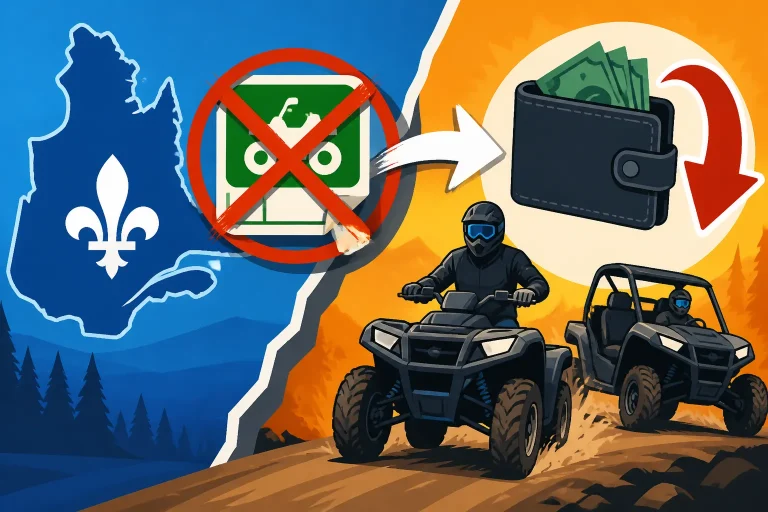
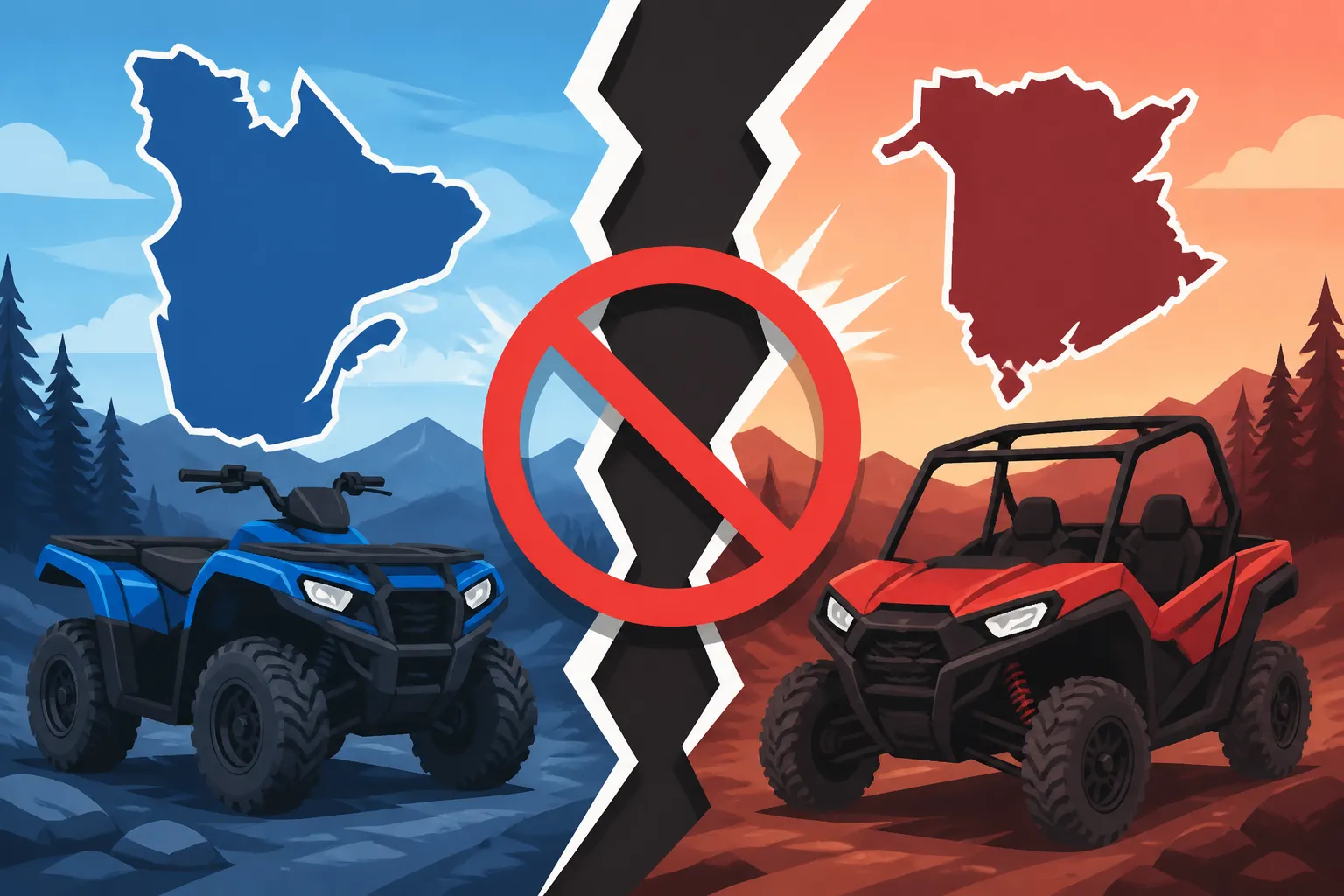
Quebec and New Brunswick no longer accept the former reciprocal trail-pass arrangement between them. In practical terms, having a trail pass for one province does not automatically authorize you to ride on the other province’s participating trail network. If your trip includes trails in both provinces, plan on meeting each province’s current pass requirements separately.
That’s the main change. It is about trail access, not a general agreement that once covered every part of owning or riding a machine. It does not mean your home registration automatically becomes invalid at the border, nor does it mean one province’s pass has replaced your insurance or legal obligations in the other.
A pass is permission to use the trails covered by the pass, subject to current rules and closures. It is not the same thing as:
- Registering the ATV or side-by-side with the appropriate authority.
- Carrying liability insurance that meets the requirements where you ride.
- Having a driver’s licence or other rider qualification required for the trip.
- Getting permission to use private land, roads or trails outside the pass network.
- Following local restrictions, trail closures and seasonal conditions.
These distinctions matter because riders often use “registration,” “insurance” and “trail pass” as if they were interchangeable. They are not. A machine can be properly registered and insured but still lack permission to ride a club trail. A valid trail pass does not, by itself, prove that the machine is registered or insured.
The former arrangement’s end is associated with changes made in 2023. Pass rules, products and sales periods can change, so check with the relevant provincial organization and the clubs responsible for your intended route before each trip. For Quebec, the FQCQ and its member clubs are central sources for federated trail information. For New Brunswick, check the province’s current ATV trail-pass information and the clubs or organization responsible for the trails you plan to use.
For more background on the provincial change, see Quebec and New Brunswick reciprocity ended and Quebec ended reciprocity with Ontario. Those changes are a useful reminder that cross-border trail access depends on the current arrangements, not on an old sticker or an assumption that neighbouring provinces still recognize each other’s passes.
What a pass covers and what it does not
A trail pass generally relates to access to a particular organized trail network. The exact coverage and conditions depend on the issuing organization and the type of pass. In Quebec, a pass may provide access to participating federated trails across clubs, but it does not turn every road, private trail or property into an authorized route. Quebec trail passes cover every club explains the network distinction.
A pass also does not override a closure. If a club closes a trail for thaw, damage, weather, hunting activity or another reason, a valid pass does not give you permission to ride it. Check route conditions close to departure and again during a multi-day trip. Quebec pass proof on the trail covers the practical question of what you may need to show if you are checked.
Do not assume that the trail pass includes the insurance you need. Some pass products or sales options may offer an insurance component, but that is not a reason to skip checking your own policy. Review the coverage, exclusions and proof requirements directly. Quebec passes without insurance and [Quebec insurance proof on the trail] are useful starting points for understanding the difference.
What to arrange before riding in either province
The safest approach is to prepare for each province as a separate riding destination. Start with the machine and your route, then verify the pass, insurance and rider requirements that apply on that side of the border.
1. Confirm trail-pass requirements for every province
If your route uses Quebec federated trails, check the current Quebec pass requirements even if you already hold a New Brunswick pass. If your route uses New Brunswick trails, check that province’s rules even if you hold a Quebec pass. Do not rely on an old pass, a previous season’s arrangement or a seller’s recollection of reciprocity.
When checking, identify the actual trail network you plan to use. A province may have federated trails, club routes, private networks and public roads, each with different access conditions. Ask whether your selected pass covers the planned route and whether the pass is valid on the dates you will ride. If the route passes through more than one club area, confirm which organization administers each section.
For a Quebec trip, review the current products and validity periods through the FQCQ’s official channels. Pass types and periods can differ, and the details may change. Quebec passes valid November to October provides context on the kind of validity distinction riders should pay attention to, but check the current terms rather than relying on an old date range.
For a New Brunswick trip, use the current instructions from the provincial ATV organization and the clubs connected to your route. Confirm where and how a visitor can obtain the required pass, what proof must be carried or displayed, and whether the pass has any conditions that apply to visitors.
2. Check registration and ownership documents
A trail pass does not register your machine. Before travelling, make sure the ATV or side-by-side has valid registration for the jurisdiction where it is registered and that the paperwork matches the machine and its owner. Carry whatever registration proof is required for your trip.
If you recently bought the machine, moved, borrowed it or are travelling with a machine registered to someone else, resolve any paperwork questions before leaving. A bill of sale is not always a substitute for completed registration, and a pass purchase does not fix a gap in ownership documents. Quebec owners can review Quebec registration compared to New Brunswick for the distinction between the two provinces’ registration systems. For a machine changing hands in Quebec, Quebec registration transfer after a sale may also help identify what needs to be handled before a ride.
Keep your documents accessible, but do not assume that a photo on your phone will always be accepted as proof. Check the relevant authority’s requirements for originals, digital copies and proof of purchase. A secure waterproof document pouch can protect paper copies; an outdoor document holder sold through retailers such as Amazon is one option, but it does not replace having the correct documents.
3. Verify insurance for the trip
Insurance is another separate check. Confirm that your policy covers the machine, the type of riding you plan to do and the places where you will ride. Policies can have exclusions or conditions that matter on trails, on roads, during commercial use or when a different person is driving.
Ask your insurer whether coverage applies in both provinces and whether the policy meets the legal liability requirement in each place. Confirm what proof you need to carry and whether a pass-related insurance option, if available, changes anything about your own policy. Do not infer coverage from the fact that a trail pass was purchased.
If you rent rather than bring your own machine, read the rental agreement and ask the operator what insurance is included, what it excludes and what proof or deposit conditions apply. A rental operator’s coverage may not eliminate every responsibility for the driver or passenger.
4. Check the riders and route
The rider who can legally operate a machine at home may still need to meet additional requirements for the planned trail system. Confirm licence, age, training and passenger rules for each province, and check any special conditions for side-by-sides. A pass does not waive those requirements.
Then confirm that your intended route is actually open and authorized. Look for current club notices, maps, detours and closures. Check whether a section crosses private property or uses a road that has separate access rules. If your plan depends on a short road connection between trail segments, verify that connection rather than assuming the trail pass permits it.
A simple pre-trip comparison can help:
| Requirement | Quebec trails | New Brunswick trails | What to verify |
|---|---|---|---|
| Trail pass | Check Quebec’s current pass requirement | Check New Brunswick’s current pass requirement | Whether the pass covers your route and riding dates |
| Registration | Carry valid machine registration | Carry valid machine registration | That documents match the machine and owner |
| Insurance | Confirm coverage and proof requirements | Confirm coverage and proof requirements | Territorial coverage, exclusions and liability requirements |
| Rider eligibility | Check current rider and machine rules | Check current rider and machine rules | Licence, age, training and passenger conditions |
| Trail access | Follow club routes and closures | Follow club routes and closures | Open status, land permission and road connections |
Use this as a planning checklist, not as a substitute for current rules. The details that apply can depend on the machine, rider, trail and pass product.
Planning a ride across the border
A cross-border ride is easier to manage when you decide in advance which trails you will use in each province. Do not start with the assumption that one pass covers the whole trip and try to sort out the details at the trailhead.
Build the route around authorized trails
Mark the provincial boundary on your route plan and note where you expect to enter each network. If you are using a downloaded map or phone app, confirm that it shows current trail status, not just the general trail alignment. A route visible on a map may be closed, temporarily rerouted or outside the network covered by your pass.
Where a trip combines federated trails with roads, private land or an outfitter’s network, ask who controls each segment and what permission is required. The pass you buy from a provincial organization may cover only the trails within that organization’s system. Do not assume it gives access to a private network or a road connection.
For Quebec trail conditions, consult the clubs responsible for the trails as well as the FQCQ’s current information. For New Brunswick, confirm conditions with the relevant local club or official trail source. Conditions can change after heavy rain, during seasonal closures or when maintenance work is underway.
Allow time to buy the correct pass
Check the purchase process before your departure date. Some passes may be sold through specific online or club channels, and delivery or proof-of-purchase instructions can vary. If a sticker or other physical proof is required, allow enough time to receive and place it as directed. If electronic proof is accepted, confirm what you need to show and whether you should save or print a confirmation.
Avoid buying a pass only after reaching a trail entrance. A last-minute purchase may not resolve a missing sticker, delayed confirmation or misunderstanding about which pass applies. It also does not guarantee that a trail is open or that your route is authorized.
Keep a copy of your pass confirmation, registration and insurance details with your trip documents. If you ride with a group, each machine should have the required pass and paperwork; one rider’s pass does not necessarily cover everyone else. Check the current rules for passengers and multi-machine trips rather than splitting documents between vehicles.
Budget for both provinces without relying on old figures
Because the former reciprocal arrangement has ended, account for the possibility that riding in each province requires a separate purchase. The total cost depends on the available pass type, validity period and current terms. Do not use an old receipt, an old online post or a previous season’s amount to calculate your trip budget. Check the issuing organization for current figures before buying.
If you are deciding between a shorter visit and repeated rides, compare the available pass options for the dates you expect to ride. The lowest-cost option is not necessarily the right one if it does not cover your dates or route. For Quebec, Quebec trail pass cost in 2026 discusses the cost structure, but current rates and terms should always be confirmed directly.
Also consider whether the ride will cross into a region that is not part of the federated network. A local access fee, private land permission or outfitter condition may be separate from a provincial pass. Ask about those costs before booking lodging, arranging transport or committing to a route.
Keep your paperwork organized on the ride
Carry the documents you may need to show and keep them protected from rain, mud and damage. Separate each machine’s registration and pass information so a group leader can quickly match documents to the correct ATV or side-by-side. Store a backup copy in a secure place, but do not leave all originals in a vehicle unattended.
Before leaving, tell someone outside the group where you are riding and when you expect to return, particularly if the route is remote. Save relevant trail information for offline use if mobile coverage may be limited. A pass and a map help with access and navigation; neither guarantees that a remote trail will have reliable communications or assistance.
Common assumptions that cause problems
The change in reciprocity is easy to misunderstand because a trail pass is only one part of a cross-border ride. These are the mistakes most worth avoiding.
“My home-province pass should work because I’m visiting”
That was the assumption the former arrangement encouraged. It is no longer a safe basis for planning. Treat the pass requirement in each province separately and check it with the issuing organization.
“Registration means I can ride the trail”
Registration identifies the machine for administrative and legal purposes. It does not necessarily authorize access to a club trail. You may need registration, insurance and a local trail pass at the same time.
“The pass includes all the insurance I need”
Do not assume this. Review the policy or pass terms and ask the insurer whether the machine is covered for the route and use you have planned. Confirm the required proof. A trail pass is not a substitute for checking the wording of your insurance policy.
“I can use any road or trail if I have the pass”
A pass does not give general permission to ride on every road, private property or non-federated route. Road access, landowner permission and local restrictions are separate. The same applies to trails that are closed or outside the pass network.
“A pass from last season will probably be accepted”
Pass validity and products can change. Check the dates and conditions for the pass you hold, and confirm whether it applies to the current trip. If you have a sticker from a previous year, do not assume it remains valid because it is still attached to the machine.
“The person organizing the group can buy one pass for everyone”
Pass rules usually apply to the machine or rider as specified by the issuing organization. Check whether each machine needs its own pass and what proof must be displayed. Do not rely on a group leader’s pass or a shared screenshot unless the current rules explicitly allow it.
“A phone photo is enough”
Digital proof may be useful as a backup, but acceptance can depend on the pass issuer and what patrols are authorized to check. Confirm the required format before departure. Keep the original or other required proof with the machine if the rules call for it.
“A trail shown on a map is open”
A map is not necessarily a live status report. Closures, temporary detours and seasonal restrictions can change the ride you are allowed to make. Check local conditions before starting and respect signs or barriers encountered on the route.
Frequently Asked Questions
Can I ride Quebec trails with a New Brunswick ATV pass?
Do not assume so. The former reciprocal arrangement has ended, so check Quebec’s current pass requirement and obtain the applicable Quebec pass if required for your route.
Can I ride New Brunswick trails with a Quebec pass?
Do not rely on a Quebec pass for New Brunswick trail access. Confirm the current New Brunswick requirement with the organization responsible for the trails you plan to ride.
Does the end of reciprocity affect my ATV registration?
The change concerns trail-pass recognition. Registration remains a separate requirement. Keep your machine registration valid and check the rules that apply to your machine and destination.
Do I need separate insurance for each province?
Not necessarily, but you must confirm that your policy applies to your machine and planned riding in both provinces, meets applicable requirements and provides the proof you need. Ask your insurer rather than assuming coverage from your trail pass.
Where should I check before a trip?
Check the current pass requirements with the provincial trail organization, then verify route status with the clubs responsible for the trails. Also confirm registration, insurance, rider eligibility and any private-land or road permissions that apply.
Disclaimer
This article is for general informational purposes only and does not constitute professional advice. Laws, prices and regulations vary by location and change over time. Consult a qualified professional for guidance on your specific situation.