Riding With Headlights in Daylight
One of the questions that often pops up in our Quebec ATV and UTV circles, especially among newer riders or those visiting from out of province, is about the seemingly simple act of turning on your headlights during the day. It might feel counterintuitive when the sun is shining bright, but understanding Quebec's rules for riding with headlights on during daylight hours is absolutely crucial for staying safe and avoiding an unexpected chat with a trail patrol officer. This guide is here to cut through any confusion, explaining why these rules exist, what they mean for you, and how to ensure your machine is always trail-ready for optimal visibility.
The Law: Why Your Headlights Matter, Even in Broad Daylight
It’s easy to think that if the sun is up and you can see perfectly, your headlights are just for show. But on Quebec’s vast network of trails and in the specific scenarios where off-road machines interact with roads, the rules are pretty clear: visibility is paramount, and your machine's lighting plays a huge role in that, regardless of the time of day. This isn't just a suggestion; it's a legal requirement aimed at enhancing safety for everyone.
What Quebec's Off-Highway Vehicle Act Says
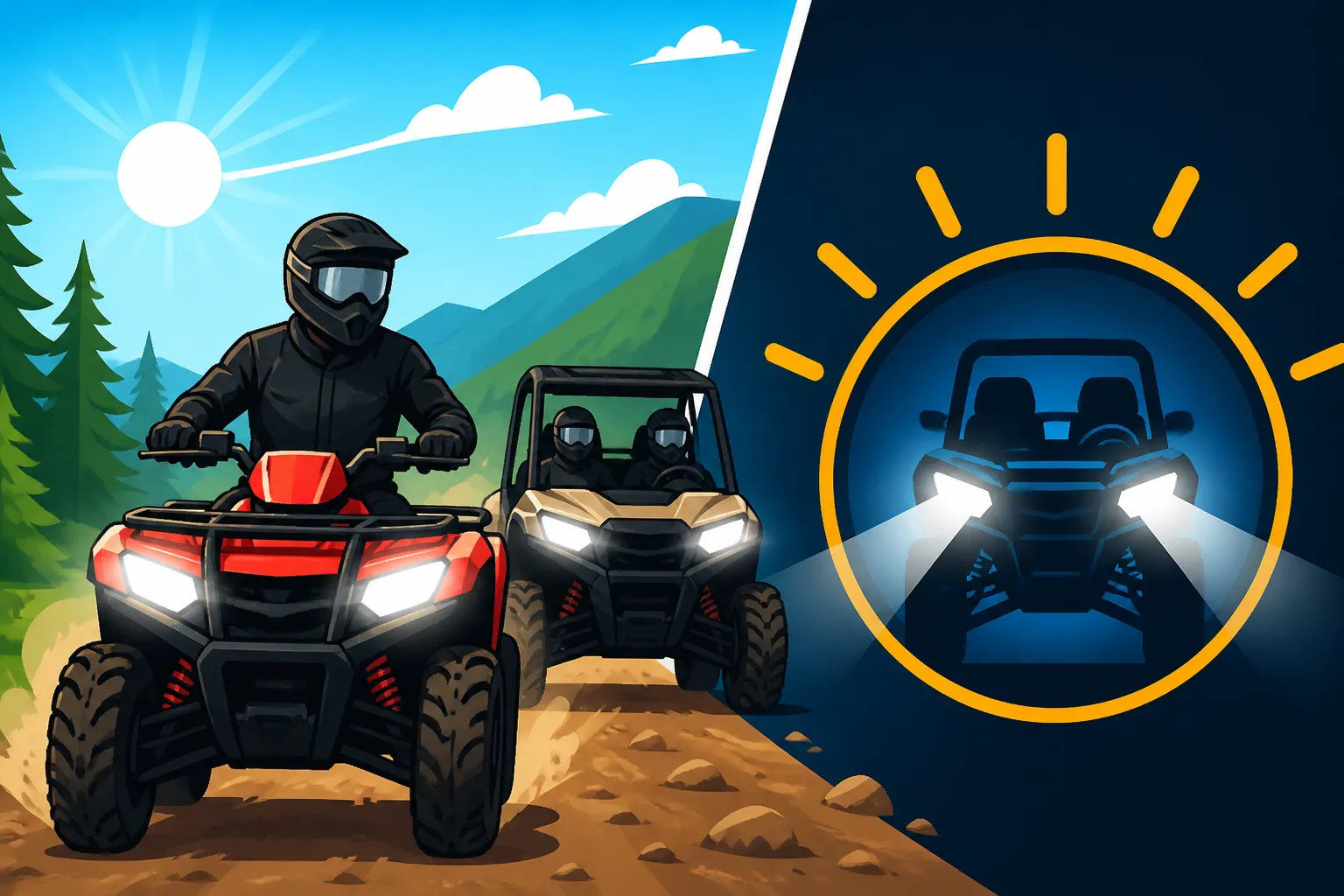
Quebec's Off-Highway Vehicle Act, often referred to by its French acronym LVHR (Loi sur les véhicules hors route), is the bedrock of all off-road riding regulations in the province. And it's quite explicit about lighting. Essentially, it mandates that your ATV or UTV must have its headlights and taillights on whenever the machine is in operation, day or night. This isn't just about darkness; it's about being seen at all times. This rule aligns with similar regulations you might find for motorcycles and other vehicles that need extra visibility.
Think of it this way: even on the brightest day, a quad can be surprisingly hard to spot against certain backdrops, especially in forested areas with shifting light or when dust is kicked up. The constant glow of your headlights and taillights creates a distinct visual signature that helps other riders, pedestrians, and even wildlife become aware of your presence much sooner. Neglecting this simple step can lead to fines, which, let's be honest, nobody wants when they're out enjoying the beautiful Quebec scenery. It's a small flick of a switch that makes a big difference in collective safety. Your [Quebec's Off-Highway Vehicle Act and Your Papers] outlines many of these foundational rules.
Understanding the Rationale: Visibility and Safety
The "why" behind this daylight headlight rule boils down to one thing: accident prevention. Off-highway vehicles, by their nature, are often used in environments where they might encounter other users unexpectedly – other ATVs, hikers, cyclists, or even forestry workers. These machines can also move quickly and unpredictably through varied terrain. By requiring headlights to be on constantly, the law aims to achieve several critical safety objectives:
- Improved Conspicuity: A machine with its lights on is simply more noticeable. This is especially true when emerging from dense foliage, crossing a clearing, or navigating a dusty section of trail. The human eye is naturally drawn to light, making it easier to register an approaching vehicle. This is the same logic that applies to [Quebec Lighting Requirements at Night], but extended to daytime hours for consistent visibility.
- Reduced Reaction Time: If another person spots your machine sooner, they have more time to react, whether that means moving out of the way, slowing down, or making eye contact. This is particularly important on blind corners or crests where visibility is already limited.
- Standardized Expectations: When every rider has their lights on, it creates a predictable environment. Everyone expects to see illuminated machines, which helps to foster a safer trail culture. It removes any guesswork about whether a machine is "on" or just parked.
- Counteracting Environmental Challenges: Quebec trails offer incredible diversity, from sun-drenched open fields to deep, shadowed forest tunnels. Weather can change in an instant, bringing fog, rain, or heavy cloud cover. Having your lights on automatically prepares you for these sudden shifts, ensuring you're visible even when conditions deteriorate rapidly. This is a far simpler approach than having riders constantly assessing and reactivating their lights based on transient conditions.
When and Where Headlights Are Crucial for Quebec Riders
Knowing the rule is one thing, but understanding its practical application is another. While the general mandate is "always on," there are specific scenarios and environments where this simple act of flipping a switch becomes incredibly vital, truly underscoring the spirit of the law. It’s not just about avoiding a ticket; it’s about making sure you return home safely after every adventure.
Navigating Trails and Forest Roads
The vast majority of your riding in Quebec will likely take place on designated trails or forest roads. These environments, while beautiful, present numerous challenges to visibility. Winding paths, elevation changes, and dense tree cover create a dynamic light environment where shadows dance and light flickers. It’s not uncommon to go from bright sunlight to near-dusk conditions within a matter of seconds as you enter a thick canopy.
Here, your headlights aren't just for seeing; they're for being seen. Imagine a scenario where you're on a narrow, twisting trail. Another rider is approaching from the opposite direction. Even if it's midday, the trees might obscure your view until you're quite close. The distinct glow of your headlights gives them an early warning, allowing both of you to react, slow down, and pass safely. This is especially true if you encounter heavy dust, which can dramatically reduce visibility for everyone. Think about how much easier it is to spot a vehicle in a dust cloud if its lights are on. This is where [Quebec Trail Etiquette Locals Expect] really emphasizes shared responsibility, and part of that is ensuring you're easily seen.
Brief Road Access and Crossings
Quebec's ATV network often requires riders to use or cross public roads for short distances to connect trail sections, access services like gas stations or restaurants, or bypass unrideable terrain. When your off-highway vehicle briefly enters the public road system, the need for visibility escalates dramatically. Other road users – cars, trucks, motorcycles – are not always expecting an ATV to appear, even if the road is signed for quad access.
For these moments, having your headlights on is non-negotiable. They make your machine more visible to oncoming traffic and vehicles approaching from behind. Even a quick jaunt of a few hundred metres can put you in harm's way if a distracted driver doesn't see you. This is why rules like [Quebec ATV Road Rules Under the LVHR] are so critical, and the headlight requirement is a core component of safe road interaction. When you are performing tasks like [Quebec Rules for Crossing a Highway] or simply riding [Quebec Rules for Riding a Shoulder], your lights make you an active, visible participant in the flow of traffic, even if you’re only there for a moment.
Weather Conditions and Reduced Visibility
Quebec weather can be famously unpredictable. A sunny morning can quickly turn into a cloudy, rainy, or even foggy afternoon. These conditions significantly diminish natural light and can make machines blend into their surroundings. When visibility drops, even slightly, your headlights become your primary tool for ensuring others can see you.
- Fog and Mist: These conditions scatter light, making objects appear hazy. Your headlights cut through some of this haze, making your silhouette more defined to others.
- Heavy Rain: Rain not only reduces visibility but also creates spray and glare, making it harder to distinguish objects. The consistent light of your headlights helps you stand out.
- Overcast Skies: On dark, cloudy days, the ambient light can be surprisingly low, mimicking dusk. Your headlights help you avoid becoming a dark shape against a dark background.
It’s about being proactive. Rather than waiting for conditions to worsen and then remembering to turn on your lights, keeping them on from the start ensures you’re always prepared for whatever Mother Nature throws your way. It’s a simple layer of safety that pays dividends, regardless of the forecast.
Ensuring Your Lighting System Is Up to Snuff
So, we know that headlights are mandatory, even in daylight. But merely having them isn't enough; they need to be in good working order and, for some riders, might even benefit from an upgrade. Just like you wouldn't head out on the trail with bald tires, you shouldn't rely on dim or faulty lighting.
Checking Your Factory Headlights
Before every ride, or at least regularly, make it a habit to do a quick check of your machine's lighting system. This simple routine can prevent a lot of headaches, including potential fines and, more importantly, accidents.
Here's what to look for:
- Functionality: Are both headlights working? Is your taillight illuminated? Are your brake lights activating when you press the lever or pedal? A common issue is a burned-out bulb or a loose connection from vibrations on the trail.
- Cleanliness: Mud, dust, and grime can quickly obscure your lights, drastically reducing their effectiveness. Give your lenses a quick wipe with a damp cloth before you head out. A clean light is a bright light!
- Alignment (less critical for daytime, but good practice): Ensure your headlights are generally pointed forward and not skewed off to one side or pointing too high or low. While this primarily affects your ability to see at night, properly aligned lights contribute to overall machine integrity.
If you find a bulb out, replace it promptly. Carrying spare bulbs (if your machine uses traditional incandescent bulbs) or knowing where to get replacements quickly is a smart move. For LED systems, check connections, as the individual diodes are usually quite robust. Remember, [What a Patrol Can Ask to See] includes ensuring your safety equipment, like working lights, is in order.
Considering Aftermarket Lighting Upgrades
While factory headlights are designed to meet minimum legal requirements, some riders find them less than optimal, especially on older machines or those frequently used in challenging conditions. If you're looking for an upgrade, the aftermarket offers a wealth of options that can dramatically improve your visibility, both for you and for others.
Many riders choose to add LED light bars or brighter LED replacement bulbs for their headlights. These offer several advantages:
- Increased Brightness: LEDs produce significantly more light than traditional halogen bulbs, making your machine much more noticeable.
- Lower Power Draw: Despite their brightness, LEDs are often more energy-efficient, putting less strain on your machine's electrical system.
- Durability: LEDs are solid-state devices, meaning they have no fragile filaments to break from vibrations, making them more resilient to the rigors of off-road riding.
Brands like SuperATV offer a wide range of aftermarket lighting solutions, from powerful light bars to enhanced headlight assemblies that are designed to withstand tough trail conditions. Investing in these can not only boost your visibility but also enhance your ability to see the trail during early mornings, late evenings, or in adverse weather. Just be mindful of local regulations regarding auxiliary lights, especially their use on public roads. While beneficial for off-road visibility, some incredibly bright light bars are strictly for off-road use only and should be covered or switched off when on public thoroughfares.
Routine Maintenance for Optimal Performance
Beyond just checking if the lights work, a little routine maintenance on your machine's electrical system can go a long way in ensuring your lights are always at their best.
- Battery Health: Your battery is the heart of your electrical system. A weak battery can lead to dim lights or intermittent function. Ensure your battery terminals are clean and tight, and consider a trickle charger if your machine sits for extended periods.
- Wiring Inspection: The constant vibrations and exposure to elements on the trail can take a toll on wiring. Periodically inspect visible wiring for fraying, cracks, or loose connections. Secure any dangling wires to prevent snagging.
- Fuse Box Check: If a light suddenly stops working, the first place to check after the bulb is the fuse box. Familiarize yourself with its location and carry spare fuses of the correct amperage.
- Alternator/Stator Output: This is what recharges your battery and powers your lights while the engine is running. If you consistently notice dim lights or a battery that won't hold a charge, it might be worth having this checked by a mechanic.
Taking care of these small details ensures that when you flip that switch, your lights come on bright and strong, providing the visibility you and others depend on. This proactive approach to maintenance is part of responsible off-road riding, echoing the sentiment of [Quebec Equipment Checks by Patrols] where patrols ensure all your machine's critical safety components are in working order.
Beyond Headlights: Enhancing Your Visibility on Quebec Trails
While headlights are a cornerstone of daytime visibility on Quebec trails, they are part of a larger safety ecosystem. A truly safety-conscious rider considers multiple layers of visibility, ensuring they're seen from all angles and in all conditions. This holistic approach significantly reduces risks, making every ride more enjoyable and secure.
Reflective Gear and Machine Markings
Your machine's lights do a fantastic job of making you visible from the front and rear, but what about your own person? And what about the sides of your machine? This is where reflective gear and additional machine markings come into play.
- Rider Apparel: Wearing bright, contrasting colours is a simple yet effective way to stand out. Fluorescent greens, oranges, and yellows catch the eye, especially during the day. For added measure, many riders choose gear with integrated reflective strips. Even small details, like reflective tape on your helmet, can make a difference. This is why discussions around [Quebec ATV Helmet Rules] often touch upon visibility.
- Machine Decals and Tape: Beyond what comes from the factory, you can add reflective decals or tape to your machine. Applying these to fenders, side panels, or even the back of your helmet can significantly improve lateral visibility, which is crucial when navigating intersecting trails or passing through areas where you might be seen from the side first. Consider durable options from brands like SuperATV if you're customizing your machine.
- Flags: In some open, dusty environments, or when riding in groups, a visibility flag mounted high on your machine can be incredibly effective. It's an extra vertical element that can be seen over terrain features or other vehicles, giving an early warning of your presence.
These additions complement your active lighting, providing passive visibility that works continuously, enhancing your overall presence on the trail.
Using Your Taillights and Brake Lights Effectively
We've focused a lot on headlights, but your taillights and brake lights are equally important for conveying information to riders behind you. The LVHR mandates taillights on at all times, just like headlights.
- Consistent Taillight Glow: Your taillight's steady illumination signals your presence to anyone approaching from the rear. This is vital on multi-use trails, where you might be followed by other quads, dirt bikes, or even snowmobiles in winter.
- Responsive Brake Lights: When you slow down or stop, your brake lights are critical. They instantly communicate your change in speed, giving the rider behind you precious seconds to react and avoid a rear-end collision. Make sure your brake lights activate quickly and brightly with minimal pressure on your brake levers or pedal. A sticky or slow-to-activate brake light is a major safety hazard.
- Keeping Them Clean: Just like your headlights, your taillights can get covered in mud and dust. A quick wipe ensures they're always projecting their maximum light output.
A simple maintenance check should always include ensuring your taillight is on and your brake lights respond to both front and rear brake actuation. This is a primary concern for any [Quebec Trail Patrol Officer] you might encounter.
The Role of Driving Habits in Being Seen
Ultimately, no amount of lights or reflective gear can fully compensate for poor riding habits. How you operate your machine significantly impacts how well you are perceived by others.
- Maintain a Safe Distance: Always keep enough space between your machine and others. This gives everyone more time to react, especially in dusty conditions or when trail conditions are unpredictable.
- Anticipate and Signal: Be aware of what's ahead and around you. If you're approaching a blind corner, slow down and be prepared for oncoming traffic. If your machine has turn signals, use them when appropriate, particularly during [Quebec Rules for Riding to a Gas Station] or making quick lane changes on brief road sections.
- Ride Predictably: Avoid sudden, erratic movements. Other riders and road users rely on predictable behaviour to anticipate your actions.
- Make Eye Contact: When interacting with other people, especially at crossings or intersections, try to make eye contact. A quick nod or wave confirms that you've seen each other.
By combining mandatory lighting with smart equipment choices and responsible riding techniques, you become a master of visibility on Quebec's trails. It's about being proactive, ensuring that your presence is always clearly communicated to everyone sharing the incredible natural beauty of our province.
Visibility Checklist for Quebec Quad Riders
To make sure you’re always seen and compliant with Quebec’s rules, here’s a quick checklist to run through before your rides:
| Item | Check | Notes |
|---|---|---|
| Headlights | Both on and bright? | Always required, day or night. |
| Taillights | On and clearly visible? | Essential for being seen from the rear. |
| Brake Lights | Activate quickly when brakes applied (front & rear)? | Crucial for signaling deceleration. |
| Lenses | Clean and free of mud/dust? | Dirty lenses drastically reduce light output. |
| Reflective Gear (Rider) | Wearing bright colours? Reflective strips on helmet/jacket? | Enhances personal visibility, especially from the side. |
| Reflective Markings (Machine) | Any additional reflective tape/decals on fenders, sides? | Improves machine's visibility from various angles. |
| Wiring & Fuses | Quick visual check for damage; spare fuses on hand? | Prevents unexpected electrical failures. |
| Battery | Terminals clean and tight? | Ensures consistent power for all lights. |
| Switch Operation | Light switch functions smoothly? | A faulty switch could leave you in the dark. |
| Alertness | Ready to ride defensively and be aware of surroundings? | Your most important safety tool. |
This article is for general informational purposes only and does not constitute professional advice. Laws, prices and regulations vary by location and change over time. Consult a qualified professional for guidance on your specific situation.