Leaving Gates as You Found Them
A gate on a Quebec ATV trail can look like a small obstacle, but opening it the wrong way may let livestock wander, leave a property unsecured, or put trail access at risk. The safest rule is simple: leave every gate as you found it. This guide explains how to handle open, closed, locked, and confusing gates without creating problems for landowners or other riders.
Why gates matter on Quebec ATV trails
Gates often protect more than the trail
A trail may cross farmland, a forest property, or land used for several purposes. Gates can keep cattle or horses contained, control access to a private road, protect equipment, or separate one section of a property from another. In places such as the Laurentians, Charlevoix, Beauce, and the Outaouais, a route can pass through changing landscapes where a gate serves a practical purpose that is not obvious from the trail.
A gate is not just a barrier to get past as quickly as possible. If it is left open, livestock may reach a road or another part of the property, and a landowner may have to spend time finding and securing them. If it is left closed when it was open, it may block a farmer or another authorized user. Either mistake can create friction between riders and the people who make trail access possible.
Some gates are part of a signed and maintained riding corridor; others may mark a property boundary or a route that is not open to recreational traffic. Seeing tire tracks or an opening in a fence does not by itself establish permission to ride through. Follow posted signs, club guidance, and the route information for the trail you are using. For more background, see Quebec Trails That Cross Private Land and Quebec Private Land Permission.
A gate can signal a change in access conditions
A gate may be open during one season and closed during another, or it may be closed temporarily for farm work, forestry, repairs, or another land-use activity. A closed gate can therefore communicate more than “please close this behind you.” It may mean that access is restricted at that point.
Do not assume you can open a closed gate simply because a mapped trail appears to continue beyond it. Stop and check for signs, club notices, and official route updates. If the route is marked closed or the gate is locked, do not climb over it, force it, or ride around the end of the fence. A detour across the edge of a field can damage vegetation or crops and may take you onto land where you do not have permission to travel.
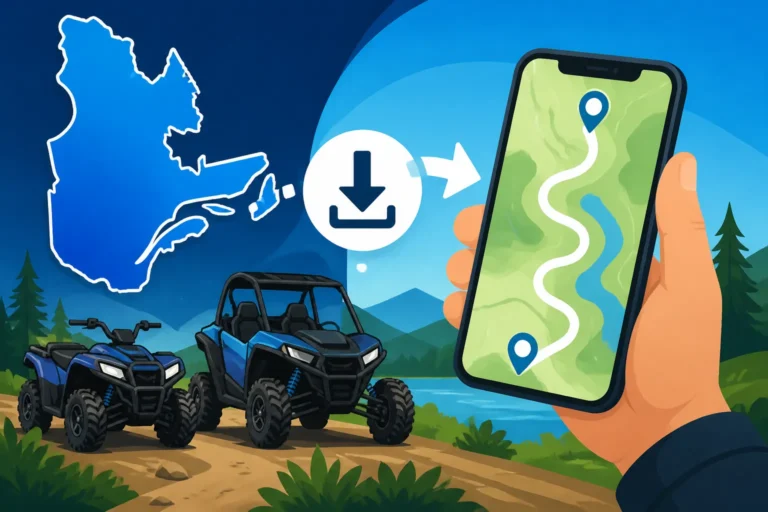
Trail conditions and access permissions can change. Before heading out, check the relevant club’s current information and use the official trail map or guidance for the area. Apps such as onX Offroad can help with route planning and orientation, but treat any map as a planning aid—not as permission to pass through a gate or proof that a route is open. This is especially important when a route crosses private property or connects to an unfamiliar road.
What to do when you reach a gate
Pause, assess, and follow the gate’s position
Approach slowly enough to stop safely before the gate. If you are riding with a group, leave room between machines so the rider in front can deal with it without pressure from people close behind. Look for signs, latches, chains, livestock, traffic, and any indication that the trail is temporarily closed.
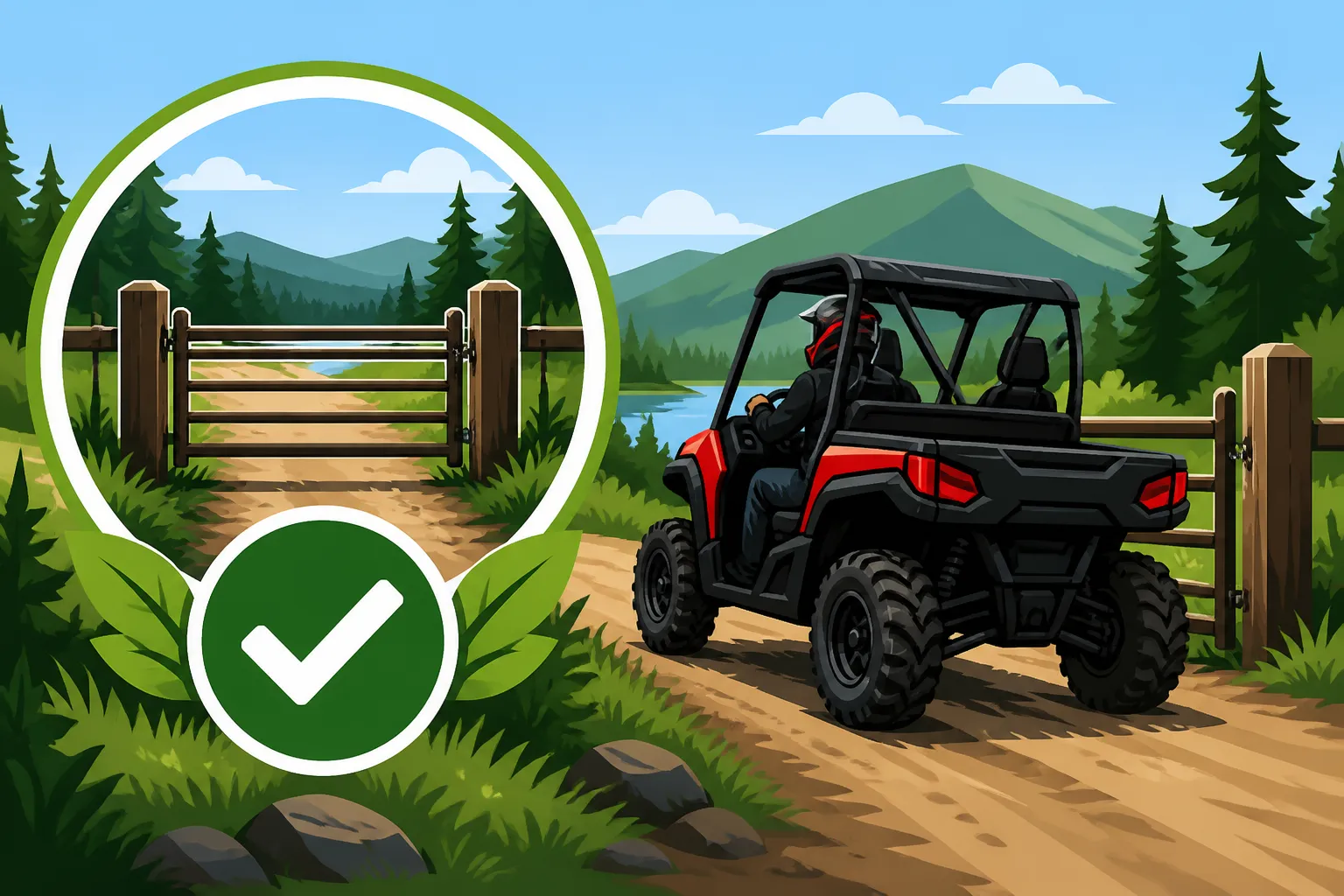
If the gate is open and there is no sign or other instruction to the contrary, pass through carefully and return it to the same position. If it is closed but appears intended for rider access, open it only if you are authorized to use the route and can secure it exactly as it was. If you cannot tell what the original position was, or the gate is chained or locked, do not guess. Stop and seek reliable guidance rather than bypassing it.
| What you find | Safer response |
|---|---|
| Gate is open, with no closure sign | Pass through cautiously and leave it open |
| Gate is closed and appears to be a normal access gate | Open only if the route is authorized, then close and secure it as found |
| Gate is locked, chained, or marked closed | Do not force it, climb it, or go around it |
| Gate position is unclear | Pause, check signs and route guidance, and avoid guessing |
| Livestock or farm activity is nearby | Slow down, keep distance, and follow any posted instructions |
| Gate is damaged or cannot be secured | Do not leave it in a less secure condition; report the issue to the responsible club or land contact |
The key is to reproduce the position you encountered, not the position that feels most convenient. A gate left open may look harmless when you are riding through a quiet wooded section, but the property owner may rely on it to contain animals or secure access.
Handle the gate without putting yourself or others at risk
Before getting off your ATV or side-by-side, choose a safe stopping place. Avoid blocking a narrow corridor or stopping where another rider could come around a blind bend and meet you unexpectedly. Keep the machine stable, use the parking brake as appropriate, and make sure the group knows you are stopping.
If you need to dismount, turn off or secure the machine according to its operating instructions before handling the gate. Be cautious around hinges, latches, chains, and spring-loaded mechanisms; a gate can swing or shift unexpectedly. Keep hands and clothing clear of pinch points, and do not stand where the gate could strike you if it moves.
With a group, decide who will handle the gate and who will watch for approaching trail users. Riders should pass one at a time rather than crowding the opening. Once through, the last rider should check that the gate has been returned to the correct position and that the latch is engaged if it was secured when the group arrived. This final check matters: a gate that looks closed but is not latched may swing open after the group leaves.
Avoid common gate mistakes
Do not use a fence opening as an unofficial detour
When a gate is locked or the trail beyond it appears blocked, it can be tempting to ride around the end of the fence. That is not a safe workaround. The gap may lead onto private land, a crop field, a steep bank, or a route that is not authorized for ATV use. Riding around a barrier can also widen an opening and encourage others to follow.
The same caution applies when a gate is partly open, damaged, or lying on the ground. Do not assume its condition means the route is abandoned. A landowner or club may be arranging repairs, or the access may have changed. Keep to the signed corridor and ask the relevant club or property contact for direction when possible.
A phone map may help you understand where you are, but it cannot tell you whether a landowner has granted access at that moment. onX Offroad can be useful for reviewing a planned route and your position, but compare it with local trail information and obey the signs on the ground. If a gate or closure conflicts with a line on a screen, do not treat the digital route as the final word.
Do not leave the gate open for the riders behind you
It may seem considerate to hold a gate open while the rest of your group passes, but the last rider still needs to return it to its original position. Agree on that responsibility before the group reaches the gate. If the group is large, have one person keep track of the final rider and confirm the gate has been secured.
For example, imagine a group of six riding in the Lanaudière region. The first rider opens a closed gate, and the next five pass through. If everyone assumes someone else will close it, the group may be several kilometres away before anyone notices. A simple call—“last rider closes and checks”—prevents that confusion.
Do not wedge a gate open with a branch, rock, helmet, or machine unless the landowner or posted instructions specifically direct you to do so. Temporary props can fall, damage the gate, or leave it unsecured. If a gate cannot be closed or latched as you found it, avoid improvising a repair. Make a note of the location and report the problem to the trail club or appropriate contact.
Make respectful gate habits part of every ride
Prepare before you leave the trailhead
Before riding, check that your chosen route is open and that you understand its access rules. Use the trail club’s information where available, pay attention to local signs, and keep a route map accessible. An app such as onX Offroad may supplement your planning by helping you follow your position, but it should not replace trail signs, club updates, or the need to respect a physical closure.
It also helps to set expectations with your group before the ride starts. Tell everyone that gates are to be left as found, that no one should bypass a locked barrier, and that the last rider is responsible for checking the gate. This is particularly useful when riding with guests or newer ATV riders who may not know how a particular corridor is managed.
For general trail conduct, Quebec Trail Etiquette Locals Expect and Staying on a Federated Corridor offer useful related guidance. Following a marked route and treating land access carefully helps protect the relationship between clubs, riders, and property owners.
Report problems without making them worse
If you find a gate damaged, missing, or impossible to secure, do not leave it in a more open position than necessary. Avoid taking apart a latch or attempting repairs unless you have clear permission and the right tools. Record the location in a practical way, such as the trail name, nearby intersection, or a clear landmark, and contact the trail club or land manager responsible for that route.
If a sign indicates a closure, follow it and report the information through the appropriate channel if it seems inconsistent with the route guidance you checked. Do not post an unverified claim that a trail is open, and do not direct other riders around the barrier. A short, accurate report can help the club investigate without encouraging people to enter a restricted area.
Clubs and landowners depend on riders to notice problems and behave responsibly. A gate closed properly may seem like a small courtesy, but repeated small actions shape whether access remains workable. The same principle applies to staying on the marked route, observing closures, and respecting landowner decisions. See Quebec Club Volunteer Days for more on the local work that helps maintain riding areas, and Quebec Trails That Cross Crown Land for a related look at how trail settings and access can differ.
Disclaimer
This article is for general informational purposes only and does not constitute professional advice. Laws, prices and regulations vary by location and change over time. Consult a qualified professional for guidance on your specific situation.