Quebec Club Volunteer Days
A Quebec ATV club volunteer day can mean clearing branches, repairing signs, checking a trail after a storm, or helping prepare a route for the season. It can also be hard to know who to contact, what to bring, and whether you need riding experience. This guide explains how to find a work day, show up prepared, and help without putting yourself or the trail at risk.
What happens at a Quebec ATV club volunteer day
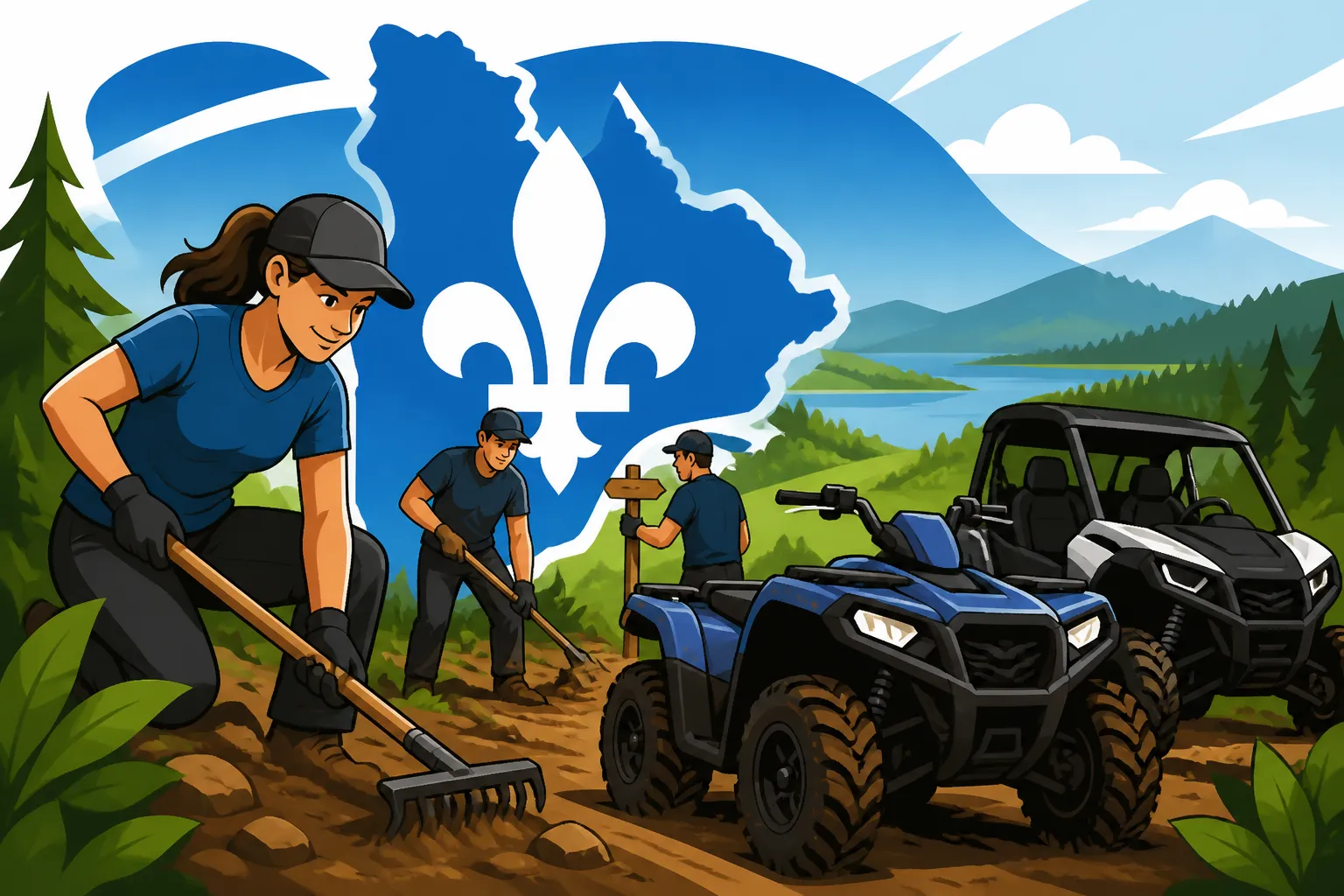
A volunteer day is usually a planned work session organized by a local club or trail group. The job might be a short task close to a road or a longer outing along a remote corridor. The goal is to keep an authorized trail usable and safe, not to build or ride wherever volunteers please.
Trail work can be surprisingly varied. One group might clear small branches after a storm, while another checks signs, fills a rut, or removes litter from a trailhead. The work depends on the location, the season, the club’s priorities, and what the landowner or relevant authority permits.
Common jobs volunteers take on
Many work days focus on light maintenance that can be completed with a small team. Volunteers may trim brush away from signs, clear fallen limbs, check for washed-out spots, or report a damaged bridge or culvert to the club. Some jobs are more about observing and recording problems than fixing them on the spot.
The task may also be administrative or community-focused. A club might need help setting up for an event, organizing equipment, or sharing trail condition information. If you are new, say so when you contact the organizer. There may be a useful role for you that does not require experience with tools or riding in difficult terrain.
Heavier work should be handled by people with the right training, equipment, and authorization. Do not assume that a volunteer day is permission to cut trees, move structures, operate machinery, or alter a route. Ask the organizer what is approved and who is responsible for the work.
Who organizes the work
Start with the club responsible for the area where you want to help. Quebec has local ATV clubs connected to the wider trail network, but the club that maintains one route may not be responsible for another nearby section. The best contact is usually the club’s official website or social media page, or an organizer you have met at a club event.
If you are looking for a club near a destination, check [Quebec Clubs and What They Maintain] and [Quebec Club Volunteer Days]. Ask whether they have a planned work day, whether they accept first-time volunteers, and what kind of help they need. A club may not post every work session publicly, particularly if access details or landowner coordination need to be confirmed first.
Keep your message straightforward. For example: “I’m new to the area and would like to help with trail maintenance. Do you have a volunteer day coming up, and what should I bring?” Include your general availability and whether you have relevant experience, such as using hand tools, first aid, or operating an ATV safely. Let the club decide which skills fit the task.
What to expect on the day
A well-organized work day should have a clear meeting place, a contact person, and an explanation of the job before work begins. You may be asked to sign in, attend a safety briefing, or wait while the organizer confirms that the group can access the work area. Bring patience: weather, trail conditions, equipment problems, or a change in land access can alter the plan.
The work may involve more walking than riding. Even when the group travels by ATV or side-by-side to reach a location, volunteers may need to park and work on foot. A task that sounds simple—such as checking signs—can take longer if the route is muddy, overgrown, or difficult to reach.
Here is a practical overview of what different tasks may call for:
| Volunteer task | Possible preparation | Important question to ask |
|---|---|---|
| Clearing small branches | Work gloves, sturdy footwear, water | Which tools are approved, and who provides them? |
| Checking signs or trail markers | Weather-appropriate clothing, phone or notebook | Should problems be reported or repaired on site? |
| Picking up litter | Gloves, sturdy footwear, bags if requested | Where should collected waste be left? |
| Inspecting a damaged section | Outdoor clothing, first-aid supplies | Is the route safe to access, and who makes repair decisions? |
| Helping at a club event | Comfortable clothing, water, any requested supplies | What time should you arrive, and who is your contact? |
How to prepare safely and responsibly
A little preparation makes the day easier for you and the organizer. Confirm the meeting location, start time, expected duration, and whether you are expected to bring tools or your own machine. Do not bring equipment that the club has not requested; an unfamiliar chainsaw or cutting tool can create extra risk rather than help.
Also ask about the work’s physical demands. A volunteer task may involve uneven footing, lifting, bending, mud, insects, or a long walk. If you have an injury or limitation, you do not need to overexplain it. Simply ask whether there is a suitable task or a way to contribute without taking on the parts that could aggravate it.
Clothing, tools, and personal supplies
Dress for the conditions, not just the forecast at home. A sunny morning in a town can feel different under a shaded forest canopy, and the weather can change over the course of a work session. Wear sturdy footwear with good grip, work gloves suited to the task, and clothing that protects your skin from brush and insects. Bring water and any food you will need if the group will be out for several hours.
Ask before packing tools. Clubs may already have equipment and may want particular tools used only by designated people. If volunteers are asked to bring hand tools, confirm the type and condition expected. Do not bring power equipment or use it without the organizer’s explicit approval and the necessary experience.
A basic personal kit can include a charged phone, drinking water, snacks, any personal medication, and a small first-aid item you know how to use. If you will be travelling by ATV, confirm what safety equipment and documents are expected for the ride. Rules for riding on trails still matter when the purpose of your trip is volunteer work; see [Quebec ATV Equipment Checks by Patrols] and [Carrying a Driver's Licence on a Federated Trail].
Riding to a work site
Some work sites are reached by ATV, but that does not make the route an informal work road. Before riding, confirm the route is open and authorized for your machine and that any required registration, insurance, trail pass, and rider qualifications are in order. A volunteer invitation does not automatically replace those requirements.
Ask the organizer whether you should ride your own machine, travel with another volunteer, or meet at a trailhead and continue as a group. If you are unfamiliar with the area, do not rely on a pin or a map screenshot as your only directions. Confirm the meeting point, access route, and any restrictions directly with the club.
Navigation apps can be useful for planning and keeping track of your location, but they are not permission to ride a route. If you use onX Offroad, treat it as a navigation aid and verify that the route is open and approved with the club. Map information may not reflect a temporary closure, a landowner’s conditions, or a newly changed trail alignment.
This matters in Quebec, where a route may cross land with specific access rules or be closed temporarily. Learn the basics in [Quebec Trails That Cross Private Land] and [Quebec Trails Closed for Hunting Season]. If a volunteer leader asks the group to stay on a particular corridor, follow that instruction rather than trying a shortcut.
Working around hazards and other trail users
A trail work site can have hazards that are easy to miss when you are focused on the task: unstable branches, soft shoulders, standing water, exposed roots, or equipment in use nearby. Listen to the safety briefing, keep clear of tools you are not trained to operate, and tell the organizer if something feels unsafe. You are allowed to ask questions before starting.
Do not work alone in a remote spot unless the organizer has specifically assigned and planned for it. Keep your group informed if you need to step away, and agree on how to reconnect if people become separated. If the work area is near a riding corridor, ask how the group will warn or guide passing riders. Avoid assuming that a trail is empty just because you cannot hear a machine.
Leave the work site as the organizer directs. That may mean packing out rubbish, returning tools, recording a damaged spot, or leaving a repair for a qualified crew. A half-finished fix can be more dangerous than a clearly marked problem, so do not make an improvised repair just to leave the trail looking tidy.
How to find a work day and become a useful regular
The easiest way to get involved is to make contact before a work day is announced. Clubs can explain which sections need help, what kinds of tasks are suitable for beginners, and how they communicate changes. If there is no scheduled work session, ask whether the club has another way to contribute, such as helping at an event or reporting trail conditions.
Volunteer efforts are especially valuable when they are coordinated. A group may need people who can give a few hours, but it also needs reliable communication and respect for access rules. Showing up when expected, checking before making changes, and reporting problems accurately can be just as helpful as having specialized skills.
Contacting a club and choosing a task
When you contact a club, make it easy for the organizer to place you. Share the dates or general times you are available, whether you have an ATV, and any experience that could be relevant. You can also say clearly that you are a beginner and would prefer a task that does not require operating tools.
Ask how the club announces work days and whether there is a volunteer list or group communication channel. Follow the club’s instructions about meeting locations and access details. If plans change, notify the organizer rather than simply not showing up; the group may be relying on a particular number of people or vehicles.
If the club suggests a task that does not suit your experience, say so early. For example, if you are not comfortable operating a saw, you might be able to help carry supplies, flag a problem area, collect litter, or assist with an event. The organizer can decide what is safe and useful.
Respecting land access and trail conditions
Trail access can depend on permission and local conditions. A volunteer day does not grant independent permission to return later, bring friends, or ride beyond the work area. Ask whether access is limited to the scheduled activity and whether there are specific directions for parking or crossing private property.
Stay on the route the club identifies, and follow instructions about gates, signs, and closures. These details help maintain good relationships with landowners and protect the trail network. For more context, read [Staying on a Federated Corridor] and [Why a Quebec Landowner Withdraws Permission].
Conditions can change quickly after heavy rain, during the spring thaw, or when a club closes a section for another reason. Before travelling to help, confirm that the work day is still going ahead and that the access route is open. If you use onX Offroad to plan your approach, compare what the app shows with the club’s latest directions rather than treating the map as the final word.
Staying involved after the work day
At the end of the session, ask whether the organizer needs a short report of what was completed or what remains. A clear note—such as the location of a damaged sign or an area that still needs attention—can help the club plan its next visit. Avoid posting sensitive access details publicly unless the club says they are appropriate to share.
Thank the people who organized the day and ask how to hear about future work. If the experience went well, consider joining the club or helping at another event. Club participation can involve more than trail maintenance: volunteers may support communications, safety efforts, events, or local coordination. [Quebec Club Membership Benefits] explains the kinds of involvement members may find through a club.
If you are not ready to commit to a full work day, start with one session and see how it feels. You will learn what the work actually involves, meet people who know the area, and find out whether your skills match the club’s needs. A few hours of coordinated help can make a real difference, especially when volunteers follow the organizer’s plan and respect the trail’s access conditions.
Disclaimer
This article is for general informational purposes only and does not constitute professional advice. Laws, prices and regulations vary by location and change over time. Consult a qualified professional for guidance on your specific situation.