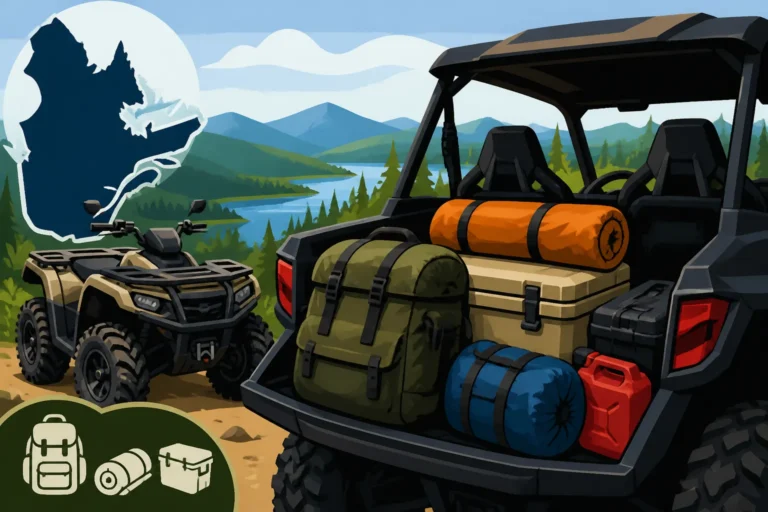
Le Summum and Who It Suits
A 314-kilometre ATV circuit can sound like a straightforward weekend ride until you start working out fuel, lodging, trail access and how much distance your group can comfortably cover. Le Summum is a better fit for some riders than others. This guide explains what the route’s length means in practice, who may enjoy it, and how to plan without treating a mapped circuit as a guaranteed itinerary.
What Le Summum’s 314-kilometre length means
Think of it as a route to plan, not a promise of one-day riding
Le Summum is identified as a 314-kilometre Quebec ATV circuit. That figure is useful for understanding its scale, but it doesn’t automatically tell you how long your trip will take or how many kilometres you should expect to ride in a day. Stops, conditions, detours, trail closures and the pace of the slowest rider all affect the real itinerary.
It helps to separate the circuit’s total distance from your daily riding target. A group might spread the route across several days, ride only one section, or use a trailhead as a base and explore nearby corridors. A full circuit is not an obligation. Choosing a shorter portion can make the outing more enjoyable than trying to fit every kilometre into a tight schedule.
Before leaving, confirm the route and any connections using current regional trail information. A line shown on a planning map is not a guarantee that every segment is open, passable or appropriate for your machine on the day you arrive. For a broader look at how named routes fit into the network, see [Quebec Quad Circuits Worth Riding] and [Trans-Québec Trails Explained].
Why the advertised distance is only one part of the plan
Distance alone doesn’t capture the effort of a trail ride. A familiar, flowing section can feel very different from a slower corridor with rough ground, frequent turns or stops to regroup. Riders may also need extra time for fuel, meals, photos, mechanical checks and navigating unfamiliar junctions. Those pauses are part of the trip, not wasted time.
Imagine a mixed group with one experienced rider, two occasional riders and someone new to trail riding. The experienced rider might be comfortable with a long day, but the group’s pace will be set by the person who needs more time to handle turns, rough patches or navigation. Planning around the group rather than the fastest machine reduces pressure and helps prevent a late finish.
Build flexibility into the schedule. If a section takes longer than expected, having a lodging option, a shorter stopping point or a way to revise the day’s route makes a big difference. Check trail status before departure and again while travelling; closures or local conditions can change the plan. [Quebec Trail Conditions Before You Go] is a useful companion topic when you’re deciding whether a planned section is suitable.
Who Le Summum is likely to suit
Riders who enjoy a multi-day route with room to adapt
Le Summum may appeal to riders who like the idea of linking trail sections into a larger trip rather than repeating short loops from home. A named circuit gives a group a shared objective: follow the route, explore a region and make progress over more than one riding day. That sense of journey can be rewarding even if the group doesn’t complete the entire circuit.
It may also suit riders who are comfortable adjusting plans as they go. Weather, fatigue, a machine issue or a change in trail access can make the original itinerary impractical. Riders who treat the route as a framework, rather than a fixed schedule, are usually better positioned to enjoy the experience. This is especially true when travelling with several machines or people with different levels of confidence.
The circuit can be a good conversation starter for a group planning a trip, but it isn’t a shortcut around practical preparation. Everyone still needs to agree on daily distance, pace, stops and the expectations for the ride. If part of the group wants a relaxed day with long breaks while others want to cover ground, settle that difference before you set off.
Riders who may prefer a shorter outing first
A 314-kilometre route may feel ambitious for a first-ever ATV trail trip, a brand-new machine or a group whose members have not ridden together before. That doesn’t mean beginners should rule it out. It does mean they should consider starting with a manageable section and leaving enough time to learn how the group handles trail pace, communication and navigation.
A shorter trial outing can reveal things that are hard to predict from a map. One rider may tire sooner than expected. A passenger may need more frequent breaks. The group may discover that it wants a slower pace than the person who organized the trip assumed. Learning this close to home is easier than discovering it after committing to a longer multi-day itinerary.
For newer riders, choose a section that the group can complete comfortably, then reassess. Look at [Best Quebec ATV Trails for Beginners] for ideas about matching a route to experience, and read [Quebec Trail Difficulty Ratings] before interpreting a route as suitable based on its name or length alone. A circuit’s overall distance doesn’t tell you how challenging each segment will feel to your particular group.
| Rider or group | Why Le Summum may fit | Planning consideration |
|---|---|---|
| Experienced riders travelling together | A longer circuit can provide a shared multi-day objective | Confirm open sections, fuel options and overnight stops |
| Mixed-experience group | The route can be divided into more manageable portions | Set the pace for the least-experienced rider |
| First-time trail riders | A selected section can be a learning outing | Avoid committing to the full distance before testing the group’s comfort |
| Riders with limited trip time | A partial route may still deliver a rewarding ride | Choose the start and finish points before travelling |
| Riders travelling with passengers | A planned circuit can make a getaway feel like a complete trip | Check machine capacity, comfort, breaks and passenger rules |
How to plan a Le Summum trip
Break the route into daily sections
Start by deciding how many days you have, then work backwards. Don’t divide 314 kilometres evenly and assume each day will be equally easy. A realistic itinerary accounts for where you can start and finish, what sections connect to suitable services, and how much riding your group wants to do before stopping.
Mark likely stopping points and alternatives. If the group falls behind schedule, a backup plan can be as simple as ending the day earlier or dropping a section. If you’re travelling with a support vehicle, check where it can meet you and whether access is allowed. If you’re travelling without support, your route, supplies and overnight arrangements need to work together.
Give each day a clear start point, a planned finish and a reasonable fallback. Share those details with the group before the ride, including a meeting location in case someone gets separated. Route planning is easier when everyone is working from the same map and understands that the itinerary may change. For help with organizing the route on a device, see [Planning a Route on the Interactive Map] and [Downloading a Circuit to Your Phone].
Confirm access, trail status and overnight arrangements
Check the relevant trail information before travelling, rather than relying on an old screenshot or a route someone saved last season. A circuit can include areas managed by different clubs or local organizations, and a closure in one spot may affect the practical route through the area. Check for seasonal restrictions, active closures and any access conditions that apply to your planned dates.
Don’t assume that a trail pass, machine registration or club membership answers every question about where you can ride. Trail access, vehicle paperwork and local permissions are separate parts of trip preparation. If you’ll ride on a federated trail, review [Quebec's Annual FQCQ Trail Pass] and [Quebec Pass Proof on the Trail]. Also confirm that each rider has the required documents and that the machine is ready for the trip; [Quebec Registration Before Your First Ride] covers the registration side of that checklist.
Book overnight stays with the actual route in mind. Ask whether the property welcomes ATV riders, where machines can be parked and whether the location connects conveniently to the trail plan. Lodging advertised as being in a region may still require a road transfer, so check the details instead of assuming you can ride directly to the door. [Quebec Trails With Lodging Along the Way] and [Booking Lodging on a Long Route] offer helpful planning angles.
Preparing your machine and group
Make the machine fit the distance you intend to ride
A machine that feels fine for an afternoon outing may need more attention before several consecutive days on the trail. Check the owner’s manual for routine maintenance guidance and inspect the basics before departure: tires, brakes, lights, steering, battery, fluid levels and any items that have recently needed attention. If something feels wrong at home, it is better to address it before the trip than to hope it behaves on a remote section.
Pack for ordinary problems without turning the machine into an overloaded workbench. A basic tool kit, tire-repair supplies, a first-aid kit, water and communication equipment can be more useful than a pile of gear chosen without a plan. Long routes also make it sensible to think about spare parts that match your machine and riding conditions. [Carrying a Spare Belt on a Long Circuit] and [First Aid on a Remote Circuit] can help you build a practical kit.
Fuel planning deserves particular care. Don’t assume that every village, trail junction or lodging stop will have fuel available when you need it. Work out the distance your machine can reasonably cover under the conditions you expect, and leave a margin for detours or slow riding. The route plan should reflect the fuel range of the least capable machine in the group, not simply the longest range one rider has achieved.
Match the schedule to the people, not just the machines
A successful trip depends on the group’s comfort as much as the equipment. Talk in advance about riding pace, rest breaks, passenger needs and what happens if someone wants to stop early. A rider who is reluctant to speak up about fatigue can turn a manageable day into a stressful one, so make it normal to check in with one another.
Agree on simple group habits. Decide where to regroup after turns, who leads and who rides at the back, and how people will communicate if they need to pull over. Keep the group together at junctions instead of assuming everyone can follow the same line of sight. If riders have different navigation tools, identify a shared reference route and make sure everyone understands the backup plan.
If the group uses a digital navigation app, treat it as one tool rather than the final authority on access. onX Offroad may help some riders organize saved routes or review their position, but it should not replace current local trail information or confirmation that a segment is open. Check the route before departure, keep an offline option where possible, and carry a backup way to navigate. A second mention of onX Offroad is most useful in this context: comparing what your app displays with the relevant local trail map can help expose a mismatch before it becomes a problem on the ground.
Deciding whether to ride all or part of the circuit
Use a simple go or adjust check before departure
A useful pre-trip check is to ask whether the route, the group and the machines are all ready for the same plan. If the route is not confirmed, the lodging is uncertain or a machine needs attention, adjust the itinerary instead of hoping those issues resolve themselves. A shorter ride with a clear plan is often a better trip than a full circuit attempted under pressure.
Consider the least-experienced rider and the most limited machine when setting daily distance. If either one is likely to struggle, shorten the day or pick a section with simpler logistics. The same applies when the weather is poor, daylight is limited or the group is unfamiliar with the area. Leave yourself permission to change the plan without treating it as a failure.
Use a quick checklist before you load up:
- Confirm the route and current trail access for your travel dates.
- Choose start and finish points for each riding day.
- Check fuel needs, overnight stops and backup options.
- Make sure riders and machines have the necessary documents and equipment.
- Share the itinerary, regrouping plan and communication expectations.
- Decide in advance what conditions would make you shorten or postpone the ride.
Keep the trip enjoyable if the full distance is not realistic
A route doesn’t lose its value because you ride only part of it. You can choose a section that works with your available time, use a shorter outing to learn the area, or save the remaining distance for a future visit. For many groups, that flexibility is what makes a larger circuit approachable rather than intimidating.
It can also help to think beyond completion. A rewarding ride might mean discovering a good lunch stop, navigating a new trail region as a team or finishing the day with enough energy to enjoy the evening. Those goals are easier to reach when the schedule gives the group time to pause and adapt. If the only measure of success is reaching the end of all 314 kilometres, the ride can start to feel like a deadline.
For navigation, onX Offroad can be part of a rider’s personal planning setup if it suits their needs, but use it alongside current local trail resources and a clear understanding of access. Verify the route and closures before setting out, and don’t let a line on a screen override posted signs or local instructions. That combination keeps the focus where it belongs: a well-planned ride that fits your group, rather than a distance target at any cost.
Disclaimer
This article is for general informational purposes only and does not constitute professional advice. Laws, prices and regulations vary by location and change over time. Consult a qualified professional for guidance on your specific situation.