Riding the 141-Kilometre Covered Bridge Circuit
A 141-kilometre ATV ride can look straightforward on a map and still become a long day once you factor in trail conditions, fuel, stops, and the time it takes to reach a public road crossing. This guide explains how to plan the Covered Bridge Circuit in Quebec’s Chaudière-Appalaches region, what to check before leaving, and how to make the ride enjoyable rather than rushed.
What to Expect From the Covered Bridge Circuit
Understanding the 141-kilometre distance
The Covered Bridge Circuit is a named route in Quebec’s Chaudière-Appalaches region. Its 141-kilometre distance gives riders a useful sense of scale, but it should not be treated as a guaranteed riding time or a promise that every segment will be open. Trail conditions, detours, access points, and closures can change the practical shape of a day.
Distance is only one part of the planning. A group that rides steadily without many stops will cover ground differently from a family group, first-time riders, or a crew that wants to pause for food and photographs. Add time for trail junctions, road crossings, traffic, and breaks. A route that looks manageable on a screen can feel much longer after several hours in the saddle.
Before setting out, confirm the circuit’s current alignment and access on the official trail information available for the region. A broad overview such as [Quebec Quad Circuits Worth Riding] can help with trip ideas, while [Planning a Route on the Interactive Map] is a useful reminder to check the actual route rather than relying on a remembered description or an old screenshot.
The regional feel and covered bridge theme
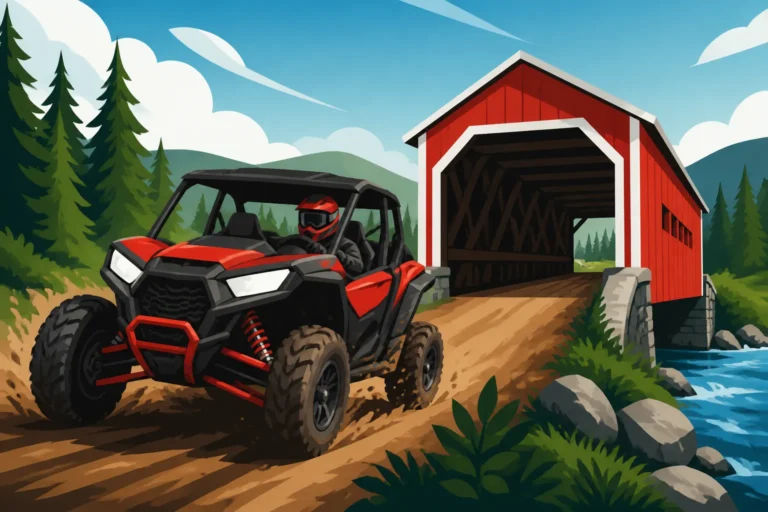
The circuit’s name points to one of the pleasures of riding in this part of Quebec: the chance to connect a trail day with the region’s rural landscape and heritage. Chaudière-Appalaches is known for its farms, villages, river valleys, and historic covered bridges. Those features can make the ride feel like more than a mileage challenge, especially if your group has time to stop and explore responsibly.
A covered bridge is a destination or landmark, not permission to ride across private property, leave a marked corridor, or park wherever it is convenient. Some scenic stops may require a legal public-road approach or a separate parking area. Check access details before travelling, and follow signs at the site. If a trail brings you near a village or bridge, stay on the authorized route and avoid blocking residents, businesses, or emergency access.
For riders who want to compare the circuit with other regional options, [Quebec Circuits in Chaudière-Appalaches] offers a useful next step. The broader guide [Between Beauce and Lotbinière] can also help put the area’s riding and landscapes into context without assuming that every nearby attraction is directly connected to the circuit.
Planning the Ride Before You Leave
Choosing a start point and setting a realistic pace
Start by deciding whether you want to ride the full circuit, a shorter section, or a portion that returns you to your vehicle without requiring a complicated shuttle. The best starting point depends on the official route, parking availability, trail access, and the needs of your group. Don’t choose a launch spot simply because it looks central on a map; confirm that parking and trail access are permitted there.
For a full-distance day, build a plan with a few clear checkpoints: where you expect to stop, where you can refuel, and what you will do if the group falls behind schedule. Agree on a turnaround point or a time when you will shorten the ride. This is especially helpful when riders have different levels of experience. Nobody enjoys feeling pressured to keep up after a long morning on unfamiliar trails.
A practical route plan leaves room for the unexpected. A slow section, a closed connector, or a mechanical issue can alter the day. Use [Quebec Trail Conditions Before You Go] to guide your pre-ride checks, and review [Quebec Trail Maps and the iQuad App] for trail-navigation information. Apps such as onX Offroad can be useful for organizing a trip and viewing your position, but an app should not replace official trail updates, posted signs, or permission requirements.
Checking closures, trail access, and passes
The route may cross a mix of trail corridors and local access points, and the status of each section matters. Spring thaw, heavy rain, hunting activity, maintenance work, or local decisions can affect where riding is allowed. A line displayed on a map is not proof that a trail is open today. Confirm current status before you load the trailer, then pay attention to signs when you arrive.
In Quebec, riding a federated trail generally involves more than knowing the route. Riders need to understand the applicable trail-pass and safety requirements, and they must respect closures even if a pass has already been purchased. A pass does not turn a closed trail into an open one. Review [Quebec Trail Passes Cover Every Club] for background on the pass system and [Quebec's Spring Thaw Closure] before planning an early-season trip.
Access beyond a marked trail is a separate question. A trail map does not grant permission to cross private land, take an unofficial shortcut, or ride into a nearby field or forest road. Stay on the authorized corridor and follow local instructions. For a closer look at land access, read [Quebec Private Land Permission]. When in doubt, choose the marked route and ask the relevant club or land manager rather than guessing.
Preparing maps and navigation
Download or save the information you need before leaving home, especially if you expect limited cell coverage. Keep an offline map available, bring a charged phone, and consider carrying a separate power bank. If several machines are travelling together, make sure at least two riders can navigate independently rather than relying on one person’s phone.
Digital tools are helpful for orientation, but they can show information that is incomplete, outdated, or intended for a different kind of travel. onX Offroad may help you compare terrain and keep track of your position, but it should be treated as a planning aid—not as the final authority on Quebec trail access. Verify the circuit against official trail maps, club updates, and on-the-ground signs. If a digital route conflicts with signage or a posted closure, follow the local instructions.
Before departure, zoom in on junctions, crossings, and likely stopping points. Make sure every rider understands the planned route and has a way to contact the group if separated. A simple meeting rule—such as waiting at the next safe, clearly marked junction—can prevent a minor navigation mistake from turning into a stressful search. Avoid stopping in a place that blocks the trail or creates a hazard for other riders.
| Planning question | What to check | Why it matters |
|---|---|---|
| Is the route open? | Current regional or club trail updates and posted signs | A mapped trail may be closed or rerouted |
| Can we complete the distance? | Group pace, daylight, breaks, and a backup turnaround point | The stated distance does not predict your actual riding time |
| Where can we stop? | Legal parking, food, fuel, and safe pull-offs | Not every village or landmark has ATV parking |
| Is the machine ready? | Fuel, tires, belt, lights, and basic tools | A small mechanical problem can delay the whole group |
| Can everyone navigate? | Offline maps, charged devices, and a shared meeting plan | Cell service and battery life can be unreliable |
Making a Full Day Comfortable and Safe
Fuel, food, and sensible breaks
Do not estimate fuel needs from distance alone. A machine’s range changes with terrain, load, riding style, tire choice, and mechanical condition. Mud, steep sections, frequent stopping, and carrying a passenger can all affect consumption. Start with a full tank where possible, then identify confirmed fuel options along or near your planned route. Never assume that a gas station in a nearby community is accessible from the trail.
Pack water and food even if you expect to stop in a village. Business hours, seasonal availability, and trail access can make a convenient-looking stop impractical. A small meal, snacks, and enough water for the group can make a long day much more comfortable. Keep food and rubbish secured, and take everything back with you.
Plan breaks before people become tired or irritated. A short stop lets riders drink, stretch, check equipment, and confirm that the group is still together. Choose a safe place where machines can be parked clear of the trail. For longer regional rides, [Quebec Trails With Fuel Stops] and [Quebec Restaurants Along a Trail] can help shape the broader trip, but confirm that any listed stop fits your route and is operating when you plan to visit.
Packing for weather and mechanical problems
Quebec weather can shift during the day, and conditions in the countryside may feel different from the forecast in a larger town. Bring layers that can handle wind, rain, and temperature changes. Keep gloves and a dry layer in a sealed bag, and make sure every rider has the required helmet and protective gear. A rain jacket is useful even when the morning begins under clear skies.
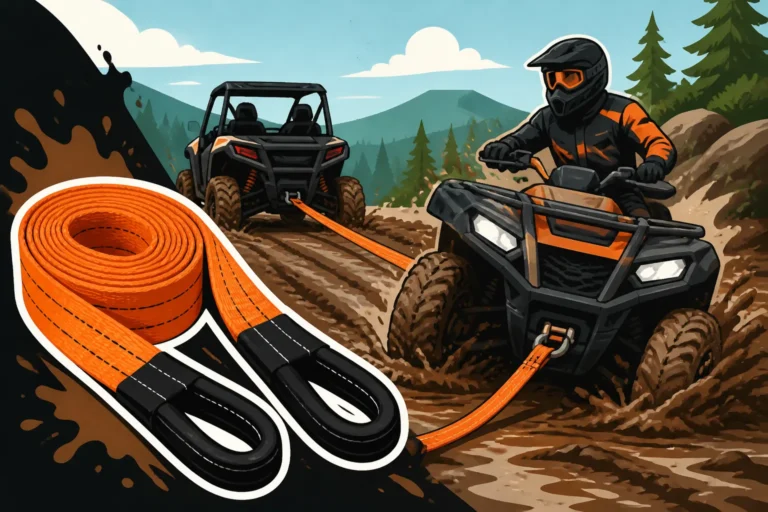
Pack a small repair and recovery kit suited to your machine and experience. Depending on the group, that might include basic hand tools, a tire repair kit, a tow strap, spare fuses, a flashlight, and items needed for routine checks. A strap is not a substitute for knowing safe recovery practices; discuss who will help and where to attach it before anyone gets stuck. Avoid improvised pulls that could damage a machine or injure someone.
Before loading up, inspect the tires, brakes, lights, fuel, and visible fasteners. Check the machine’s owner information for maintenance needs, particularly if it has been sitting unused. For a more detailed long-ride checklist, [Packing for a Multi-Day Ride] and [Carrying a Spare Belt on a Long Circuit] offer relevant preparation ideas. You may not need every item for a one-day outing, but a little preparation is far easier than trying to solve a preventable problem beside the trail.
Riding with a group
Agree on basic group rules before the first machine moves. Decide who leads, who rides at the back, how often the group waits, and what to do if someone misses a turn. Keep a comfortable gap between machines and avoid riding so close that dust, mud, or a sudden stop becomes a problem. A leader should set a pace that the least experienced rider can manage.
At junctions, make sure the group knows whether it will regroup immediately or continue to a designated safe stopping point. Don’t assume that every rider saw the same sign or heard the same instruction. If a rider is missing, stop somewhere safe and use your agreed communication plan rather than sending several machines in different directions.
Courtesy matters on a shared trail. Slow down near homes, farms, pedestrians, and other trail users. Follow posted speeds and local rules, and avoid loud or aggressive riding. [Quebec Trail Etiquette Locals Expect] is useful background for keeping the ride enjoyable for residents as well as visitors. For route-specific behavior and safe passing practices, see [Passing Safely on a Blind Corner].
Choosing the Right Ride for Your Group
Full circuit or shorter outing
The full 141-kilometre circuit may suit experienced riders who are comfortable spending much of the day on the machine and who have a well-prepared route plan. It can be a satisfying goal for a group that enjoys covering distance, but the number alone should not decide whether it is appropriate. Think about the slowest rider, the machine with the shortest practical range, and how much daylight remains after travel to the trailhead.
A shorter outing can be the better choice for a first visit, a mixed-ability group, or a day with uncertain weather. Choose a section that has a clear return plan and a reasonable place to stop. If the circuit is not a simple loop from your launch point, make sure you understand how you will get back to your vehicle before committing to a one-way segment.
A useful way to decide is to plan two versions of the day: the preferred route and a shorter alternative. Set a decision time, such as after lunch, when the group will assess pace, weather, and energy. This keeps the day flexible without creating confusion. For broader trip planning, [Quebec Trails for a Weekend Trip] may help you decide whether to make the circuit part of a longer stay.
Matching the route to rider experience
Experienced riders may be comfortable with a long day, but a group’s ability depends on more than the most confident person’s skill. New riders need time to learn how the machine responds, how to follow trail signs, and how to manage crossings and changing surfaces. If someone is new, reduce the pressure by choosing a shorter section and setting a pace that allows questions and breaks.
Before the ride, confirm that every driver meets Quebec’s applicable age and licence requirements and understands the rules for the machine they will operate. These requirements can differ for an ATV and a side-by-side, and youth riders may have additional conditions. Start with [Quebec ATV Age Requirements] and [Quebec Rules for a Side-by-Side Driver] if your group includes younger riders or UTV drivers.
Passengers need planning, too. Check that the machine is designed for the number of people riding, and that everyone knows how to sit securely and use the required restraints where applicable. A long route can be tiring for a passenger, especially if the ride is bumpy or the weather turns. Build in regular stops and do not treat a child or passenger’s comfort as an afterthought.
A Practical Pre-Ride Plan
The day before
Review the route and current conditions, then make a clear plan for the start point, intended distance, fuel, and return. Confirm where parking is allowed and whether any trail segment is closed. Check the forecast for the riding area rather than relying only on conditions in your home community. If the group is travelling from Montreal, Quebec City, or farther away, allow time for the drive and for unloading before setting out.
Charge phones and navigation devices, download maps, and share the route plan with everyone. Tell someone who is not riding where the group expects to go and when it should be back. This is a simple precaution that becomes especially valuable if the group has a mechanical problem or changes plans in an area with limited cell coverage.
Prepare machines and gear in advance instead of rushing through checks at the trailhead. Look over tires and lights, fill fuel, pack water, and make sure the right papers and safety equipment are on board. If you need a more complete administrative checklist, [Quebec Registration Before Your First Ride] and [Quebec ATV Registration Paperwork Checklist] cover the kinds of documentation owners should organize before riding.
At the trailhead and on the route
At the trailhead, confirm that the group has arrived at the intended access point and that signs match your plan. Check that machines are parked without blocking traffic, trail access, or nearby property. Take a moment to review the order of riders, the next stopping point, and the plan if the group becomes separated.
Once underway, keep checking the group’s pace and condition. Do not let the desire to finish the circuit override fatigue, changing weather, or a developing machine issue. If trail conditions are worse than expected, shorten the day. If a section is closed, turn around or follow an authorized detour; do not make a new route through private land or an unmarked corridor.
At the end of the ride, account for everyone, inspect machines for obvious damage, and secure the area before loading. If you notice trail damage, a hazard, or a confusing sign, report it through an appropriate local club or trail contact. Good trail access depends on riders treating the corridor and surrounding communities with care. A considerate ride helps preserve the experience for the next group as well as for the people who live nearby.
Disclaimer
This article is for general informational purposes only and does not constitute professional advice. Laws, prices and regulations vary by location and change over time. Consult a qualified professional for guidance on your specific situation.