Why September 10, 2021 Matters
If you’re a quad or side-by-side owner in Quebec, or you're thinking of becoming one, you've likely heard the date September 10, 2021, mentioned with a mix of confusion and frustration. Many riders found themselves scrambling to understand new requirements, while others felt like their long-standing riding traditions were suddenly under threat. This date isn't just a random calendar entry; it marks a pivotal moment when Quebec's Off-Highway Vehicle Act (often referred to by its French acronym, LVHR, for Loi sur les véhicules hors route) underwent significant changes, forever altering how off-road machines can be legally operated across the province. This guide aims to clear up the confusion, explain exactly what changed, and help you navigate the updated rules for a safe and compliant riding experience.
The Off-Highway Landscape Before 2021
Before September 10, 2021, the world of off-highway vehicle (OHV) riding in Quebec, while regulated, often felt a little more… fluid. There was a sense that certain rules, particularly around road access or age limits, were either less strictly enforced or simply not as clearly defined for the average rider. This isn't to say there were no laws – far from it – but the older framework sometimes allowed for more ambiguity, which could lead to misunderstandings or, frankly, some riders pushing the boundaries.
Older Perceptions and Existing Rules
For many years, some riders operated under the assumption that if they were "just crossing a road" or "only riding a short distance to the gas station," the rules were a bit more relaxed. There was a prevalent understanding that age limits were somewhat flexible, especially on private land or when an adult was supervising. Helmets were always a given for safety, but the specifics around licensing and what constituted a legal road crossing weren't always top-of-mind for every enthusiast hitting the trails. This often led to a patchwork of enforcement, depending on the municipality or the trail patrol.
The reality was that even before 2021, Quebec had laws governing OHV operation, including registration requirements with the SAAQ and mandatory liability insurance. The federation of ATV clubs (FQCQ) also played a huge role in maintaining trails and promoting safe riding practices. However, the legislation itself hadn't seen such a comprehensive overhaul in quite some time, meaning it was playing catch-up with the increasing popularity and capability of modern machines. The rapid evolution of powerful side-by-sides, for example, brought new considerations that the older act hadn't fully addressed.
The Need for a New Framework
As off-road machines became more powerful, faster, and more numerous, the existing legal framework started to show its age. Concerns grew around public safety, environmental impact, and consistent enforcement. Accidents involving OHVs, particularly those involving minors or occurring on public roads, highlighted gaps in the regulations. There was a clear need to modernize the laws to reflect the realities of contemporary off-road riding, protect both riders and the public, and provide clearer guidelines for municipalities, law enforcement, and trail patrols alike.
The provincial government recognized that simply tweaking the old rules wouldn't suffice. A complete reimagining of the Off-Highway Vehicle Act was necessary to bring Quebec in line with modern safety standards and ensure a safer, more sustainable future for the sport. This groundwork laid the foundation for the sweeping changes that would eventually come into force on September 10, 2021, aiming to create a more consistent and responsible riding environment for everyone.
The New Off-Highway Vehicle Act: What Changed
September 10, 2021, marked the effective date of significant amendments to Quebec's Off-Highway Vehicle Act. This wasn't just a minor update; it was a comprehensive overhaul designed to enhance safety, standardize rules across the province, and address the growing concerns associated with off-road vehicle use. The changes touched upon nearly every aspect of OHV operation, from who can ride to where they can ride, and what equipment is mandatory.
Core Principles of the Amended Act
At its heart, the updated Act introduced stricter rules focused on rider competence, machine suitability, and responsible operation. The underlying principle was to professionalize the sport, ensuring that anyone operating a powerful off-highway vehicle understood their responsibilities and adhered to a clear set of safety standards. This included a greater emphasis on driver's licenses, minimum age requirements, and specific conditions for accessing public roads. The aim was to reduce accidents, protect vulnerable road users, and clarify the roles of various authorities, including the SAAQ and municipal governments.
One of the most significant shifts was the explicit recognition of side-by-sides as distinct from traditional ATVs, with some specific rules tailored to their design and capabilities. The Act also sought to empower municipalities with more clear guidelines on how they could regulate OHV access within their territories, moving away from previous ambiguities. It was a clear signal that off-highway riding, while a cherished recreational activity, needed to be conducted with a heightened sense of caution and respect for public safety and the environment.
Expanded Scope and Application
The revised Act broadened its scope to cover more scenarios and machine types, aiming for a more holistic approach to OHV regulation. This meant that machines previously operating in a grey area now fell under explicit rules. For instance, the definition of what constitutes an "off-highway vehicle" was clarified, ensuring consistency. The law also made it clear that while some exceptions existed (like for farm work or certain professional activities), the general rules of registration, insurance, and safe operation applied broadly across the province.
The SAAQ, as the provincial body responsible for vehicle registration and insurance, saw its role further solidified under the new Act. Every off-road machine in Quebec, whether it's a quad or a side-by-side, must be registered with the SAAQ and carry mandatory liability insurance. This ensures that in the event of an accident, there's a baseline level of protection for all parties involved. If you're looking at [Quebec ATV Registration With the SAAQ] or [Quebec Registration for a Side-by-Side], you'll see how central the SAAQ is to legal ownership and operation. The Act aimed to leave fewer loopholes and ensure greater accountability from all OHV users.
Key Changes for Riders and Owners
For individual riders and machine owners, September 10, 2021, introduced several critical new requirements that directly impacted their ability to hit the trails or even move their machines short distances on public land. These changes required a significant adjustment for many, particularly those who had been riding for years under the older rules.
Driver's Licence and Age Requirements
Perhaps the most impactful change for many was the requirement for all OHV operators to possess a valid driver's licence. Prior to 2021, while a licence was recommended, it wasn't strictly mandatory for all situations. Now, to legally operate an ATV or side-by-side on any federated trail, public land where OHVs are permitted, or any road where OHV access is allowed, you must hold at least a Class 5 probationary licence (or equivalent from another jurisdiction). This immediately raised the bar for entry, ensuring a basic level of road knowledge and driving competency.
Alongside the licence requirement came revised age restrictions. For ATVs (VTTs), the minimum age to operate on federated trails or approved public roads is now 16 years old. However, 16 and 17-year-olds also need to have successfully completed a recognized training course from the FQCQ and carry proof of this certification. For side-by-sides (VHRs), the minimum age is even higher, set at 18 years old, with no exceptions for a training course. This distinction between ATVs and side-by-sides reflects the different handling characteristics and power outputs of these machines. You can find more details on [Quebec ATV Age Requirements] and [Quebec Rules for a Side-by-Side Driver] which underline these critical changes.
Passenger and Helmet Rules
The new Act also brought greater clarity and stricter enforcement to rules around passengers and helmet use. Passengers are now only permitted on off-highway vehicles that are designed by the manufacturer to carry more than one person and are equipped with a designated seat and footrests for each passenger. This put an end to the practice of carrying passengers on the rack of a single-seater ATV, which was never truly safe but sometimes overlooked. Side-by-sides, with their multi-seat configurations and seatbelts, are generally well-suited for passengers, provided the number of occupants doesn't exceed the factory-designed capacity.
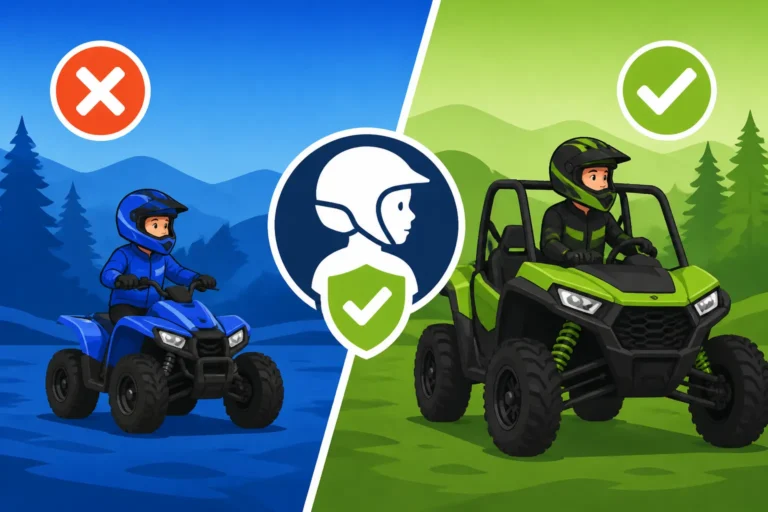
Regarding helmets, the requirement for an approved helmet has always been a cornerstone of safe riding in Quebec. The 2021 changes reinforced this, adding more specific requirements for visors or goggles. For instance, the helmet must now be equipped with a visor, or the rider must wear eye protection (goggles or safety glasses) at all times while riding. This is a common-sense measure to protect against debris, wind, and insects, but it's now explicitly legislated. Even for those riding at lower speeds, such as trappers, there are still rules to consider regarding helmets and eye protection, which is worth checking out if you're riding for work. [Quebec Helmet and Visor Rules] provides a deeper dive into these requirements.
Impact on Road Access and Municipalities
One of the most contentious and frequently discussed aspects of the 2021 changes revolved around off-highway vehicle access to public roads. Historically, there was considerable variability in how municipalities approached this, leading to confusion and inconsistent enforcement. The new Act sought to create a more standardized, yet still flexible, framework.
The 1 Kilometre Rule and Road Crossings
Under the updated Off-Highway Vehicle Act, the general rule is that OHVs are prohibited from circulating on public roads. However, there are crucial exceptions, the most significant being the "1-kilometre rule." This allows OHVs to use a public road for a maximum distance of one kilometre to access a trail, services (like a gas station or restaurant), or a private property, provided the road is explicitly signposted by the municipality as an authorized OHV route. Without proper signage, that 1-kilometre privilege does not apply. This is a crucial distinction: it's not a blanket right to ride a kilometre; it's a conditional one.
Furthermore, when crossing a public road, the rules became more stringent. Riders must do so at a right angle, after coming to a complete stop and ensuring the way is clear. The visibility at the crossing point is also a key factor; there are specific sightline distances (e.g., 50, 100, 200 metres depending on the speed limit) that must be met to ensure safety. This is a critical safety measure, acknowledging the speed differential between OHVs and road vehicles. Understanding [Quebec Crossing Sightline Distances] is essential for any rider who plans to access trails that require road crossings.
Municipal Exceptions and Bylaws
The Act empowers municipalities to enact their own bylaws to allow OHV access on specific roads within their territory, beyond the standard 1-kilometre rule. This provides local flexibility, recognizing that some communities rely on OHV tourism or have unique geographical circumstances. However, for a municipality to designate a road for OHV use, they must follow a specific process, including providing 15 days' notice to the Ministry of Transport and installing appropriate signage. This ensures transparency and gives the province oversight.
It's important to remember that if you're riding in a town that has opened up more than a kilometre of road for OHVs, you must still adhere to all the other rules of the Act, including speed limits ([Quebec's 50 km/h Speed Limit for ATVs] on designated roads) and age requirements. Many towns have enthusiastically embraced this option, creating networks that connect trails directly to local businesses, while others have chosen to maintain stricter prohibitions. As a rider, it's your responsibility to know the local bylaws before venturing onto municipal roads. Always check local signage and any available municipal resources before you head out.
Ensuring Compliance and Avoiding Fines
Navigating the updated rules in Quebec can seem daunting, but ensuring compliance is crucial, not just to avoid hefty fines but, more importantly, to ensure your safety and the safety of others. Ignoring the new regulations can lead to significant penalties, machine impoundment, and even legal trouble in the event of an accident.
Required Documents and Machine Specifications
Every time you head out on your off-highway vehicle, you must carry proof of certain documents. This includes your valid driver's licence, your SAAQ registration certificate (the little grey card), and proof of your mandatory liability insurance. For 16 and 17-year-olds, proof of the FQCQ training certificate is also essential. Trail patrols, Sûreté du Québec officers, and even municipal police have the authority to stop you and request these documents. You can find a comprehensive checklist at [Quebec Insurance Proof on the Machine] and [Quebec Registration Paperwork Checklist].
Your machine itself must also meet certain specifications. This includes having a working muffler that adheres to noise limits, functional headlights and taillights for night riding, and a rearview mirror. While aftermarket parts from companies like SuperATV can enhance your machine's performance or utility, it's vital to ensure any modifications still comply with provincial regulations, especially concerning noise levels or lighting. For example, light bars are fantastic for off-road visibility, but they might need to be covered or disconnected when on public roads. Always check that your equipment, even if you've customized it with quality parts, doesn't put you in violation of the law.
Patrol Checks and Penalties
Patrols on federated trails, whether by FQCQ-affiliated volunteers or law enforcement, are more vigilant than ever in enforcing the updated Act. They will check for all the mandatory documents, ensure age and licence compliance, verify your trail pass, and inspect your machine for basic safety equipment. If you're found in violation of any part of the Act, the penalties can be severe.
Fines for riding without a licence, an expired registration, or without the required age can range from hundreds to thousands of dollars. Repeated offenses can lead to even higher fines, impoundment of your machine, and even loss of driving privileges. For instance, riding an unregistered machine or without adequate liability insurance can result in substantial fines. Riding on a closed trail during the spring thaw, or operating past midnight in restricted areas, also carries fines. The goal of these penalties isn't just to punish, but to deter unsafe and illegal practices, emphasizing the importance of respecting the rules.
The Future of Off-Road Riding in Quebec
The changes implemented on September 10, 2021, weren't necessarily the final word on off-highway vehicle regulation in Quebec. Laws evolve, and as the sport continues to grow and new challenges emerge, further adjustments may be on the horizon. However, the spirit of the 2021 Act remains clear: safe, responsible, and sustainable riding is paramount.
Rider Responsibility and Continued Education
The onus is heavily on individual riders to stay informed, understand the rules, and operate their machines responsibly. This means not only adhering to the letter of the law but also embracing a culture of safety and respect for other trail users, landowners, and the environment. Organizations like the FQCQ offer resources and training, which are invaluable for both new and seasoned riders. Continuous education, perhaps through courses or simply staying updated with FQCQ communications, is key to adapting to any future changes and maintaining a high standard of riding.
For instance, understanding things like [Quebec Trail Etiquette Locals Expect] or how to properly interact with [Quebec Wildlife on the Trail] goes beyond mere legal compliance; it speaks to the shared responsibility of preserving the riding experience for everyone. Many riders also use accessories from brands like SuperATV to enhance safety, such as upgraded harnesses, robust winches, or protective bumpers. While these aren't always legally mandated, they demonstrate a commitment to safety that aligns with the spirit of the new Act.
Potential Future Amendments and Advocacy
As with any significant piece of legislation, the Off-Highway Vehicle Act may undergo further amendments as new issues arise or as the effectiveness of the current rules is evaluated. For example, there could be ongoing discussions around specific machine types, evolving safety technology, or new forms of recreational access. Rider associations and clubs play a vital role in advocating for the interests of the OHV community, ensuring that future legislative decisions are well-informed and balanced.
Being an active member of your local quad club, participating in surveys, or engaging in respectful dialogue with elected officials are ways riders can contribute to the ongoing evolution of the sport. The goal should always be to foster a safe, accessible, and enjoyable environment for off-road enthusiasts while ensuring the protection of Quebec's natural landscapes and the well-being of its citizens. The 2021 changes were a major step, and the journey of responsible riding continues.
Summary of Key Changes (2021)
To help visualize the shift, here's a quick overview of some of the most impactful changes brought by the September 10, 2021, update to Quebec's Off-Highway Vehicle Act:
| Feature | Before September 10, 2021 | After September 10, 2021 |
|---|---|---|
| Driver's Licence | Not always strictly mandatory for all situations. | Mandatory Class 5 (probationary) or equivalent for all operators. |
| Minimum Age (ATV) | Varied, sometimes lower with supervision. | 16 years old, plus FQCQ training certificate for 16-17 year-olds. |
| Minimum Age (Side-by-Side) | Less defined, often treated like ATVs. | 18 years old for all operators. |
| Passenger Rules | Some ambiguity, single-seater racks sometimes used. | Only on machines designed for multiple passengers with dedicated seats/footrests. |
| Helmet Requirements | Approved helmet mandatory. | Approved helmet with a visor or eye protection (goggles) mandatory. |
| Road Access (General) | More varied municipal rules, often less signage. | Prohibited, with strict exceptions (1 km, signed municipal roads). |
| Road Crossing | Rules existed, but sometimes less emphasized. | Must stop, cross at right angle, clear sightlines required. |
| Training Certificate (16-17) | Not required. | Mandatory for 16 and 17-year-olds on ATVs. |
| Municipal Authority | Less clear framework for opening roads. | Clear process for municipalities to open roads beyond 1 km (with signage and notice). |
This table highlights just how significant the legislative changes were and why every Quebec off-highway vehicle owner and rider needs to be well-versed in the current regulations.
Disclaimer
This article is for general informational purposes only and does not constitute professional advice. Laws, prices and regulations vary by location and change over time. Consult a qualified professional for guidance on your specific situation.