Quebec Road Riding Fines From $350
Riding your ATV or UTV in Quebec can be an incredible experience, offering access to thousands of kilometres of breathtaking trails. However, the allure of conveniently zipping down a public road to connect trail sections or reach a gas station can quickly turn into a financial headache if you're not fully aware of the province's strict regulations. Many riders find themselves facing hefty fines because they misunderstood where and how their off-highway vehicle (OHV) is permitted on public roadways. This guide will meticulously break down the various fines associated with road riding in Quebec, explain the nuances of the law, and help you navigate the rules to avoid costly penalties.
Understanding Quebec's Off-Highway Vehicle Act on Roads
Quebec has specific legislation governing off-highway vehicles, known as the Loi sur les véhicules hors route (LVHR), or Off-Highway Vehicle Act. Unlike some other jurisdictions, Quebec generally restricts OHVs from public roads, with only very specific exceptions. It’s not about whether your machine can physically travel on a road, but whether it is legally allowed to do so at that exact moment and location.
The General Prohibition and Limited Exceptions
The foundational principle in Quebec is that off-highway vehicles like ATVs (or VTTs, as they're called here) and side-by-sides (VHRs) are generally prohibited from circulating on public roads. This isn't just a suggestion; it's a hard and fast rule designed to separate off-road recreation from regular traffic flow for safety reasons. However, the law isn't entirely black and white, and there are crucial exceptions that allow for limited road use under specific conditions.
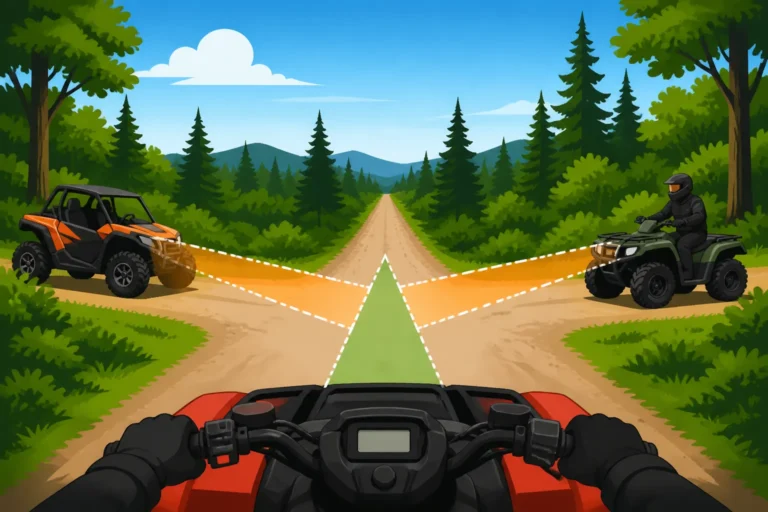
These exceptions are narrowly defined and often misunderstood, leading to many infractions. For instance, you might be allowed to cross a public road at a right angle after ensuring sufficient sightlines, or travel a very short distance – typically up to one kilometre – along a road shoulder to connect two authorized trail segments, provided there is specific signage. This signage isn't just a courtesy; it's a legal requirement. Without the proper signs erected by the municipality or trail club, that stretch of road, no matter how short, remains off-limits. Imagine you're on a fantastic new trail route, excited to see a small village ahead, and decide to take the road for a quick shortcut. If that road isn't explicitly signed for OHV use for that specific distance, you're immediately in violation, and ignorance of the law is rarely an acceptable defence. These rules are detailed further in resources like [Quebec ATV Road Rules Under the LVHR].
What Changed in 2021
September 10, 2021, marked a significant turning point for off-highway vehicle regulations in Quebec, as substantial amendments to the LVHR came into effect. These changes aimed to enhance safety, clarify rules, and in some areas, tighten restrictions, particularly concerning road use and rider qualifications. One of the most impactful changes was the formalization of certain road access conditions and the introduction of new requirements for drivers, such as mandatory driver's licenses for all OHV operators. Before 2021, some grey areas existed, but the updated law sought to eliminate ambiguity, making it even more imperative for riders to be fully informed.
These amendments directly influenced how OHVs interact with public roads. For example, while the one-kilometre rule for connecting trail segments existed, the 2021 changes often clarified the need for municipal authorization and specific signage. It also reinforced the rules about riding hours, speed limits, and passenger restrictions, which all contribute to safe road interactions. Understanding [Why September 10, 2021 Matters] is key to comprehending the current regulatory landscape. Many of the fines we'll discuss directly stem from violations of these updated provisions.
Specific Road Riding Scenarios and Their Associated Fines
When it comes to road riding in Quebec, the most common scenario leading to fines is simply being where you shouldn't be, or not following the rules even when you are permitted. The penalties can be substantial, designed to deter unauthorized use and enhance public safety.
Riding on Unauthorized Public Roads
This is perhaps the most straightforward way to incur a fine. If you are operating your ATV or side-by-side on any public road, street, highway, or shoulder that has not been explicitly designated and signed for OHV use, you are in violation of the LVHR. It doesn't matter if it's a quiet back road, a short residential street, or a bustling provincial highway; if it lacks the proper authorization signage, you are breaking the law. A common mistake is assuming that if "everyone does it," it must be okay, but patrols are increasingly vigilant.
Imagine you've just come off a beautiful section of trail, and the GPS on your SuperATV navigation system shows a quick route to the next trail segment that involves about two kilometres of road. You don't see any specific ATV signage on the road itself, but it looks like a harmless stretch. You decide to go for it. A provincial police officer or a trail patrol officer from a local club, empowered to enforce the LVHR, spots you. They don't need to prove intent; merely being on an unauthorized road is enough. The fines for this type of infraction can start around $350 and go significantly higher, not including administrative fees or potential court costs. It's a quick way to turn an enjoyable ride into a very expensive lesson.
Exceeding Permitted Road Distances or Conditions
Even when you are permitted to be on a public road for a short distance, there are strict conditions that must be met. Ignoring these conditions is another common reason for fines. The primary authorized use is typically for crossing a road or traveling a short distance (up to one kilometre) to link two trail sections, provided the municipality has authorized it and proper signage is in place.
Let's say you're on a properly signed one-kilometre stretch of road shoulder connecting two trails. The law requires you to ride prudently, often at a reduced speed, and stay on the very edge of the road or shoulder. If you decide to take the full lane because there's no traffic, or you continue past the one-kilometre marker because the next trail entrance isn't immediately obvious, you've overstepped the bounds of the exception. Similarly, if you're crossing a road, you must do so at a right angle and ensure clear sightlines in both directions. Lingering on the road, doing a U-turn, or simply travelling along it to reach a convenience store instead of a trail connection point would also be violations. These actions, while seemingly minor, negate the authorized use and can result in fines similar to those for being on an unauthorized road in the first place. You can find more information about these specific rules in [Quebec Municipal Road Access Up to 1 Kilometre] and [Quebec Crossing Sightline Distances].
Beyond the Direct Road Riding Fines: Other Penalties
While riding on unauthorized roads or exceeding permitted conditions are direct road-related infractions, there are many other ways riders can be fined that often come to light during a road stop. These are general OHV regulations that become particularly critical when you're interacting with public infrastructure.
Lack of Proper Registration and Insurance
Every off-highway vehicle operated in Quebec, whether on trails or in the limited road-access scenarios, must be properly registered with the Société de l'assurance automobile du Québec (SAAQ) and carry the mandatory liability insurance. This isn't optional; it's a legal requirement for any machine that leaves private property. Without registration, your machine is essentially illegal to operate in public spaces. The SAAQ acts as both the registrar and the mandatory liability insurer, streamlining the process. You can learn more about this in [Quebec SAAQ Is Registrar and Insurer].
If you are stopped on a road, whether it's an authorized section or not, the first thing a patrol officer will check, after your driver's license, is your machine's registration and proof of insurance. Operating an unregistered or uninsured ATV or side-by-side carries its own significant fines. These penalties are often separate from and in addition to any fine for illegal road use. So, a single stop could lead to multiple tickets: one for illegal road riding, one for no registration, and another for no insurance. This quickly multiplies the financial burden, turning a $350 fine into something much larger, easily pushing into the thousands, particularly when you consider [Quebec's Liability Insurance Rule] that mandates a high minimum coverage.
Operating Without a Valid Driver's License or Age Violation
Another critical aspect of Quebec's OHV laws, especially when interacting with public roads, is the requirement for a valid driver's license. Since the 2021 changes, anyone operating an off-highway vehicle on land other than private land must possess a valid driver's license for an automobile (Class 5) or motorcycle (Class 6). This means that even if you're just connecting two trails via a permitted road section, you need that license.
Age restrictions also apply. A rider must be at least 16 years old to operate an ATV, and 18 years old to operate a side-by-side. For 16 and 17-year-olds, additional training certificates are required. If you're pulled over on a road and don't have the appropriate license, or if you're underage without the necessary qualifications (or for a side-by-side, regardless of qualifications if under 18), you're looking at yet another substantial fine. For instance, a 17-year-old operating a side-by-side would be in violation, regardless of their training certificate. These fines are often in the hundreds of dollars, and repeatedly violating these rules can lead to more severe consequences, including vehicle seizure in some cases. It's crucial to understand [Quebec ATV Age Requirements] and [Quebec Requires a Driver's Licence Since 2021].
Helmet, Equipment, and Passenger Violations on Roads
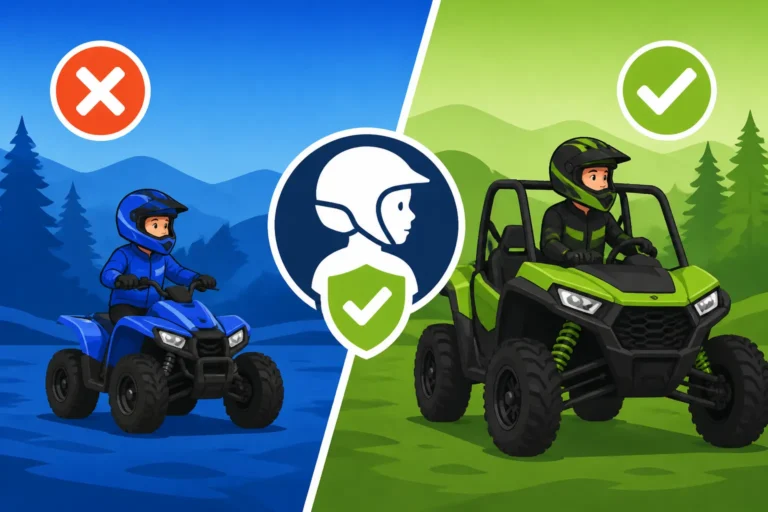
The LVHR also has strict rules about personal protective equipment and machine specifications, which are particularly enforced when OHVs are on or near public roads. Helmets are mandatory for all riders and passengers. These helmets must meet approved safety standards and often require a visor or goggles. While some exceptions exist for trappers operating at very low speeds for specific purposes, these do not apply to general road riding.
Beyond helmets, your machine itself must meet certain equipment standards. This includes functional headlights, taillights, brake lights, and a proper muffler. Mirrors are also often required, especially when your machine is being operated in areas where it might interact with other traffic. Many riders enhance their machines with aftermarket parts from companies like SuperATV, but it's vital to ensure these modifications still comply with Quebec's regulations. Adding extra lights might be great for the trail, but ensure they don't violate road-use rules (e.g., specific brightness or colour).
Passenger rules are also strictly enforced. ATVs are generally designed for one operator, unless specifically manufactured and marked for two riders. Side-by-sides have designated seating capacities. Carrying more passengers than the machine is designed for, or carrying a passenger on a single-rider ATV, will result in a fine. For example, a child passenger must also adhere to specific rules about their ability to reach footrests and handholds. These violations, when encountered during a road stop, add further penalties. For more on this, check [Quebec Passenger Rules on an ATV] and [Quebec Helmet and Visor Rules].
The Financial Impact of Quebec ATV Fines
Understanding the regulations is one thing, but truly grasping the financial repercussions of violating them can be a powerful motivator for compliance. Quebec's fines are not trivial; they are designed to be a deterrent and reflect the seriousness of the infractions, especially those that compromise public safety.
Breakdown of Typical Fine Ranges and Associated Costs
When you receive a ticket for an OHV infraction in Quebec, it's rarely just the base fine amount listed on the citation. There are usually additional fees and charges that quickly inflate the total. These can include administrative fees, victim surcharge, and potentially court costs if you choose to contest the ticket and lose. Let's look at a table to illustrate typical fine ranges for common road-related infractions:
| Offence Category | Typical Fine Range (CAD) | Additional Fees (approx.) | Potential Total (CAD) | Notes |
|---|---|---|---|---|
| Riding on Unauthorized Public Road | $350 – $700 | $50 – $100 | $400 – $800+ | Direct violation of the LVHR. Increases with aggravating factors. |
| Exceeding Permitted Road Distance | $350 – $700 | $50 – $100 | $400 – $800+ | Applies even on 'authorized' stretches if conditions are not met. |
| No Valid Driver's License | $450 – $900 | $50 – $150 | $500 – $1050+ | Separate from road use, but often discovered during a road stop. |
| Underage Operation (ATV 16, SxS 18) | $350 – $700 | $50 – $100 | $400 – $800+ | Does not include potential for vehicle seizure or parental liability. |
| No Registration (VHR Plate) | $350 – $700 | $50 – $100 | $400 – $800+ | Mandatory for all public land operation. See [Quebec VHR Plates Explained]. |
| No Mandatory SAAQ Liability Ins. | $350 – $700 | $50 – $100 | $400 – $800+ | Mandatory $1M liability is part of SAAQ registration. See [The $1 Million Liability Floor Every Owner Carries]. |
| No Approved Helmet/Visor | $250 – $500 | $30 – $70 | $280 – $570+ | Applies to driver and all passengers. |
| Improper Equipment (Lights, Muffler) | $150 – $300 | $20 – $50 | $170 – $350+ | E.g., no working lights, excessively loud muffler, missing mirrors. |
| Carrying Unauthorized Passenger | $250 – $500 | $30 – $70 | $280 – $570+ | On a single-rider ATV, or exceeding capacity. |
As you can see, a single road stop can quickly escalate into multiple violations, with total costs easily exceeding $1,000 or even $2,000, particularly if you're missing registration, insurance, and a license on top of an illegal road ride. It's not uncommon for an unwary rider to face a "trifecta" of tickets during a single encounter with law enforcement.
Long-Term Consequences and Record Keeping
The immediate financial hit from fines is often just the beginning. Depending on the nature and severity of the infraction, there can be long-term consequences that continue to impact you. For instance, driving without a valid license or having multiple serious infractions can lead to points being added to your driver's license, which can affect your automobile insurance premiums. While OHV infractions don't always directly transfer points to your car license in the same way car infractions do, they can still appear on your driving record and be taken into account by insurers.
Repeated violations could also lead to more severe penalties, such as the suspension of your privilege to operate an OHV, or even the seizure of your machine. While less common for a first-time minor offence, serious or repeat offenders face an escalating scale of penalties. Furthermore, having a record of these infractions can impact your ability to rent OHVs in the future, as many rental operators check driving records or require a clean history. It's a sobering thought that a quick, illicit shortcut on a road could end up costing you far more than just the immediate fine, potentially impacting your driving privileges and insurance rates for years to come.
Avoiding Fines: Best Practices for Quebec ATV Riders
The best way to avoid fines is, quite simply, to know the rules and follow them. Quebec has a robust trail network and clear regulations, and a little planning goes a long long way in ensuring your rides are enjoyable and free of legal troubles.
Know Before You Go: Researching Routes and Municipal By-Laws
One of the most crucial steps you can take is to thoroughly plan your route before you even load your machine onto the trailer. Don't rely on assumptions or old information. The FQCQ (Fédération québécoise des clubs de quads) provides excellent resources, including an interactive map and the iQuad app, which clearly show authorized trails. These tools are invaluable for plotting a legal course and identifying potential gaps where road use might be necessary and, more importantly, permitted.
Crucially, remember that while the FQCQ maintains the federated trail network, the authorization for OHVs on public roads often rests with individual municipalities. A short road segment that links two trails in one municipality might be legal, while an identical stretch in a neighbouring town is strictly prohibited. This is why checking local municipal by-laws, in addition to the FQCQ map, is so important, especially if you plan to stray from the main federated trails. Look for specific signage on the ground; if the sign isn't there, assume the road is off-limits. Resources like [Quebec ATV Trails: The FQCQ Network] and [Using the iQuad App to Follow a Circuit] can be lifesavers.
Essential Paperwork and Equipment Checks
Before every ride, and especially when you know you might encounter even a small stretch of public road, make sure you have all your essential paperwork readily accessible. This includes your valid driver's license, your SAAQ registration certificate (which doubles as proof of mandatory liability insurance), and your FQCQ trail pass. While a phone photo of some documents might sometimes be accepted, having the physical documents is always the safest bet. Many riders keep these laminated in a waterproof pouch on their machine, perhaps in a glove box or a SuperATV cargo box. It's detailed in [Quebec Insurance Proof on the Machine] that having proof on hand is essential.
Equally important is a quick but thorough check of your machine's critical safety equipment. Ensure your headlights, taillights, and brake lights are all in perfect working order. Check your horn, and ensure your mirrors (if required for your machine or local bylaws) are properly adjusted and clean. Confirm your muffler isn't excessively loud – noise complaints are a common reason for increased patrols. A simple pre-ride inspection can prevent fines and ensure your safety. Don't forget your helmet and ensure any passengers also have properly fitted, approved helmets with visors or goggles.
Safe and Responsible Riding Habits
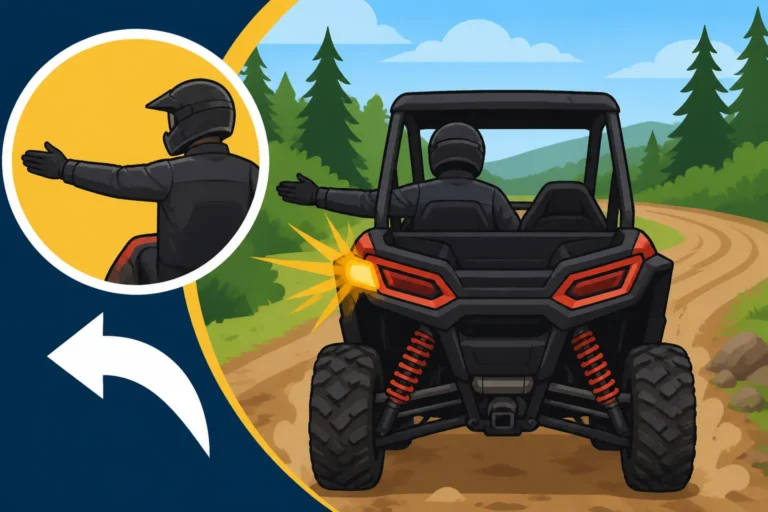
Beyond legal compliance, adopting safe and responsible riding habits generally keeps you off the radar of law enforcement and enhances everyone's enjoyment of the trails. When you are on a permitted road segment, ride courteously and cautiously. Adhere strictly to the posted speed limits for OHVs (often 50 km/h on trails, but potentially lower on roads, especially near dwellings) and be acutely aware of your surroundings. Stay to the extreme right of the road or shoulder, and signal your intentions clearly.
Avoid riding during restricted hours, such as after midnight or before 6 a.m., even on trails, as these restrictions also apply to any road use. [Quebec Riding Hours From 6 a.m. to Midnight] outlines these rules clearly. Be mindful of residential areas and noise levels. Excessive noise can quickly draw unwanted attention and lead to complaints, prompting patrols to investigate. By being a visible example of responsible OHV operation, you not only protect yourself from fines but also contribute to a positive image for the entire riding community. Remember, we all share the trails and the spaces around them.
Disclaimer
This article is for general informational purposes only and does not constitute professional advice. Laws, prices and regulations vary by location and change over time. Consult a qualified professional for guidance on your specific situation.