Parental Permission on Private Land
A minor may be allowed to ride an ATV on private land in Quebec, but the answer depends on who owns the property and whether the rider has the required licence and training. Parental permission is not a blanket pass: it does not grant access to someone else’s land or cancel rules that apply on trails, roads, and other public areas.
When parental permission is required
According to the Gouvernement du Québec, a minor under 18 who does not hold a driver’s licence and a training certificate may operate an off-road vehicle on private property belonging to an individual only with parental permission. This is a specific rule for private property; it should not be treated as general permission to ride anywhere.
The rule has an important family-property exception. According to the Gouvernement du Québec, the authorization and accompanying supervision rules do not apply when the minor operates the vehicle on property owned by their parent, legal guardian, or another family member. That exception concerns the parental authorization and supervision requirement. It does not establish permission to ride on property owned by someone outside the family, and it does not erase other rules that may apply to a vehicle, location, or activity.
| Situation | What to keep in mind |
|---|---|
| Private property owned by an individual outside the family | A minor under 18 who lacks a driver’s licence and training certificate needs parental permission under the rule described by the Gouvernement du Québec. The landowner’s or tenant’s permission is a separate matter. |
| Property owned by the rider’s parent or legal guardian | The parental authorization and accompanying supervision rules described by the Gouvernement du Québec do not apply. Other applicable safety and operating rules still matter. |
| Property owned by another family member | The same exception applies under the Gouvernement du Québec. Do not assume it applies to a friend’s, neighbour’s, or unrelated landowner’s property. |
| A trail, road, public land, or municipal private land | Different age, licence, and training requirements may apply. Parental permission alone does not replace them. |
A useful way to understand the distinction is to separate permission from eligibility. Permission answers whether the young rider has authorization for the situation covered by the private-property rule. Eligibility asks whether the rider can legally operate that type of machine in that location. A parent’s approval does not make a restricted trail or road available to a rider who does not meet the requirements for that setting.
For more on the family-property distinction, see Quebec Rules for a 15-Year-Old on Family Land. For the separate issue of permission from the person who controls the land, see Quebec Private Land Permission.
Parental permission is not the same as landowner permission
There may be two separate permissions to consider: the parent’s authorization for the minor and the property owner’s or tenant’s consent to ride on the land. Having one does not automatically provide the other.
For example, if a young person wants to ride on a neighbour’s land, a parent may give the required permission for the minor, but the neighbour must also allow the vehicle onto the property. According to the Gouvernement du Québec, driving an off-road vehicle on private property without the owner’s or tenant’s permission carries a minimum fine of $350, a figure stated by the Gouvernement du Québec as of November 2026. A family connection to the rider does not, by itself, give the rider permission to use another person’s property.
It is sensible to get permission directly from the person who owns or rents the land, and to make the boundaries of that permission clear. Ask which areas may be used, when riding is allowed, and whether there are restrictions on passengers, noise, or particular machines. These are practical questions to settle in advance, not a substitute for confirming the rules that apply in the municipality or at the specific property.
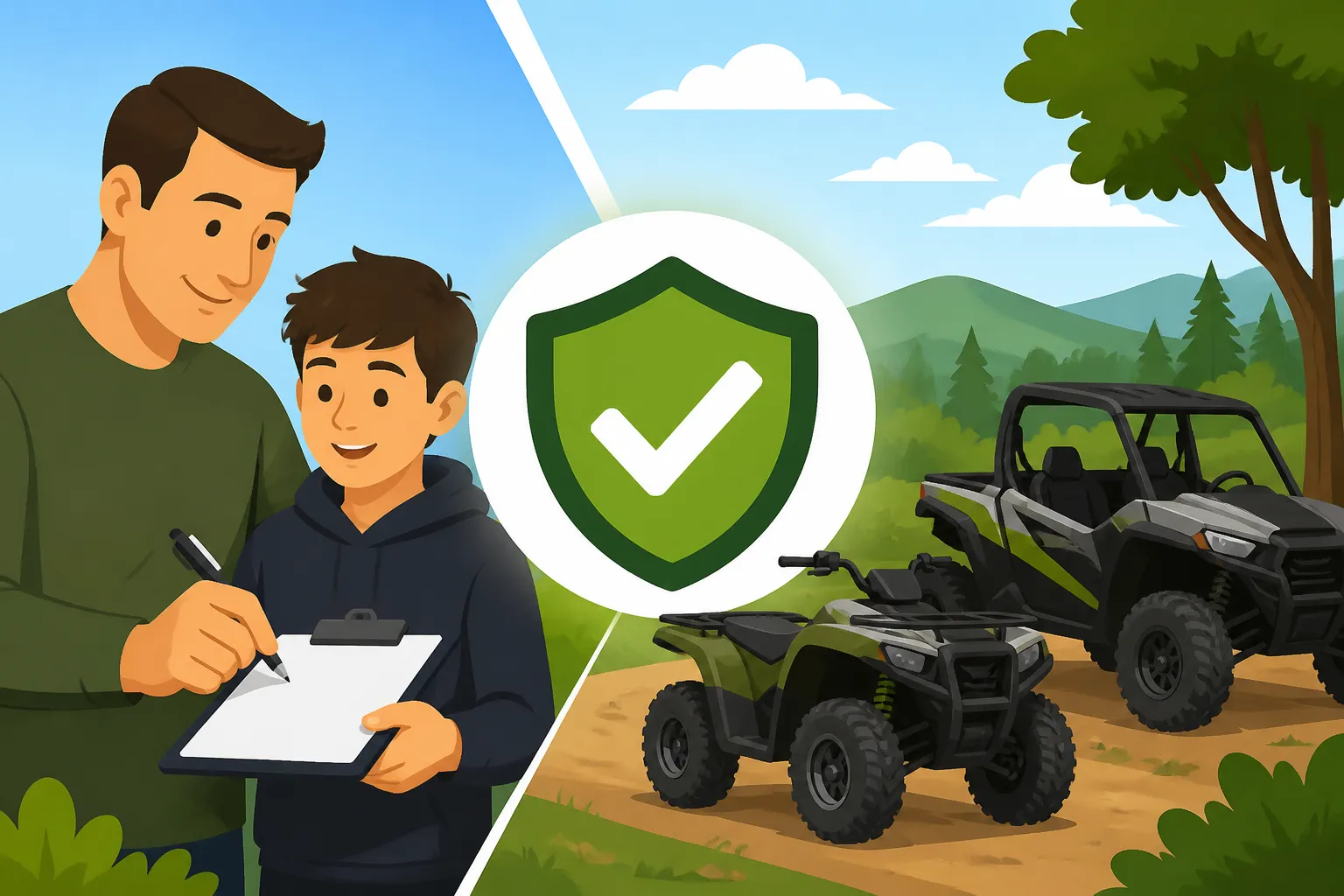
When a minor is riding on property covered by the parental-permission rule, recording the permission in writing can also prevent confusion later. The facts provided do not specify a required form or wording, so do not assume that a particular template is mandatory. A written note or message can simply make clear who has given permission, which young rider and vehicle it concerns, and what property or activity is covered. If the landowner or tenant has separate conditions, keep those distinct from the parent’s authorization.
If the property belongs to a parent, legal guardian, or another family member, the exception removes the parental authorization and accompanying supervision requirements described by the Gouvernement du Québec. It is still wise for the family to agree on boundaries and operating conditions. The legal exception should not be mistaken for a safety recommendation to let a young person ride without suitable instruction or adult awareness.
Why trails and roads have different requirements
Private property rules do not automatically carry over to public trails, roads, public land, or municipal private land. According to the Gouvernement du Québec, drivers aged 16 or 17 must hold a driver’s licence and a training certificate from a recognized federation to drive an off-road vehicle on a trail, road, public land, or municipal private land. A parent’s permission does not replace either requirement.
That difference matters when a property has a trail connection or the ride is planned to leave the family’s land. A route that begins in a backyard may enter a public or federated trail, a road, or land managed for public use. The applicable requirements can change once the rider crosses onto that area. Do not rely on the private-property exception for a route that includes any of those places.
A utility task vehicle, commonly called a side-by-side, has a separate minimum-age rule. According to the Gouvernement du Québec, a driver must be at least 18 and hold a valid driver’s licence to drive a utility task vehicle. Parental permission cannot make a younger driver eligible under that rule. The general label “ATV” can cover different machines, so identify the vehicle type before deciding which requirements apply. Quebec Rules for a 16-Year-Old Rider and Quebec Rules for a 17-Year-Old Rider cover the age-specific trail and road questions in more detail.
The same care is needed with modified vehicles. According to the Gouvernement du Québec, a driver of an all-terrain motorcycle modified with an add-on seat must be at least 18 and hold a training certificate and a valid driver’s licence. Adding a seat does not make that machine a regular quad for the purpose of deciding who can drive it.
Before a ride that may leave private land, check the route and the rules for each part of it. A trail permit, registration, proof of insurance, licence, and training certificate are different documents or requirements; one does not automatically stand in for another. Related details are covered in Quebec Rules for Riders Under 16, Quebec ATV Age Requirements, and Quebec Registration for a Youth Machine.
A practical check before a minor rides
A quick conversation before the machine starts can clarify who has authorized the ride and where that authorization applies. Use the following steps as a practical checklist, not as a replacement for checking the specific legal requirements.
-
Identify the machine. Confirm whether it is a quad, side-by-side, all-terrain motorcycle, or another off-road vehicle. The rules may differ by vehicle type, especially for side-by-sides and modified motorcycles.
-
Identify the property. Establish who owns or rents the land. If it is not owned by the rider’s parent, legal guardian, or another family member, do not assume the family-property exception applies.
-
Get the right permissions. For private property belonging to an individual, check whether parental permission is required for the minor under the rule described by the Gouvernement du Québec. Separately obtain permission from the owner or tenant before riding there.
-
Check the route. Find out whether the ride stays on private property or enters a trail, road, public land, or municipal private land. The private-property rule does not replace the age, licence, and training requirements for those locations.
-
Confirm the rider’s eligibility. If the route includes a trail, road, public land, or municipal private land, check the rider’s age and required documents. For drivers aged 16 or 17, the Gouvernement du Québec requires a driver’s licence and a recognized federation training certificate for the listed locations.
-
Agree on boundaries and conditions. Make sure the young rider understands where they may go and what conditions the landowner, tenant, or family has set. If permission is given for one property, it should not be taken as permission to cross neighbouring land.
-
Review basic safety. According to the Gouvernement du Québec, drivers and passengers must wear a helmet with a visor, or safety goggles if the helmet has no visor, and drivers must wear shoes or boots that allow easy control of the pedals. The Gouvernement du Québec also requires the front white headlights and red taillights to be turned on while operating an off-road vehicle. These rules are separate from parental authorization.
If any part of the plan is unclear, pause before riding and verify the requirement with the relevant official source or the person responsible for the property. That is especially important when the vehicle is modified, the route crosses a property boundary, or the ride involves a trail or municipal land. Permission is easiest to understand when everyone agrees on the rider, machine, location, and limits before the trip begins.
Sources
- Gouvernement du Québec — Off-highway vehicle trail patrol | Gouvernement du Québec (checked November 3, 2026)
- Gouvernement du Québec — Rules for off-road vehicles | Gouvernement du Québec (checked November 3, 2026)
- Gouvernement du Québec — Mandatory equipment for off-road vehicles | Gouvernement du Québec (checked November 3, 2026)
Disclaimer
This article is for general informational purposes only and does not constitute professional advice. Laws, prices and regulations vary by location and change over time. Consult a qualified professional for guidance on your specific situation.