Why Interprovincial Stickers Died in 2023
A sticker that once helped some out-of-province ATV riders access Quebec’s federated trails stopped working as a shortcut in 2023. If you’re planning a ride across the provincial border, the key is to separate your machine’s registration and insurance from its trail pass. Here’s what changed, why reciprocity ended and what to check before unloading your ATV or side-by-side.
What the interprovincial sticker did, and what ended in 2023
For a time, riders from outside Quebec could use an interprovincial arrangement to access Quebec’s federated ATV trail network. The sticker or related pass arrangement recognized that a visitor might already hold a valid trail permit in their home province. It was meant to reduce the need to navigate two separate systems for a cross-border ride.
That arrangement ended in 2023. The practical consequence is straightforward: a pass or sticker issued in another province is no longer a substitute for the Quebec trail pass required on Quebec federated trails. The end of the arrangement did not make out-of-province ATVs inherently ineligible to ride in Quebec. It changed which trail-access document a visitor needs.
The name “interprovincial sticker” can make the change sound broader than it is. It concerns reciprocal trail access, not every document or legal requirement for a machine. A visitor still has to consider the requirements that apply to the machine and rider, including registration, insurance, trail-pass coverage, permitted routes and any applicable rider rules.
| Issue | What the interprovincial arrangement concerned | What a visitor should check now |
|---|---|---|
| Trail access | Whether a permit from another province could be accepted on Quebec federated trails | Current Quebec trail-pass requirements for the planned ride |
| Vehicle registration | Whether the machine is registered under its home jurisdiction | Whether the registration is valid and what documents to carry |
| Insurance | Whether the machine has applicable liability coverage | The policy’s coverage, exclusions and proof requirements |
| Trail and road rules | Where and how the machine may be operated | Quebec rules, trail conditions and local restrictions |
| Other destinations | Whether Quebec’s trail pass covers trails elsewhere | The destination’s own pass and access requirements |
In short, losing the reciprocal sticker does not cancel a machine’s home-province registration, and buying a Quebec trail pass does not replace registration or insurance. These are separate questions. Riders who treat them as interchangeable can arrive at a trailhead with paperwork that proves ownership but does not authorize trail use.
The change is particularly important for people who used to ride across the border without checking the Quebec pass system each time. A familiar sticker on the ATV may still be valid for another purpose or jurisdiction, but it should not be assumed to grant access to Quebec’s federated trails. For the background on the Ontario arrangement, see Quebec Ended Reciprocity With Ontario and What the Old Ontario Top-Up Cost. The related change for New Brunswick is covered in Quebec and New Brunswick Reciprocity Ended.
A visitor heading to a non-federated private route, private property or a commercial outfitter should not assume the same pass rules apply as on the federated network. Access terms can depend on who controls the land and trail. A Quebec pass may be necessary for one part of a trip but not be the document that grants permission on a separate private route. Ask the landowner, operator or club what applies to the specific route, and do not treat a pass as permission to ride wherever a trail appears on a map.
Why reciprocity ended, and what that means for visitors
Reciprocity depends on organizations agreeing to recognize each other’s trail-access systems. That recognition can simplify cross-border riding, but it also involves administration and coordination between separate jurisdictions. In 2023, the federation responsible for Quebec’s ATV trail network walked away from the arrangement. The decision has been associated with administrative costs and the practical burden of maintaining reciprocity.
That explanation is more useful than guessing that the agreement ended because visitors were no longer welcome, or because Quebec changed its vehicle-registration system. The end of reciprocity was a decision about trail-pass recognition. It should not be read as a blanket prohibition on visitors or as proof that an Ontario or New Brunswick registration is invalid in Quebec.
For a visiting rider, the change means planning around the place where the ride will happen, rather than relying on the place where the machine is registered. If the itinerary includes Quebec federated trails, check the Quebec pass options and instructions before the trip. If the ride also uses trails in another province, check that province’s current requirements separately. One pass should not be presumed to cover multiple jurisdictions unless the relevant organizations explicitly say it does.
The end of reciprocity also affects the way a trip is budgeted and organized. A rider may need to account for a Quebec pass in addition to the permit already purchased at home. The exact options, eligibility, validity periods and purchase process can change, so confirm the current details with the Federation or the relevant Quebec club rather than relying on an old sticker, saved checkout page or advice from a previous season.
One practical reason to verify the rules is that old information can remain in circulation. A club page, forum post or trip checklist may describe the former arrangement. It might be accurate for a past season and still be wrong for a planned ride now. If a source does not clearly state which jurisdiction and riding period it refers to, confirm before treating it as current. May 2023 and What Changed explains the transition, while Why the Federation Walked Away gives more context for the decision.
A pass also does not guarantee that a route is open on the day you arrive. Trails can close for seasonal conditions, maintenance, land-access issues or other local reasons. A valid pass does not override a closure, a landowner’s restrictions or a route-specific rule. Check current trail notices and route access shortly before departure, not only when buying the pass.
What Quebec visitors need to arrange before riding
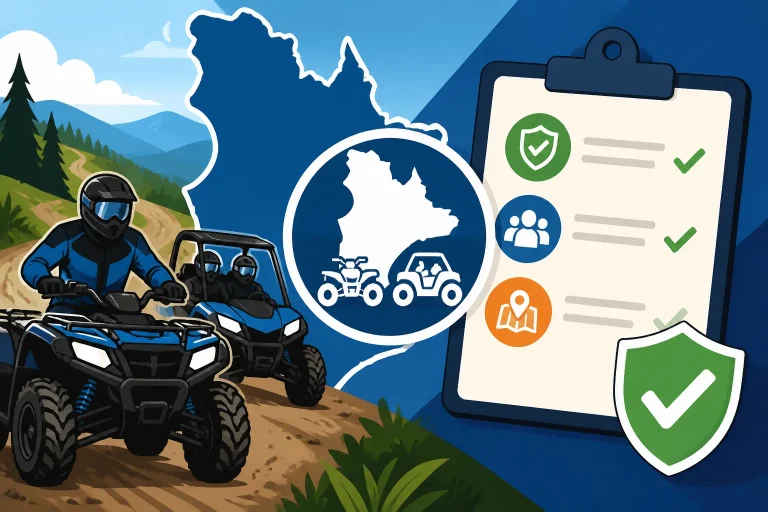
The simplest way to avoid a border-side paperwork surprise is to work through each requirement separately. Start with the route, then verify the pass, the machine’s documents and the rider’s obligations. This is especially useful when a trip includes both Quebec and the home province, or when several riders are bringing machines with different registrations.
- Confirm where you intend to ride. Identify whether the route uses Quebec federated trails, private trails, public roads or a mix. A trail pass is not a general-purpose permit for every place an ATV can physically travel.
- Check the current Quebec trail-pass requirement. Use the current information from the relevant federation or club. Do not rely on an interprovincial sticker from a prior season as proof of Quebec access.
- Choose an option that matches the trip. Compare available pass types and their validity periods against the length and timing of the visit. Check whether each machine needs its own pass and how proof must be carried or displayed.
- Verify registration separately. Make sure the machine is properly registered for its home jurisdiction and that the registration document is available. A Quebec trail pass does not register an ATV or side-by-side.
- Review insurance separately. Confirm that the policy covers the machine and the intended riding, including any relevant exclusions. Keep the required proof accessible. A trail-pass purchase should not be assumed to replace the machine’s own coverage.
- Check the rider and machine rules. Verify applicable age, licence, helmet, passenger and equipment requirements, including any rules specific to the route or activity.
- Check access conditions again before departure. Look for current closures, detours, thaw restrictions and club notices. Save the route information and the documents you may need on the ride.
For a wider explanation of the pass system, see Quebec Visitors Must Buy a Quebec Pass. Quebec trail passes are tied to the federated network; the pass does not make every club trail open in every season. Quebec Trail Passes Cover Every Club explains the network-wide aspect, while Quebec Trail Pass Proof on the Trail is useful when deciding how to keep proof available during a ride.
The registration question can be less obvious for someone used to a different province’s terminology and process. Quebec and Ontario do not use identical registration systems, so check the details rather than assuming that a familiar document serves the same role on both sides of the border. Quebec Registration Compared to Ontario can help separate the registration issue from trail access.
Insurance deserves its own check, too. Do not infer that a trail pass includes the liability protection required for the machine, or that home-province coverage automatically applies to every activity in Quebec. Read the policy or ask the insurer about geographic limits, trail use, passengers and other exclusions that matter to the trip. [Quebec Insurance Proof on the Trail] covers the practical question of carrying evidence of coverage, and Quebec Passes Without Insurance helps distinguish pass choices from a rider’s separate insurance obligations.
If you are riding with a group, share the checklist with every machine owner. One person buying a pass does not automatically establish that all the other machines are covered. Confirm whether the selected pass is tied to an individual machine, a rider or another condition, and follow the provider’s instructions. Keep records of each purchase and make sure the group knows how to show proof if requested.
Common misunderstandings and how to avoid them
The most common mistake is treating “registered,” “insured” and “permitted on the trail” as synonyms. They are not. Registration identifies the machine within the relevant vehicle system. Insurance provides coverage under a policy’s terms. A trail pass grants access under the conditions of the applicable trail network. A rider may need all three, and one does not usually stand in for the others.
Another mistake is assuming the old sticker remains useful because it has not expired or still looks official. A document can remain physically valid for a different purpose while no longer being accepted under a discontinued reciprocal arrangement. Confirm the pass rules for the location and riding period instead of relying on the appearance or wording of a sticker.
Do not assume that the 2023 change applied identically to every province, every trail or every kind of land. The end of the interprovincial arrangement removed a particular recognition pathway. Private-land permission, commercial trail access and rules in other jurisdictions are separate matters. Ask the organization or land manager responsible for the route.
A fourth misunderstanding is that buying a Quebec pass settles every legal question for the trip. It does not. It does not grant permission to trespass, open a closed trail, exempt the rider from Quebec requirements or guarantee that the machine meets equipment rules. Route access and rider conduct remain subject to the applicable rules and restrictions.
Finally, riders sometimes plan around the pass alone and leave the paperwork check until they reach a trailhead. That is a poor time to discover that a document is missing, a policy excludes the intended use or a route is closed. Build the verification into trip planning. Keep a short checklist in the tow vehicle, and have each rider check the documents for their own machine before departure.
When the information you find conflicts, prioritize the current instruction from the organization responsible for the trail or pass. An old club page or a retailer’s description may not reflect a change in federation policy. For a specific route, the local club can often clarify whether the route is federated, whether it is open and what proof patrols expect. For a specific insurance or registration question, check with the insurer or registration authority responsible for the machine.
Frequently Asked Questions
Can I ride Quebec trails using my Ontario or New Brunswick interprovincial sticker?
Do not rely on it for Quebec federated trails. Reciprocity ended in 2023, so check the current Quebec pass requirements before riding. The machine’s home-province registration and insurance remain separate matters.
Did Quebec ban riders from other provinces?
No. Ending reciprocal pass recognition was not a blanket ban on visitors. Out-of-province riders can plan to ride where access is permitted, but they need to meet the requirements that apply to the specific Quebec trail or property.
Does a Quebec trail pass replace registration or insurance?
No. A trail pass concerns access to the relevant trail network. Registration and insurance are separate obligations, and a pass should not be treated as a substitute for either.
Does buying a Quebec pass let me ride any trail in the province?
No. A pass does not grant access to every private route or override closures, local restrictions or landowner permission. Confirm the status and rules of each route before setting out.
Disclaimer
This article is for general informational purposes only and does not constitute professional advice. Laws, prices and regulations vary by location and change over time. Consult a qualified professional for guidance on your specific situation.