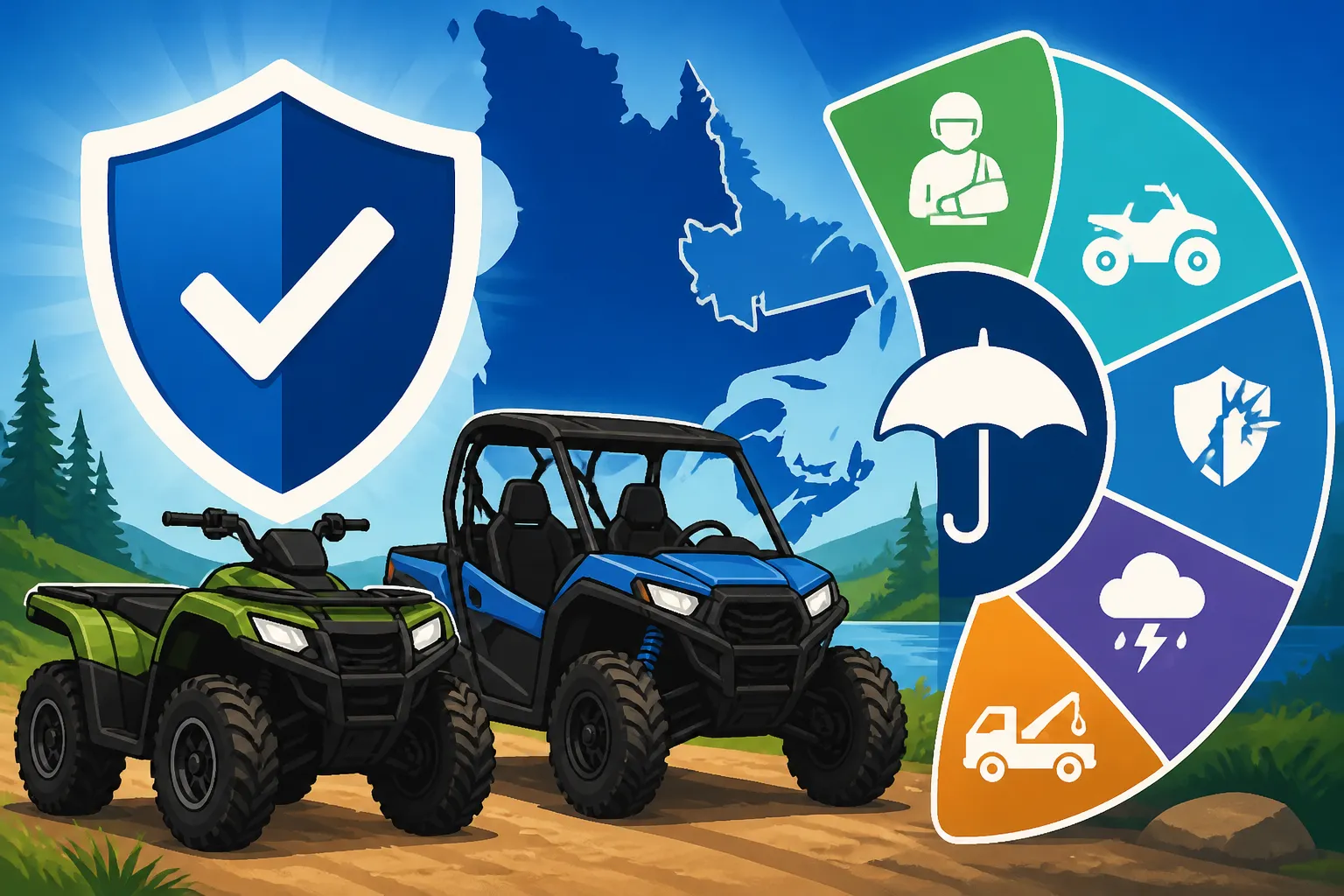
What the Insurance Option Actually Covers
Quebec ATV riders can encounter an optional insurance offer when buying a trail pass and reasonably wonder whether it covers the machine, trail accidents, or liability to other people. The key is to separate trail-pass insurance from the coverage required for registration and from a full ATV or UTV policy. The policy wording, not the offer’s short label, determines what is covered.
What the trail pass insurance option is
A Quebec trail pass and an ATV’s registration serve different purposes. The pass allows access to federated trails under the applicable conditions; registration and required liability insurance are separate responsibilities for the vehicle owner. Buying a pass does not, by itself, settle whether your machine is properly registered or insured for road use and other activities.
The optional insurance offered with a trail pass is a separate insurance arrangement connected to the pass. Its exact coverage depends on the current policy and the person, machine, activity, and location described in its terms. Don’t treat the word “insurance” as a promise that every loss related to riding is covered.
A useful starting point is to ask whether the option is intended to provide civil liability coverage for a particular trail-related exposure, or whether it provides some other narrowly defined benefit. If the documents describe civil liability, that generally concerns a covered claim that the insured is legally responsible for causing injury to another person or damage to someone else’s property. It does not automatically mean the policy repairs your own machine or pays your own medical expenses.
The option may be offered as an add-on when you buy a pass, but it should still have insurance documents explaining its terms. Look for the insurer or underwriting organization, the policy or certificate, the insured parties, covered activities, limits, exclusions, and claim-reporting instructions. If you can see only a short description during purchase, get the full wording before relying on the coverage.
For context, Quebec has a separate liability-insurance requirement for registered off-highway vehicles. You can review Quebec’s Liability Insurance Rule and [Quebec Insurance Proof on the Trail] to understand the owner’s responsibility and the kind of proof a rider may need to carry. Those obligations should not be confused with the optional insurance offered alongside a trail pass.
What it does not automatically mean
The option’s presence does not automatically mean:
- Your machine is registered.
- You have met the insurance requirement tied to registration.
- Your ATV or UTV has comprehensive or collision coverage.
- A passenger’s injuries are covered.
- Every rider in your group is insured.
- Your riding is covered away from the eligible trail network.
- You are covered while working, racing, renting, or using the machine in another excluded activity.
- Your existing insurer will treat the two policies as interchangeable.
Some of these areas may be covered by a particular policy; others may be expressly excluded. The point is to confirm the answer in the actual documents rather than infer it from the fact that an insurance option was available at checkout.
What it may cover, and where the boundaries are
The coverage question is easiest to answer by identifying the kind of loss. An insurance contract may respond differently to a claim by another person than to damage to your own vehicle, even when both arise from the same ride.
| Type of loss | What to check in the trail-pass policy | Why it matters |
|---|---|---|
| Injury to another person | Whether civil liability is included, who qualifies as insured, and which riding activities are covered | A liability policy responds only when its terms apply and the insured is legally responsible |
| Damage to someone else’s property | Covered property, exclusions, limits, and whether the incident occurred during an eligible activity | Property damage may be treated differently from bodily injury |
| Damage to your ATV or UTV | Whether physical damage coverage is included or excluded | Liability coverage generally does not repair the insured’s own machine |
| Theft, fire, or vandalism | Whether the policy includes vehicle physical damage or property protection | A trail pass is not proof of theft or comprehensive coverage |
| Your own injuries | Whether the documents include accident benefits or another personal-injury benefit | Civil liability coverage is not the same as first-party medical coverage |
| A passenger’s injury | Whether passengers are insured, eligible claimants, or subject to special exclusions | The answer can depend on the rider’s role and the circumstances |
| Riding outside federated trails | The policy’s territory and activity definitions | Trail access and insurance territory are not necessarily the same thing |
| Riding by another person | Who is insured and whether permission, age, licence, or operator conditions apply | A pass attached to a machine or purchaser may not cover every operator |
If the option is a liability policy, the central question is usually not simply, “Was there an accident?” It is whether there is a covered claim against an insured person for an incident within the policy’s scope. The policy may define who is insured, which vehicles qualify, and what use is permitted. A claim can fall outside coverage even if the incident happened on a trail.
A third-party liability policy is also different from insurance that pays regardless of fault. Liability coverage generally concerns legal responsibility to someone else. It does not automatically pay for the rider’s own treatment, lost income, damaged equipment, or vehicle repairs. Those benefits, if available, need to be identified separately in the policy.
The machine itself
Owners often assume an insurance option associated with a vehicle pass protects the vehicle. That assumption is risky. Liability insurance and physical damage insurance address different losses:
- Liability coverage may respond to a covered claim from someone else.
- Collision coverage may help with damage to your own machine after a collision, subject to the policy.
- Comprehensive coverage may address specified non-collision losses, such as theft or fire, subject to the policy.
- Personal accident or medical benefits may provide defined benefits to an insured person, if included.
Do not count on the pass option to pay for a bent frame, a damaged ATV after a rollover, a stolen machine, or a rider’s medical expenses unless the documents specifically describe that benefit. If vehicle damage matters to you, ask your vehicle insurer whether your own policy covers the machine on trails and under the way you use it.
The same caution applies to accessories and equipment. A helmet, trailer, winch, phone, tools, or riding gear may not be insured just because it was used during a covered ride. Check whether the relevant property is listed, included, or excluded.
Riders, passengers, and other operators
Coverage may depend on who was operating the machine and who is claiming. Read the definitions for “insured,” “operator,” “passenger,” and any similar terms. A policy may cover a named pass holder, a registered owner, an authorized operator, or another defined group; it is not safe to assume the wording.
This is particularly important for family rides and group outings. If another household member, friend, or guest will drive, confirm whether that person qualifies under the policy and whether conditions apply to their age, licence, training, or permission to use the vehicle. The same goes for passengers. Eligibility to ride as a passenger under safety rules does not itself establish that the passenger is insured.
A pass also does not make an otherwise ineligible ride eligible. If a route is closed, access is not permitted, or a rider violates a policy condition, the insurance question may be affected. Trail-access rules and insurance terms are separate, so check both.
How it differs from required registration insurance
The most important practical distinction is between an optional trail-pass insurance offer and the coverage required for a registered off-highway vehicle. A pass purchase does not transfer the vehicle owner’s registration obligations to the trail-pass provider.
Quebec owners should confirm that the machine has the registration and insurance required for its use. The relevant policy must match the vehicle and the activities in question. If the insurance option offered with a pass is being considered as a substitute, get clear confirmation from the insurer or the SAAQ that it satisfies the specific requirement. Do not infer that it does based on a similar-sounding coverage label.
The distinction matters even if both documents refer to liability. Two liability policies can differ in insured persons, covered vehicles, territory, permitted use, limits, exclusions, and how other insurance is coordinated. Having one policy does not prove that the other requirement is met.
Use this comparison as a prompt for checking the documents, not as a substitute for them:
| Question | Registration-related insurance | Trail-pass insurance option |
|---|---|---|
| Why it exists | To meet the applicable insurance requirement for the vehicle | To provide the specific coverage described in the pass-related policy |
| Who must check it | The owner or person responsible for registration | The purchaser and each person relying on the option |
| What it applies to | The vehicle and uses described in the applicable policy | The people, machines, activities, and territory described in its policy |
| Does it register the ATV or UTV? | No; registration is a separate step | No |
| Does it necessarily cover the other policy’s risks? | Not necessarily | Not necessarily |
For a clearer explanation of the required minimum, see The $1 Million Liability Floor Every Owner Carries. The applicable amount and policy requirements should be confirmed with the official source and insurer, since requirements and policy terms can change. A figure quoted in a club post or an older document is not enough to establish what applies to your vehicle today.
A practical rule is to keep the documents distinct:
- Confirm the machine’s registration status.
- Confirm that the required insurance is active for that vehicle and its intended use.
- Review the optional trail-pass policy separately.
- Carry the proof required for the ride, and make sure the documents identify the correct machine and insured person.
- Contact the insurer if the policies overlap or you are unsure which one responds first.
If you have coverage through more than one insurer, ask how the policies coordinate. Do not assume that duplicate liability coverage doubles the available protection or that one policy will automatically fill gaps in another.
Common assumptions that can leave a gap
“The pass includes insurance, so I’m fully covered”
An insurance option is not the same as a complete vehicle policy. It may address a limited type of claim, in a limited setting, for defined insured people. It might not cover physical damage, theft, personal medical costs, or use away from eligible trails. The only reliable way to know is to read the full terms and ask about anything unclear.
“It covers me wherever I ride”
Trail-pass access and insurance territory are separate questions. The policy may define where and when coverage applies, while trail rules determine where you may ride with the pass. Riding on a public road, private land, a closed trail, a work site, or a non-federated route may be treated differently from riding on an eligible federated trail.
Do not assume that a trail-pass insurance option extends to every place your vehicle can go. If you use a machine at a camp, on a farm, for work, or on private land, describe that use to your insurer and ask what policy applies. Related questions are covered in Quebec Machines Used Only on Private Land and Quebec Registration for a Farm Machine.
“The vehicle is insured, so every driver is insured”
The policy may define insured operators and impose conditions. A friend borrowing the machine, a young family member, or a passenger may not have the same status as the purchaser or registered owner. Check before handing over the keys, rather than after a collision.
“Liability insurance will pay to fix my machine”
Liability coverage usually concerns responsibility for loss suffered by someone else. It should not be treated as collision coverage for your own ATV or UTV. A crash can produce several different losses, and each may be handled under a different policy.
“My registration paperwork proves this option is enough”
Registration paperwork and a trail-pass insurance certificate serve different purposes. A certificate for one policy does not necessarily establish that another coverage requirement has been met. Make sure you know which document proves which coverage.
“A club member told me it covers everything”
Informal summaries are useful for finding the right question, but they are not the insurance contract. Club materials can be simplified, outdated, or aimed at a different pass type or riding situation. Check the current policy and ask the insurer for a written clarification when a point affects your decision.
For more background on the pass itself and the insurance choice, see Quebec Passes Without Insurance and Does the Trail Pass Option Replace Your Own Insurance?. The first helps separate the pass from the optional insurance; the second focuses on whether the add-on can stand in for a rider’s other coverage.
How to check the option before you buy
You do not need to interpret every insurance clause alone. Start with the certificate or summary, then ask the provider or insurer specific questions. It is more useful to ask, “Does this cover a passenger’s claim for injury while I operate my ATV on a federated trail?” than to ask, “Am I covered?”
Use this checklist:
- Identify the policy. Record the insurer or underwriting organization and obtain the current certificate and full wording.
- Confirm who is insured. Ask whether the pass purchaser, registered owner, operator, and passengers qualify, and whether each person must meet conditions.
- Confirm which machine is covered. Check whether coverage follows a specific ATV or UTV, the registered owner, the pass holder, or another defined party.
- Name your actual riding activities. Ask about federated trails, road crossings, private land, work use, towing, organized events, and any other use relevant to you.
- Ask what kinds of losses are covered. Separate third-party liability from injury benefits, collision, theft, fire, and damage to equipment.
- Check limits and exclusions. Look for the maximum amount payable, deductibles if any, exclusions, and any conditions that could void or limit coverage.
- Confirm how claims work. Note the reporting deadline, required documents, emergency contact process, and any duty to notify another insurer.
- Ask how it interacts with your existing insurance. Confirm whether it is primary, excess, or subject to another coordination rule. Get the response in writing if the answer is important.
- Save proof for the ride. Keep the policy certificate and the required registration insurance proof accessible, in the format accepted for the situation.
- Recheck at renewal. Do not assume last season’s terms, covered machine, or insurance option carries forward unchanged.
For the registration insurance certificate itself, Carrying an Insurance Certificate on Every Ride offers a related checklist. For a broader review of policy exclusions and riding use, consult Reading a Policy Before the Season. If the issue is specifically what a patrol may ask to see, [Quebec Insurance Proof on the Trail] is also relevant.
What to ask the insurer
Before relying on the option, get direct answers to questions such as:
- Is the coverage civil liability, accident benefits, physical damage, or a combination?
- Which person is insured when operating the machine?
- Does it cover passengers, and under what conditions?
- Does it apply only on federated trails, or also to connecting sections and road crossings?
- Is use on private land or for work excluded?
- Does it cover the ATV or UTV itself, or only claims made by other people?
- Does it meet the insurance requirement tied to my machine’s registration?
- If I have another policy, which one responds first?
- What do I need to do immediately after an incident?
- Where can I find the complete, current policy wording?
If an answer is unclear, ask for the relevant section of the policy or a written explanation from the insurer. Keep that explanation with your insurance records. A verbal summary can be hard to rely on later, particularly if it leaves out a limitation or condition.
Deciding whether the option is useful
The option may be useful if its defined coverage fills a real gap for your situation, and you understand who and what it covers. It may be less useful if it duplicates coverage you already carry, excludes your typical riding, or provides a type of protection you do not need. Those judgments depend on the actual wording and your existing policies.
Before deciding, compare the option with your current ATV or UTV insurance. Ask your own insurer whether your policy covers riding on federated trails, whether other operators are covered, and whether physical damage or theft protection applies while the machine is being used there. Provide accurate details about how you ride; an answer based on road use alone may not address off-highway use.
If you do not own the machine, or you are riding a borrowed or rented one, ask the owner or rental provider for the relevant insurance details. Do not assume that the pass purchaser’s insurance automatically protects every person using the vehicle. Rental coverage, trail-pass coverage, and a renter’s own policy can have different terms.
A simple decision sequence can help:
- First, meet the registration and insurance requirements that apply to the machine.
- Next, identify what your existing policy already covers on the trail.
- Then read the optional policy to find a specific additional benefit.
- Finally, decide whether that benefit is worth the cost and limitations for the way you ride.
If you cannot identify a distinct benefit in the documents, pause before buying on the assumption that it is broad protection. Contact the insurer or pass provider, and ask for a direct comparison with the coverage you already have. Check current terms and any cost with the provider rather than relying on an old price or a previous season’s description.
The bottom line is straightforward: the pass-related insurance option may provide valuable protection, but its name alone does not tell you what that protection is. Treat it as a separate policy, confirm its scope, and keep required registration insurance in place unless the appropriate authority and insurer confirm otherwise.
Frequently Asked Questions
Does the trail-pass insurance option replace insurance required for registration?
Do not assume that it does. Registration-related insurance and the pass option are separate matters. Confirm with the insurer and the SAAQ whether a particular policy meets the requirement for your vehicle and use.
Will the option pay for damage to my own ATV or UTV?
Only if the policy specifically includes that kind of physical damage coverage. A liability policy generally addresses claims by other people, not repairs to the insured’s own machine.
Are passengers covered?
That depends on the policy’s definitions and conditions. Check whether passengers qualify as insureds or claimants and whether any restrictions apply.
Does the option cover riding away from a federated trail?
Not automatically. Check the policy’s territory and activity definitions, and separately confirm that your ride is permitted under the trail, land-access, and vehicle rules.
Disclaimer
This article is for general informational purposes only and does not constitute professional advice. Laws, prices and regulations vary by location and change over time. Consult a qualified professional for guidance on your specific situation.