Quebec Registration for a Farm Machine
For many Quebec farmers, the ATV or side-by-side isn't a recreational toy; it's a vital piece of equipment, a workhorse for everything from checking fences to moving feed. However, when it comes to registering these essential machines, there's often a bit of head-scratching about whether the rules apply to equipment used almost exclusively on private land. This guide will help you navigate the specific SAAQ registration requirements for farm machines in Quebec, ensuring your operational quads and side-by-sides are properly titled, insured, and ready for work.
Why Your Farm Machine Needs SAAQ Registration
It’s a common misconception that if a machine never leaves the farm, it doesn't need to be registered. While that might feel logical, Quebec's Off-Highway Vehicle Act (often shortened to LVHR) doesn't always see it that way, especially if there's any chance your machine might touch a public road or participate in club-sanctioned activities. The SAAQ (Société de l'assurance automobile du Québec) is the provincial body responsible for registering all off-highway vehicles, including those used for agricultural purposes, and ensuring they carry mandatory liability insurance. This isn't just about trail riding; it's about public safety and accountability.
Think about it this way: even if your quad spends 99% of its life on your fields, what happens if you need to cross a municipal road to get to another parcel of land, or quickly run down the shoulder to the general store for a repair part? The moment your wheels touch public property, even for a short distance, the rules of the road—and the rules of registration and insurance—kick in. The SAAQ's framework is designed to cover these eventualities, making sure that if an incident occurs, there's a clear record of ownership and a minimum level of financial protection in place. It's less about trying to make things difficult for farmers and more about creating a universal safety net for everyone, regardless of a machine's primary purpose.
The SAAQ's Dual Role for Farm Equipment
One of the unique aspects of registering any off-highway vehicle in Quebec, including farm machines, is that the SAAQ acts as both the registrar and the mandatory liability insurer. This means when you go through the registration process, you're not just getting a plate; you're also automatically securing the minimum required liability insurance. This might seem like an extra step or cost, but it streamlines the process significantly, as you don't need to shop around for basic coverage before you can even get your plate. [Quebec SAAQ Is Registrar and Insurer] explains this in more detail.
For farm machines, this integrated system provides peace of mind. If, for instance, a farm vehicle, even unintentionally, causes damage to another person's property while crossing a short stretch of road, that mandatory SAAQ liability coverage is there. Without it, a farmer could face significant personal financial risk. The rules are the rules, whether your machine is hauling hay or hitting the trails for fun. It’s about ensuring every off-highway vehicle owner has that basic level of protection for others.
When "Private Land Only" Still Needs Attention
While the general rule is that a machine used exclusively on private land does not need SAAQ registration, the definition of "exclusively" is critical and often misunderstood. If your farm machine never, ever leaves your property—not even to cross a driveway that's technically a public easement, or to quickly move between two non-contiguous parcels of land via a public road—then you might be exempt. However, this is a very strict interpretation. Any use that could be construed as public access, even incidental or for a short distance, usually triggers the registration requirement.
Consider a large farm with fields on both sides of a concession road. Even if you're just driving straight across the road from one field to another, that's public road use. Or perhaps you have a remote sugar shack accessible by a shared laneway that other residents use; that laneway might be considered a public right-of-way. It's often safer, and certainly less stressful, to simply register your farm machine if there's any grey area in its usage. This avoids potential fines, ensures you're properly insured for those quick jaunts, and keeps you compliant with [Quebec's Off-Highway Vehicle Act and Your Papers].
Specific Exemptions and Conditions for Farm Quads and Side-by-Sides
Quebec does offer some specific, albeit limited, exemptions for certain agricultural uses of off-highway vehicles, but it's crucial to understand their precise scope. These aren't blanket exemptions but rather apply to very particular circumstances, usually tied to public road use rather than registration itself. Most farm quads and side-by-sides, if they might ever touch public land, will still need registration.
The main area where farm machines often differ from recreational ones is in their use on public roads. While general recreational use of ATVs on public roads is highly restricted (with specific exceptions for short distances and certain municipalities), a farm machine might need to briefly access a public road to move between fields or access facilities. It’s these very specific, limited allowances that can sometimes be confused with a total exemption from registration or insurance.
Rules for Farm Use on Public Roads
Under specific conditions, the LVHR allows off-highway vehicles used for agricultural purposes to operate on certain public roads. This is not an exemption from registration or insurance, but rather a permission to use public infrastructure for specific work-related tasks. Generally, this means short distances, following specific signage, and only for the purpose of carrying out agricultural work. For instance, you might be permitted to travel a short distance on a municipal road to move equipment or livestock between two fields of your farm.
These allowances are very specific and often come with strict rules regarding speed, time of day, and the need for appropriate lighting and signage on the vehicle itself. It's not a free pass to drive your quad into town. Always check with your local municipality and the SAAQ for the most current and specific regulations that might apply to your farm's location, as local bylaws can sometimes add further restrictions or permissions. What applies to a worker on a quad might be slightly different than pure recreational use. [Quebec Rules for a Farmer on a Quad] delves into these nuanced distinctions.
Trailers and Implements on Farm Machines
When you're using your ATV or side-by-side for farm work, chances are you're often towing a small trailer, sprayer, or other implement. The good news is that these towed implements typically don't require separate SAAQ registration themselves, as long as they are specifically designed for off-highway vehicle use and are being towed by a properly registered and insured ATV or side-by-side. The focus of the SAAQ registration is on the primary power unit—your quad or side-by-side.
However, safety remains paramount. Ensure that any trailer or implement you are towing is securely attached, not overloaded, and has appropriate reflective markings, especially if you ever take it onto a public road. Overloading or operating an unsafe combination could still lead to fines or liability issues, even if the primary machine is registered. Always follow manufacturer guidelines for towing capacity and safe operation. If you're using a home-built trailer or one not specifically designed for ATV use, exercise extra caution and consider its legality for any public road interaction.
The Registration Process for a Quebec Farm Machine
Registering a farm machine with the SAAQ is largely similar to registering any other off-highway vehicle, but understanding the steps can save you a lot of time and potential frustration. The key is to gather all your necessary paperwork beforehand and be prepared for the SAAQ counter. Remember, this is about proving ownership and ensuring the machine meets basic safety and insurance standards.
The most common scenarios for farm machine registration are buying a new one from a dealer or purchasing a used one privately. Each situation has slightly different paperwork requirements, but the end goal is the same: to get your VHR plate and ensure your machine is legally ready for farm work, even if that work occasionally involves a brief interaction with public land. [How to Register an ATV in Quebec] provides a broader overview of the general process.
Required Documents for a New Farm Machine
If you've just bought a brand-new ATV or side-by-side for your farm from a dealership, the process is usually quite straightforward. The dealer will often handle a significant portion of the SAAQ paperwork for you, making sure all the necessary forms are filled out correctly and that the provincial sales tax is applied. You'll typically leave the dealership with a temporary registration or a receipt that allows you to operate the machine for a short period until your official plate arrives.
When you go to the SAAQ, or if the dealer sends in the paperwork, you'll need:
- Proof of Purchase: This will be your sales contract or invoice from the dealership.
- Proof of Identity: A valid driver's license or other government-issued ID.
- Proof of Address: A utility bill or other official document showing your Quebec address.
- The machine's serial number (VIN): This will be on the sales contract, but it's good to double-check it against the machine itself.
- Payment for registration fees and sales tax: The SAAQ will calculate this based on the machine's value and type. [Quebec ATV Registration Costs Explained] can give you an idea of the various fees involved.
The dealer's role in this process is a huge help, as they are familiar with the specific forms and submission requirements, reducing the chance of errors that could delay your farm machine from getting to work.
Registering a Used Farm Machine from a Private Seller
Buying a used ATV or side-by-side for your farm from a neighbor or another private seller requires a bit more legwork on your part, as there's no dealer to facilitate the paperwork. This is where attention to detail really pays off to avoid future headaches. The most crucial document here is a well-drafted bill of sale. A good bill of sale protects both the buyer and the seller, establishing proof of purchase and detailing the machine's information.
When heading to the SAAQ, you'll need:
- A Bill of Sale: This document is paramount. It must clearly state the full names and addresses of both the buyer and seller, the date of sale, the purchase price, and a detailed description of the machine including its make, model, year, and crucially, the Vehicle Identification Number (VIN) or serial number. Both parties should sign and date it. You can find templates for these online, or services like LawDepot can help you generate a legally sound [Paperwork Two Individuals Sign on a Private Sale].
- Previous Owner's Registration Certificate: While not strictly mandatory for you to submit, having the previous owner's registration certificate (the yellow SAAQ paper) is highly recommended. It verifies the previous owner's legal right to sell and confirms the VIN.
- Proof of Identity and Address: Again, your valid driver's license and proof of residence are essential.
- Payment for registration fees and sales tax: Remember, even on a private sale, you'll owe provincial sales tax on the agreed-upon purchase price when you register the machine. [Quebec Sales Tax on an ATV Purchase] elaborates on this.
It's always a good idea to inspect the machine thoroughly and compare the VIN on the machine to all paperwork before completing the purchase. This prevents issues later when you try to register.
Essential Documents and What to Expect at the SAAQ
Dealing with government bureaucracy can sometimes feel daunting, but with the right preparation, registering your farm machine at the SAAQ can be a smooth process. Knowing what forms you'll encounter, what questions they might ask, and how the insurance aspect integrates will help you feel more confident. The SAAQ clerks are there to help, but having your ducks in a row makes their job, and yours, much easier.
Remember that the ultimate goal is to obtain your VHR (Véhicule Hors Route) plate and ensure your farm machine is covered by the mandatory liability insurance. This single plate allows you to operate the machine legally for its intended farm purposes, including those occasional short trips on public roadways that are permitted under agricultural exemptions. [Quebec's VHR Vehicle Class] details what this specific classification entails.
The SAAQ Counter Experience
When you visit an SAAQ service outlet, the clerk will guide you through the process, but having all your documents ready will significantly speed things up. They will verify your identity, process your proof of ownership (bill of sale or dealer invoice), and input the machine's details into their system. They will calculate the registration fees and the provincial sales tax (if applicable, for private sales). This is also where the mandatory liability insurance is automatically activated as part of your registration.
Don't be afraid to ask questions if anything is unclear, especially if you have specific concerns about your farm machine's unique usage patterns. While the general rules apply, ensuring the clerk understands that this is a farm vehicle, not just a recreational quad, can sometimes help with context, though the registration process itself remains standard. Expect to pay on the spot for the registration and taxes. You'll receive a temporary document and your official VHR plate either immediately or by mail, depending on the SAAQ service centre. [Documents to Bring to a Service Counter] provides a useful checklist.
Understanding the SAAQ Registration Forms
While you won't necessarily fill out complex forms from scratch at the SAAQ counter for a standard registration, you'll be signing documents generated by the SAAQ's system. These forms will capture all the details of your machine, your personal information, and confirm the transaction. If you're doing a private sale, the key document you'll need to present is your [Quebec SAAQ Forms for a Private Sale] or an equivalent robust bill of sale.
For agricultural purposes, there isn't usually a special "farm machine" form, but the vehicle category on the SAAQ system will reflect it as an off-highway vehicle (VHR). The clerk might also confirm the primary use if it affects any specific local regulations or questions you might have. Once registered, keep your official registration certificate safe, as you'll need it for future renewals and as proof of ownership if ever requested by authorities or during a sale.
Liability Insurance and Your Farm Quad
As mentioned, the SAAQ registration automatically includes basic liability insurance. This is a crucial safety net for farmers, as it covers damages you might accidentally cause to other people or their property while operating your farm machine. This is not optional; it's bundled into the registration fee. The amount of coverage is set by the SAAQ, and for off-highway vehicles, it typically meets a significant minimum, providing substantial protection. [Quebec Insurance Minimum for an Owner] details the base level of coverage every owner carries.
It's important to understand that this SAAQ-provided insurance is liability only. It does not cover damage to your own farm machine, nor does it cover injuries to yourself or your passengers. For comprehensive coverage that includes collision, theft, or fire for your valuable farm equipment, you would need to purchase additional private insurance from a separate insurance provider. While the SAAQ covers third-party liability, protecting your investment often requires that extra step. Always assess your needs and discuss them with a private insurer if you want more than the basic liability protection.
Table: Key Registration Differences for Farm vs. Recreational ATVs
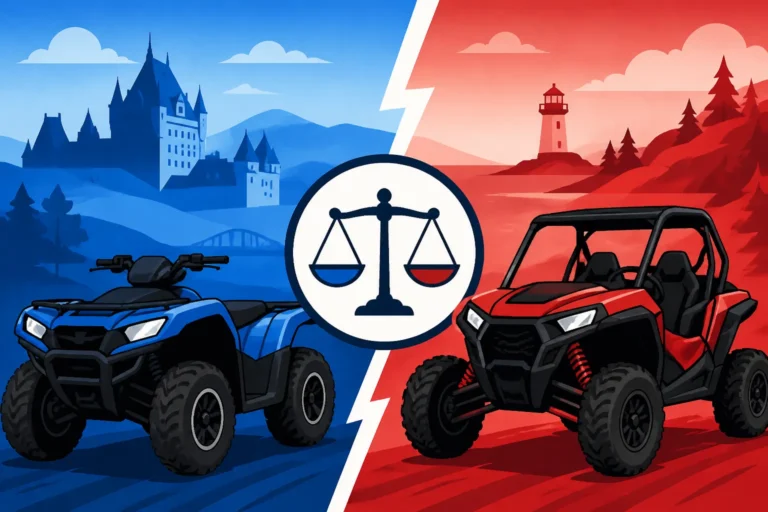
While the SAAQ registration process for farm machines largely mirrors that of recreational ATVs, some operational nuances and considerations are specific to agricultural use. This table highlights those key differences to help you navigate the process.
| Feature | Recreational ATV/UTV | Farm Machine ATV/UTV |
|---|---|---|
| Primary Use | Leisure, sport, trail riding | Agricultural work, farm maintenance, animal husbandry |
| SAAQ Registration | Mandatory if used on federated trails or public roads | Mandatory if used on federated trails or public roads, or for any public road crossing between farm parcels. |
| Mandatory Insurance | Included with SAAQ registration (liability only) | Included with SAAQ registration (liability only) |
| Public Road Use | Highly restricted; short distances, specific signage, municipal bylaws; not for general transit. | Permitted for specific agricultural tasks (e.g., crossing roads between fields, short distances for farm access) under strict conditions. |
| Trail Pass | Mandatory for FQCQ federated trails | Not required if used strictly for farm work on private land or permitted road segments; mandatory if riding FQCQ trails for leisure. |
| Driver's License | Mandatory for all public road & trail use | Mandatory for all public road & trail use |
| Bill of Sale (Private) | Crucial for proving ownership, sales tax calculation | Equally crucial; may involve transfers within family or estate documents if inheriting. LawDepot can assist. |
| Additional Insurance | Recommended for comprehensive coverage (collision, theft) | Highly recommended for protecting valuable farm assets; may be deductible as a farm expense. |
| Common Misconception | "I only ride on my friend's land, so I don't need it." | "It's just for the farm, it never really leaves, so I don't need it." |
This overview should help clarify the specific considerations when registering a machine that is an integral part of your farming operations. Whether you're hauling feed, checking fences, or heading to the back forty, making sure your farm machine is properly registered and insured is a fundamental step to protect yourself and your livelihood.
Disclaimer
This article is for general informational purposes only and does not constitute professional advice. Laws, prices and regulations vary by location and change over time. Consult a qualified professional for guidance on your specific situation.