What a Trapper’s Quad Needs on the Trapline
Navigating Quebec's vast wilderness as a trapper brings a unique set of challenges, and your all-terrain vehicle (ATV) or side-by-side (SxS) is often the most critical tool in your arsenal. It's not just about getting from point A to point B; it's about reliable transportation for gear, safe passage through unforgiving terrain, and adherence to specific regulations that can differ significantly for those engaged in commercial activities like trapping. This guide will walk you through the essential equipment, legal requirements, and practical considerations to ensure your quad is perfectly set up for the demanding life on a Quebec trapline.
Navigating Quebec's Off-Highway Vehicle Act for Trappers
The life of a trapper often means spending countless hours in remote areas, far from paved roads and often away from formal trails. While this solitude is part of the appeal, it doesn't exempt you from the rules governing off-highway vehicles in Quebec. In fact, specific provisions within the province's Off-Highway Vehicle Act (LVHR) apply directly to workers, including trappers, ensuring both safety and accountability.
Essential Registration and Insurance
First and foremost, just like any other quad owner in Quebec, your trapper's machine needs to be properly registered with the Société de l'assurance automobile du Québec (SAAQ). This isn't just a formality; it's a legal requirement that ties your machine to you and ensures you meet the province's mandatory liability insurance. Without this registration, you're looking at potential fines and headaches if a patrol officer stops you, or worse, if you're involved in an incident. The SAAQ acts as both the registrar and the mandatory insurer for all off-highway vehicles, including those used for commercial purposes like trapping.
The SAAQ provides the unique "VHR" plate that designates your machine for off-highway use. Along with this, they provide the minimum mandatory liability coverage, which has been set at a substantial amount to protect you and others in case of an accident. It's absolutely crucial to have your registration certificate and proof of this insurance with you whenever you're operating your quad. We're talking about the original documents, not just a photo on your phone, though a photo can be a helpful backup. This ensures you're always ready to show proof if asked, whether by a Sûreté du Québec officer or a local conservation officer. Failing to carry these documents can lead to fines and an unnecessary interruption to your trapline duties. For a deeper dive into the specifics, you can check out [Quebec ATV Registration With the SAAQ] and [Quebec SAAQ Is Registrar and Insurer]. Understanding [Quebec Insurance Minimum for an Owner] is also vital.
Driver's Licence and Age Rules on the Trapline
For many trappers, especially those who might bring family members or apprentices along, understanding the driver's licence requirements is non-negotiable. As of recent changes, Quebec requires all ATV and side-by-side operators to hold a valid driver's licence. This isn't just for recreational riders; it applies equally to trappers using their machines for work. If you're out on the trapline, you need to be legally licensed to operate your vehicle. This rule helps ensure that everyone on the trail, whether for work or pleasure, has demonstrated a basic level of driving competence.
Age rules are also important. While the general minimum age for operating an ATV on federated trails is 16 (with specific training requirements for those under 18), and 18 for side-by-sides, there are nuances for individuals working, such as trappers. If you have a younger assistant who is helping you with the trapline, they must still meet these age and licensing criteria unless very specific exemptions apply, which are rare and typically limited to private land scenarios under strict supervision. It's always best to err on the side of caution and ensure everyone operating a machine is fully compliant. After all, safety should be paramount when navigating remote wilderness. For the full scope of requirements, take a look at [Quebec Requires a Driver's Licence Since 2021] and [Quebec Rules for a Worker on a Quad].
Helmet and Other Safety Gear Exemptions
Here's where trappers get a specific, albeit conditional, exemption. The Quebec Off-Highway Vehicle Act generally mandates helmet use for all ATV and side-by-side operators. However, for those engaged in forestry, agricultural, or trapping activities, there's a specific exemption: you don't need to wear a helmet if you're operating the vehicle at speeds of 30 km/h or less, and if you are making frequent stops as part of your work. This exemption acknowledges the practicalities of a trapper's work, where dismounting frequently and operating at slow speeds is the norm.
Despite this exemption, safety should never be optional. While you might not need a helmet under these specific conditions, wearing eye protection – whether goggles or a visor – is still highly recommended to protect against branches, dust, and insects. Sturdy footwear, gloves, and appropriate clothing for the weather and terrain are also critical. Remember, the exemption is for helmet use, not for abandoning all common sense regarding personal protective equipment. If you're exceeding 30 km/h, even briefly, or simply transiting between areas without frequent stops, that helmet needs to be on your head. Understanding the details of [Trapping Under 30 km/h Without a Helmet] and [Quebec Helmet and Visor Rules] will keep you compliant and safe.
Equipping Your Quad for the Demands of the Trapline
A trapper's quad isn't just a recreational toy; it's a workhorse that needs to be configured for maximum utility, durability, and reliability in challenging conditions. The standard factory setup, while often good, might not cut it when you're deep in the bush, miles from help, and relying on your machine to get the job done and get you home safely.
Specialized Tires and Suspension for Rough Terrain
The terrain on a Quebec trapline can be incredibly diverse and often brutal. You'll encounter everything from deep mud and loose gravel to rocky climbs, slippery roots, and potentially deep snow. Standard all-purpose tires simply won't offer the traction, puncture resistance, or durability required. Investing in aggressive, multi-ply tires (think 6-ply or 8-ply rated) designed for utility and mud is paramount. These tires provide superior grip, resist punctures from sharp rocks or stumps, and can handle the fluctuating air pressures needed for different ground conditions. Many experienced trappers opt for tires with deep, self-cleaning treads that can dig through muck without bogging down.
Beyond tires, your suspension system needs to be up to the task. Carrying heavy loads—whether it's bait, traps, tools, or harvested animals—will quickly overwhelm a stock suspension designed for lighter, recreational use. Upgrading to heavier-duty springs, shocks, or even a full suspension kit can make a world of difference. This not only improves the ride comfort and handling with a load but also reduces wear and tear on your machine and helps maintain ground clearance. Without adequate suspension, your quad will sag, scrape, and become much harder to control, especially on uneven ground, potentially leading to damage or even an accident.
Storage and Carrying Capacity for Gear and Haul
Trapper's gear isn't light, nor is it small. You'll need efficient and secure ways to transport traps, bait, tools, emergency supplies, and eventually, your harvest. Factory racks are a starting point, but most trappers quickly find them inadequate. Investing in heavy-duty, reinforced front and rear racks is essential. Many aftermarket options are available, designed specifically for utility and off-road work. These racks should be able to support significant weight and provide multiple tie-down points.
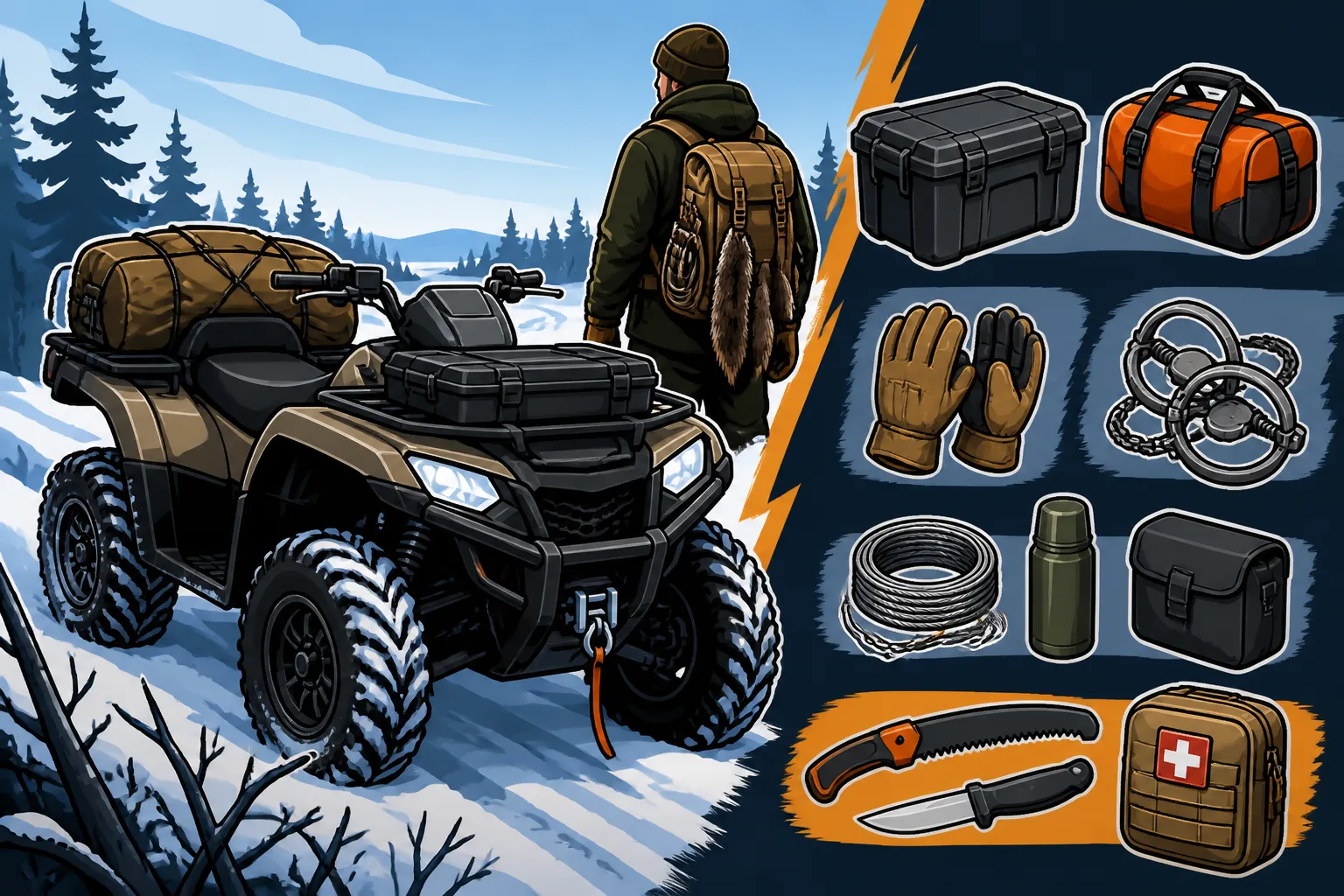
Waterproof storage solutions are also critical. Think hard-shell boxes mounted securely to your racks, or heavy-duty dry bags that can withstand the elements. These protect sensitive items like maps, phones, first-aid kits, and extra clothing from rain, snow, and mud. For larger items or when you need to haul multiple animals, a small utility trailer specifically designed for ATVs can be a game-changer. Ensure any trailer you use is robust, has good ground clearance, and is properly registered if it will be used on shared trails or roads for any distance. Having reliable storage means your essential gear is always protected and accessible, preventing frustration and potential loss in the field.
Lighting, Winches, and Navigation Tools
When you're out before dawn or heading back after sunset, especially during the shorter days of late fall and winter, effective lighting is non-negotiable. Stock headlights are often barely adequate. Consider adding powerful LED light bars or auxiliary spot/floodlights to the front and rear of your quad. These not only illuminate your path but also make your machine more visible to others, which is a crucial safety aspect. Good lighting can prevent hitting hidden obstacles or missing a turn in unfamiliar territory.
A winch is arguably the most important piece of recovery gear for any serious off-road worker, especially a trapper. It's not a matter of if you'll get stuck, but when. Whether you're mired in deep mud, trying to pull a heavy log out of the way, or just need to winch yourself up a steep, slippery incline, a reliable winch can save you hours of back-breaking work or even prevent you from being stranded overnight. Ensure your winch is adequately rated for your machine's weight and potential loads, and that you know how to use it safely. Always carry essential winching accessories like tree saver straps, shackles, and gloves.
Finally, for navigation, relying solely on your memory or a paper map (though always carry one as a backup!) isn't enough in extensive, remote traplines. A robust, waterproof GPS unit or a reliable smartphone app with offline mapping capabilities is indispensable. Mark your trap locations, key landmarks, fuel caches, and potential hazards. Consider a two-way radio or, for truly remote areas beyond cell service, a satellite messenger or communicator. These devices can be life-savers, allowing you to call for help in an emergency, or simply check in with family. This level of preparedness gives you confidence and peace of mind when venturing deep into the Quebec wilderness.
| Feature | Recreational Quad Use | Trapper's Trapline Needs |
|---|---|---|
| Tires | All-purpose, moderate tread, 4-ply usually sufficient | Aggressive, high-traction, 6-8 ply rated for puncture resistance |
| Suspension | Stock often fine, occasional passenger | Heavy-duty springs/shocks for consistent heavy loads, rough terrain |
| Storage | Small cargo box, backpack, bungee cords | Reinforced front/rear racks, waterproof hard cases, dry bags, possible utility trailer |
| Lighting | Stock headlights for casual evening rides | Auxiliary LED light bars (front/rear) for low light/night work |
| Winch | Optional, for extreme situations, sometimes not present | Essential for self-recovery, clearing obstacles, hauling loads |
| Navigation | Phone GPS, general trail maps | Dedicated GPS unit with detailed topo maps, satellite communicator, paper map backup |
| Safety Gear | Helmet, eye protection, gloves | Helmet (with exemption conditions), eye protection, sturdy boots, survival kit |
| Maintenance Kit | Basic tools for simple repairs | Comprehensive toolkit, spare belt, spark plug, tire repair kit, fuel siphon |
Practical Considerations and Trail Etiquette for Trappers
Beyond the mechanical setup and legal requirements, there are crucial practical considerations and unspoken rules of the bush that every trapper, especially those on a quad, needs to respect. Operating responsibly is not just about avoiding fines; it's about maintaining access, respecting the environment, and ensuring your own safety and the safety of others.
Planning Your Route and Respecting Land Rights
A trapper's operations depend entirely on access to specific lands, and this often involves a complex mosaic of private, public (Crown), and sometimes federated club lands. Before you even turn the key, detailed route planning is essential. You must be absolutely certain of your trapline boundaries and the ownership of the land you'll be traversing. Unintentional trespass can lead to serious legal issues and sour relations with landowners, potentially jeopardizing your trapline access. Obtaining and carrying clear documentation of your trapline leases or ownership is critical.
For private land crossings, explicit permission from the landowner is non-negotiable. Verbal agreements can be tricky, especially if ownership changes or memories fade. This is where formalizing these permissions becomes incredibly valuable. Using a service like LawDepot can help you draft clear, legally sound agreements for private land access, specifying duration, scope of access, and any specific conditions. These documents provide clarity and protection for both you and the landowner. Remember, even on Crown land, there might be specific rules or zones where ATV use is restricted or requires special permits. For more on land permissions, consult [Quebec Private Land Permission] and [Quebec Crown Land Riding Rules].
Maintenance and Preparedness for Remote Operations
When you're miles into the wilderness, far from any garage or cell service, the phrase "an ounce of prevention is worth a pound of cure" takes on literal meaning. Your quad needs to be meticulously maintained. Before every trapline run, conduct a thorough pre-trip inspection: check fuel levels, oil, coolant, tire pressure, brakes, lights, and battery. Ensure all fluid levels are optimal and that there are no visible leaks or damaged components. A small issue ignored in the garage can become a major, stranding problem in the bush.
Beyond routine maintenance, your preparedness kit for remote operations should be comprehensive. Always carry a well-stocked toolkit that includes essentials like wrenches, screwdrivers, pliers, zip ties, duct tape, and a tire repair kit. Crucial spare parts like an extra drive belt, a spark plug, and fuses can mean the difference between a quick fix and a long walk out. Emergency supplies are equally vital: a robust first-aid kit, fire-starting materials, a survival blanket, extra food and water, and a communication device (as mentioned, a satellite messenger for remote areas). Remember that conditions can change rapidly, and being prepared for an unexpected overnight stay is just good practice. Even seemingly simple items like [Quebec Machines Stored Over Winter] highlight the need for seasonal maintenance.
Environmental Responsibility and Respect for Wildlife
As a trapper, you are intimately connected with the wilderness, and demonstrating respect for the environment and other users of that space is paramount. This means sticking to established paths and trails whenever possible to minimize environmental impact. Creating new trails unnecessarily can lead to erosion, habitat destruction, and conflict with land managers or other outdoor enthusiasts. Your quad's engine and exhaust system should be in good working order to minimize noise pollution, especially when operating near cabins, camps, or areas frequented by wildlife. Excessive noise can disturb animals and annoy other people enjoying the quiet of nature.
Proper waste disposal is another critical aspect. Anything you pack in, you pack out – this includes fuel containers, food wrappers, and any broken equipment. Leaving trash behind is not only illegal but also spoils the natural beauty of the trapline for everyone. Being mindful of wildlife is also part of your responsibility. While your work involves interacting with animals, operating your quad responsibly, avoiding harassment, and giving animals a wide berth when possible contributes to healthy ecosystems. Remember that your presence on the land sets an example, and maintaining a positive image for all ATV users, especially those involved in commercial activities, benefits the entire community. Reviewing aspects like [Quebec Noise Complaints About Quads] can help understand communal expectations.
Legal Documentation and Agreements
The life of a trapper is inherently tied to specific land areas, and with that comes a unique set of legal and administrative needs. Having your papers in order goes beyond just the quad's registration; it extends to your right to be on the land and conduct your business.
Ownership and Proof of Trapline Rights
Your ability to set traps and carry out your trapline duties hinges on having legitimate rights to the land. Whether you lease a private trapline, have inherited rights, or operate on designated Crown land, you must have clear, verifiable documentation to prove these rights. This could be a formal lease agreement, a permit issued by the Ministère des Forêts, de la Faune et des Parcs, or legal documents affirming ownership. These documents are your evidence that you are operating legally and within your designated territory.
It is absolutely crucial to keep these documents in a safe, accessible place, and to have copies available. If approached by a wildlife officer, conservation officer, or even a Sûreté du Québec patrol while on your trapline, they may request to see proof of your authority to be there and conduct trapping activities. Being unable to produce such documentation could lead to significant delays, investigations, or even fines. Treat your trapline rights documentation with the same importance as your [Quebec Registration and Proof of Ownership] for your quad itself.
Drafting Permission Agreements with LawDepot
As previously touched upon, many traplines inevitably cross or abut private lands. Relying on verbal agreements for access, while common in some rural communities, can lead to misunderstandings, disputes, and loss of access. A formal, written permission agreement is a powerful tool to prevent these issues. This is where services like LawDepot can be incredibly beneficial for trappers.
LawDepot provides templates and guidance to help you create legally binding documents, such as a land use agreement or a permission form for private land access. These agreements can clearly outline the terms: the specific parcels of land you are allowed to cross, the duration of the agreement, any limitations on vehicle use, and responsibilities regarding gates, fences, or property damage. By formalizing these agreements, you create a clear understanding between yourself and the landowner, reducing ambiguity and providing a legal record should any questions arise. This protects both parties and ensures your continued, undisputed access to critical parts of your trapline.
Contingency Planning for Incidents
Despite all precautions, incidents can occur in the remote environment of a trapline. Your contingency plan should include knowing exactly who to contact in various emergencies. This means having the contact information for local emergency services, the Sûreté du Québec, and relevant wildlife or conservation authorities readily available. If you're operating a satellite communicator, know how to use its emergency functions.
Should an accident occur involving injury, significant property damage, or even an incident with wildlife that requires reporting, you must know the proper procedures. Quebec has specific rules for reporting accidents involving off-highway vehicles, and understanding these can save you further complications. Even if you're alone and think no one saw it, certain types of incidents require official notification. Being prepared for these eventualities is a mark of a responsible trapper and ensures you can handle unforeseen challenges effectively. Familiarize yourself with regulations such such as [Quebec Accident Reporting Rules] to be fully prepared.
Disclaimer
This article is for general informational purposes only and does not constitute professional advice. Laws, prices and regulations vary by location and change over time. Consult a qualified professional for guidance on your specific situation.