Registration Rules for a Quad Worked on a Farm
For farmers in Quebec, the question of whether to register that workhorse ATV or side-by-side with the SAAQ can be a real head-scratcher. It feels like it's just a tool for the farm, right? But the reality is a bit more nuanced, and misunderstanding the rules can lead to some costly headaches. This guide aims to clear up the confusion around ATV and UTV registration requirements when your machine is primarily, or even exclusively, used for agricultural purposes on the farm.
The Core Question: Does My Farm Quad Need SAAQ Registration?
This is where many farmers get caught in a tricky spot, believing that because their quad is primarily for work on their land, it's somehow exempt from the usual registration requirements. Unfortunately, it's not quite that simple. Quebec's regulations for off-highway vehicles (OHVs), which include your typical ATV or side-by-side, are quite clear, but the application to farm use often requires a closer look at where and how the machine is being operated.
Understanding the "Private Land" Versus "Public Domain" Distinction
At the heart of the matter is whether your farm machine ever touches the "public domain." The SAAQ (Société de l'assurance automobile du Québec) is the registrar and insurer for off-highway vehicles in Quebec, and their primary concern is public safety and liability. If your quad or side-by-side never, ever leaves your private property – meaning your farm land, your internal roads, and areas not accessible to the general public – then, generally speaking, SAAQ registration isn't strictly necessary. This is a specific and narrow exception for [Quebec Machines Used Only on Private Land].
However, this "private land only" definition is far more restrictive than many realize. If you use your quad to check fences along a municipal road allowance, or to move equipment between two fields that require even a brief crossing of a public road, or to access a remote woodlot on Crown land, you've entered the public domain. Even if it's just a few feet onto a shoulder, or crossing a quiet concession road, those actions typically trigger the requirement for SAAQ registration. The frustration here is understandable; it often feels like you're just trying to get work done, not go joyriding on a trail.
The Legal Framework: Quebec's Off-Highway Vehicle Act
The rules governing ATVs and UTVs in Quebec are primarily found in the Loi sur les véhicules hors route (LVHR), or the Off-Highway Vehicle Act. This act outlines everything from age restrictions and helmet laws to where you can and cannot ride. While the act is comprehensive, it doesn't offer a blanket "farm use" exemption for OHVs that are generally intended for recreational use but repurposed for work. The core principle behind SAAQ registration for these machines is to ensure that every machine operating in the public domain, however briefly, carries mandatory third-party liability insurance.
This liability coverage is vital, regardless of your machine's primary purpose. Accidents can and do happen on farms, even on private land, and the damages incurred if a third party is injured or property is damaged can be catastrophic. If your machine is registered with the SAAQ, that built-in liability insurance provides a crucial safety net. This is why understanding [Quebec's Off-Highway Vehicle Act and Your Papers] is so important for all owners, including farmers.
When "Farm Use" Still Requires a Plate
Let's get specific about those scenarios where your trusty farm quad absolutely needs to be registered and sport a VHR plate:
- Crossing or Riding Public Roads: This is the most common trigger. If your farm is bisected by a public road, or if you have multiple parcels of land that require you to drive your quad across or along any part of a municipal, provincial, or even privately maintained but publicly accessible road, you need a plate. Even a quick jaunt down the gravel shoulder to get to the next field counts.
- Accessing Crown Land or Federally Controlled Areas: Many farms have woodlots, pastures, or other areas that are accessed via Crown land, or land managed by entities like Hydro-Québec, or even federated trail systems. These are all considered part of the public domain, and any use of your quad within them requires SAAQ registration.
- Use by Employees Off Private Land: If you have farmhands or employees who use the quad for work, and their tasks involve any of the above scenarios (e.g., driving to town for parts, checking remote fields via public access routes), the machine must be registered. This isn't just about legality; it's about protecting your business from potential liability if an employee causes an accident.
- Any Scenario Beyond the Fence Line: Essentially, if your quad's tires touch anything other than your strictly private land, you're likely in a situation where registration is legally required. This helps clarify [Quebec ATV Registration With the SAAQ] for agricultural users.
The Practicalities: What Farmers Need for Registration
So, you've determined your farm quad needs to be registered. What's next? The process itself isn't overly complicated, but like any interaction with a government agency, it requires specific documentation and a bit of patience. The good news is that once it's done, you'll have peace of mind knowing you're compliant and insured.
Gathering Your Documentation
To register your ATV or side-by-side with the SAAQ, you'll need to prove two main things: that you are who you say you are, and that you legally own the machine.
Here's a breakdown of what you'll typically need to bring to an SAAQ service outlet:
- Proof of Identity: A valid driver's license (from Quebec or another province/state) or another form of government-issued photo ID.
- Proof of Address: A recent utility bill, municipal tax bill, or lease agreement showing your current Quebec address.
- Proof of Ownership for the Machine: This is usually the most critical document.
- If you bought it new from a dealer: The sales contract or invoice from the dealership, which will clearly list you as the owner and the machine's VIN (Vehicle Identification Number) or serial number. Dealers typically handle a lot of the initial SAAQ paperwork for new machines, which simplifies things immensely.
- If you bought it used from a private seller: You'll need a properly completed bill of sale. This document should clearly state the buyer's name, seller's name, date of sale, purchase price, and detailed information about the ATV/UTV (make, model, year, VIN/serial number). Both buyer and seller should sign it. If the machine was previously registered in Quebec, having the seller's old registration certificate can also expedite the process. Resources like LawDepot can be incredibly useful for drafting a professional and legally sound [Bill of Sale Written in French] to ensure all the necessary details are included for the SAAQ.
- If it's an older machine with no original paperwork: This can be a challenge. The SAAQ may accept a statutory declaration (an affidavit sworn before a commissioner of oaths) explaining how you acquired the machine and why original documents are unavailable, combined with a VIN verification. However, this is usually a last resort, and it's always best to have solid proof of ownership.
- Previous Registration Certificate: If the machine was previously registered to you or a family member, that document is invaluable.
For a more detailed list, refer to [Quebec Registration Paperwork Checklist]. Having everything in order before you go will save you time and a potential second trip.
The SAAQ Process and Fees
Once you have your documents, you'll visit an SAAQ service outlet. There, a clerk will guide you through the forms and verify your paperwork. The key thing to remember is that when you register your off-highway vehicle, you're not just getting a plate; you're also acquiring the mandatory third-party liability insurance provided by the SAAQ. This insurance is automatically included in your annual registration fee and is a major component of why these machines need to be registered for public domain use. It ensures that if your quad is involved in an accident that causes injury or property damage to someone else, there's a baseline of coverage in place.
The cost for registration is an annual fee. This fee can vary based on the type of machine and year, so it's always a good idea to check the most current rates directly on the SAAQ's website or inquire at a service counter. These fees cover the administrative costs of registration and, crucially, your mandatory liability insurance. For a general understanding of these costs, you can look at [Quebec ATV Registration Costs Explained].
Displaying Your Plate and Carrying Proof
After successful registration, you'll receive your VHR (Véhicule Hors Route) plate. This plate, which is smaller than a standard vehicle plate, must be affixed to the rear of your ATV or side-by-side in a clearly visible location. Most quads have a designated spot on the rear fender for this purpose. Proper [Quebec Plate Placement on a Quad] ensures that trail patrols or law enforcement can easily identify your machine.
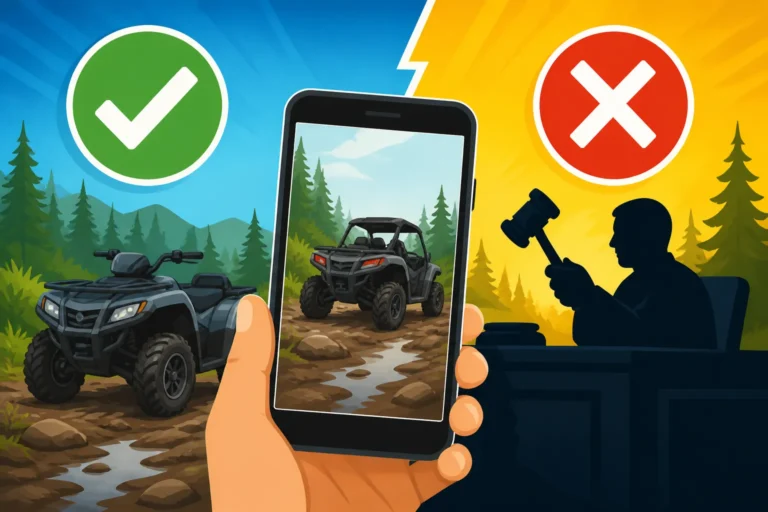
Equally important is carrying your registration certificate and proof of insurance with you whenever the machine is in operation, especially if there's any chance it will leave your strictly private land. The SAAQ registration certificate usually serves as proof of both registration and the mandatory liability insurance. While you might keep your physical documents in a waterproof pouch on the machine, a clear photo of them on your smartphone is often accepted by patrols in Quebec. However, it's always safer to have the physical copies. This practice is detailed further in [Quebec Insurance Proof on the Machine].
Common Misconceptions and Specific Scenarios
The idea that farm equipment is exempt from various regulations is common, but it's often applied incorrectly to ATVs and UTVs in Quebec. Let's tackle some of the prevalent misunderstandings and look at how specific situations play out for farm operators.
The "Farm Vehicle Exemption" Myth
One of the most persistent myths is that there's a blanket "farm vehicle exemption" for ATVs and UTVs, just as there are specific exemptions for farm tractors or implements that might operate on public roads. Unfortunately, for off-highway vehicles, this simply isn't the case in Quebec. While a tractor may have a special license plate (or none at all for certain uses) under different sections of the law, an ATV or side-by-side, even if used exclusively for agricultural tasks, is still classified as an off-highway vehicle under the LVHR. This means it's subject to the OHV registration rules, especially if it ever ventures beyond the absolute confines of your private farm property.
The only true "exemption" from SAAQ registration for an ATV or side-by-side is if it operates exclusively on private land, with no public access. If your machine is used, for example, to pull a small trailer of feed between barns on your own property, and never crosses a public road or enters a common area, then registration is not required. However, the moment it crosses that threshold, even for a short distance to get to a different part of your farm, the registration requirement kicks in. It's crucial to distinguish between a piece of farm machinery (like a combine) and a farm vehicle (like an ATV) that falls under [Quebec's VHR Vehicle Class].
Using a Quad on a Trapline or for Other Commercial Purposes
It's helpful to look at how similar commercial uses are treated. A trapper, for instance, often uses an ATV to access remote traplines, which might involve riding on Crown land, forestry roads, or even crossing federated trails. In such cases, the trapper's quad absolutely needs to be registered because it's operating in the public domain. The same principle applies to outfitters or any other business using an OHV for commercial purposes outside of strictly private property. The purpose of the ride (farm work, trapping, recreation) doesn't change the underlying requirement for registration when operating in areas accessible to the public. For more on this, you can look into [Quebec Registration for a Trapper's Machine].
What Happens If You're Caught Unregistered?
Ignoring the registration requirements, even for a farm machine, can lead to serious consequences. If a trail patrol officer or police officer stops you while operating an unregistered ATV or side-by-side on a public road, federated trail, or any other part of the public domain, you could face significant fines. Beyond the initial fine, the vehicle itself could potentially be seized.
But the financial penalties are often the least of your worries. The biggest risk is personal liability. Remember, SAAQ registration includes mandatory third-party liability insurance. If you're involved in an accident with an unregistered machine and cause injury to another person or damage to their property, you could be personally responsible for all the associated costs. This could easily amount to hundreds of thousands, or even millions, of dollars, without the SAAQ's coverage. This is why [Quebec Penalties for Riding Unregistered] are so severe – they reflect the seriousness of operating an uninsured vehicle in the public domain. The annual registration fee, while an added expense, is a small price to pay for that peace of mind and financial protection.
Here's a quick comparison of various farm quad use cases and their SAAQ registration requirements:
| Scenario | SAAQ Registration Required? | Key Reason |
|---|---|---|
| Quad used exclusively on private farm land, never leaves property | No | No operation in the public domain; no public access to the operating area. |
| Quad driven briefly across a municipal road to access another field | Yes | Any operation on a public road, even short distances, triggers the LVHR. |
| Quad used to patrol fences bordering a publicly accessible road | Yes | Operating on the public road allowance or shoulder constitutes public domain use. |
| Quad used to access a private woodlot via a federated ATV trail | Yes | Federated trails are part of the public domain, managed for OHV access. |
| Quad used by a farm employee for tasks that involve leaving private land | Yes | Employee operates in the public domain; machine must be registered and insured for third-party liability. |
| Quad always stays within clear, fenced, private farm boundaries | No | Confined entirely to private land with no interaction with public roads or trails. |
Disclaimer
This article is for general informational purposes only and does not constitute professional advice. Laws, prices and regulations vary by location and change over time. Consult a qualified professional for guidance on your specific situation.