Riding the 206-Kilometre Sugar Bushes Circuit
A 206-kilometre ATV ride can feel straightforward on a map and much more demanding once you add rough surfaces, trail closures, fuel stops, and changing weather. The Sugar Bushes Circuit offers a rewarding way to explore Quebec’s countryside, but a good day depends on planning the route as carefully as the ride itself. Here’s how to prepare, navigate, and ride it responsibly.
What to expect from the Sugar Bushes Circuit
A long ride through Quebec’s rural landscape
The Sugar Bushes Circuit is a named route associated with Quebec’s network of ATV trails and is described as 206 kilometres long. That distance makes it a substantial outing, not a quick spin before lunch. Even experienced riders can find that a full day’s progress changes with trail surface, stops, group size, and the pace of the least-experienced driver.
The name evokes one of Quebec’s most familiar rural landscapes: sugar bushes, forest edges, small communities, and working countryside. A route like this is part of the appeal of trail riding here. You’re not simply covering distance; you’re moving through a patchwork of land uses where trail access depends on permissions, local management, and respect for posted rules.
Treat the 206 kilometres as a route length, not a promise that every rider will finish it in a set number of hours. A group that stops often for photos, lunch, fuel, or mechanical checks may need substantially longer than a small group riding steadily. If you’re planning an overnight stay or meeting someone at a specific time, leave room for delays rather than building the day around an optimistic estimate.
Why route details need a fresh check
A route name and distance are useful starting points, but they don’t tell you everything you need to know for the day you ride. Trails can be temporarily closed, rerouted, or affected by weather and seasonal conditions. A route that appeared complete on an older map might not be passable in the same way when you arrive.
Before leaving, check the relevant club and trail-network information for current access, conditions, and any closures. Use a current map or navigation tool to understand the route and nearby options, but don’t treat any single digital map as a replacement for posted signs or official local updates. onX Offroad can help riders review mapped routes and track their position, while local trail information should guide decisions about whether a corridor is open.
Also confirm the exact route you intend to follow. A circuit name can be used in more than one map, guide, or trip plan, and a route may connect with other trail sections. Make sure your starting point, direction, and planned loop match the version you have reviewed. If the route differs between a map and a sign, stop somewhere safe and resolve the discrepancy instead of guessing at a junction.
For a broader look at how Quebec circuits fit into the regional trail network, see [Quebec Quad Circuits Worth Riding] and [Quebec's 25,000 Kilometres of Federated Trail].
Plan the route before you start
Decide whether you’re riding the full circuit
A 206-kilometre circuit is not automatically the right choice for every group. Think honestly about the slowest rider, the least familiar machine, and the time available. If someone is new to trail riding, recovering from a recent injury, or uneasy about a full day in the saddle, a shorter out-and-back or partial loop may make the trip more enjoyable for everyone.
Before setting off, agree on the plan in plain language. Identify the intended route, where the group expects to stop, and what you’ll do if a rider wants or needs to turn back. Don’t rely on a vague “we’ll see how far we get.” That can leave the group negotiating a decision when everyone is tired, daylight is fading, or the next junction is confusing.
Route length alone also doesn’t describe difficulty. The condition of the trail, recent rain, the amount of loose material, narrow sections, and the way the route crosses roads or developed areas all affect the experience. Review the available trail notes, then choose a plan that gives the group more than one safe option if conditions are harder than expected.
Build time for stops, navigation, and surprises
A useful itinerary includes more than riding time. Allow time to gather at the start, confirm everyone’s equipment, check maps, take breaks, and deal with ordinary delays such as a loose strap or a rider who needs a rest. A little spare time is also valuable if the group has to backtrack after a missed turn or wait for a trail to clear.
Choose meeting and turnaround points before departure where possible. Let someone who isn’t riding know your general plan and when you expect to check in. If you change your route substantially, update that person when practical. This is simple trip planning, but it matters more on a long ride than on a short local loop.
Use a map that can be checked offline if mobile coverage is unreliable along your intended route. onX Offroad may be useful for viewing your planned track and keeping an eye on your location, but download or save what you need before leaving areas with a strong connection. Carry a backup way to navigate, such as a paper map or another prepared route, and know how to read it without relying on a live data signal.
| Planning question | What to decide before departure |
|---|---|
| Route | Confirm the correct circuit, direction, and planned start point |
| Time | Allow for breaks, slower sections, and possible delays |
| Fuel | Check the machine’s practical range and identify verified fuel options |
| Conditions | Review current trail updates, closures, and local notices |
| Navigation | Prepare an offline map and a backup navigation method |
| Group plan | Agree on regrouping points and what to do if someone turns back |
| Return plan | Set a realistic latest return time and tell someone your itinerary |
Prepare your ATV or side-by-side
Check the machine for a full day on the trail
A machine that feels fine on a short ride may reveal problems after hours of vibration, dust, mud, and changing terrain. Before the trip, check the basics: tires, wheels, brakes, steering, lights, fuel, and visible leaks. Follow the machine maker’s maintenance guidance, and don’t assume a quick look at the tires is enough if they have been losing pressure or showing damage.
Pack any model-specific items you may need, such as a spare drive belt if appropriate for your machine and tools you know how to use. Include a basic tire repair kit, a compact air source, and practical recovery equipment suited to your machine and riding conditions. Equipment only helps if someone in the group knows how to use it safely. If you don’t, learn the basics before a remote ride rather than trying to figure them out under pressure.
For a side-by-side, check seat belts, doors or nets, and cargo tie-downs. Keep loose items secured so they cannot shift into the controls or fall from the vehicle. For an ATV, check that luggage is balanced and firmly attached without blocking lights or interfering with the rider’s movement. Don’t overload the machine or use a rack as a substitute for a proper passenger seat.
Pack for people as well as machines
Bring water, food, weather-appropriate layers, and basic first aid. A warm or dry start can turn chilly after a long period of riding, especially if the weather changes or the group stops for an extended time. Gloves and a spare layer are small items that can make the last part of the ride much more comfortable.
Keep essential items accessible rather than buried under cargo. A phone, map, small first-aid kit, water, and any required documents should be easy to reach without unloading the vehicle at every stop. Protect electronics from rain and dust, and don’t count on a phone battery lasting all day if you are using it for navigation. A power bank can help, but it should not be the only backup plan.
Before departure, make sure everyone knows the group’s basic procedures. Decide how riders will signal a problem, where the group will stop if it becomes separated, and who will stay with an injured or disabled rider. On a long circuit, a calm, agreed-upon response is better than several people heading in different directions to look for someone.
For practical ideas on gearing up for longer rides, see [Packing for a Multi-Day Ride] and [Carrying a Spare Belt on a Long Circuit].
Ride safely and respect trail access
Follow signs, local rules, and posted closures
Quebec trail access is not a blanket permission to ride anywhere. Federated trails, roads, private property, and other land have different rules and conditions. Follow signs at every junction, stay on the authorized corridor, and don’t assume that a visible track is open just because another vehicle has used it.
Road access can be limited and may depend on signage and local authorization. A route may include a legal crossing or a specifically authorized road section, but that does not mean riders can use any road they encounter. Stop and check the signs before crossing, follow the indicated route, and never improvise a road connection because a trail appears to end. For details on the legal framework and road access, consult [Quebec ATV Road Rules Under the LVHR] and [Quebec Road Signage for Quad Routes].
A posted closure deserves the same respect as a blocked bridge or unsafe trail. Closures can protect riders, property, and the people who maintain the route. Don’t ride around a barrier, enter a corridor marked closed, or rely on a track recording from a previous trip as proof that access is allowed today. Check current conditions before departure and again when local signage indicates a change.
Keep the group comfortable and predictable
Ride at a pace that gives everyone time to react. On a narrow or unfamiliar section, keep enough space between machines to avoid dust, sudden braking, or debris kicked up by the rider ahead. Avoid riding so close that the person in front has no room to stop safely.
Regroup at agreed points rather than stopping unpredictably in a tight corner or where another rider cannot see you. If someone falls behind, the group should slow down or stop at the next safe place according to the plan. A lead rider and a sweep rider can help keep a larger group together, but they need to agree on their roles before the ride starts.
Be especially considerate near homes, cottages, farms, and trail users travelling in the opposite direction. Slow down when visibility is limited, keep noise under control, and give others room to pass. Trail access depends on goodwill as well as formal permissions; careless riding near residents or landowners can undermine the route for everyone.
Make fuel, navigation, and weather part of the plan
Treat fuel range as a practical limit
Don’t plan fuel stops based on a best-case estimate from a short ride. Fuel use can change with terrain, speed, load, tire pressure, machine condition, and frequent stops and starts. A side-by-side carrying passengers and equipment may use fuel differently from a lightly loaded ATV. Check your machine’s real-world range under conditions similar to the planned ride.
Confirm that a fuel stop is actually available and accessible to the route before relying on it. A business may have different hours, access may change, or the proposed stop may be a detour from the circuit. If the route is remote, plan with a reserve rather than arriving at a fuel point with the gauge nearly empty. Carrying extra fuel can add flexibility, but it must be stored and secured safely in an appropriate container.
Agree on a group fuel plan. If one machine has significantly less range than the others, the entire group needs to plan around it. Don’t leave a rider behind to search for fuel alone, and don’t pressure someone to continue past a sensible refill point just to keep the schedule.
Prepare for weather and trail changes
Weather can change the feel of a long ride quickly. Rain may make a familiar section slippery, reduce visibility, and increase the effort required to keep a group together. Dry, dusty conditions can also make it harder to see the rider ahead. Check the forecast before departure, but keep watching actual conditions as the day unfolds.
Choose clothing that works across the likely range of conditions and bring a way to keep essential items dry. If rain, wind, heat, or poor visibility makes the route uncomfortable or unsafe, shorten the ride or stop at a safe location. Finishing the planned circuit is not more important than getting the group back without an avoidable incident.
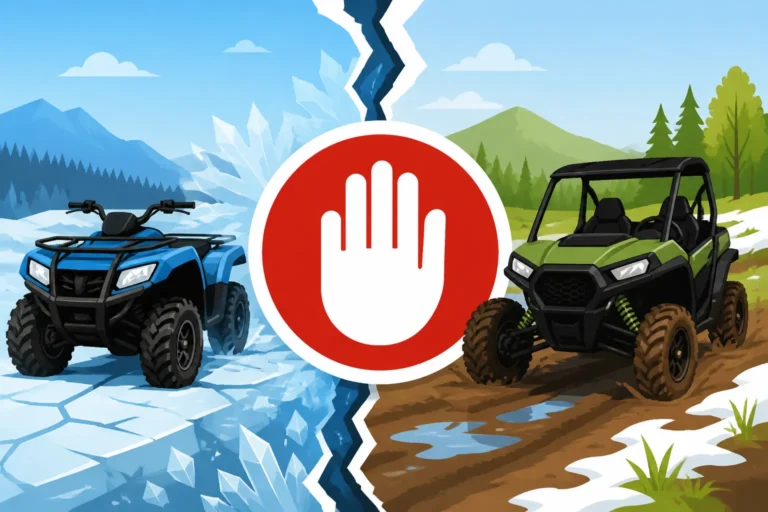
Spring conditions deserve particular care. Thaw periods and wet trails can lead to closures or fragile surfaces that are easily damaged by vehicle traffic. A route that was open on a previous visit may be closed when conditions change. Check [Quebec's Spring Thaw Closure] and [Quebec Trail Conditions Before You Go] as part of your planning, then obey local signs even if your navigation app still displays the trail.
Keep the ride enjoyable from start to finish
Make the circuit work for your group
A good trip plan balances the distance with the people riding it. For a group with mixed experience, set a comfortable pace and let the newest rider ask questions without feeling rushed. If the group is large, agree on a lead and sweep rider, a consistent regrouping routine, and a way to communicate when machines are noisy or riders are spread out.
Don’t let the goal of completing all 206 kilometres turn the day into a test. If a machine develops a problem, a rider is tired, or the group loses time, choosing a shorter return route can be the sensible choice. Build that flexibility into the plan before anyone is under pressure to make a decision.
For a first visit, keep the itinerary conservative. You can learn how the group handles the surface, navigation, and stops, then plan a longer day next time. Riders who already know each other’s pace and machines may be able to plan more confidently, but they still need to respond to the conditions in front of them.
Leave the route in good shape for the next rider
Stay on the marked trail and avoid creating new tracks around mud, obstacles, or a closed section. Going off-route can damage vegetation, disturb property, and create access problems for the club or landowner. If a section appears unsafe or badly damaged, stop where it is safe and report the problem through the appropriate local trail channel rather than widening the trail with repeated attempts.
Pack out everything you bring in, including food wrappers, broken straps, and disposable items. Keep noise down near residences and respect gates, barriers, and private property. These habits may seem small during a single ride, but trail access is built on many people behaving responsibly over time.
Before heading home, check that no one is missing equipment, personal items, or required papers. Give your contact person a quick update if your schedule changed. A short post-ride check also helps you catch damage, low tire pressure, or maintenance needs before the next outing.
A successful Sugar Bushes Circuit ride is not just about reaching the end of a 206-kilometre route. It’s about choosing a realistic plan, staying alert to current trail conditions, and leaving the corridor as welcoming as you found it. For more route-planning ideas, explore [Planning a Route on the Interactive Map] and [Quebec Trail Etiquette Locals Expect].
Disclaimer
This article is for general informational purposes only and does not constitute professional advice. Laws, prices and regulations vary by location and change over time. Consult a qualified professional for guidance on your specific situation.