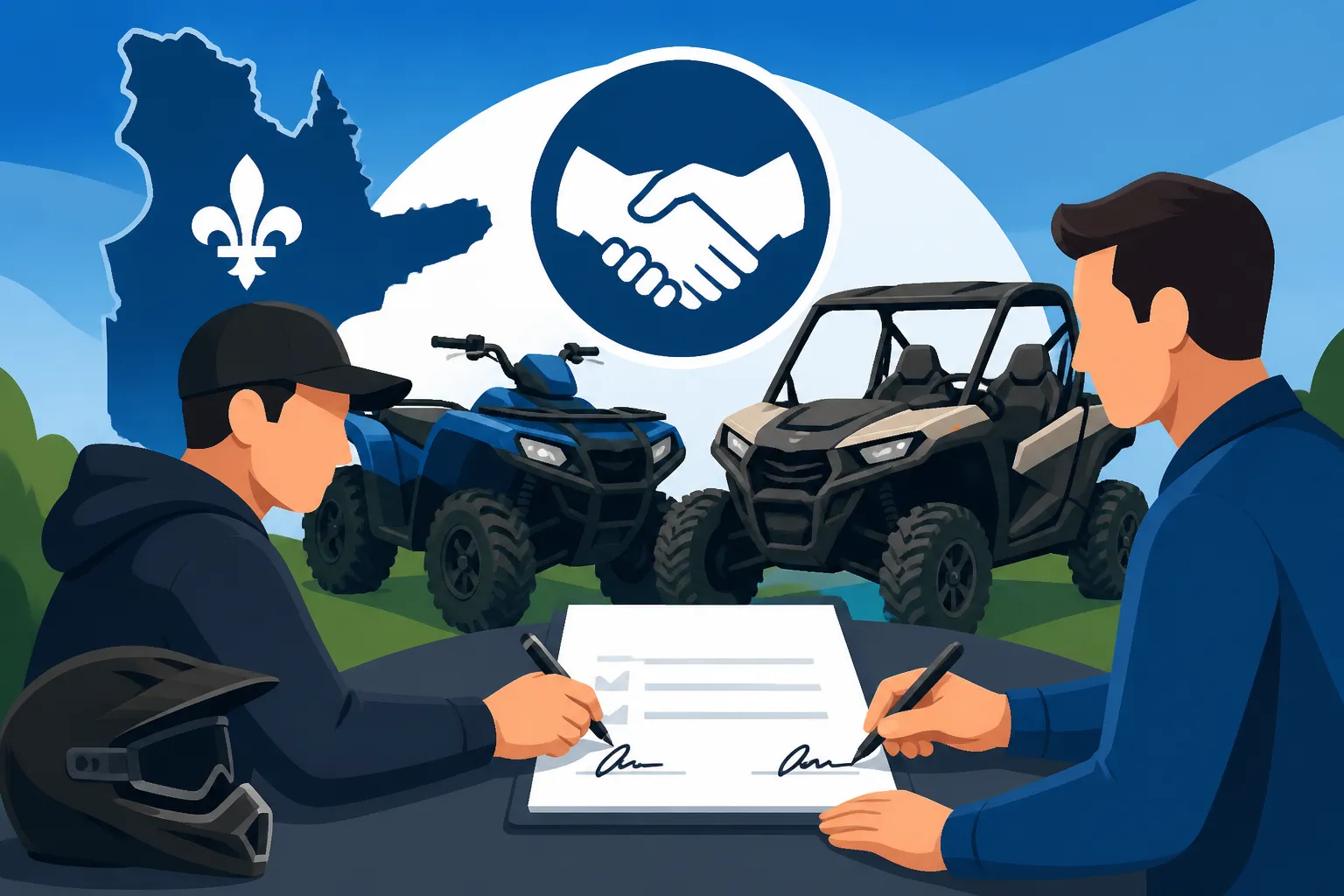
Paperwork Two Individuals Sign on a Private Sale
Buying or selling an ATV or side-by-side privately in Quebec can feel like navigating a legal jungle, especially when it comes to making sure all your ducks are in a row with the paperwork. You're trying to get a good deal or make a fair sale, and the last thing you want is a nasty surprise from the SAAQ or a legal headache down the road. This guide is here to walk you through the absolutely essential documents that two individuals need to sign and exchange during a private sale, ensuring a smooth transfer of ownership and peace of mind for both parties.
Why the Right Paperwork Matters in a Private Quebec ATV Sale
When you're dealing with a private sale of an off-highway vehicle (OHV) in Quebec, it's not just about shaking hands and exchanging cash. There are specific rules, and the SAAQ (Société de l'assurance automobile du Québec) is quite particular about how these transfers happen. Skipping steps or missing crucial documents can lead to significant problems, from an inability to register the machine to potential legal disputes.
Protecting Yourself as a Buyer
Imagine you've just bought a shiny new-to-you quad from a private seller, and you're stoked to hit the trails. You head to the SAAQ only to find out the machine has a lien against it, meaning the previous owner still owes money on it, or worse, it's been reported stolen. Without the right paperwork, you could be out your hard-earned cash and left with a machine you can't legally register or ride. A properly executed bill of sale and the seller's original [Quebec Registration Transfer After a Sale] certificate are your shields against these kinds of nightmares. They prove that you lawfully acquired the machine and protect you from inheriting someone else's problems. If the SAAQ can't verify ownership, they won't issue you a new registration, and your new toy will be nothing more than an expensive paperweight.
Protecting Yourself as a Seller
On the flip side, as a seller, you want to make sure that once your ATV leaves your driveway, you're no longer responsible for it. Picture this: you sell your quad, the buyer takes off, and a week later, you get a speeding ticket in the mail or, heaven forbid, a notice about an accident. If the ownership hasn't been properly transferred in the SAAQ system, you could still be on the hook for fines, insurance claims, or other liabilities. That's why having a signed, dated, and comprehensive bill of sale is crucial. It clearly states the date and time of the transaction, effectively passing responsibility to the new owner. This documentation also ensures the SAAQ has a clear record that you are no longer the owner, preventing future headaches and ensuring your liability ends when the machine changes hands.
Essential Documents the Seller Needs to Provide
When you're buying an ATV or side-by-side from a private seller in Quebec, there are a few non-negotiable documents that the seller must provide you with. These aren't suggestions; they are critical for you to be able to legally register the machine in your name and avoid any future grief.
The SAAQ Registration Certificate (Proof of Ownership)
This is the big kahuna, the most important piece of paper you’ll exchange. The SAAQ registration certificate is essentially the vehicle's "title" in Quebec. It clearly lists the machine's details (make, model, year, VIN/serial number) and, crucially, the name of the current registered owner. As a buyer, you need the original certificate from the seller. A photocopy simply won't cut it for the SAAQ. You'll often find a section on the back of this certificate specifically for private sales, where the seller signs to transfer ownership.
What if the seller tells you they've lost it? This is a red flag, but not necessarily a deal-breaker if handled correctly. The seller is responsible for obtaining a duplicate from the SAAQ before the sale. Do not proceed with the sale if they don't have the original or a valid duplicate in hand. Insist on it, because without it, you cannot complete your own [Quebec ATV Registration With the SAAQ]. Always confirm that the name on the certificate matches the seller's identification.
Proof of Identity and Address
While not strictly a document to be "signed over" for the sale, the seller absolutely needs to provide proof of their identity and address. This means a valid driver's license or another piece of government-issued identification. As the buyer, you should carefully compare the name and address on their ID to the information on the SAAQ registration certificate and the bill of sale. This step is vital in preventing fraud. You want to be certain you are buying the machine from its legal owner. If there's any discrepancy, ask for clarification. If the seller can't provide matching, legitimate identification, walk away. Verifying the seller's identity is a basic but powerful safeguard against buying a stolen vehicle or getting involved in a fraudulent transaction.
Lien Search (Optional but Highly Recommended)
A lien is a legal claim against an asset, like an ATV, typically to secure a debt. If the previous owner financed the machine and hasn't paid it off, the bank or lender might have a lien on it. If you buy a machine with a lien, you could potentially become responsible for that debt, or the lender could repossess the ATV, even though you paid for it! It's a terrifying thought.
While the seller isn't always legally required to provide a lien search to you, as a buyer, you should always insist on one, or perform one yourself. You can usually do this through services that search the Quebec Register of Personal and Movable Real Rights (RDPRM). This small investment can save you thousands of dollars and immense stress down the line. A clean lien search report confirms that there are no outstanding debts tied to the machine. Never assume; always verify. This step is crucial for understanding [Quebec Registration and Lien Records] associated with your potential purchase.
Crafting a Solid Bill of Sale for a Quebec ATV Private Sale
The bill of sale is the foundational document of your private ATV transaction. While the SAAQ registration certificate proves who was the owner, the bill of sale proves who is the owner after the transaction. It's more than just a receipt; it's a legal contract that protects both buyer and seller.
What Must Be Included in a Quebec Bill of Sale
A comprehensive bill of sale should leave no room for ambiguity. Here's a breakdown of what absolutely needs to be in there:
- Full Legal Names and Addresses of Both Parties: This means the complete names (as they appear on IDs) and current residential addresses of both the buyer and the seller. This ensures clear identification of who is involved in the transaction.
- Detailed Machine Description: Don't just write "a quad." Include the make, model, year, colour, and most importantly, the Vehicle Identification Number (VIN) or serial number. This unique identifier links the bill of sale directly to the specific machine being sold. Double-check that the VIN on the bill of sale matches the VIN on the machine itself and the SAAQ registration certificate.
- Purchase Price: Clearly state the agreed-upon price in Canadian dollars. This is not only for transparency but also helps the SAAQ calculate the provincial sales tax (QST) when the buyer goes to register.
- Date of Sale: The exact date the transaction takes place is critical. This marks the moment ownership (and associated liability) officially transfers from seller to buyer.
- Signatures of Both Parties: Both the buyer and the seller must sign the bill of sale. This signifies their agreement to the terms outlined. Ensure the signatures look consistent with other identifying documents.
- "As-Is" Clause (Recommended for Sellers): Most private sales are "as-is," meaning the buyer accepts the machine in its current condition with no warranties from the seller. Including a clear "sold as-is, where is, with no warranties expressed or implied" clause can protect the seller from future claims about mechanical issues that arise after the sale.
- Statement of Ownership: A declaration by the seller that they are the legal owner of the ATV and have the right to sell it, and that it is free of all liens and encumbrances (unless explicitly stated otherwise).
For crafting this document, you don't need a lawyer, but you shouldn't just scribble something on a napkin either. Reputable online legal document services like LawDepot offer customizable bill of sale templates that are tailored to provincial requirements. Using such a template ensures you don't miss any critical details and creates a professional, legally sound document. This level of detail is essential for [Buying From a Private Seller in Quebec].
The Importance of a Witness (and Why It's Often Skipped)
While not a legal requirement in Quebec for a bill of sale to be valid, having a neutral third-party witness present during the signing can add an extra layer of security and verification. A witness can confirm that both parties signed willingly and that the details of the transaction were agreed upon. In the rare event of a dispute down the road, a witness's testimony can be invaluable.
However, in the hustle and bustle of a private sale, especially if it happens quickly or in a rural setting, finding a witness can be difficult, and many people skip this step. If you can't have a witness, ensure every other aspect of the bill of sale is meticulously filled out and agreed upon by both parties. Take photos of the signed documents and the machine (including its VIN) at the time of sale. This digital record, while not a replacement for a witness, can offer some additional peace of mind.
Handling Sales Tax in a Private Transaction
One common point of confusion in private sales is how sales tax works. As a buyer, you need to understand that the seller does not collect sales tax from you. Instead, you, the buyer, will pay the Quebec Sales Tax (QST) directly to the SAAQ when you go to register the ATV in your name.
The SAAQ will calculate the QST based on the higher of two values: either the selling price declared on your bill of sale, or the SAAQ's estimated value for that particular make, model, and year of ATV. This is to prevent people from declaring a ridiculously low sale price to avoid tax. So, while you'll state the actual purchase price on your bill of sale, be prepared for the SAAQ to use their own valuation if it's significantly higher. It's a key part of [Quebec Sales Tax on an ATV Purchase] and [Quebec Tax on a Private ATV Sale]. Don't be surprised by this calculation; factor it into your budget when considering a private purchase.
After the Paperwork is Signed: What's Next?
So, you've got the SAAQ registration certificate in hand, a thoroughly completed and signed bill of sale, and you've exchanged funds. Congratulations! But the process isn't quite over. There are crucial next steps to ensure everything is legally concluded for both the buyer and the seller.
The Buyer's Immediate Responsibility
As the new owner, your very next step is to head to an SAAQ service counter to register the ATV in your name. This isn't something you can put off. Riding an unregistered ATV on trails or public lands in Quebec is illegal and can lead to hefty fines. You'll need to bring several key documents with you:
- The original SAAQ registration certificate signed by the seller.
- The completed and signed bill of sale.
- Your valid driver's license or other proof of identity.
- Proof of address if it's not on your driver's license.
At the SAAQ, you will pay the necessary registration fees for your [Quebec VHR Plates Explained] and the QST as discussed earlier. The SAAQ clerk will process the transfer, issue you a new registration certificate in your name, and provide you with your VHR plate. Make sure you don't try to register a machine [Quebec ATV Registration Without a Bill of Sale], as this will be impossible. This immediate action is vital to legally own and operate your new machine. Getting this done promptly protects you from potential legal issues and allows you to ride without worry. For a complete list, check [Documents to Bring to a Service Counter].
The Seller's Peace of Mind
For the seller, ensuring the SAAQ has recorded the change of ownership is paramount. While the buyer is responsible for initiating the transfer, a proactive seller can take steps to confirm it. You can often check the status of your vehicle registrations through your SAAQ online account a few days after the sale. If the machine still appears registered in your name, contact the SAAQ immediately to inquire about the transfer.
Also, once your machine is sold and no longer registered in your name, you should [Returning a VHR Plate After a Sale]. While you might keep it as a souvenir, returning it to the SAAQ ensures it's properly taken out of circulation and confirms the cancellation of that registration. This final step further solidifies that you are no longer associated with the machine and any liabilities.
Common Pitfalls to Avoid
Even with the best intentions, people sometimes fall into traps during private sales. Being aware of these common pitfalls can help you steer clear:
- Handwritten Notes Instead of a Formal Bill of Sale: While a simple note can be legally binding, it's far more prone to missing critical information, being misinterpreted, or lacking the weight of a professional document. Always use a proper bill of sale, perhaps a template from LawDepot, that includes all the necessary details.
- Not Verifying Seller's ID: Never, ever take someone at their word. Always compare the seller's government-issued photo ID with the name on the SAAQ registration certificate. Fraudsters often use stolen vehicles or identities.
- Leaving Blank Spaces on Documents: A blank space on a bill of sale or registration certificate is an invitation for someone to fill it in later, potentially changing the terms of the sale or the stated price. Ensure all fields are filled, even if it's with "N/A" if truly not applicable.
- Not Knowing About Existing Liens: As mentioned earlier, failing to perform a lien search can have devastating consequences for the buyer. It's an easy step that is often overlooked in the excitement of a purchase.
- Delaying Registration: For buyers, delaying registration at the SAAQ is a major mistake. Not only is it illegal to operate an unregistered machine, but it also means the previous owner could still be held liable for anything that happens with the ATV while it's technically still in their name. Get it done, and get it done quickly.
By understanding these common issues and being meticulous with every piece of paperwork, both buyers and sellers can ensure a smooth, legitimate, and stress-free private ATV transaction in Quebec. The time spent on paperwork up front is always less than the time spent unraveling a legal mess later on.
Disclaimer
This article is for general informational purposes only and does not constitute professional advice. Laws, prices and regulations vary by location and change over time. Consult a qualified professional for guidance on your specific situation.