Buying From a Private Seller in Quebec
Buying an ATV or side-by-side from a private seller in Quebec can feel like you've stumbled upon a hidden gem, a chance to get a fantastic machine without the dealer markup. But let's be honest, it often comes with a hefty dose of anxiety, wondering if you're missing a crucial piece of paperwork or if you're about to unknowingly inherit someone else's problems. This guide is here to walk you through the entire process, making sure you're confident and prepared to seal the deal on your next off-road adventure machine.
The Allure (and Pitfalls) of Buying Privately in Quebec
There's a natural appeal to buying a used ATV or side-by-side directly from its owner. You often hear stories of saving a few thousand dollars compared to a dealer, or finding that perfectly maintained, lightly used machine from a meticulous owner. For many, it feels like a more personal transaction, a handshake deal that cuts out the middleman. You might even find a model that's no longer in production but is exactly what you've been searching for.
However, the private sale landscape in Quebec, especially for off-highway vehicles (OHVs), is rife with potential pitfalls. Unlike a dealership that has a legal obligation to disclose certain information and handle much of the SAAQ paperwork, a private seller has fewer formal responsibilities. You're essentially on your own to verify the machine's history, ensure all documentation is correct, and navigate the transfer process. This can be intimidating, leaving many buyers feeling overwhelmed and worried about making an expensive mistake. The key is knowing exactly what to look for and what questions to ask.
Finding a good deal often means digging through local classifieds, online marketplaces, or even word-of-mouth recommendations from friends and fellow riders. It's exciting when you spot a machine that fits your budget and seems to be in great shape. But remember, the initial excitement needs to be tempered with a healthy dose of skepticism and a rigorous process of verification. A low price could be a genuine bargain, or it could be a red flag for hidden issues or missing paperwork that will turn your "deal" into a major headache down the line.
Navigating the Paperwork: Your Essential Checklist for Private Sales
When you're buying an ATV or side-by-side from a private seller in Quebec, the paperwork is your best friend and your primary defense against future problems. It might seem like a lot to keep track of, but each document plays a critical role in proving ownership, ensuring the machine is legal, and protecting your investment. Skipping steps here can lead to delays at the SAAQ, unexpected fees, or even discovering later that the machine isn't legally yours.
The Bill of Sale: Your Proof of Purchase
This is, without a doubt, the most important document in a private sale. A properly drafted bill of sale acts as your legal proof that you purchased the machine from the seller for an agreed-upon price on a specific date. It should clearly identify both the buyer and the seller, using their full legal names and addresses. Crucially, it must accurately describe the off-highway vehicle itself, including the make, model, year, and its unique Vehicle Identification Number (VIN) or serial number. Don't just jot it down on a napkin; get a formal document.
Many buyers and sellers find it helpful to use a template for this. You can find generic bill of sale templates online, or use services like LawDepot to generate a custom document tailored to your specific needs. This helps ensure all the necessary legal clauses are included, such as the statement that the machine is being sold "as is" or any specific warranties (though usually in private sales, it's "as is"). Both parties should sign and date the bill of sale, and it's a very good idea to have a witness present who can also sign, adding an extra layer of validity. Make sure you get the original signed copy, and the seller should keep a copy for their records too. This document is absolutely vital when you go to the SAAQ to register the machine in your name. For more details on what should be in this document, refer to [Paperwork Two Individuals Sign on a Private Sale].
Previous Registration Certificate
The seller should be able to provide you with the most recent registration certificate for the ATV or side-by-side from the SAAQ. This document proves that they are the legal owner of the machine. Compare the information on this certificate with the machine itself – especially the VIN/serial number. If the seller can't produce this, it's a massive red flag. It could indicate outstanding liens, a stolen machine, or that they aren't the rightful owner. Don't proceed without seeing this document and verifying its details.
The SAAQ registration certificate will have the seller's name and address matching their ID, and the vehicle information matching the machine you're looking at. This is critical for the transfer of ownership. If the names don't match, or if there's any discrepancy in the VIN, stop the transaction immediately and investigate further. Without a clear chain of ownership, you could run into serious trouble when trying to register the machine yourself. This links directly to [Quebec Registration and Proof of Ownership].
Proof of Identity for Both Parties
When you meet the seller, ask to see their valid government-issued photo identification, such as a driver's license. This allows you to verify that the name on the registration certificate matches the person selling the machine, and that they are who they say they are. Likewise, be prepared to show your own ID, as the seller might want to verify your identity as well. While not strictly required by law for the sale itself, it’s a crucial step for both parties to protect themselves from fraud and ensure a smooth transaction at the SAAQ.
If the machine has two owners listed on the SAAQ registration, make sure both individuals are present to sign the bill of sale, or that one has written, legally notarized authorization to act on behalf of the other. Failing to do so could mean you don't actually acquire full legal ownership, leading to complicated issues down the road. This also relates to [Quebec SAAQ Forms for a Private Sale], which will require correct owner information.
Liens and Encumbrances: Are There Outstanding Debts?
Before finalizing the purchase, it's crucial to check if there are any outstanding liens on the ATV or side-by-side. A lien means that another party (like a bank or finance company) has a legal claim to the machine because the seller used it as collateral for a loan. If you buy a machine with an outstanding lien, you could become responsible for that debt, and the lienholder could repossess your newly purchased machine!
You can check for liens through Quebec's Register of Personal and Movable Real Rights (RDPRM). You'll need the machine's VIN/serial number to perform this search. It's a small fee, but it offers immense peace of mind. Always insist that any outstanding liens be cleared by the seller before you hand over payment. Get written proof from the lienholder that the lien has been discharged. This step is often overlooked by first-time private buyers but is absolutely non-negotiable for your protection. The SAAQ might flag a lien during registration, causing significant delays, as discussed in [Quebec Registration and Lien Records].
Here's a handy checklist to keep track of the critical documents:
| Document | Buyer's Responsibility | Seller's Responsibility | Importance |
|---|---|---|---|
| Bill of Sale | Obtain signed copy | Provide and sign copy | Legal proof of purchase, essential for SAAQ registration. Can be drafted using resources like LawDepot. |
| SAAQ Registration Cert. | Verify details, keep copy | Provide original or copy | Proves seller's ownership, vital for transfer. |
| Proof of Identity | Show own, verify seller's | Show own, verify buyer's | Confirms identities match documents, prevents fraud. |
| Lien Check (RDPRM) | Perform the search | Disclose any existing liens | Ensures no outstanding debts on the machine that could transfer to you. |
| Previous SAAQ Plate | Bring to SAAQ (if applicable) | Remove before sale | Important for proper de-registration by seller and new registration by buyer. |
| Maintenance Records (Optional) | Review and keep | Provide (if available) | Gives insight into machine's history, condition, and care. |
The SAAQ Transaction: Making It Official and Avoiding Headaches
Once you've agreed on a price, done your due diligence, and gathered all the necessary paperwork, the next crucial step is to officially transfer ownership and register the ATV or side-by-side in your name at the Société de l'assurance automobile du Québec (SAAQ). This isn't just a formality; it's a legal requirement to ride your machine on federated trails or any public land where OHVs are permitted. Without proper registration and the mandatory liability insurance provided through the SAAQ, you're looking at potential fines and headaches if you encounter trail patrols.
Visiting the SAAQ: What to Bring
You and the seller should ideally go to an SAAQ service outlet together to complete the transfer. This allows for a smoother process, as any questions or discrepancies can be addressed on the spot. Make sure you bring:
- Your valid driver's license: The SAAQ needs to confirm your identity.
- The signed bill of sale: This is your core proof of purchase. Make sure it's complete and legible.
- The seller's previous SAAQ registration certificate: This helps the SAAQ clerk process the transfer efficiently.
- The Quebec ATV or side-by-side itself (optional but sometimes helpful): While usually not required, having the machine present or at least easily accessible can be useful if the SAAQ clerk needs to verify the VIN.
- Payment for registration fees and sales tax: Be prepared to pay the applicable Quebec Sales Tax (QST) on the purchase price, as well as the annual registration fee. The QST is calculated on the higher of the declared purchase price or the SAAQ's estimated value for the machine, to prevent under-declaration. For a full breakdown of the costs, check out [Quebec Sales Tax on an ATV Purchase] and [Quebec Tax on a Private ATV Sale].
When you arrive at the SAAQ, the seller will de-register the machine, returning their license plate. Then, you, as the buyer, will register it in your name, receive a new VHR plate, and pay the registration and tax. This ensures a clean break in ownership. If the seller can't come with you, they should still de-register the machine first. You would then present the bill of sale and their old registration certificate to register it yourself. This process is detailed further in [Quebec ATV Registration With the SAAQ] and [Quebec Registration Transfer After a Sale].
Understanding the Fees and Taxes
Quebec has specific rules about sales tax on private sales of vehicles, including ATVs and side-by-sides. You'll pay the Quebec Sales Tax (QST) at the SAAQ when you register the machine. The amount of tax is usually calculated based on the higher of two figures: the price you declared on the bill of sale, or the average wholesale value of the machine according to the SAAQ's valuation guides. This is a common point of frustration for buyers who feel they got a great deal only to have the SAAQ tax them on a higher "estimated" value.
In addition to the QST, you'll pay the annual registration fee. This fee includes the mandatory liability insurance provided by the SAAQ, which is a minimum of [Quebec Liability Minimum Rose to $1 Million]. It’s important to understand that this SAAQ insurance is liability-only; it does not cover damage to your own machine or injuries to yourself. You'll need to arrange separate private insurance for comprehensive coverage if you desire it. Be sure to understand [Quebec ATV Registration Costs Explained] before you go.
What if There's No Paperwork?
This is a scenario that can send shivers down any seasoned buyer's spine. What if the seller doesn't have a previous registration certificate, or the bill of sale is incomplete, or they claim it was lost? While it might be tempting to proceed if the deal is too good to pass up, acquiring a machine without proper documentation in Quebec is highly risky. The SAAQ requires clear proof of ownership to register any vehicle. Without it, you could end up with a machine you can't legally register or ride.
In situations where a seller claims to have lost the original registration, they should be able to obtain a duplicate from the SAAQ. If they refuse or are unable to do so, consider it a major red flag. If you are ever in doubt about the provenance of a machine, it's safer to walk away. The hassle, potential legal issues, and financial loss simply aren't worth the perceived savings. For more on this, check out [Quebec Machines With No Paperwork].
Protecting Yourself: Due Diligence Beyond the Paperwork
Even with all the right paperwork in hand, a private sale still requires you to be a diligent inspector. The beauty of an ATV or side-by-side lies in its ability to tackle rugged terrain, but this also means these machines can suffer significant wear and tear, or even hidden damage from previous rough rides or accidents. You need to do more than just kick the tires; you need a comprehensive inspection to ensure you're not buying a money pit.
Physical Inspection: What to Look For
Before you even talk price, give the machine a thorough visual inspection. Start with the frame: look for cracks, bends, or signs of welding that might indicate a major impact. Check the suspension components—shocks, A-arms, tie rods—for bends, leaks, or excessive play. Worn bushings are a common issue and can lead to sloppy handling. Examine the tires for uneven wear, which could signal alignment problems or frame damage.
Beyond the frame, inspect the engine for leaks (oil, coolant), listen for unusual noises during start-up and idle, and check the oil and coolant levels and condition. Pop the seat off and check the battery terminals for corrosion. Test all the lights, the horn, and the brakes. Make sure the steering feels tight and responsive, without excessive play. A test ride (if possible and safe to do so) can reveal a lot about the engine's performance, transmission shifting, and overall handling. Don't be shy; get down on your hands and knees and really scrutinize the machine. Bringing a knowledgeable friend can be invaluable here.
Verifying the VIN/Serial Number
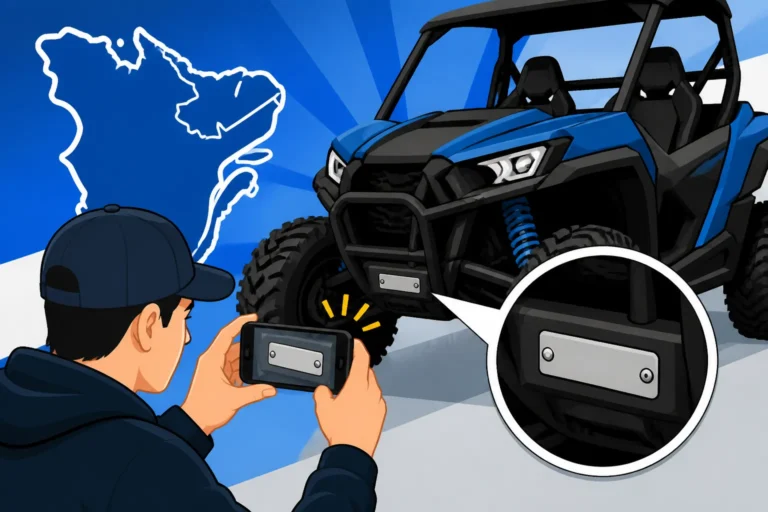
The Vehicle Identification Number (VIN) or serial number is the unique identifier for your ATV or side-by-side. It should be located on the frame, usually stamped into a metal plate or directly into the frame itself. Compare this number exactly to what's on the seller's registration certificate and the bill of sale. If there's any discrepancy, or if the VIN plate looks tampered with (e.g., re-riveted, painted over, scratched out), walk away immediately. This is a huge red flag that could indicate a stolen machine or one with a dubious past. Taking a photo of the VIN and comparing it is a smart move, as mentioned in [Photographing a Serial Number Before You Buy].
A match is non-negotiable for registration and for your own peace of mind. The SAAQ relies on this number to track ownership and ensure the machine is legitimate. If you try to register a machine with a VIN that doesn't match its documentation or shows signs of tampering, you could face serious legal repercussions and lose your investment.
Asking the Right Questions
Don't be afraid to grill the seller with questions. A reputable seller will be happy to answer them honestly. Ask about the machine's history:
- How long have they owned it?
- Why are they selling it?
- Has it ever been involved in an accident or rollover?
- What kind of maintenance has it received, and can they provide records?
- Where was it primarily ridden (trails, farm, mud)?
- Are there any known issues or quirks?
Also, inquire about any modifications made to the machine. Aftermarket parts or engine tuning can sometimes void warranties or affect reliability. Be wary of sellers who are vague, evasive, or seem overly eager to rush the sale. A smooth, transparent transaction benefits everyone involved. Even though you might be using a generic bill of sale from LawDepot, you can still add specific clauses or notes about disclosures made during this questioning phase.
Ultimately, buying from a private seller can be a fantastic way to find your next Quebec ATV or side-by-side, but it requires careful preparation and a keen eye for detail. By focusing on meticulous paperwork, understanding the SAAQ process, and performing thorough inspections, you can navigate the private sale landscape with confidence and ride off into the Quebec trails with peace of mind.
Disclaimer
This article is for general informational purposes only and does not constitute professional advice. Laws, prices and regulations vary by location and change over time. Consult a qualified professional for guidance on your specific situation.