First Aid on a Remote Circuit
A minor injury can become a serious problem when your group is hours from a road, cell service disappears, and the trail back is rough. A remote Quebec ATV or UTV circuit calls for more than a first-aid kit: you need a plan for preventing injuries, giving basic care, and getting help when someone cannot ride out safely.
Plan for an Injury Before You Leave
Share a route and a realistic return time
Before setting out, tell someone who is not riding with you where you plan to go, who is in the group, and when you expect to be back. Include your planned trailhead, route or circuit, and any alternate route you might take if conditions change. “We’re riding near Charlevoix” is not enough for someone trying to work out where you could be.
Your plan should also name the person who will notice if you are overdue and what they should do next. Agree on a check-in time, leave a reasonable buffer for mechanical problems or trail delays, and ask your contact to follow up if you miss it. If you change your route, update that person while you still have service.
A downloaded map can help riders stay oriented, but it is not a rescue plan by itself. If you use onX Offroad or another mapping app, download the route and relevant map area before leaving service, and check that your phone can display them offline. Carry a separate power bank and, where appropriate, a paper map or other backup. Apps can help you describe your location; they cannot guarantee that rescuers can reach you or that you can send a message from a dead zone.
Build a communication plan for areas without service
Do not assume a phone will connect from every trail, valley, wooded stretch, or remote staging area. Check for service before you leave, but plan as though you may have none once you are underway. Depending on the route and your equipment, a satellite messenger or satellite communicator may offer a way to send an emergency message outside ordinary cellular coverage. Learn how it works before the ride, keep it charged, and carry it where you can reach it after a fall.
Decide who will use the communication device and what the group will do if that person is injured. Keep emergency contacts and useful details—such as your route, machine descriptions, and the location of your vehicle—available to the person managing the trip. If you cannot send a message, a clear location description from a downloaded map, trail sign, junction, or kilometre marker may help when you reach a place with service.
Planning routes through recognized corridors and checking conditions before riding can reduce confusion when the group needs to turn around or report an incident. Guides such as Quebec Trail Maps and the iQuad App and Quebec Trail Conditions Before You Go can help you think through navigation and trail information. Whatever tools you use, agree on a simple rule: if a rider is hurt, the group stops, assesses the situation, and does not split up casually.
Choose the right people and ride within the group’s limits
A first-aid kit is only useful if someone knows how to use it. For a remote trip, it is worth having at least one rider with current first-aid and CPR training, and making sure the rest of the group knows where the kit is and how to summon help. Training helps people stay calmer and work through the basics, but it does not turn a trail rider into a medical professional. When an injury looks serious, prioritize getting professional help.
Talk about the group’s experience, fitness, machines, and comfort level before choosing a route. A long circuit that feels manageable to experienced riders can become a difficult evacuation when someone is injured, the weather turns, or a machine breaks down. Leave room in the schedule for rest, food, and unexpected delays instead of planning to finish at the edge of daylight.
For an unfamiliar area or a complicated route, consider whether a guide, local club information, or a more conservative circuit would make the day safer. Quebec Group Ride Planning and Quebec Trail Difficulty Ratings are useful topics to review when choosing a route that fits the whole group, not just its most confident rider.
Pack and Prepare for Basic First Aid
Carry a kit suited to ATV and UTV riding
A compact kit is better than a large one that stays buried under luggage. Store it in a known, accessible place, protect it from water and dirt, and tell everyone where it is. Check supplies before the season and again before a longer ride. Replace items that are used, damaged, expired, or no longer clean.
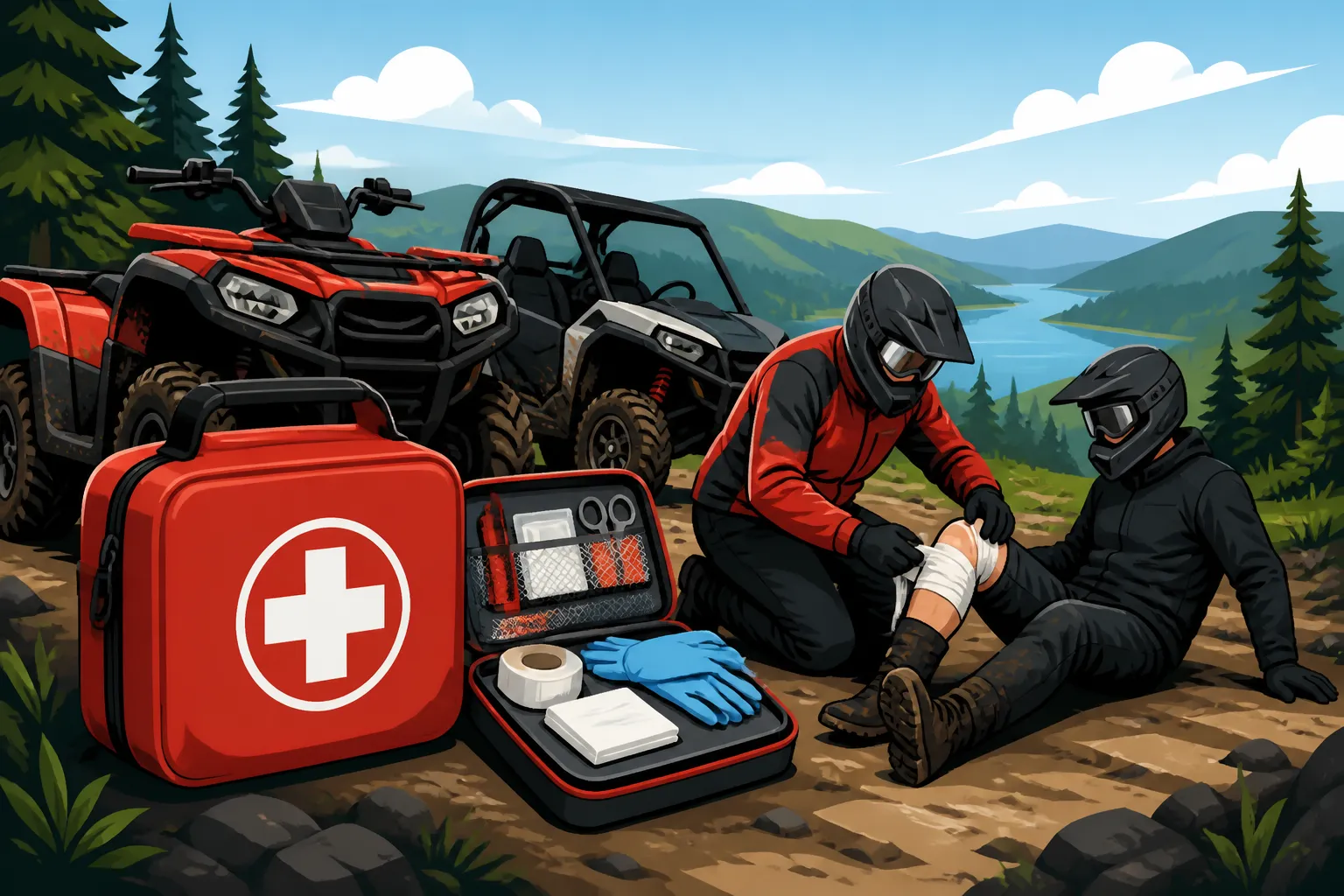
For a remote circuit, a practical kit may include disposable gloves, gauze pads, roller bandages, adhesive dressings, medical tape, antiseptic wipes, a pressure dressing, blunt-tip scissors, tweezers, a triangular bandage, and a thermal blanket. Add personal medication and any essential supplies specific to someone in the group. Pack water and basic food separately; a first-aid kit does not replace what you need to manage a long delay.
| Preparation item | Why it matters on a remote ride |
|---|---|
| Gloves and dressings | Help protect the injured person and manage small wounds |
| Pressure dressing and gauze | Useful for controlling bleeding while help is arranged |
| Thermal blanket and dry layers | Help reduce heat loss during a long stop |
| Personal medication | Covers needs a shared group kit may not address |
| Charged phone and power bank | Support navigation and communication when service is available |
| Satellite communication device, where suitable | May provide a way to send an emergency message beyond cellular coverage |
| Offline route and backup map | Help the group explain its location if it needs assistance |
| Water, food, and rain protection | Make an unexpected wait more manageable |
Pack only items you understand how to use. A sealed kit full of unfamiliar equipment can be less helpful than a smaller kit paired with training. For medical concerns, follow the instructions you were taught and seek professional care when needed.
Dress for changing weather and a long stop
A rider who is comfortable while moving can become cold quickly after a crash, especially if clothing is wet, the wind is strong, or the person cannot move normally. Bring a dry insulating layer and rain protection that can be reached without unloading the entire machine. Keep a warm layer in a waterproof bag, and think about how you will protect an injured person from wind and wet ground while waiting.
Helmet, eye protection, gloves, boots, and appropriate riding gear help reduce exposure to common trail hazards. They do not prevent every injury, but protective equipment can matter when a rider is thrown, struck by branches, or caught in changing conditions. Check that everyone’s gear fits and is in usable condition before the ride, not at the first trail junction.
Hydration and rest matter too. Tired or overheated riders may make poorer decisions, and a group that pushes through fatigue is more likely to have a preventable incident. Plan stops, carry water where it can be reached, and be willing to shorten the route if someone is struggling. The goal is not to complete the circuit at any cost.
Respond Safely When Someone Is Hurt
Stop the ride and check for immediate danger
When a rider goes down, stop the group in a safe place and make sure other machines are not creating another hazard. Turn off engines where appropriate, watch for traffic or unstable ground, and put on gloves before giving care if they are available. One person should stay with the injured rider while another takes responsibility for contacting help or finding a reliable way to do so.
Check whether the person responds and appears to be breathing normally. If they are unresponsive, having trouble breathing, bleeding heavily, or showing signs of a serious injury, treat it as an emergency and seek professional help immediately. Use your first-aid training and follow instructions from emergency dispatch or a medical professional. Do not delay a call or message while attempting a complicated treatment beyond your training.
If there is heavy bleeding, use firm, direct pressure with a clean dressing while someone arranges help. If a wound is serious, do not probe it or remove an object stuck in it. If the person may have a head, neck, or back injury, avoid moving them unless staying where they are presents an immediate danger. These are general first-aid principles; the circumstances and local emergency guidance matter.
Keep the person warm, calm, and still
After the immediate danger is addressed, help the rider stay as comfortable and still as you can. Shield them from rain and wind, use dry layers or a thermal blanket, and reassure them in a calm voice. Avoid giving food or drink to someone who is seriously injured, confused, very drowsy, or may need urgent medical care. Do not leave the person alone simply because the rest of the group is eager to ride for help.
A suspected fracture or painful limb should not be pulled into place. Support it in the position found, as your training allows, and avoid unnecessary movement. A rider who seems alert can still have a significant injury, so do not use “they say they’re fine” as the only reason to send them back onto a machine. Pain, dizziness, nausea, confusion, weakness, or worsening symptoms deserve serious attention.
For a possible head injury, watch for changes in alertness, confusion, repeated vomiting, unusual behaviour, or worsening pain. Do not let the group dismiss concerning symptoms because the rider can speak or stand. If there is any doubt about the severity, arrange professional assessment rather than relying on a long, rough ride back as a test.
Decide whether the group can safely move
Not every injury means the same response. A small scrape may be manageable with basic care, while a suspected spinal injury, serious head injury, major bleeding, breathing problem, or loss of consciousness calls for urgent professional help. When you are unsure, err on the side of getting medical advice. A remote location makes an early call more important, not less.
Do not put an injured rider on a machine just to get them off the trail if movement could make the injury worse. If the person is stable and the injury is minor, the group may be able to return slowly with a companion, but the rider should not be pressured to continue. Consider the terrain, remaining distance, weather, daylight, and whether someone can accompany them without leaving others in an unsafe position.
If the group must seek help in person, keep the decision deliberate. Identify who stays with the injured rider, who goes, and what communication equipment remains behind. Avoid sending a lone rider away without a clear destination and plan. On a remote circuit, keeping the group organized is part of first aid.
Get Help and Manage the Ride Out
Give rescuers useful location details
When contacting emergency services, explain what happened, how many people are involved, the injured person’s condition, and what help is needed. Give your location as clearly as possible: a trail name or number, nearby junction, sign, bridge, kilometre marker, coordinates from a mapping tool, or a recognizable landmark. Mention that you are on an ATV or UTV route and describe any access difficulty you know about.
If you are using onX Offroad or another offline mapping app, check whether you can read or share your position before you ride; a phone without service may still show a stored map location, but it may not be able to send it. If you have satellite communication, follow its instructions and keep the device available for further messages. Do not assume a message has gone through until you receive confirmation.
A caller may be asked to remain available, guide responders from a meeting point, or provide updates. Keep the line open if instructed and conserve phone battery when possible. If you have to move to get reception, make sure someone stays with the injured person and that the person seeking help knows how to return.
Keep the rest of the group safe
An emergency can tempt people to rush, take an unfamiliar shortcut, or separate without a plan. That can create additional injuries and make the rescue more complicated. Assign simple roles: one person stays with the injured rider, one manages communications, and another helps keep the remaining riders together. Adapt those roles to the number of people and the seriousness of the situation.
Keep other machines and gear clear of the access route if help may be arriving. If a rider is stable and a controlled return is appropriate, move at a pace everyone can manage and stop if symptoms worsen. Never let embarrassment, schedule pressure, or the cost of a long day persuade someone to conceal a serious injury.
After the incident, contact the person who had your route plan and let them know what has changed. Once everyone is safe, record basic details while they are still clear: where it happened, the trail conditions, what equipment was involved, and any gear that needs replacing. The group can review the route and preparation later, without blaming the injured person.
Learn from the incident before the next circuit
A short debrief can reveal a practical fix. Perhaps the first-aid kit was difficult to reach, the group’s route was too ambitious, a phone battery ran down, or no one knew who was carrying the communication device. Fixing one of those gaps before the next trip can make a real difference.
Review your kit after every ride, even if it was not used. Restock supplies, recharge devices, and confirm that downloaded maps and emergency contacts are available. If a piece of equipment was unfamiliar or difficult to use under pressure, consider training or replacing it with something simpler.
Remote riding will always involve some uncertainty, but a careful plan makes a bad moment less chaotic. Choose a route that suits the group, communicate the plan, carry supplies you understand, and know when an injury is beyond basic first aid. For related preparation, see Packing for a Multi-Day Ride, First Aid on a Remote Circuit, and Quebec Cell Coverage on Remote Trails.
Disclaimer
This article is for general informational purposes only and does not constitute professional advice. Laws, prices and regulations vary by location and change over time. Consult a qualified professional for guidance on your specific situation.