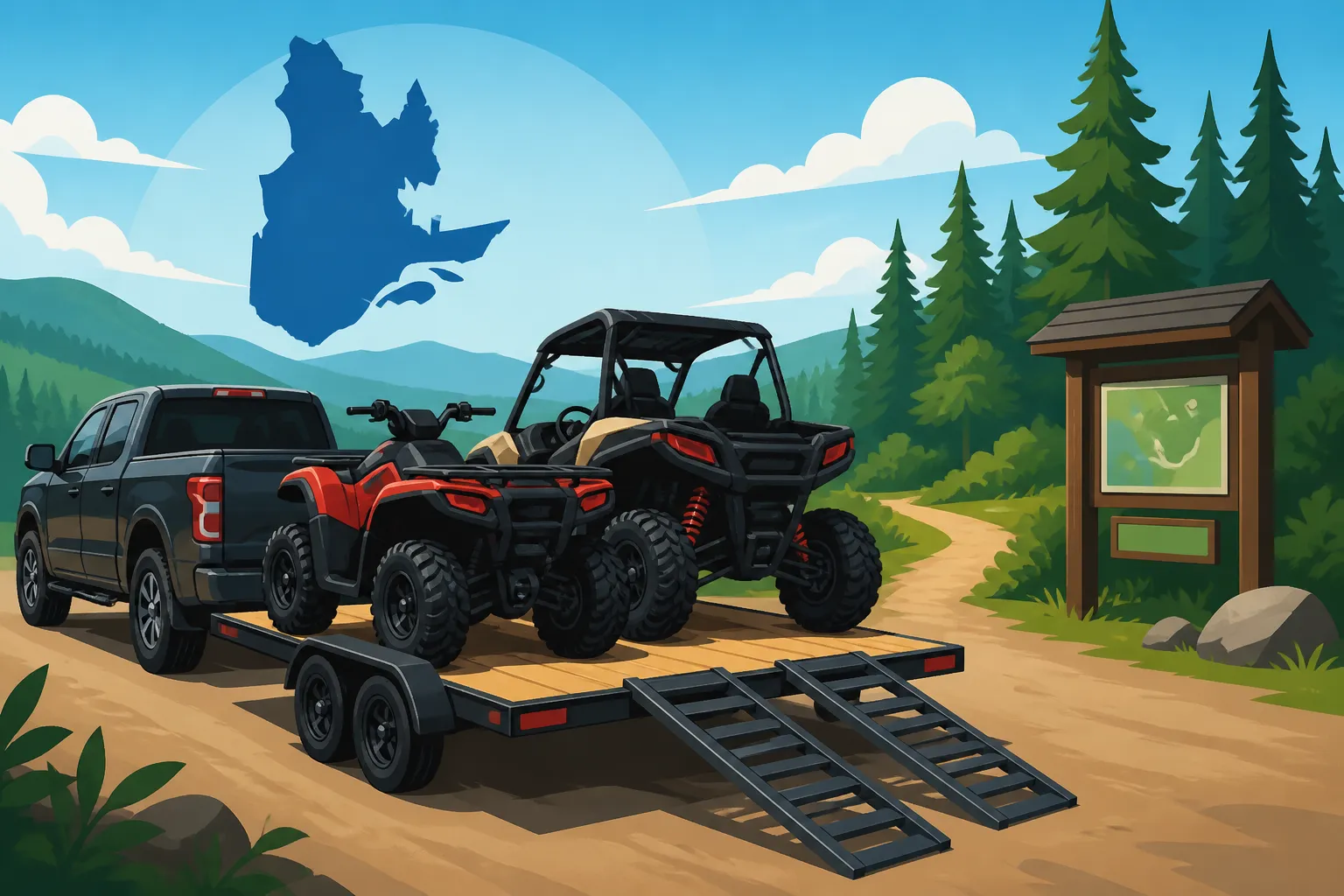
Trailering to a Regional Trailhead
Trailering an ATV or UTV to a Quebec trailhead can turn into a frustrating start if the parking area is full, the access road is unsuitable for your truck and trailer, or the trail is closed when you arrive. This guide walks through how to plan the drive, secure your machine, choose a suitable place to unload, and check the essentials before riding.
Plan the route and confirm the trailhead
Choose a trailhead that fits your whole vehicle combination
A parking lot that can accommodate a car may not be practical for a pickup towing a long trailer. Before setting out, consider the full length and turning radius of your truck and trailer, the room needed to reverse, and whether there is space to unload without blocking traffic or other riders.
Look for information about designated parking, access roads, gates, and any restrictions on overnight parking. A narrow entrance, steep gravel approach, or tight turnaround can be difficult with a loaded trailer, especially in poor weather. If a trailhead’s layout is unclear, contact the local club, municipality, or land manager rather than assuming there will be room to manoeuvre.
The network in regions such as the Laurentians, Charlevoix, and Chaudière-Appalaches can involve different trail access points and local conditions. Use a designated access point where possible, and check Quebec Trailheads With Parking before choosing a starting location. Don’t park on a shoulder, block a gate, or use an informal clearing unless parking is clearly allowed there.
Check current access, closures, and trail conditions
A mapped trail is not automatically open for riding. Seasonal closures, spring thaw restrictions, hunting activity, construction, weather damage, and local land-access changes can all affect a planned route. Check the relevant club’s updates and trail information shortly before departure, not only when you first plan the trip.
For federated trails, confirm that your intended route is open and that your documents and trail pass are in order. A trail pass is not permission to ignore a closure or ride outside the authorized corridor. See Quebec Trail Conditions Before You Go and Quebec’s Spring Thaw Closure when planning around changing conditions.
Digital maps can help with orientation, but treat them as one part of your planning. The iQuad app and club information can help you follow Quebec’s trail network. onX Offroad may be useful as a supplementary mapping tool for organizing a route or saving reference points, but don’t assume a line shown in any mapping app is an authorized trail or a substitute for local closure information. Download what you need before leaving reliable cell coverage, and bring a backup plan for navigation.
Check the parking plan for groups and overnight stays
A group arriving in several vehicles can quickly fill a small lot, even when each trailer seems manageable on its own. Agree on a meeting point, arrival order, unloading area, and a plan for moving vehicles after the machines are off the trailers. If you’re coordinating a larger outing, Where to Stage a Group of Eight offers a useful planning angle: think about vehicle space and safe circulation, not just the number of riders.
If the plan includes leaving a truck and trailer overnight, confirm that the location allows it. Ask about access hours, overnight restrictions, and whether the lot is used by other visitors. Don’t leave fuel cans, riding gear, or valuables visible in a parked vehicle, and avoid blocking snow-removal or maintenance access.
Prepare the ATV, UTV, and trailer for the drive
Match the trailer to the machine and towing vehicle
Before loading, check the tow vehicle’s capacity and the trailer’s rated capacity. The combined weight of the trailer, machines, fuel, tools, and other cargo matters; a trailer that looks large enough may still be overloaded. If you carry more than one machine, account for the load as a whole and distribute weight according to the trailer and vehicle manufacturers’ guidance.
Think through the machine’s dimensions as well. A long UTV may need a different ramp arrangement and tie-down position from a compact ATV. Confirm that the ramps are rated for the machine, sit securely on the trailer, and provide a stable loading angle. Avoid loading on soft ground or on a slope if a flatter, firmer area is available.
A simple pre-trip check can prevent an unpleasant roadside problem:
- Inspect the hitch, coupler, safety chains, and electrical connection.
- Check that trailer lights and signals work.
- Inspect tires for damage and appropriate inflation.
- Confirm that the trailer load is within its rated capacity.
- Secure ramps, tools, spare tires, and loose equipment.
- Recheck the hitch and load after travelling a short distance.
Your vehicle and trailer manuals are the right reference for weight limits, hitch setup, and towing procedures. If you’re unsure whether the combination is suitable, resolve that before loading rather than trying to compensate with extra straps or a slower drive.
Secure the machine and protect vulnerable parts
Use tie-down equipment rated for the load, and attach it to appropriate points on the machine and trailer. The goal is to prevent movement forward, backward, and sideways. Straps should be snug, routed so they won’t rub against sharp edges, and positioned so they don’t compress or damage vulnerable components. Avoid fastening to parts that are not designed to serve as tie-down points.
For a UTV, secure the vehicle using its designated anchor points and ensure doors, cargo, and accessories are latched. For an ATV, check that handlebars, racks, and added equipment cannot shift or snag a strap. If the machine has a winch, don’t rely on the winch alone to hold it in place; use suitable tie-downs as well.
After driving a short distance, stop somewhere safe and inspect the straps, hitch, and load. A strap can loosen as suspension settles or cargo shifts. Check again during longer drives, especially after rough pavement, a sharp turn, or a sudden stop. Carrying an extra strap is sensible, but it should be a backup—not a reason to use damaged or unsuitable tie-down gear.
Keep gear organized for arrival
It’s easy to arrive at a busy trailhead and discover that the helmet is buried under fuel cans or the registration papers are in a bag inside the cab. Pack with unloading in mind: keep riding gear accessible, separate dirty equipment from clean clothing, and secure tools so they don’t slide around during the drive.
Bring the documents and equipment you expect to need on the trail, and check that they apply to the machine you’re bringing. Registration, insurance proof, and a trail pass serve different purposes. Review Quebec Registration Before Your First Ride and Quebec Trail Pass Proof on the Trail rather than assuming one item covers every requirement.
For a longer outing, build a checklist based on the trip instead of loading every tool you own. Packing for a Multi-Day Ride can help you think through gear beyond the trailer itself, including practical items for remote sections and changing weather.
Unload safely and get ready to ride
Set up a safe unloading area
Choose a firm, level spot where the trailer can be parked without obstructing other vehicles or trail users. Apply the parking brake, follow the trailer manufacturer’s guidance for stabilizing the trailer, and keep bystanders clear of the loading path. If the trailhead is crowded, wait for a safer opening instead of unloading into a traffic lane or beside a blind entrance.
Before moving the ATV or UTV, check that the ramp is aligned, properly secured, and suitable for the machine’s weight. Keep the route from trailer to staging area clear of people, loose straps, and gear. Move slowly and deliberately. If visibility or footing is poor, ask a capable helper to guide from a safe position without standing directly behind the machine or in its path.
Once unloaded, move the machine out of the way before organizing bags and equipment. This small step helps keep the access area usable for the next person and reduces the chance of a vehicle or trailer blocking the entrance while you prepare.
Complete a machine and document check before leaving
After unloading, walk around the machine and look for anything that may have shifted during transport. Check for loose straps or cargo, inspect tires, and make sure the machine is operating normally. Put the trailer ramps away and secure them before leaving the parking area.
Confirm that the documents and trail access requirements are in place for each rider and machine. Quebec trail use can involve separate obligations for the vehicle and for access to a federated trail. Read Quebec Trail Passes Cover Every Club and Quebec’s Off-Highway Vehicle Act and Your Papers for related details, and check local trail information for any route-specific requirements. Requirements can differ depending on where you ride, so don’t rely on a friend’s setup as proof that your own is complete.
Before starting, make sure everyone in the group knows the planned route, regrouping points, and what to do if someone falls behind. Save the route or relevant map information offline if you use a phone for navigation. onX Offroad can be an additional planning reference, but compare its information with official trail and club updates. Keep the device charged and accessible, and don’t let a phone map distract the driver while riding.
Make the drive home part of the plan
Recheck the trailer before leaving the trailhead
Mud, leaves, and gear can make it harder to spot a strap that is twisted or a latch that isn’t fully closed. Before loading, clear the trailer deck and inspect the ramps, tires, and tie-down points. Load the machine in a way that follows the trailer’s weight-distribution guidance, then secure it and check that nothing can shift during the return drive.
Do a final walk-around: confirm the hitch connection, safety chains, electrical plug, lights, ramps, and cargo. Check that fuel containers and tools are properly secured and that the parking area is clear of anything you brought. If you’re travelling as a group, agree on where to stop and recheck loads so nobody feels pressured to rush out of the lot.
Leave the access point as you found it
A trailhead is shared space, not an extension of a private garage. Keep noise and idling to a minimum, take all garbage with you, and leave room for other trailers to turn around. Don’t drive the ATV or UTV outside the authorized access route just to reposition it or find a more convenient place to load.
Respect posted signs and any instructions from the trail club or land manager. If you notice a damaged sign, blocked access, or unsafe parking condition, report it through the appropriate local channel instead of trying to move barriers or improvise a new route. Staying on the authorized corridor matters both for safe riding and for keeping access available to others. Staying on a Federated Corridor explains why following the marked route is important.
A little planning makes trailering to a Quebec regional trailhead much less stressful: confirm that the access point is suitable, check local trail status, secure the load carefully, and leave room for others when you arrive. It also gives you a better chance of starting the ride calmly, with the paperwork and gear you need close at hand.
Disclaimer
This article is for general informational purposes only and does not constitute professional advice. Laws, prices and regulations vary by location and change over time. Consult a qualified professional for guidance on your specific situation.