Quebec Thaw Closures in Early May
Early May can look like riding weather in Quebec: the snow has mostly disappeared, the sun is out, and the trails may seem firm from the road. But thawing ground can turn soft beneath the surface, and a quad or side-by-side can leave deep ruts that take months to repair. This guide explains why closures happen, how to check conditions, and what to do when your usual route is still closed.
Why Quebec ATV trails close during the spring thaw
The ground can be soft even when it looks dry
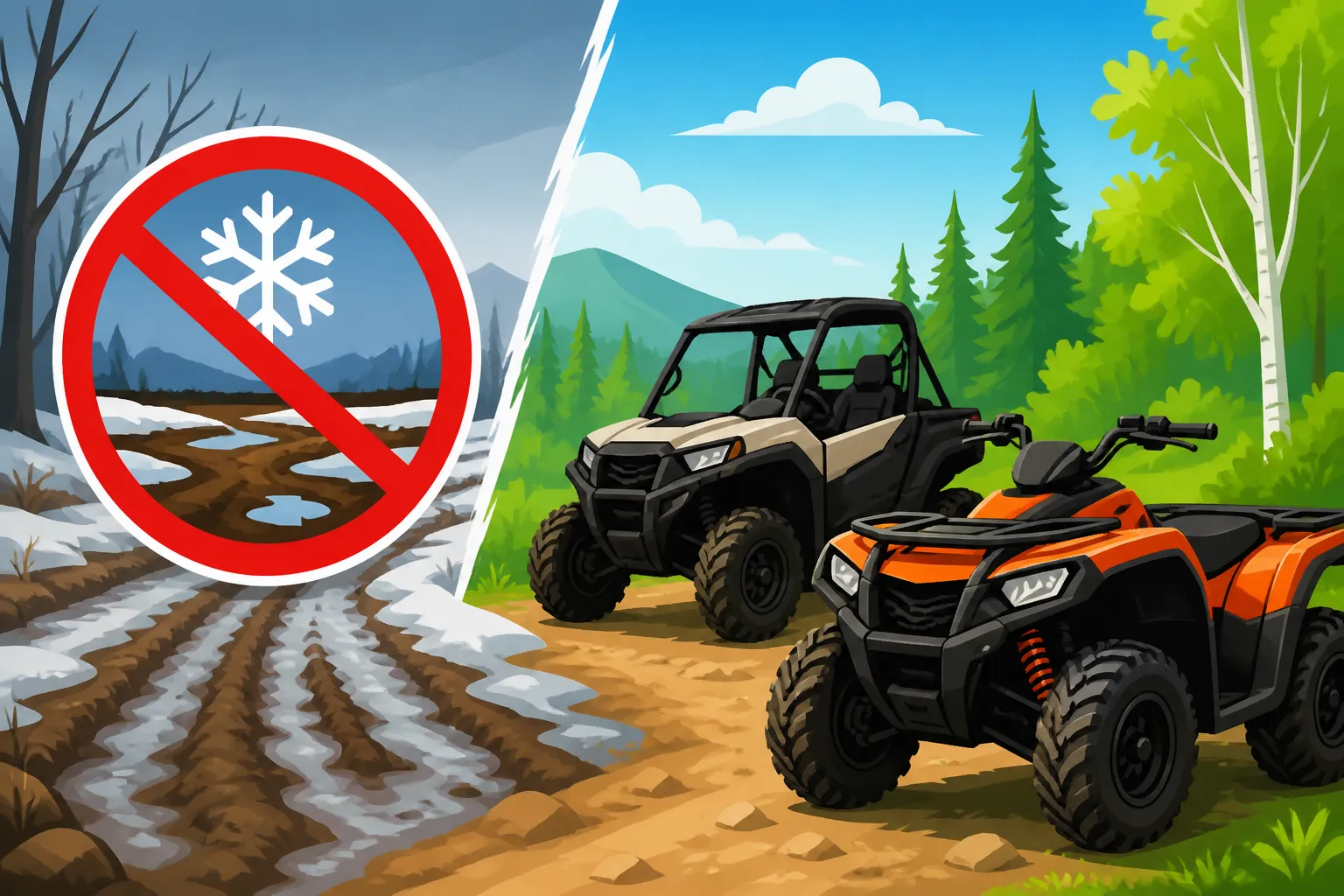
In spring, the top layer of soil may dry before the ground underneath has thawed completely. That mix can be deceptively fragile. A trail that seems solid at the entrance may become soft farther along, especially in shaded woods, low-lying areas, or places where snowmelt collects.
When a heavy machine travels over that surface, its tires can dig into the trail and leave ruts. Those ruts may channel water, worsen erosion, and make the route rougher or harder to maintain later in the season. Damage can also spread when riders try to steer around a muddy patch and widen the trail edge.
The conditions are not the same everywhere. A sunny, well-drained section near a village may be firm while a wooded section nearby remains saturated. That is one reason a trail reopening in one area does not mean every trail in Quebec is ready for traffic. Clubs may assess separate sections and reopen them at different times.
Closures protect trails, not just the riding surface
A spring closure is a way to give trails time to dry and become strong enough to support traffic. It can protect the trail base, drainage features, bridges, and the surrounding land. It also helps reduce the repair work clubs and volunteers would otherwise face once regular riding begins.
The closure period can feel frustrating, especially if you have been waiting all winter to take your machine out. It may seem like a trail should be usable because the snow is gone. But snowmelt, rain, shaded ground, and local soil conditions all affect how quickly a route becomes rideable. A few warm afternoons do not necessarily mean the trail has dried through.
Quebec has both established club trails and other routes with different access arrangements. Do not assume that a route is open simply because it appears on a map or because you have ridden it in another season. For background on how spring restrictions affect riding access, see [Quebec's Spring Thaw Closure] and [Quebec Passes and the Thaw Period].
Early May is a planning window, not a guaranteed start date
For many riders, early May is when they begin checking for the season’s first openings. It is better to treat it as a time to monitor conditions than as a dependable kickoff date. Reopening depends on the trail’s condition and on decisions made for the specific area. Weather can also change quickly: a stretch of dry weather may be followed by rain that leaves low sections soft again.
That variation matters if you are planning to trailer to a distant trailhead or have arranged a group ride. A route that was open during your last check may be affected by a later closure or a new condition notice. Before committing to a long drive, check the latest information for the exact trails you intend to ride.
How to check whether a trail is open
Check the club or trail network before leaving home
Start with the organization responsible for the route. Trail-status information may come from a local club, a regional trail network, or the Fédération Québécoise des Clubs Quads. Look for updates that identify the specific trail or sector, rather than relying on a general statement that “the trails are open.”
If you are planning a ride around the Laurentians, Charlevoix, the Eastern Townships, or another region, check the local information for that area. Conditions can differ between nearby routes, so an update for one trail is not proof that a connecting trail is open. If a notice is unclear, contact the club or operator responsible for the section before riding.
A map is useful for planning, but it is not always a live status board. The [Quebec Trail Maps and the iQuad App] can help with route planning, while club updates and posted closure information are important for confirming whether you can ride a particular section. You can also use onX Offroad to help review route options and organize a trip, but do not treat a mapping app as permission to ride or as confirmation that a trail is currently open.
Understand what the map can and cannot tell you
A route line on a digital map can show where a trail is generally located, but it may not communicate a temporary closure, a washout, a detour, or a change in access. Even when an app displays a route, the landowner or trail organization may have closed it since the map data was last updated.
Use maps to prepare, then verify conditions through the relevant club or official trail-status channel. If you use onX Offroad to compare route options, check each segment against current local notices. Keep a downloaded map available if you expect limited cell service, but remember that offline access helps with navigation; it does not replace a current closure check.
Also pay attention to signs at trail entrances and junctions. A closure sign on the ground takes priority over your planned route. Do not ride around a barrier, follow tracks through a closed section, or assume a closure only applies to vehicles other than yours. If you encounter conflicting information, stop and clarify before continuing.
Use this quick check before a spring ride
| What to check | Why it matters | What to do |
|---|---|---|
| Local club or trail status | Closures may apply to specific sections | Check the notice for your exact route |
| Recent weather | Rain can soften trails that had been drying | Recheck after significant rain |
| Trailhead signs and barriers | Conditions may have changed since your online check | Follow posted restrictions |
| Map route details | A mapped line may not show temporary closures | Confirm access with the responsible organization |
| Pass and machine requirements | An open trail still has riding requirements | Review [Quebec Trail Pass Proof on the Trail] and relevant riding rules |
If your plan depends on a connection between two routes, verify both sections. A single closed link can change the whole day’s itinerary. Build in a fallback plan, such as a shorter ride on a confirmed-open route or postponing the trip.
What to do when your route is still closed
Do not ride around a barrier or onto a closed trail
It is tempting to think that one careful pass will not make a difference, especially if the trail looks mostly dry. But a closure is there because the route is not ready or access is not permitted. Riding around a barrier can damage the very section the closure is meant to protect, and tire tracks left by one rider can encourage others to follow.
If you arrive at a closed entrance, turn around and choose a confirmed-open alternative. Do not use a nearby private lane, field, or forestry road as a substitute unless you have permission and know that motorized access is allowed. A route that looks like a continuation of the trail may cross private property or have separate rules.
For more on why a pass does not override a closure, read [Your Pass Is No Use During the Spring Thaw]. It is also worth understanding the consequences and practical risks described in [Riding a Closed Trail Anyway]. The simplest way to avoid a disappointing or damaging start to the season is to confirm access before unloading your machine.
Choose a flexible alternative
If the trail network in your preferred area remains closed, you can still make the day useful without pushing onto a wet route. Consider postponing the ride, shifting to a confirmed-open area, or using the time to prepare the machine and gear for the season.
For a group ride, tell everyone that the route is conditional until the final status check. Agree on a backup plan before meeting at the trailhead, so nobody feels pressured to continue just because they have already driven a long way. If you are travelling with friends from different parts of Quebec, designate one person to confirm the status of each section and share the update before departure.
Some routes may operate under different access arrangements, but that does not mean they are automatically open during thaw season. Always confirm the rules with the landowner or operator. A trail described as open year-round can still be affected by temporary restrictions, weather, or local conditions; see [Quebec Trails Open Year-Round] for context, and verify the route before riding.
Make a practical spring readiness check
A spring outing is a good reason to inspect your ATV or UTV after storage. Check the tires for damage, confirm that the brakes and lights work, and look for leaks or loose parts. Make sure your registration, insurance information, and any required trail pass are in order. If the route is open, also consider whether the conditions suit your machine and your experience.
Pack for changing weather. Early-season rides can begin chilly and become warmer later in the day, while wet sections can leave riders and equipment muddy. Bring basic tools, water, and a way to communicate if you become separated from your group. If you are travelling where cell coverage may be limited, share your route and expected return time with someone who is not riding with you.
Keep the ride considerate once trails reopen. Stay on the marked corridor, avoid widening muddy spots, and follow local signs. The advice in [Quebec Trail Etiquette Locals Expect] is useful throughout the season, but it matters especially when clubs are trying to protect trails after a difficult spring.
A better way to plan around thaw closures
Build your schedule around confirmed access
Instead of choosing a date first and assuming your favourite trail will be open, choose a region with alternatives and check status close to departure. This is especially helpful for riders making a longer trip from Montreal, Quebec City, or another distant starting point. A short status check can save a day of travel to a closed trailhead.
If you are organizing a weekend, keep the first day flexible. Avoid promising a specific route until you have checked the local updates. A confirmed-open option may be less ambitious than your original plan, but it is better than riding a closed section or arriving with no workable alternative.
onX Offroad can be part of your route-planning routine when you want to compare possible routes or keep navigation information handy. Use it alongside local trail-status updates, not in place of them. For early-season riding, an up-to-date closure notice is more important than a route line that looks convenient.
Be patient with changing conditions
A closure can feel like a small inconvenience when the weather finally turns pleasant. For clubs and riders, though, waiting for a trail to dry can prevent much bigger problems later. If you come across a closed section, respect it, report unclear signage or obvious damage to the responsible club, and check again before your next trip.
Early May is a good time to prepare, follow local updates, and make a realistic plan. The most enjoyable start to the season is not necessarily the first possible ride; it is a ride on a route that is open, suitable, and ready to handle traffic.
Disclaimer
This article is for general informational purposes only and does not constitute professional advice. Laws, prices and regulations vary by location and change over time. Consult a qualified professional for guidance on your specific situation.