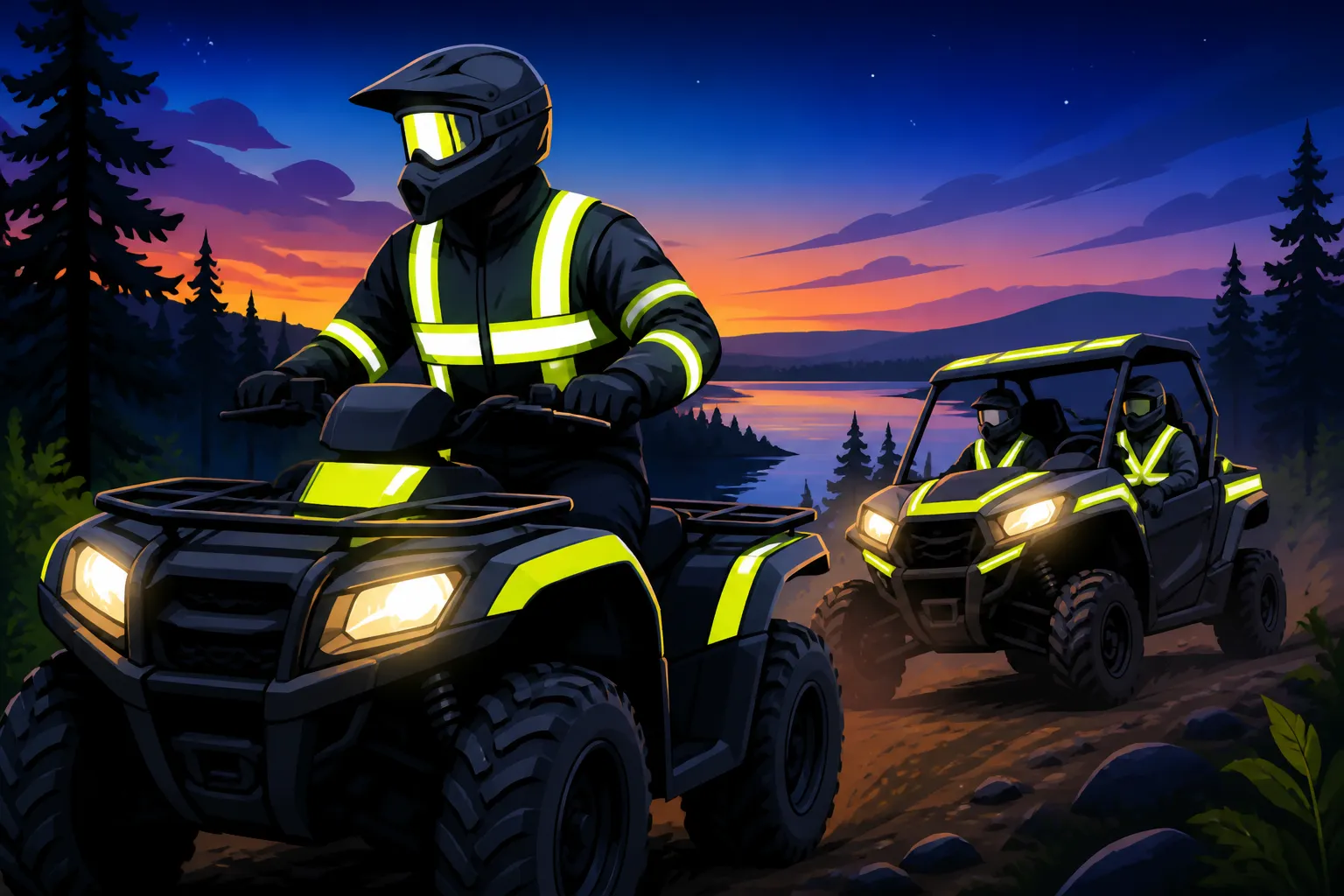
Reflective Gear on an Evening Ride
As the golden hour fades and dusk settles over Quebec's vast forests and winding trails, the sheer beauty of the landscape can be breathtaking. Yet, for ATV and UTV riders, this transition from daylight to darkness brings a critical challenge: visibility. It's incredibly difficult for other trail users, motorists, or even wildlife to spot you when the light is low, dramatically increasing the risk of accidents. This guide is designed to help you understand the importance of reflective gear, detailing what you need and how to use it effectively to ensure your evening rides in Quebec are safe and worry-free.
The Unseen Hazards of Low-Light Riding in Quebec
Riding an ATV or UTV in Quebec as evening approaches is an experience many cherish, but it's vital to acknowledge the inherent dangers that come with reduced visibility. It's not just about seeing where you're going; it's about being seen by everyone else sharing the environment, whether on a remote trail or a short legal stretch of road. The provincial regulations, designed for safety, emphasize the importance of being properly equipped, especially when riding outside of peak daylight hours.
Why Being Seen is as Important as Seeing
Think about driving a car at night: headlights illuminate your path, but taillights and side markers ensure others know where you are. On an off-road machine, this principle is even more critical. Your machine might have factory lights, but these are primarily for illuminating the path ahead, not for making your entire profile visible from all angles. Oncoming traffic, whether it's another quad, a snowmobile on a shared winter trail, or a motorist during a legal road crossing, needs ample warning of your presence. Without adequate reflective materials, your machine and rider profile can simply blend into the darkening background, especially against trees or shadowed terrain. This drastically cuts down reaction time for others, which can be the difference between a close call and a serious collision.
Moreover, visibility isn't just about preventing collisions with other vehicles. It's also crucial for rescue situations. If you find yourself in an emergency after dark, whether due to a breakdown or an injury, reflective gear can significantly aid search and rescue teams in locating you. A small, subtle reflection can catch the beam of a flashlight or a spotlight from a helicopter, guiding help directly to your position much faster than if you were completely unlit. It's a layer of passive safety that works for you even when you're stationary or unable to signal for help actively.
Legal Requirements for Night Riding
Quebec's Off-Highway Vehicle Act (LVHR) has specific requirements for operating off-road vehicles after dark or in conditions of reduced visibility. While many focus on headlights and taillights, the spirit of the law extends to overall visibility. For instance, [Quebec Lighting Requirements at Night] clearly outline the minimum lighting standards for your machine. However, reflective gear complements these requirements by enhancing your passive visibility. It acts as a safety net, reflecting light from external sources, like headlights from another vehicle, back to the source, making you stand out long before they might spot your active lights. Ignoring these regulations or the broader principles of visibility can lead to fines and, more importantly, put you and others at unnecessary risk.
Consider the practical implications. If you're on a multi-day trip and the evening ride stretches longer than planned, or if unexpected fog rolls in, your reliance on good reflective gear becomes paramount. While [Quebec Riding Hours From 6 a.m. to Midnight] give you a generous window, conditions within those hours can vary wildly. A trail patrol officer performing [Quebec Equipment Checks by Patrols] might not fine you for lack of reflective tape if your lights are working, but they'll certainly appreciate – and often recommend – the added safety measure. It shows you're a responsible rider who takes safety seriously, contributing positively to the overall riding community.
Essential Reflective Gear for Rider and Machine
When we talk about reflective gear, it's not just a single item. It's a system that works together to maximize your visibility from all angles. This includes elements on your person, your clothing, and directly on your ATV or UTV. The goal is to create a conspicuous profile that can be seen by light sources from any direction, giving others ample time to react.
High-Visibility Clothing and Accessories
The easiest and often most effective way to boost your visibility is through your riding attire. Many modern riding jackets, pants, and helmets come with integrated reflective piping or panels. If yours doesn't, or if you want extra protection, there are plenty of options. A high-visibility vest in neon yellow or orange with reflective strips is a game-changer. These vests are lightweight, easy to throw over any gear, and relatively inexpensive. They make your upper torso, which is often the highest point of your moving body, instantly noticeable. Helmets are another prime location; adding reflective decals to the front, back, and sides significantly enhances head-on and rear visibility, which is crucial as your head moves independently of the machine.
Beyond vests and helmets, consider reflective accents on your gloves and boots. Even small patches can make a difference, especially when signaling or when your feet are on the ground. For riders who carry backpacks, attaching reflective tape or choosing a pack with integrated reflective material is a smart move. Think about any item that might be visible from the front, back, or sides, and consider how a little reflective touch could make it pop in low light. Remember, the more reflective surface area you present, the harder you are to miss. This is especially true for [Quebec Rules for a Worker on a Quad] who might be operating in less predictable environments.
Machine-Mounted Reflective Materials
While factory lighting is a must, adding reflective materials directly to your ATV or UTV provides an additional, passive layer of safety. This is where products like those from SuperATV can come in handy, as they offer various aftermarket accessories, some of which are designed with visibility in mind. Reflective tape, available in various widths and colours (though brighter colours like white, yellow, or red are most effective), can be strategically placed on your machine. Think about the outer edges of your fenders, the sides of your cargo boxes, the front bumper, and the rear rack. The idea is to outline the dimensions of your vehicle, making it easier for others to gauge its size and distance.
Placing reflective decals on the front and rear of the machine, especially on flat surfaces, can create a larger reflective target. Some riders even apply reflective paint to specific components, though tape is generally easier to apply and remove. For side-by-sides, which have a larger profile, consider reflective strips along the roll cage or door panels. Ensure that whatever you apply is durable enough to withstand the elements and the rigours of off-road riding. It needs to stay put through mud, dust, and washdowns. The more angles from which your machine can reflect light, the safer you'll be.
Quebec's Approach to Visibility and Safety Gear
Quebec's regulations are always evolving to enhance rider safety. While specific laws around reflective gear on personal ATVs might not be as explicit as those for active lighting, the overall emphasis on being visible and preventing accidents is clear. Understanding the spirit of these laws and integrating best practices ensures you're not just compliant, but truly safe.
Recommended Placement for Maximum Impact
Strategic placement of reflective materials is key. For riders, focus on areas that are highly visible and move. This includes the shoulders, chest, back, and helmet. If you wear a backpack, ensure reflective elements are on the back of the pack. The goal is to create a human silhouette that glows when hit by light. For your machine, think about outlining its extremities. The widest points of your fenders, the highest points of your racks, and the side profiles are excellent spots. A common mistake is to only put reflective tape on the front or back; however, a side-on collision risk is just as prevalent, especially when crossing roads or trails. Consider a pattern that creates a continuous reflective line around the perimeter of your quad or side-by-side.
Here’s a quick guide for optimal placement:
| Item | Recommended Placement | Visibility Angle Enhanced |
|---|---|---|
| Riding Jacket | Shoulders, chest, back (especially across the width) | Front, Back, Side |
| Helmet | Front, back, and sides (e.g., above visor, rear crown) | All Angles |
| High-Vis Vest | Entire torso (worn over jacket) | All Angles |
| Gloves | Back of hands | Front (when signaling) |
| ATV/UTV Fenders | Outer edges, front and rear | All Angles |
| ATV/UTV Racks | Top and sides of front and rear racks | All Angles |
| Side-by-Side Roll Cage | Vertical and horizontal bars, especially rear and sides | Side, Rear |
| Side-by-Side Doors | Along the outer edges of the doors | Side |
Remember, the reflective material works best when it's clean. Regularly cleaning your reflective strips and clothing ensures they maintain their maximum retro-reflectivity. Mud, dust, and grime can drastically reduce their effectiveness, essentially making them invisible.
Beyond the Basics: Advanced Visibility Solutions
While reflective tape and vests are foundational, some riders opt for even more advanced solutions. Certain aftermarket accessories, including specific models from SuperATV, offer integrated LED lighting that can be added to bumpers, light bars, or even underbody lights. These active lighting systems, when used responsibly and according to regulations, can further enhance visibility, especially in truly dark conditions. However, active lights consume power and can sometimes be too bright for certain situations or can even wash out reflective materials if not designed properly. Reflective gear, in contrast, is always passive and always on, relying only on an external light source.
Another consideration for long-distance or multi-day trips is the use of emergency strobe lights or beacons. These are typically not for continuous use but can be invaluable in breakdown situations. A small, battery-operated strobe light attached to your helmet or the highest point of your machine can signal distress over a long distance. Always ensure these additional lights are compliant with local regulations and used appropriately, especially if you venture onto road sections where [Quebec ATV Road Rules Under the LVHR] might apply.
Making Smart Choices for Your Evening Adventures
Riding in Quebec after the sun dips below the horizon offers a unique tranquility, but it's a privilege that comes with the responsibility of being prepared and highly visible. Your choices in gear and your riding habits directly impact your safety and the safety of everyone else you might encounter.
Combining Reflective Gear with Good Habits
No amount of reflective gear can replace good judgment and safe riding practices. Always assess the conditions before heading out, especially if you anticipate riding into the evening. Check the weather forecast, consider the terrain, and be mindful of your route. Even with optimal reflective gear, reducing your speed is paramount in low-light conditions. Your reaction time and the reaction time of others are both diminished. [Quebec's 50 km/h Speed Limit for ATVs] on trails is a maximum, not a target, and it might be too fast after dark, particularly on unfamiliar terrain or in dense areas.
Furthermore, ensure all your machine's active lights are in perfect working order before every ride. This includes headlights, taillights, and brake lights. Reflective gear is a supplement, not a replacement, for functional lighting. Carry spare batteries for any battery-operated reflective accessories, and always have a working flashlight or headlamp with you, which can be invaluable for making repairs or simply getting around camp after dark. Proper preparation means having a full system of safety measures in place, not just one piece of the puzzle.
Planning for the Unexpected on Quebec Trails
Quebec's trail network is vast, and even well-maintained trails can present surprises. Planning your route, letting someone know your itinerary, and carrying essential repair tools are always good practices. For evening rides, these become critical. What if you have a mechanical issue far from home base, and it's getting dark? [Quebec Accident Reporting Rules] remind us that being prepared for unforeseen events is part of responsible riding. Your reflective gear will play a crucial role if you need to wait for assistance or signal for help. Having a fully charged phone, ideally with a portable power bank, is also vital for communication, and many navigation apps, like iQuad for Quebec trails, have a "share my location" feature.
Finally, consider who you're riding with. If you're in a group, ensure everyone understands the importance of visibility and is equipped accordingly. Riding in a group can enhance visibility somewhat, but each individual and machine should still be independently conspicuous. When you're out there enjoying the quiet beauty of a Quebec evening on your ATV or UTV, remember that safety is a shared responsibility, and making yourself as visible as possible is one of the most fundamental ways you can contribute to it. Gear like that provided by SuperATV can help outfit your machine for visibility, but your diligence in using it properly makes all the difference.
Disclaimer
This article is for general informational purposes only and does not constitute professional advice. Laws, prices and regulations vary by location and change over time. Consult a qualified professional for guidance on your specific situation.