What a Club Trail Patroller Can Make You Do
It's a common moment for any quad or side-by-side enthusiast in Quebec: you're out enjoying the vast network of trails, soaking in the scenery, when suddenly, you see a uniform or a designated vest ahead. Your heart might do a little flip-flop, wondering, "What exactly can this club trail patroller ask of me, and what happens if I don't comply?" This guide is here to demystify those encounters, helping you understand the role of these dedicated volunteers and how to navigate an interaction smoothly.
The Authority of Quebec Club Trail Patrollers
When you ride on Quebec's federated trails, you're entering a network maintained by passionate volunteers. These trails aren't public roads; they're often on private land with agreements, or on Crown land managed by the clubs, under the umbrella of the Fédération Québécoise des Clubs Quads (FQCQ). This unique structure gives rise to the role of the trail patroller, someone whose job is to ensure everyone's safety and the longevity of the trail system.
Who Are These Patrollers Anyway?
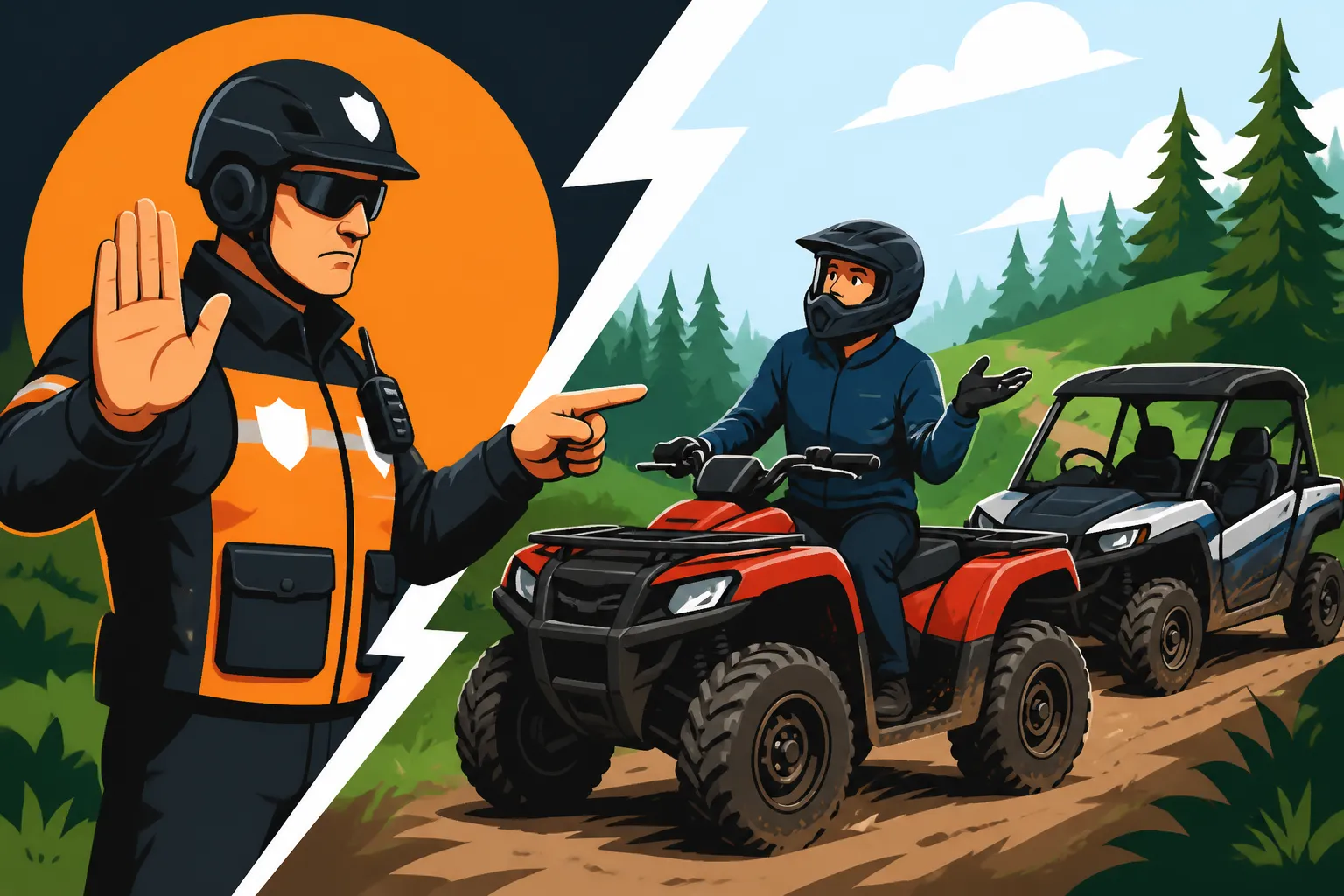
Think of trail patrollers as the guardians of our quad and side-by-side trails. They are not police officers, nor are they Sûreté du Québec personnel or wildlife enforcement officers. Instead, they are members of the local quad clubs, volunteers who dedicate their time to ensure the rules are followed, the trails are safe, and the experience is enjoyable for everyone. They often wear distinctive vests or jackets, sometimes with the FQCQ logo or their local club's emblem, making them easily identifiable. They're out there because they love the sport and want to protect it for all of us. They're often seasoned riders themselves, familiar with the trails and the machines.
What Grants Them Authority?
The authority of a Quebec trail patroller primarily stems from the FQCQ and the local quad clubs. When you purchase an [Quebec Annual FQCQ Trail Pass], you are agreeing to abide by the rules and regulations set forth by the federation and its member clubs. This agreement forms the basis of the patroller's ability to enforce these rules. They are essentially enforcing the terms and conditions of your access to the private and managed land that constitutes the trail network. Their presence ensures that the land use agreements with private landowners are respected, and that the vast network of trails can continue to operate. Without this self-policing, the entire system would quickly break down, losing landowner permissions and funding.
Differentiating From Law Enforcement
It's crucial to understand that while patrollers have a role in enforcement, they do not possess the same legal powers as police officers or other authorized law enforcement personnel. They cannot arrest you, issue official government fines, or physically detain you. Their power is administrative and report-based. However, they can gather information, document violations, and, most importantly, report serious infractions or non-compliance to the proper authorities, such as the Sûreté du Québec or local police. In such cases, law enforcement can then intervene, and that's when you might face official charges or fines under [Quebec's Off-Highway Vehicle Act and Your Papers]. So, while a patroller might not carry a badge, ignoring their requests can still lead to serious consequences down the line.
What Patrollers Can Ask You To Do (and What They Can't)
Interacting with a trail patroller should generally be a straightforward and respectful exchange. They have specific areas where they can make requests, centered around safety, documentation, and compliance with trail rules.
Asking to See Your Papers
This is one of the most common requests you'll encounter. Patrollers are authorized to ask for proof that you're legally entitled to be on the trail and operating your machine. This typically includes:
- Your Driver's Licence: To ensure you're a qualified operator.
- Your ATV/UTV Registration Certificate: Showing your machine is legally registered with the SAAQ. For clarity, a VHR plate means your machine is registered as a "véhicule hors route," or off-highway vehicle. You can find more detail on [Quebec VHR Plates Explained].
- Your FQCQ Trail Pass: This proves you have paid the necessary fees to use the federated trails. Patrollers will look for the physical sticker on your machine, but also expect to see proof of purchase.
- Proof of Liability Insurance: While your SAAQ registration includes a mandatory minimum liability, patrollers might ask to see [Quebec Insurance Proof on the Machine] for good measure, especially if there's any doubt.
It's always a good idea to have physical copies of these documents or clear, accessible digital copies on your phone, as [Carrying Papers on a Long Ride] is a key part of responsible riding.
Equipment Checks
Patrollers are also looking out for general safety and compliance with equipment regulations. They may perform a quick visual inspection of your machine and gear. This isn't usually an in-depth mechanical inspection, but rather a check for obvious safety or regulatory issues. They might check:
- Helmets and Visors: Ensuring you and any passengers are wearing an approved helmet and that it has a visor or you're wearing goggles, as required under [Quebec Helmet and Visor Rules].
- Mirrors: Checking for functional mirrors.
- Muffler and Noise Levels: To ensure your exhaust system isn't excessively loud or modified beyond legal limits. Aftermarket parts from brands like SuperATV can offer great performance and durability, but always ensure any modifications to your exhaust or engine still meet Quebec's noise and emission standards.
- Lighting: Especially if you're riding near dawn, dusk, or night, they'll verify working headlights and taillights.
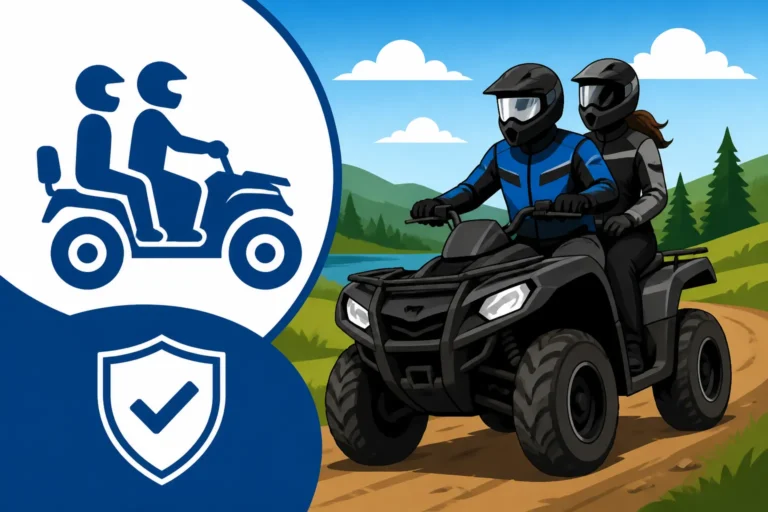
- Machine Capacity: Confirming that the number of passengers on your machine doesn't exceed its factory design capacity, particularly if you have extra seating or are riding two-up on a single-rider machine. [Quebec Rules for Passengers on a Quad] outlines these requirements.
Directing Your Actions
In certain situations, patrollers may issue directives related to your immediate actions on the trail. These are usually for safety or to prevent further rule violations. For instance, they might:
- Tell you to slow down: If you're observed speeding, especially in sensitive areas or near dwellings. [Quebec ATV Speed Limit on Trails] is generally 50 km/h.
- Direct you to turn around or exit the trail: If you're on a closed section, an unauthorized path, or a trail that is not suitable for your machine.
- Ask you to stay on the marked trail: To prevent damage to private property, sensitive ecosystems, or to avoid dangerous unmarked areas.
- Advise you to stop riding: If your machine appears to be unsafe, or if you're riding during prohibited hours, such as after midnight, which can lead to [Quebec Night Riding Fines From $250].
These directives are usually given to maintain safety and preserve the trail system, which everyone benefits from.
When They Cannot Force You
While patrollers have important roles, it's vital to remember their limitations. They cannot:
- Physically detain you: They are not law enforcement and cannot physically prevent you from leaving, though doing so might lead to them reporting your license plate number to the police.
- Search your person or your machine: They can request to see documents or observe equipment, but they cannot legally search your belongings or the interior of your machine without your consent.
- Confiscate your machine or property: Only law enforcement officers have the authority to impound a vehicle or seize property.
Remember, resisting or verbally abusing a patroller can lead to more serious issues, as they can still report such behaviour to the police. Respectful communication is always the best approach.
Here's a quick comparison of what different authorities might ask for:
| Authority Type | What They Can Ask/Request | What They Cannot Do (Without Police Authority) |
|---|---|---|
| Club Trail Patroller | See Licence, Registration, Trail Pass, Insurance | Arrest, detain, search, issue official fines |
| Check safety equipment (helmet, mirrors, muffler, lights) | Impound vehicle, demand personal information | |
| Direct actions on trail (speed, path, turning around) | Forcibly remove you from the trail | |
| Report violations to police/SAAQ | ||
| Police Officer / Sûreté du Québec | Demand identification, registration, insurance, licence | Conduct illegal searches without probable cause |
| Issue official fines, confiscate machines, make arrests | Violate your rights | |
| Enforce all provincial and federal laws | ||
| Wildlife Officer | Demand hunting/fishing permits, check equipment | Enforce general traffic laws |
| Enforce wildlife and natural resource regulations |
Common Violations Patrollers Look For
Patrollers are out there to maintain order and safety, so they're trained to spot common infractions that put riders, trails, and landowners at risk. Knowing what they're looking for can help you stay compliant and avoid unnecessary hassle.
Lack of Proper Documentation
This is probably the easiest thing for a patroller to check and one of the most common reasons for an interaction. Failing to have the correct paperwork on hand is a direct violation of the rules for using federated trails. This includes:
- Expired or Missing Trail Pass: Your [Quebec Trail Pass Prices for 2025 to 2026] is essential. If your pass has expired or you simply haven't purchased one, you're riding illegally on the federated network. Patrollers can and will turn you back, or report you for [Quebec Penalties for Riding Without a Trail Pass].
- No Driver's Licence: Operating an ATV or side-by-side in Quebec requires a valid driver's licence. [Quebec Requires a Driver's Licence Since 2021], and patrollers will verify this. Riding without one is a serious offense that will be reported to the police.
- Unregistered Machine: All off-highway vehicles in Quebec must be registered with the SAAQ. If your machine isn't registered, or its registration has lapsed, you're looking at significant [Quebec Penalties for Riding Unregistered] if a police officer gets involved.
- Lack of Insurance Proof: While the SAAQ registration includes liability, it's always wise to have proof of [Quebec Insurance Minimum for an Owner] on hand. Patrollers might inquire, and having it shows you're a responsible rider.
Safety Equipment Lapses
Safety is paramount on the trails, and patrollers are vigilant about ensuring riders are adequately protected and machines are safe.
- Missing or Improper Helmet/Visor: As mentioned earlier, [Quebec Helmet and Visor Rules] are strict. A patroller will check to ensure all riders and passengers are wearing approved helmets, and that eye protection (visor or goggles) is in place. No excuses.
- Modified Exhaust/Excessive Noise: Aftermarket exhausts are popular for performance, but if they make your machine louder than legal limits, you could be in trouble. Patrollers listen for excessively noisy machines, as this is a common complaint from residents near trails and goes against [Quebec Muffler and Noise Rules]. Even high-performance parts from SuperATV, while offering great gains, must be installed and used in a way that respects local noise bylaws.
- Missing Mirrors or Lights: These are basic safety requirements, particularly for visibility and night riding. If your machine is missing mirrors or has non-functional lights, a patroller will point it out, as they are crucial for both your safety and that of others. You can learn more about [Quebec Lighting Requirements at Night] and [Quebec Mirror Requirements on a Quad].
Riding Etiquette and Trail Rules
Beyond the legal requirements, patrollers enforce basic trail etiquette and rules designed to protect the environment and maintain good relations with landowners.
- Speeding: Exceeding the posted speed limit, especially in residential zones or tight sections, is dangerous and disrespectful. Patrollers will observe speeds and can issue warnings.
- Riding Off-Trail: Straying from marked trails can damage sensitive ecosystems, trespass on private property, and erode trust with landowners. Patrollers will direct you back onto the designated path. This is also covered by [Quebec Trespass Rules for Riders].
- Riding During Prohibited Hours: [Quebec Riding Hours From 6 a.m. to Midnight] are standard. Riding outside these times, especially late at night, can lead to complaints and is something patrollers actively monitor.
- Ignoring Signage: Trail signs are there for your safety and guidance. Ignoring 'stop' signs, 'slow' signs, or 'no entry' signs is a direct violation that patrollers will address.
- Unsafe Riding Practices: Anything from dangerous passing to reckless operation that endangers others can catch a patroller's eye. They often carry a wealth of experience on the trails and can spot unsafe habits immediately. [Quebec Trail Etiquette Locals Expect] is a good read on this.
Age and Passenger Restrictions
Ensuring riders meet the age requirements and that machines aren't overloaded is critical for safety.
- Underage Riders: [Quebec ATV Age Requirements] dictate a minimum age of 16 to ride an ATV on federated trails, and 18 for a side-by-side. If a patroller encounters someone underage operating a machine, especially without the required [Quebec FQCQ Training Certificates for Teens] for 16 and 17-year-olds, they will certainly intervene.
- Too Many Passengers: Your machine has a factory-designated passenger capacity. Carrying more people than your machine is designed for, or having passengers on a single-seat ATV, is unsafe and a violation. [Quebec Rules for Passengers on a Quad] are clear on this.
What Happens When You Don't Comply
While a patroller isn't a police officer, ignoring their requests or violating trail rules can still lead to escalating consequences, from a simple warning to significant fines and even loss of trail access.
Verbal Warnings and Club Actions
For minor infractions, or if you're generally cooperative, a patroller might simply issue a verbal warning. They'll explain the rule you've broken, advise you on how to correct it, and remind you of the importance of compliance. This is their first line of action and often resolves the issue.
However, if the infraction is more serious, or if you're uncooperative or a repeat offender, the patroller can take further action at the club level. This might include:
- Reporting to the Club: The patroller can file a report with their local quad club and the FQCQ, detailing the incident.
- Pass Revocation: Depending on the severity and frequency of the violations, the club or FQCQ could decide to revoke your trail pass, meaning you would no longer be permitted to ride on any federated trails. [Is an FQCQ Trail Pass Refundable if Trails Close?] and [Quebec Pass Proof on the Trail] discuss aspects of pass management.
- Temporary or Permanent Ban: In extreme cases, a club might ban you from using their specific trails, or the FQCQ might implement a wider ban from the entire federated network. This is a rare measure but highlights the power clubs have over access.
Escalation to Police or Wildlife Officers
This is where things can get serious. If a patroller observes a significant violation—such as riding without a licence, an unregistered machine, impaired riding, or aggressive behaviour—they have the authority to contact law enforcement.
- Contacting the Sûreté du Québec or Local Police: Patrollers can call in police, providing them with details of the incident, including your machine's license plate, your appearance, and the location.
- Wildlife Officers: If the violation involves environmental damage, trespassing on protected land, or other nature-related offenses, a wildlife officer might be called.
When law enforcement arrives, they have full legal powers, including the ability to issue fines, impound your machine, or even make an arrest depending on the severity of the offense. [Quebec Impaired Riding Penalties] can be particularly severe, leading to immediate police intervention.
Fines and Legal Consequences
If law enforcement gets involved due to a patroller's report, you could face substantial fines and legal repercussions. These aren't fines from the club, but official government fines under Quebec's Off-Highway Vehicle Act or other relevant statutes.
Common fines include:
- Riding Without a Licence: This can lead to significant fines. [Quebec Fines for Riding Without a Licence] can be very steep.
- Unregistered Machine: Penalties for an unregistered VTT are also costly.
- No Trail Pass (when required): While a patroller might turn you back, a police officer can fine you for being on a federated trail without one.
- Impaired Riding: This carries the same severe consequences as impaired driving in a car, including license suspension, hefty fines, and criminal charges.
- Safety Equipment Violations: Fines for not wearing a helmet or having insufficient safety gear can also be applied by police.
Beyond fines, some offenses can lead to demerit points on your driver's licence, increased insurance premiums, or even criminal records in the most severe cases.
Maintaining Respect and Cooperation
The best way to handle an interaction with a trail patroller is with respect and cooperation. Remember, they are volunteers trying to keep the trails safe and accessible for everyone, including you.
- Be Polite and Calm: Even if you disagree, maintain a respectful tone.
- Provide Requested Documents: Have your licence, registration, insurance, and trail pass ready.
- Listen to Their Instructions: If they ask you to slow down, turn around, or leave a specific area, comply promptly.
- Ask Questions Respectfully: If you're unsure why a rule applies or what they're asking, ask for clarification in a polite manner.
- Understand Their Role: They are not there to ruin your day, but to enforce rules that protect the trail network and its users. Your cooperation helps ensure the continued enjoyment of Quebec's incredible quad and side-by-side trails for years to come.
Disclaimer
This article is for general informational purposes only and does not constitute professional advice. Laws, prices and regulations vary by location and change over time. Consult a qualified professional for guidance on your specific situation.