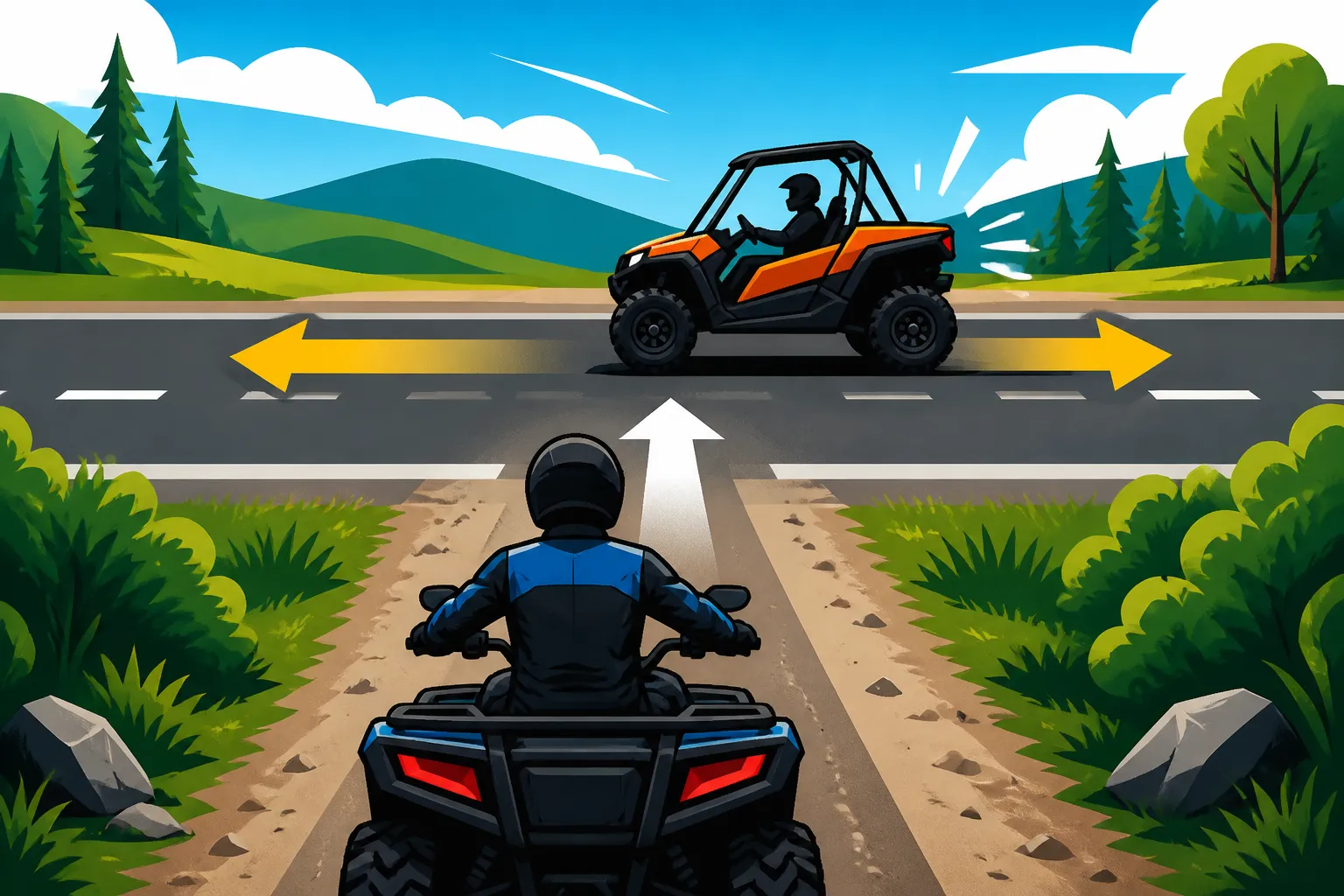
Crossing a Quebec Road at a Right Angle
One of the trickiest situations many ATV and UTV riders face in Quebec is navigating those inevitable moments when a trail suddenly ends at a road, and you need to get to the next section of trail. It’s not just about stopping and looking both ways; there's a very specific, often misunderstood rule about how you must cross that road. This guide is all about demystifying the "right-angle crossing" requirement, ensuring you understand not just what to do, but why it's so critical for your safety and to stay on the right side of the law.
The Fundamental Rule for Crossing Quebec Roads
When you're out on the trails in Quebec, enjoying the vast network, it's inevitable that you'll encounter a paved or gravel road you need to cross to connect to the next segment of your ride. This isn't like merging onto a road in a car; there are very specific regulations that govern how off-highway vehicles (OHVs) interact with public roadways. The most fundamental and often overlooked rule is the requirement to cross these roads at a right angle. This isn't just a suggestion; it's a legal obligation designed to enhance safety for everyone on the road.
Understanding the "Right Angle" Mandate
So, what exactly does "crossing at a right angle" mean in practice? Imagine the trail you're on meets a road. Instead of turning left or right along the road to angle across, you must approach the road, stop, check for traffic, and then proceed directly across to the opposite side, forming as close to a 90-degree angle with the road as possible. This means your machine should be pointed straight across, perpendicular to the flow of traffic. The intent here is clear: minimize the time your ATV or UTV spends exposed to traffic lanes and make your movement predictable for other drivers.
This rule applies whether you're crossing a quiet rural road or a busier artery, and regardless of whether the crossing is marked as an official trail intersection or simply a necessity to continue your journey. The idea is to make your presence on the road as brief and direct as possible. Think of it as puncturing the road to get to the other side, rather than becoming part of its flow. It's a quick, decisive maneuver, not a gradual merge or turn.
Minimizing Road Travel: The Spirit of the Law
The right-angle crossing rule isn't an isolated regulation; it's deeply rooted in the broader philosophy of Quebec's [Quebec ATV Road Rules Under the LVHR]. The law is designed to keep off-highway vehicles off public roads as much as possible, acknowledging the inherent differences in speed, handling, and visibility between quads and road vehicles. When you cross at a right angle, you're adhering to this principle by ensuring your OHV is on the roadway for the absolute minimum distance and duration.
This principle also ties into other regulations, like the allowance for [Quebec Municipal Road Access Up to 1 Kilometre] under very specific conditions, usually with clear signage. In those cases, you might be on the road for a short stretch, but a crossing is different. A crossing implies going from one side to the other, not traveling along the road. The law wants to avoid situations where ATVs might inadvertently impede traffic, cause confusion, or create hazards by traveling longitudinally on a road. Therefore, your goal should always be to make your entry and exit from the road as efficient and perpendicular as possible, reflecting the law's spirit of minimizing road exposure.
Practical Steps for a Safe Right-Angle Crossing
Successfully executing a right-angle crossing involves more than just knowing the rule; it demands careful observation, good judgment, and precise execution. A casual approach can put you, your passengers, and other road users at risk. Taking a few moments to plan and perform the crossing properly can make all the difference in staying safe on your adventures.
Pre-Crossing Assessment: Look, Listen, and Plan
Before you even think about entering the roadway, bring your machine to a complete stop at the edge of the trail, ideally slightly back from the asphalt or gravel shoulder. This gives you a clear vantage point without encroaching on vehicle traffic. This is your critical observation phase. First and foremost, you need to look in both directions for oncoming traffic. Don't just glance; actively turn your head and scan as far down the road as possible, taking into account any curves, hills, or other obstructions that might limit [Sightlines of 50, 100, 150 and 200 Metres]. Remember, cars move fast, and an ATV is a smaller, less visible vehicle.
Beyond visual checks, listen carefully for the sounds of approaching vehicles. Sometimes, you might hear a car or truck before you see it, especially in areas with dense foliage or blind spots. If there are any doubts about visibility, it’s always best to err on the side of caution and wait until you have a clear, unobstructed view in both directions. Consider the speed of any oncoming vehicles as well; even if you see them far off, a high-speed vehicle closes the distance quickly. Take a moment to mentally map your crossing: where will you enter, where will you exit, and what's the clearest path?
Executing the Crossing: Straight and Swift
Once you've assessed the road and determined it's clear and safe to proceed, execute the crossing promptly and directly. Your goal is to move from one side of the road to the other in a straight line, perpendicular to the road's flow. Avoid any hesitation or last-minute swerving. Accelerate smoothly but decisively, maintaining a speed that allows you control but gets you across quickly. You're not looking to linger or become a part of the road's traffic pattern; you're simply passing through.
Keep your eyes focused on your intended exit point on the opposite side. This helps ensure you maintain a straight trajectory. If you're riding with a group, ensure there's enough space between machines for each rider to cross safely, and communicate your intentions clearly. Some riders find that having robust mirrors helps them keep an eye on any unexpected traffic that might appear while they are poised to cross. Products from brands like SuperATV, for instance, offer heavy-duty mirrors designed for off-road use that can provide a wider field of view, helping you maintain awareness without needing to turn your head as much when you're preparing for the crossing. This added visibility can be a real asset when scanning for traffic before entering the roadway.
Legal Ramifications and What Patrols Expect
Understanding the "right angle" rule is one thing; appreciating its importance from a legal and enforcement perspective is another. Trail patrols and law enforcement officers in Quebec take these regulations seriously because they are fundamental to road safety, particularly where OHVs and conventional vehicles share space, however briefly. Failing to adhere to this simple rule can lead to significant consequences, disrupting your ride and potentially emptying your wallet.
Fines and Penalties for Improper Crossings
Let's be clear: riding an ATV or UTV is a privilege that comes with responsibilities, especially when interacting with public roadways. An improper road crossing – meaning one that isn't executed at a right angle – can be seen as a violation of the [Quebec ATV Road Rules Under the LVHR]. While specific fine amounts can change, you can expect penalties that start in the hundreds of dollars. These aren't just minor infractions; they reflect the potential danger an un-signalled or angled crossing poses to other motorists.
A patrol officer seeing an OHV travel along a road to "angle" across, or making a sweeping turn onto a road from a trail, will likely consider it an illegal manoeuvre. This isn't about giving you a hard time; it's about enforcing rules designed to prevent accidents. They're looking for predictable, brief, and perpendicular movement. If you're caught lingering on the road or performing a non-right-angle crossing, you'll not only face a fine but also the potential for further scrutiny of your registration, insurance, and other required documents. It’s always better to take an extra few seconds to do it right than risk a ticket or, worse, an accident.
The Role of Signage and Authorized Crossings
You might encounter areas where the trail clearly indicates a road crossing with official signage. Even at these designated spots, the right-angle rule still holds true. The signage ([Quebec Road Signage for Quad Routes]) primarily serves to alert both OHV riders and motorists to the presence of a crossing point, improving overall awareness. It doesn't negate the legal requirement for how you must perform the crossing itself. You still need to stop, look, and cross straight across.
Occasionally, you might be on a municipal road access section where ATVs are permitted to ride along the road for a specified distance, typically up to [Quebec Municipal Road Access Up to 1 Kilometre]. This is a distinct situation from a crossing. When you are explicitly allowed to travel along a road, you are expected to follow general road rules, which might include signals, staying to the right, and matching the flow of traffic where safe and legal. However, when you reach the end of such a section and need to get back onto a trail on the opposite side, you then revert to the right-angle crossing rule to exit the road. Even if a particular section of road has a unique exemption, the default for transitioning between off-road and on-road environments remains the right-angle approach. Ensuring your machine is equipped with proper mirrors, like those found in the SuperATV product line, can also assist in maintaining constant awareness of traffic, whether you're briefly traversing a road or making a quick, perpendicular crossing.
Specific Scenarios and Common Misconceptions
While the right-angle rule seems straightforward in principle, the real world often presents scenarios that can make its application feel a bit more complex. Understanding these nuances and dispelling common misconceptions is key to consistent and safe riding. After all, not every trail perfectly aligns with a roadway, and sometimes the urge to take a shortcut can lead to bad habits.
When a Trail Emerges at an Odd Angle
It's a common occurrence: you're following a beautiful, winding trail, and suddenly it spits you out onto a road at a diagonal, or even parallel to it for a short stretch, before the next trail entrance appears. In these situations, it can feel counterintuitive to re-position your machine, but it's absolutely necessary. If your trail path brings you to the road at anything other than a near 90-degree angle, you must first maneuver your ATV or UTV off the direct line of travel, safely to the side of the road (off the pavement/gravel if possible), and then pivot your machine until it's facing directly across the road.
This might mean backing up slightly, pulling forward to a wider shoulder, or finding a safe, clear spot a few feet down the road from where the trail initially emerged. The key is to create that perfect perpendicular approach before you attempt to cross. Don't try to "correct" your angle as you enter traffic; that's when confusion and accidents can happen. Think of it as preparing for a carefully executed dance move – you need to be in the right starting position before you begin. This preparatory step is often overlooked but is crucial for a lawful and safe crossing.
Differences from Riding on a Road
One of the biggest misconceptions is confusing a road crossing with actually riding on a road. They are fundamentally different under Quebec's off-highway vehicle laws. As we've discussed, a brief, right-angle crossing is a permitted manoeuvre to get from one trail segment to another. You are on the road for mere seconds, with the sole intent of transitioning. This is distinct from situations where the law or a specific municipal by-law permits ATVs to [Quebec Municipal Road Access Up to 1 Kilometre] or for specific purposes like farm or forestry work.
When you're legally riding on a road, even for a short distance, you're expected to comply with many of the same rules as other vehicles, such as staying to the right, using appropriate lighting, and sometimes even signaling turns. A crossing does not grant you these same privileges; it’s a quick transit. So, if you're tempted to "just turn down the road a bit" to find the next trail entrance because it feels easier than re-positioning for a right-angle cross, resist that urge. You're no longer performing a crossing; you're illegally riding on the road, which can lead to significant fines and endanger yourself and others. Always keep the distinction clear in your mind: cross at a right angle, or be prepared to abide by full road rules if you’re traveling along the pavement.
Equipment That Aids Safe Crossings
While rider awareness and proper technique are paramount, certain equipment can certainly enhance safety during road crossings. High on that list are mirrors. Unlike cars, many ATVs don't come standard with mirrors, or they have small ones. Investing in robust, properly adjusted mirrors can significantly improve your ability to monitor traffic approaching from behind without constantly turning your head, especially when you're stopped and assessing the road. Brands like SuperATV offer a variety of rearview and side mirrors designed for the rugged demands of off-road riding, providing excellent visibility that can be a game-changer for safer crossings.
Beyond mirrors, proper lighting is essential, even during the day, to make your machine more visible to motorists, particularly if there's any overcast weather or shaded areas. Ensure your headlights are on and functioning. Some riders also opt for bright flags or reflective strips on their machines or helmets, especially if they frequently cross roads in areas with limited visibility. While no piece of equipment can replace careful judgment and adherence to the right-angle rule, these additions contribute to an overall safer riding experience when you briefly intersect with public roadways.
Here's a quick overview of key considerations for right-angle road crossings:
| Aspect | Description |
|---|---|
| Legal Requirement | All ATV/UTV road crossings in Quebec must be executed at a right angle (perpendicular) to the road's flow. This is mandated by the Off-Highway Vehicle Act ([What Quebec's Off-Highway Vehicle Act Changed for Owners]). |
| Purpose | Maximizes safety by minimizing the time an OHV is on the roadway and makes its movement predictable for other drivers. It reflects the law's spirit of keeping OHVs off public roads as much as possible. |
| Pre-Crossing Actions | Come to a complete stop at the edge of the trail, off the road surface. Look and listen carefully in both directions for traffic. Assess sightlines and traffic speed. Re-position your machine if the trail doesn't meet the road at a right angle, ensuring you are perpendicular before proceeding. |
| Execution | Cross swiftly and directly in a straight line, perpendicular to the road. Avoid hesitation, swerving, or traveling along the road's length. Focus on your exit point on the opposite side. |
| Signage & Designations | Even at designated or signed crossings ([Quebec Road Signage for Quad Routes]), the right-angle rule applies. Signage indicates the crossing point but does not alter the method of crossing. |
| Penalties | Failure to cross at a right angle can result in significant fines, as it is considered an improper and potentially dangerous interaction with a public roadway. |
| Helpful Equipment | Robust mirrors (like those offered by SuperATV), functioning headlights, and reflective gear can enhance visibility and aid in safer crossings, though they do not replace proper technique and awareness. |
| Common Mistake | Confusing a brief right-angle crossing with permissible riding along a road for a distance (e.g., [Quebec Municipal Road Access Up to 1 Kilometre]). The rules and intent are different. |
Disclaimer
This article is for general informational purposes only and does not constitute professional advice. Laws, prices and regulations vary by location and change over time. Consult a qualified professional for guidance on your specific situation.