Workers Exempt From Signage
Riding an ATV or UTV for work in Quebec often brings a unique set of challenges and questions, especially when it comes to navigating public roads. Many workers find themselves needing to cover short distances on municipal roads to get from one job site to another, access remote areas, or perform duties that require their off-highway vehicle. The frustration mounts when you know you need your machine for your livelihood, but the standard rules for recreational riders about municipal signage and access seem to create unnecessary hurdles. This guide will thoroughly explain the specific exemptions available to workers under Quebec's Off-Highway Vehicle Act, clarifying when and how they can use their machines on public roads without the typical signage requirements that recreational riders face.
Understanding the Quebec Off-Highway Vehicle Act and Workers
Quebec's Off-Highway Vehicle Act, often referred to by its French acronym LVHR (Loi sur les véhicules hors route), sets the framework for how quads and side-by-sides can be used in the province. For most recreational riders, this means sticking to federated trails, obeying specific road crossing rules, and only using municipal roads for very short, signed stretches—typically up to one kilometre—with prior municipal approval. It's a system designed to keep recreational machines separate from regular traffic for safety and noise considerations.
Why Special Rules for Workers?
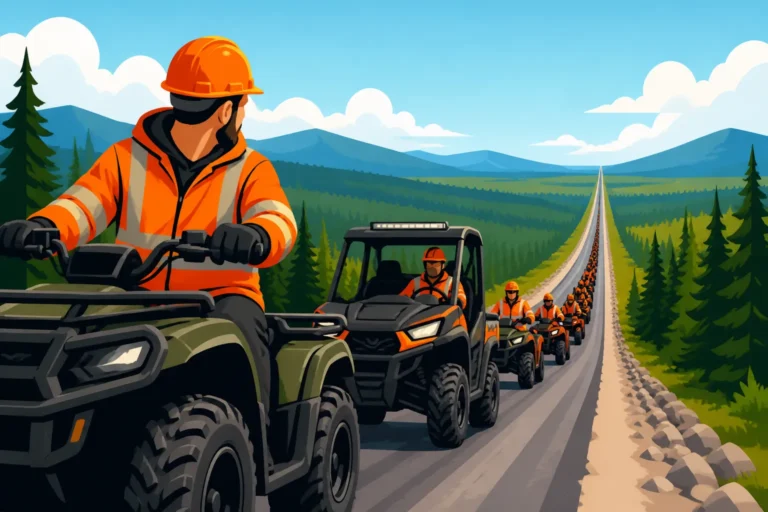
However, the reality of many jobs in Quebec, particularly in rural or resource-based sectors, necessitates the use of ATVs and UTVs. Think of forestry workers inspecting woodlots, hydro crews maintaining power lines, farmers moving between fields, or trappers accessing their lines. These aren't joyrides; they are essential tools for earning a living. Recognizing this fundamental difference, the Quebec legislature included specific provisions within the LVHR to allow workers to use their machines on public roads under certain conditions, acknowledging that their needs differ from those of someone out for a weekend ride. This exemption is crucial because without it, many vital services and industries would face significant logistical barriers. The aim is to balance public safety with the practical needs of the workforce.
The General Rule for Recreational Riders on Roads
For the vast majority of ATV and UTV enthusiasts in Quebec, the rules for riding on public roads are quite strict. If you're out for pleasure, your machine is generally not allowed on public roads. There are very limited exceptions, such as crossing a road at a right angle after ensuring clear sightlines, or riding on a specific section of a municipal road that has been formally designated and signed for off-highway vehicle use. Even then, these designated sections are typically limited to a maximum of [Quebec Municipal Road Access Up to 1 Kilometre] in length and require specific signage approved by the municipality and the Ministry of Transport. Failing to adhere to these rules can result in significant fines for [Quebec Road Riding Fines From $350] and other penalties. This distinction highlights why the worker exemption is so vital—it carves out a necessary space for essential activities that simply couldn't operate under the recreational limitations.
Specific Exemptions for Workers Using ATVs and Side-by-Sides on Roads
The heart of the matter for many working professionals is how to legally operate their ATV or UTV on public roads without running afoul of the law. The LVHR specifically addresses this, providing a pathway for those whose machines are integral to their employment. It’s not an automatic pass, but rather a set of conditions that must be met to qualify for the exemption.
Qualifying for the Signage Exemption
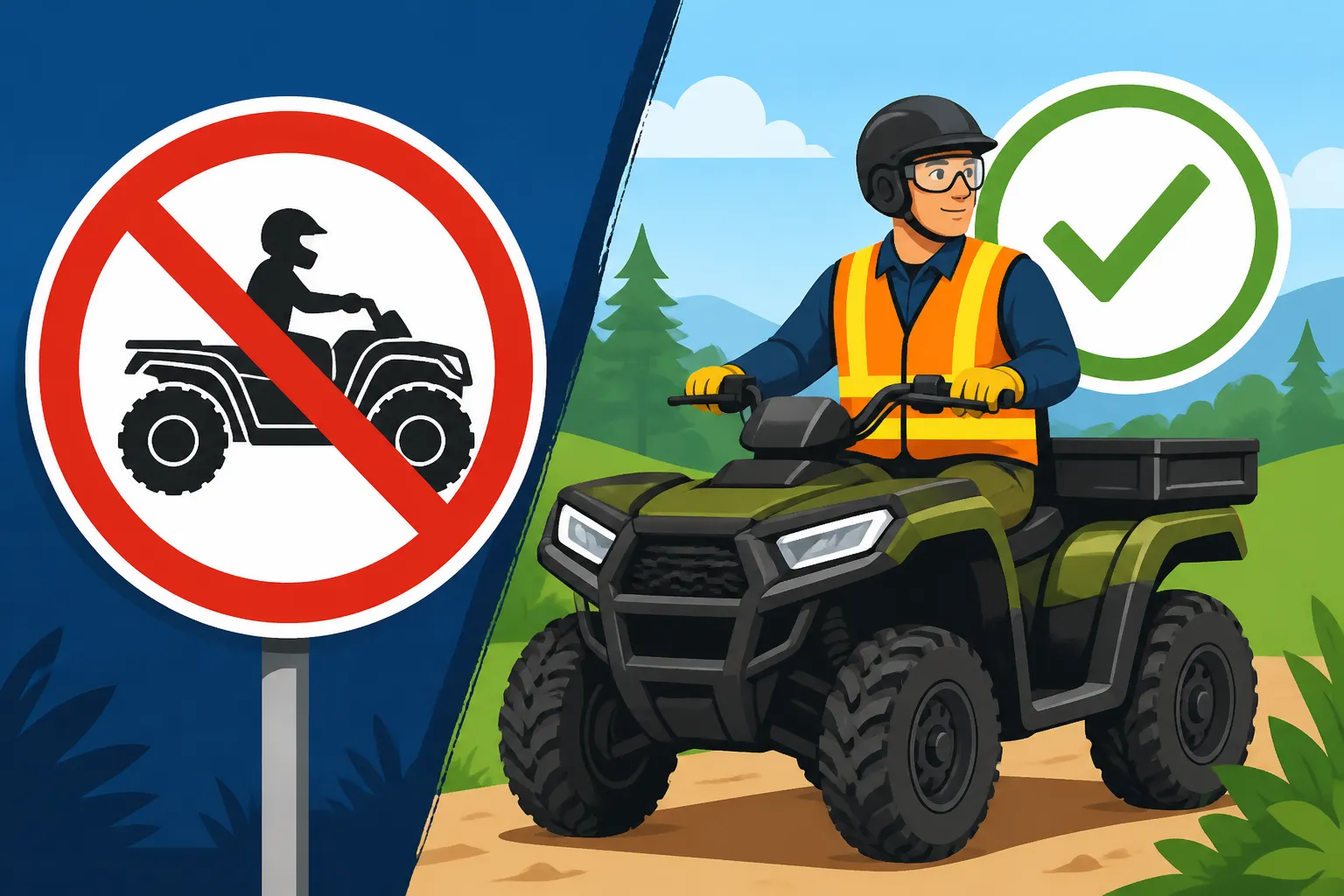
The primary benefit for workers is the exemption from the usual requirement for municipalities to post specific signage allowing off-highway vehicles on roads. This means a worker can use a road for work purposes even if there are no signs indicating that ATVs or UTVs are permitted. To qualify, the operator must be using the off-highway vehicle in the course of their work and for the purposes of that work. This isn't about running errands on your way home from the job site; it's about directly performing a task related to your employment. For instance, a technician heading to repair a remote communication tower would qualify, but using the ATV to pick up groceries after their shift would not. This exemption specifically addresses the practical need to travel between work areas, often for short distances on public thoroughfares, without waiting for every single municipality to go through the process of [Quebec's 15-Day Notice to the Ministry] and signage installation.
Permitted Uses and Conditions
Beyond simply being "at work," there are specific conditions and uses under which a worker's ATV or UTV can be operated on public roads without the standard recreational restrictions. The machine must be used to perform work that:
- Requires direct access to terrain inaccessible by conventional vehicles: Many jobs, like land surveying, utility inspection, or remote construction, often involve areas where only an ATV or UTV can effectively navigate.
- Is part of an agricultural, forestry, or trapping operation: Farmers moving feed, foresters assessing timber, or trappers checking traps often rely heavily on these machines. [Quebec Registration for a Farm Machine] and [Quebec Registration for a Trapper's Machine] acknowledge these specific uses.
- Involves the maintenance or repair of public infrastructure: This includes municipal workers repairing roads, hydro-Québec employees tending to power lines, or telecommunications technicians servicing remote equipment.
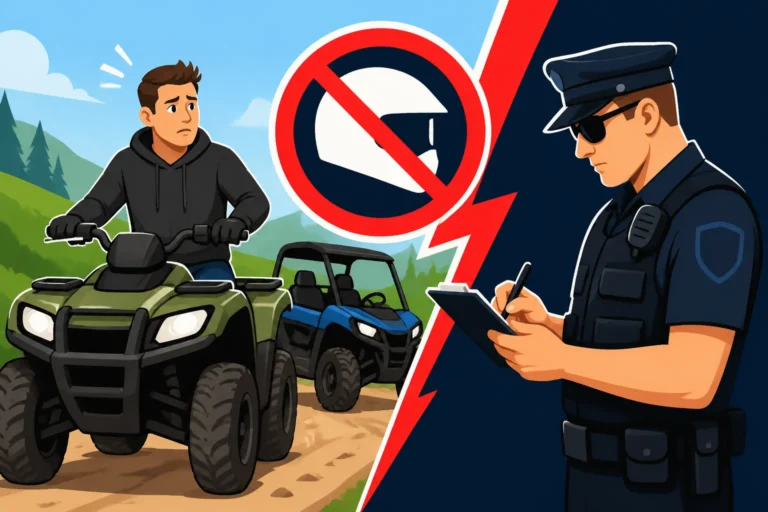
It's critical to understand that even with this exemption, workers are still bound by most other rules of the road. This means obeying speed limits, stopping at stop signs, signalling turns, and adhering to [Quebec Helmet and Visor Rules] and [Quebec's Minimum Age of 16 for ATV Riders]. The exemption focuses primarily on the access to roads without specific signage, not a wholesale disregard for traffic laws. For machines designed for heavy work, like those from SuperATV equipped with robust axles or utility beds, this exemption allows them to be driven to the worksite directly, enhancing efficiency without legal complications.
Essential Documentation and Equipment for Exempt Workers
Even with the worker exemption, you can't just hop on your ATV and assume everything is fine. There are still requirements, particularly concerning documentation and the machine itself, that you need to be aware of. It's about being prepared and responsible, not just for your own safety, but to demonstrate compliance if you're ever stopped by law enforcement.
What to Carry When Working
When operating your ATV or UTV on a public road for work purposes, it is absolutely essential to carry specific documentation. Think of it as your portable proof that you qualify for the exemption. This typically includes:
- Proof of employment: A letter from your employer stating your role, the nature of your work, and confirming that the use of an off-highway vehicle is necessary for your duties. This should ideally be on company letterhead.
- Proof of ownership and registration: Your ATV or UTV must be properly registered with the SAAQ, just like any other off-highway vehicle in Quebec. This means having your [Quebec ATV Registration With the SAAQ] and the associated papers readily available.
- Proof of insurance: The LVHR mandates that all off-highway vehicles, including those used for work, must carry liability insurance. [Quebec's SAAQ Is Registrar and Insurer] for the basic liability, but you should also have proof of any additional private insurance you carry. Since [Quebec Liability Minimum Rose to $1 Million] recently, ensuring your policy meets this is critical.
- Your driver's licence: Since [Quebec Requires a Driver's Licence Since 2021], you must have a valid driver's licence (car, motorcycle, or restricted farm vehicle licence, depending on your age and the machine) on your person.
Having these documents immediately accessible, perhaps in a waterproof pouch on your machine, can save you a lot of hassle and potential fines if you encounter a police officer or a trail patrol. It's all about demonstrating that your use of the road is legitimate and within the bounds of the law.
Machine Requirements for Work Use
While the exemption primarily deals with road access, your machine itself also needs to meet certain standards. These aren't necessarily special requirements unique to work vehicles, but rather the standard safety and legal necessities for any off-highway vehicle operating in Quebec.
- Proper registration and plate: Your ATV or UTV must have a valid [Quebec VHR Plates Explained] and be affixed in the designated manner.
- Standard safety equipment: This includes functional headlights, taillights, brake lights, and a mirror. [Quebec Lighting Requirements at Night] and [Quebec Mirror Requirements on a Quad] are non-negotiable for any road use, even if brief.
- Muffler: Your machine must have a functional muffler to reduce noise pollution. [Quebec Muffler and Noise Rules] apply to all machines.
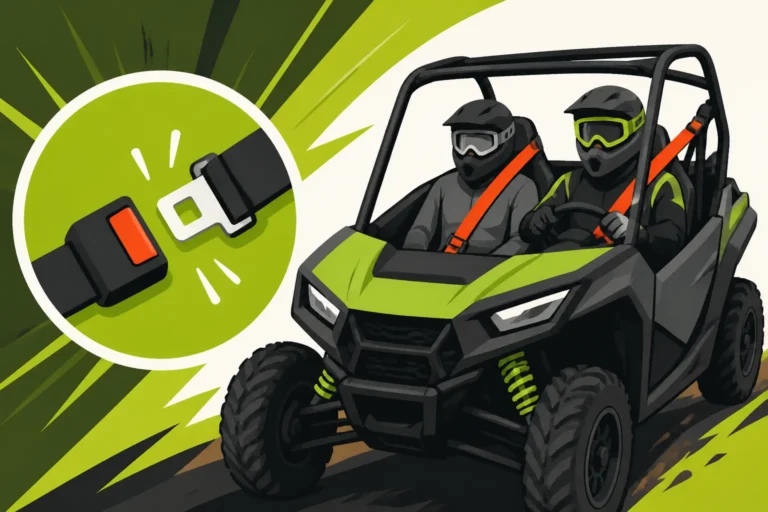
- Tires and general condition: The machine should be in good working order, with appropriate tires for the terrain and safe brakes. If you've modified your machine for heavy-duty work, perhaps with a SuperATV lift kit or heavy-duty suspension, ensure these modifications don't compromise its roadworthiness or compliance with the LVHR. It's important to remember that even if you're a worker, you're not exempt from general safety and operational standards for your vehicle.
Common Scenarios and Misconceptions for ATV Workers
The worker exemption can seem straightforward on paper, but in practice, there are many nuances and situations that can lead to confusion. It’s important to clarify what this exemption truly covers and, just as importantly, what it does not. Understanding the difference can prevent costly tickets and ensure you remain compliant while getting your job done.
Real-World Examples of Exempt Operations
Let's look at a few hypothetical, yet very common, scenarios where the worker exemption would apply:
- Forestry Operations: Imagine a crew from a local timber company needing to access different sections of a vast woodlot. They might drive their UTVs, often equipped with SuperATV winches and heavy-duty tires, a few hundred meters along a municipal gravel road connecting two forest paths. As long as they are actively engaged in forestry work—like marking trees, assessing growth, or moving small equipment—and have their documentation, they are covered by the exemption, even if no "VHR allowed" signs are posted on that road. This is a clear case of [Quebec Rules for a Worker on a Quad] applying.
- Agricultural Work: A farmer in the Eastern Townships needs to move from their main barn to an outlying pasture, a distance of about one kilometre, using a paved municipal road. They're carrying fencing tools and feed in their ATV's cargo rack. This direct commute for farming purposes falls under the exemption. The machine is being used as a critical tool for [Quebec Rules for a Farmer on a Quad], connecting essential parts of their operation.
- Utility Line Maintenance: A hydro-Québec technician uses an ATV to inspect power lines that run parallel to a rural road, occasionally needing to cross or travel short distances on the road itself to get to the next access point. This work directly involves the maintenance of public infrastructure and qualifies for the signage exemption.
- Trapper Access: A trapper needs to drive their ATV along a short, unsigned section of a municipal road to reach their trapping territory. If they are engaged in activities directly related to their trapping licence, carrying their permits and equipment, they are exempt from the signage requirements. [What a Trapper's Quad Needs on the Trapline] goes beyond just the registration.
In all these cases, the key is the direct necessity of the ATV for the work being performed and the operator's ability to prove their employment and purpose.
When the Exemption Does Not Apply
It's equally important to understand the limits of this exemption to avoid misinterpretation and potential penalties. The worker exemption is not a blanket permission for all-terrain vehicle use on public roads.
- Personal Use After Work: If a forestry worker finishes their shift and decides to use their ATV to go into the nearest village for groceries, they are no longer covered by the work exemption. At that point, they become a recreational rider, and the standard [Quebec Municipal Road Access Up to 1 Kilometre] rules, along with any relevant signage requirements, immediately apply.
- Leisure Riding to a Worksite: You cannot claim the exemption if you simply ride your ATV for leisure to a general area where you might eventually perform work, without immediately engaging in work tasks. The use must be for the purposes of work at that specific moment.
- Ignoring Other Road Rules: The exemption specifically removes the need for municipal signage; it does not exempt you from other traffic laws. Speed limits, stop signs, yielding, proper lighting, and the obligation to carry a valid driver's licence and registration still apply. You're still expected to ride safely and respect other road users. [Quebec ATV Road Rules Under the LVHR] are largely universal.
- Unqualified Machines: If your machine isn't registered, insured, or lacks basic safety equipment (like functional lights or brakes), the exemption won't protect you. Even if you're a worker, your machine must be roadworthy and legally compliant. This is where investing in reliable components, perhaps from a brand like SuperATV, can ensure your machine meets the demands of work while remaining compliant with safety standards.
Understanding these distinctions is crucial for any worker relying on an ATV or UTV for their livelihood in Quebec. It allows you to operate confidently and legally, knowing you're protected by the Act's provisions while upholding your responsibilities as a driver.
| Feature | Recreational Rider on Public Roads | Worker on Public Roads (Exempt) |
|---|---|---|
| Signage Required? | Yes, roads must be specifically signed and approved for ATV use. | No, exempt from specific signage if used in the course of work. |
| Purpose | Leisure, sport, recreation. | Directly performing duties related to employment/livelihood. |
| Road Length | Generally limited to 1 kilometre on signed sections. | No specific length limit, but must be necessary for work route. |
| Required Docs | Registration, insurance, driver's licence, trail pass (if applicable). | Registration, insurance, driver's licence, proof of employment. |
| Other Road Rules | All standard traffic laws apply (speed, stops, signals). | All standard traffic laws apply (speed, stops, signals). |
| Machine Status | Registered, insured, safe. | Registered, insured, safe. |
| Typical Context | Accessing federated trails, crossing roads. | Accessing worksites, moving between fields, inspecting infrastructure. |
Disclaimer
This article is for general informational purposes only and does not constitute professional advice. Laws, prices and regulations vary by location and change over time. Consult a qualified professional for guidance on your specific situation.