Registering an Ontario Quad After You Move
Moving your life to a new province is already a huge undertaking, filled with paperwork, new addresses, and figuring out the local way of doing things. But if you're like many outdoor enthusiasts, your all-terrain vehicle (ATV) or side-by-side isn't just a possession; it's a ticket to adventure, and bringing it with you means understanding a whole new set of registration rules. This guide is here to walk you through the often-confusing process of registering your Ontario-plated quad in Quebec, helping you navigate the provincial differences and get back on the trails with confidence.
Understanding the Quebec Registration Landscape for Newcomers
When you're coming from Ontario, where ATV registration is handled by the Ministry of Transportation (MTO) and insurance is entirely separate, Quebec's system can feel like a completely different beast. It's not just about transferring a plate; it's about integrating your machine into a system designed with Quebec's unique off-highway vehicle culture and regulations in mind. Many people feel a bit overwhelmed, thinking they'll have to jump through endless hoops, but with the right information, it's quite manageable.
Why Quebec is Different: The SAAQ's Role
The biggest difference you'll encounter right off the bat is the role of the Société de l'assurance automobile du Québec (SAAQ). Unlike Ontario's MTO, the SAAQ isn't just the registrar of vehicles; it's also the provincial insurer for off-highway vehicles, including quads and side-by-sides. This means when you register your machine, you're also purchasing a mandatory minimum liability insurance package directly from the SAAQ. This integrated system simplifies things in some ways, but it also means there are specific procedures and forms that are unique to Quebec. You can learn more about [What the SAAQ Actually Does for Quad Owners].
Imagine walking into a service centre, expecting to just show your Ontario ownership and walk out with a Quebec plate, only to be told you're also buying insurance. It can be a surprise! This unified approach is designed to ensure every registered off-highway vehicle on Quebec trails carries a baseline of protection, which is currently set at a [Quebec Liability Minimum Rose to $1 Million]. This minimum is automatically included with your registration, though you are always encouraged to seek additional private insurance for comprehensive coverage.
Essential Documents You'll Need to Gather
Before you even think about heading to an SAAQ service centre, you need to collect all your ducks in a row. Having your paperwork in order is probably the single biggest factor in how smoothly your registration process will go. Don't underestimate this step; missing even one document can mean a wasted trip and a lot of frustration. It's not uncommon for people to show up feeling prepared, only to realize they've forgotten something critical.
Here’s a breakdown of what you'll typically need:
- Your Ontario Ownership (Vehicle Permit): This is your primary proof that you legally own the quad. It should be in your name and clearly identify the vehicle.
- Proof of Identity: A valid driver's license (from any Canadian province) or another form of government-issued photo ID. Since you're moving, your Ontario driver's license is perfectly fine for this, though you'll eventually need to look into [Quebec Requires a Driver's Licence Since 2021] for riding.
- Proof of Quebec Residency: This is crucial. The SAAQ needs to confirm you now live in Quebec. Acceptable documents include a utility bill (hydro, gas, internet) in your name at your new Quebec address, a lease agreement, or a Quebec driver's license if you've already obtained one. Make sure the address matches!
- Bill of Sale (if recently purchased): While you're moving an existing quad, if you purchased it very recently in Ontario and haven't fully processed the ownership transfer there, you might need the bill of sale to prove your acquisition date and price, which can affect sales tax calculations in Quebec. Even if you've owned it for a while, having the original bill of sale for your purchase can be helpful for establishing the chain of ownership.
- Vehicle Information: The make, model, year, and most importantly, the Vehicle Identification Number (VIN) or serial number. Having this readily available helps clerks process your request efficiently. It’s always a good idea to bring the machine’s physical ownership papers, not just a photo.
The Initial Hurdles of Interprovincial Transfers
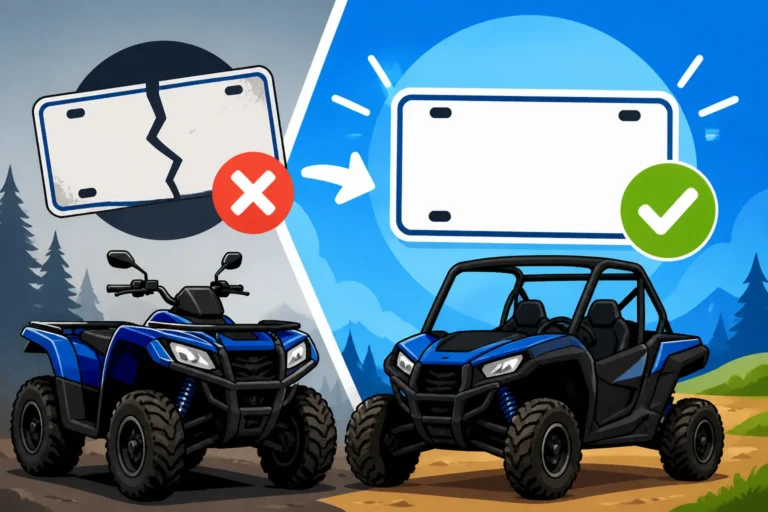
One of the common points of confusion for those relocating is how Quebec views a vehicle coming from another province. The SAAQ system is designed to register vehicles and issue plates specific to Quebec's [Quebec Calls an ATV a VTT] (Véhicule Tout-Terrain) classification. Your Ontario plate is not directly transferable; you will be getting a new Quebec plate, often referred to as a VHR plate, which stands for Véhicule Hors Route, or off-highway vehicle. You might want to read about [Quebec VHR Plates Explained].
The biggest hurdle isn't usually the physical transfer, but the mental shift in understanding that Quebec sees your quad as a "new" registration in their system, even if you've owned it for years. This means they will go through their full registration process, which includes assessing provincial sales tax (QST) on the estimated value of the vehicle, even if you paid sales tax in Ontario years ago. This can sometimes come as a shock to newcomers who assume they're simply "transferring" their existing registration.
They're not just looking at your ownership; they're essentially bringing your machine into their provincial registry and applying all their rules, including the financial ones, as if it's a new entry. It’s not quite [Quebec Registration for an Imported Machine] from another country, but it certainly has its own specific steps and considerations when crossing provincial lines.
Step-by-Step: Registering Your Ontario Quad in Quebec
Once you've wrapped your head around the SAAQ's unique approach and gathered your paperwork, it's time to dive into the actual steps. This isn't a process you can typically do online if you're coming from another province; an in-person visit to an SAAQ service centre is almost always required for initial registration.
Getting Your Proof of Ownership in Order
The SAAQ is very particular about proof of ownership. For a machine that was previously registered in Ontario, your Ontario Vehicle Permit (ownership) is your primary document. It needs to clearly show you as the registered owner. If for some reason your name isn't on the Ontario ownership, or if you've recently acquired the quad and haven't fully processed the ownership transfer in Ontario, you'll need additional documentation.
Here's where it can get a little tricky:
- If your name is on the Ontario Ownership: Great! This is exactly what the SAAQ expects to see. Make sure it's the original document, not a photocopy.
- If you bought it from a private seller in Ontario but haven't changed the ownership: You'll need the previous owner's signed-over Ontario ownership and a comprehensive bill of sale proving the transaction between you and them. This bill of sale should include the full names and addresses of both parties, the date of sale, the purchase price, and a clear description of the ATV (make, model, year, VIN). If you're missing a formal bill of sale, or need to create a clear document for your records, resources like LawDepot can provide templates for [Paperwork Two Individuals Sign on a Private Sale].
- If you purchased it from an Ontario dealer: The dealer should have provided you with all the necessary sales documents, including the proof of purchase and potentially an interim ownership document. Bring all of these.
- Missing Papers: This is a tough one. If you genuinely don't have the original Ontario ownership or a bill of sale, the SAAQ may require an affidavit or statutory declaration confirming your ownership history and explaining the missing documents. While you might be able to draft such a document yourself, using legal document templates from services like LawDepot can help ensure it contains all the necessary legal language. However, be aware that the SAAQ ultimately prefers verifiable original documents. This is a situation where you might want to call the SAAQ ahead of time to understand their specific requirements for [Quebec ATV Registration Without a Bill of Sale] or [Quebec Machines With No Paperwork].
Navigating the SAAQ Appointment and Paperwork
Registering an out-of-province vehicle isn't a quick in-and-out transaction. While some SAAQ services can be done online or at automated kiosks, bringing an Ontario quad into the Quebec system requires a visit to a service counter. It's often best to make an appointment if possible, as wait times can vary widely. Check the SAAQ website for their current appointment booking procedures.
When you arrive, you'll need to present all your gathered documents. The clerk will review them meticulously. They'll verify your identity, confirm your Quebec residency, and most importantly, check your Ontario ownership and the machine's VIN. They'll likely also ask about the machine's usage (e.g., recreational, farm, business) as this can sometimes influence specific classifications or fees, though for a standard recreational quad, it's usually straightforward.
Here's a table summarizing the common documents and what they prove:
| Document Type | What it Proves | Why it's Important |
|---|---|---|
| Ontario Vehicle Permit | Legal ownership of the quad | Essential for proving you own the machine |
| Valid Photo ID | Your identity | Required for any transaction with the SAAQ |
| Proof of Quebec Residency | Your new address in Quebec | Confirms you're a Quebec resident for registration |
| Bill of Sale | Purchase details, price, and date (if recent) | Establishes sales tax basis, especially if bought recently |
| VIN/Serial Number | Unique identification of the vehicle | Matches your documents to the physical machine |
The SAAQ clerk will input all the information into their system. This is where your Ontario-registered machine becomes a Quebec-registered [Quebec's VHR Vehicle Class]. You'll pay the necessary fees, which include the registration cost and the mandatory liability insurance. You'll then be issued a new Quebec VHR plate and a registration certificate. Make sure to review the certificate to ensure all information (your name, address, machine details) is correct before you leave.
The All-Important Sales Tax Consideration
This is often the most surprising part for newcomers. Even if you've owned your quad for years and paid sales tax when you bought it in Ontario, Quebec will assess provincial sales tax (QST) when you register it. This isn't a double tax on the original purchase; it's Quebec's application of its provincial sales tax on the value of the vehicle at the time it's brought into the province and registered.
The SAAQ will calculate the QST based on the higher of two amounts:
- The declared purchase price (if you have a recent bill of sale).
- The estimated market value of the vehicle, which the SAAQ determines using internal guides like the Guide d'évaluation des véhicules de loisir (Recreational Vehicle Valuation Guide).
So, even if you bought your quad for $8,000 ten years ago, and it's now worth $4,000, you'll pay QST on the $4,000. If you just bought it for $12,000 and moved, you'd pay QST on the $12,000. This is similar to [Quebec Sales Tax on an ATV Purchase] for any other vehicle entering the province's registration system.
Many people arrive at the SAAQ unaware of this, so be prepared for this expense. It's not a penalty; it's simply how Quebec applies its sales tax on vehicles entering its jurisdiction for registration, especially when there's no previous Quebec registration. The SAAQ clerk will be able to explain the specific calculation based on your machine's details.
What to Expect After Registration: Plates, Insurance, and Rules
Congratulations! You've navigated the SAAQ and successfully registered your Ontario quad in Quebec. But the journey isn't quite over. There are a few more things to understand about your new Quebec-registered machine before you hit the trails.
Receiving Your Quebec VHR Plate and Sticker
When you complete the registration process, you'll be given a distinct Quebec off-highway vehicle (VHR) plate. These plates are typically smaller than standard car plates and are designed to fit on the fender of your quad or side-by-side. You'll also receive a registration sticker, which you'll affix to the plate itself. This sticker indicates the current validity period of your registration.
It's crucial to properly mount your [Quebec Plate Placement on a Quad] where it is visible. Patrols on the trails will be looking for this plate and the current sticker to ensure your machine is legally registered. Your registration certificate is your official proof of registration and insurance, and you must carry it with you whenever you're operating your quad. A photo on your phone might suffice for some situations, but the physical document is always best. Take a moment to understand [Quebec Insurance Proof on the Machine].
Remember, this VHR registration is valid for a specific period, and you'll receive a renewal notice in the mail annually. Be prepared for [Quebec ATV Registration Renewal Each Year].
Understanding Quebec's Unique Insurance System
As mentioned earlier, Quebec's system integrates registration and basic liability insurance through the SAAQ. This means that when you paid your registration fees, you automatically acquired the mandatory minimum third-party liability coverage, which is currently $1 million. This coverage protects you against claims if you cause an accident that injures another person or damages their property while operating your quad.
However, this SAAQ-provided insurance does not cover damage to your own quad, nor does it cover theft, fire, or personal injury to yourself. For these types of protections, you'll need to purchase additional private insurance from a separate insurance provider. Many quad owners opt for comprehensive coverage that supplements the SAAQ's basic liability.
Think of the SAAQ's coverage as a safety net for others, but not for your own machine or well-being. It's a fundamental aspect of [Why the SAAQ Registers and Insures Your Quad]. It’s highly recommended to contact a private insurer in Quebec to discuss options for additional coverage, ensuring you’re fully protected on Quebec’s extensive trail network.
Getting Up to Speed on Quebec's Off-Highway Vehicle Act
Now that your quad is officially a Quebec VHR, you're subject to Quebec's specific laws governing off-highway vehicles, primarily the Act respecting off-highway vehicles (LVHR). This Act, updated in 2021, introduced several significant changes that newcomers from Ontario need to be aware of. What you could do with your quad in Ontario might be different here.
Key rules include:
- Driver's License Requirement: In Quebec, you absolutely need a valid driver's license (any class) to operate an ATV or side-by-side on trails or permitted roads. This is a non-negotiable rule since 2021. So, if you only had an Ontario G1 or G2, or no license at all (unlikely for an Ontario ATV owner, but worth noting), you'd need a full license. [Do You Need a Licence for an ATV in Quebec?] covers this in detail.
- Age Requirements: There are strict age limits. Generally, riders must be 16 to ride an ATV and 18 to drive a side-by-side on federated trails. There are exceptions for private land with parental supervision, but for public trails, these rules are firm. A [Quebec FQCQ Training Certificates for Teens] is also required for 16 and 17-year-olds.
- Helmet and Safety Gear: Quebec mandates approved helmets for all riders and passengers. These helmets must have a visor or be worn with goggles. There are limited exceptions for specific situations like trapping, but generally, a helmet with appropriate eye protection is required. [Quebec ATV Helmet Rules] explains this.
- Trail Pass: To ride on Quebec's vast federated trail network (maintained by the FQCQ and its member clubs), you must purchase an annual, summer, or short-term trail pass. Your registration is separate from your trail pass. Visitors from other provinces (including Ontario) must purchase a Quebec trail pass; interprovincial agreements have ended. Learn more about [Quebec Trail Pass Prices for 2025 to 2026].
- Road Access: Access to public roads is extremely restricted, generally only permitted for short distances (e.g., up to 1 km) to connect trails or access services, and only on roads specifically designated by municipal by-law and with proper signage. Do not assume you can ride on roads as you might have in parts of Ontario. [Quebec ATV Road Rules Under the LVHR] details these limitations.
Familiarize yourself with these rules before your first ride. Ignorance of the law is not an excuse, and patrols on Quebec trails are diligent in enforcing these regulations.
Common Pitfalls and How to Avoid Them
Even with all the information, it's easy to overlook small details that can turn a straightforward process into a headache. Many newcomers face similar challenges, so being aware of these common pitfalls can save you time and frustration.
Dealing with Missing or Incomplete Paperwork
This is arguably the biggest obstacle. If your Ontario ownership document is lost, damaged, or not fully in your name, the SAAQ's ability to verify your ownership becomes complicated. They need a clear, unbroken chain of legal possession.
How to avoid it:
- Before you move: Ensure your Ontario ownership is current, in your name, and physically present. If you suspect any issues, try to resolve them with the MTO before you leave Ontario.
- If papers are missing after you move: Your first step should be to contact the SAAQ directly to explain your situation. They may suggest options like a statutory declaration or affidavit of ownership. As mentioned, tools like LawDepot can assist in drafting these kinds of formal documents if needed, though SAAQ will still want to see supporting evidence of ownership. Be prepared for a potentially longer process and the need for additional supporting documents or declarations. The SAAQ might also require a VIN inspection to confirm the vehicle's identity. This can be a real pain, especially for [Registering an Older Quad With Missing Papers].
Clarifying Proof of Address and Residency
The SAAQ needs to be certain you're a legitimate Quebec resident before registering a vehicle here. A temporary mailing address or a P.O. box usually won't cut it for establishing residency.
How to avoid it:
- Establish residency first: Before heading to the SAAQ, make sure you have at least one (preferably two) official documents showing your current Quebec street address in your name. This could be a utility bill, a rental agreement, or even your Quebec driver's license if you've already made that switch.
- Matching addresses: Ensure all your documents (photo ID, proof of residency) have consistent names and addresses. Any discrepancies can raise red flags and delay the process. Make sure to update your address on all your identity documents as soon as possible after moving. [Quebec Registration Address Change] is a separate process once you're already in the system, but for initial registration, getting it right is key.
The Importance of Timeliness
While there isn't a strict "deadline" for registering your out-of-province quad after you move, delaying the process can lead to issues. You cannot legally ride your ATV on Quebec trails or designated areas with just your Ontario registration. Doing so would mean you're operating an unregistered and uninsured (by Quebec standards) vehicle, which can lead to significant fines.
How to avoid it:
- Plan ahead: Factor in the SAAQ visit shortly after you've settled into your new Quebec home. Don't wait until the day before you want to go riding.
- Understand the "grace period" (or lack thereof): There's no specific grace period for operating your out-of-province vehicle while you "get around to" registering it in Quebec. As soon as you're a Quebec resident, your vehicle should be registered in Quebec if you plan to use it. This is why it's wise to get this paperwork done early. Take time to understand [Quebec Penalties for Riding Unregistered] because they are substantial.
By being proactive, gathering all your documents, and understanding Quebec's unique system, you can ensure a smooth transition for your quad from Ontario to Quebec, allowing you to enjoy all the incredible riding opportunities Quebec has to offer.
Disclaimer
This article is for general informational purposes only and does not constitute professional advice. Laws, prices and regulations vary by location and change over time. Consult a qualified professional for guidance on your specific situation.