Why Snowmobiles Need Their Own Training Certificate
A training certificate earned for an ATV may seem like it should cover a snowmobile too. In Quebec, the two machines have different controls, risks and training requirements, so one certificate should not be treated as a substitute for the other. Here’s what the distinction means, who needs to pay attention, and what to check before riding.
Why an ATV certificate does not cover a snowmobile
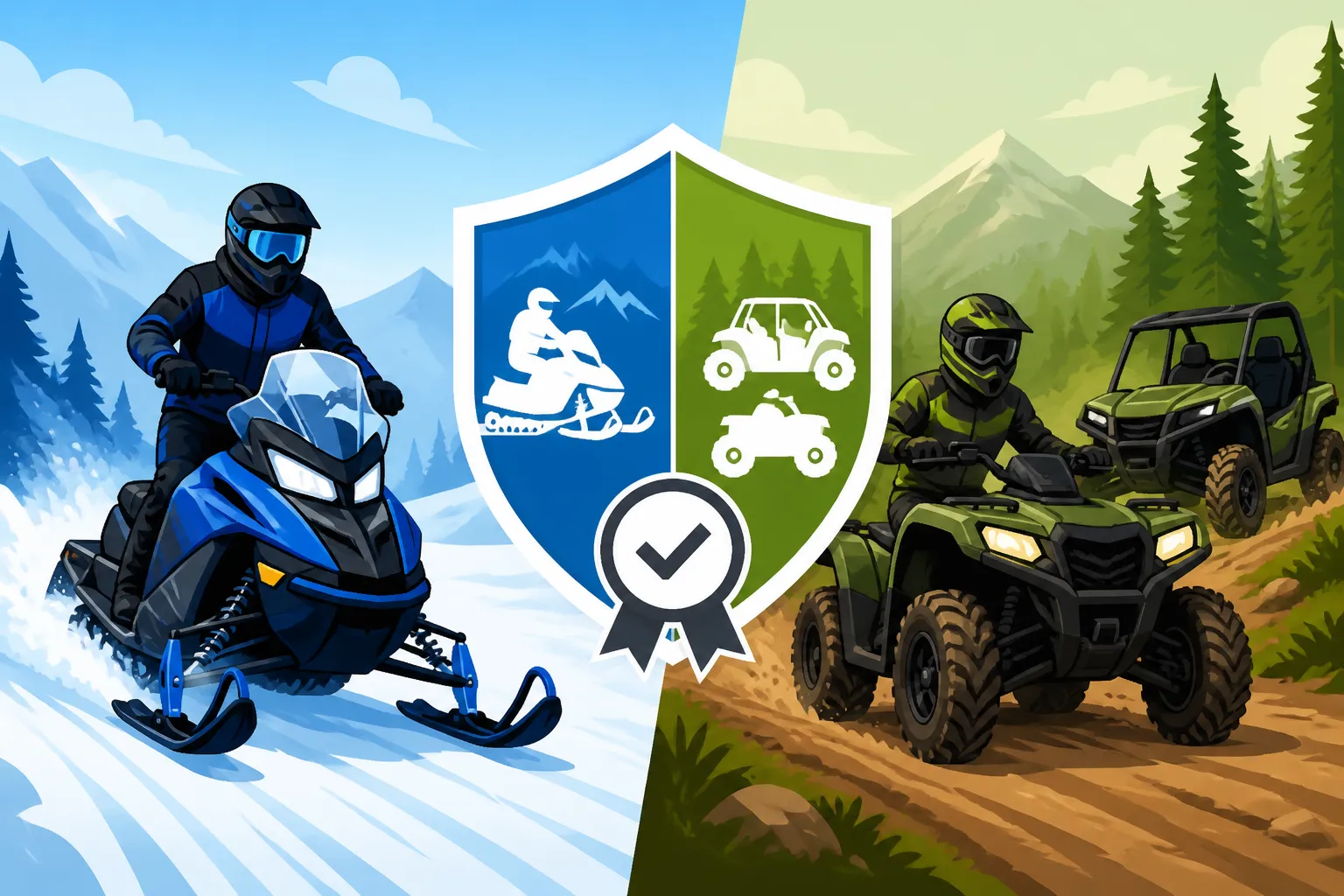
An ATV and a snowmobile are both off-highway vehicles, but they are not the same type of machine. An ATV has wheels and handlebars; a snowmobile uses skis to steer and a track to move over snow. Their handling, braking, stability and hazards differ, so training for one does not automatically prepare a rider for the other.
That difference matters in a practical way. On an ATV, riders need to understand how speed, terrain and body position affect a wheeled machine. A snowmobile requires a different understanding of steering and stopping on snow, traction, changing trail conditions and the risks of operating in winter. Learning the rules for one vehicle does not teach all of the skills needed for the other.
Quebec’s training and competency requirements are also organized around vehicle type. A certificate associated with ATV training is not a general off-highway vehicle credential that automatically applies to snowmobiles. If a rider needs a snowmobile-specific certificate to meet the rules that apply to them, an ATV certificate does not replace it.
| Document or requirement | What it relates to | What it does not replace |
|---|---|---|
| ATV training certificate | Training or competency requirements for an ATV rider, where applicable | Snowmobile-specific training or proof |
| Snowmobile training certificate | Training or competency requirements for a snowmobile rider, where applicable | ATV-specific training or proof |
| Driver’s licence | A separate licence requirement that may apply to operating a vehicle | A vehicle-specific training certificate |
| Trail pass | Permission to use a participating trail network under its rules | A licence, training certificate or insurance |
It helps to keep the documents separate in your mind: training, licensing and trail access answer different questions. A rider can have one and still need another. For an overview of how training fits into Quebec’s youth rules, see Quebec Training Certificates for Teen Riders.
The distinction is especially important for families. A teenager who has completed ATV training should not assume that completion settles the requirements for a snowmobile ride. The same caution applies if a family owns both types of machine, or if a young rider changes vehicles during the season. Check the requirements for the particular machine and rider rather than relying on a certificate’s general description or the fact that both machines are used off road.
Who needs to check the snowmobile certificate rules
The certificate question is most important for younger riders, because Quebec’s rules can depend on the rider’s age and the credential they hold. Do not assume that the same requirement applies to every adult and every teenager. The fact that a snowmobile-specific certificate may be required for some riders does not mean every snowmobile operator has identical training obligations.
Before a ride, identify the rider’s age, the machine they will operate and the setting where they will ride. Then confirm which licence or training proof is required for that combination. A rule that applies to a teenager on a trail may not be identical to the rule for an adult, or for riding on private property. If the rider is close to an age threshold, check the actual current requirement rather than relying on a general statement such as “they’ve already taken the course.”
For young ATV riders, the age-specific rules are covered in Quebec Rules for a 16-Year-Old Rider and Quebec Rules for a 17-Year-Old Rider. Those pages are useful for understanding the ATV side of the comparison, but they should not be used as a substitute for confirming snowmobile requirements. The vehicle-specific distinction remains important even if the rider is the same age and the same family owns both machines.
A parent or guardian can make the check more reliable by matching each person to the right paperwork:
- Confirm the vehicle. Is the rider operating an ATV or a snowmobile? Use the requirements for that machine, not just the generic phrase “off-highway vehicle.”
- Confirm the rider’s age. Requirements may differ for younger riders and adults.
- Check the required credential. Determine whether the rider needs a driver’s licence, a vehicle-specific training certificate, or another form of proof.
- Confirm trail access requirements separately. A trail pass, where required, is not a training certificate.
- Carry the correct proof. Keep the required documents available in the form accepted for the ride.
If the rider has only one certificate, ask the training provider or the relevant official source whether it is valid for the specific machine. Do not infer that it covers both because the course provider uses broad language such as “off-road safety” in general information. When in doubt, ask for the exact certificate name and what type of vehicle it applies to.
How to plan for riding both types of machine
Families and riders who use both ATVs and snowmobiles should treat them as two separate training and paperwork tracks. This is not just a matter of filing documents in different folders. It reduces the risk of arriving at a trail with the wrong proof, and it gives the rider a clearer sense of which skills and rules apply to the machine they are about to use.
A simple record for each rider can include the machine type, certificate or licence held, date of course completion, and any conditions or limitations attached to the credential. Keep a separate note of trail-pass requirements and insurance information. This is particularly useful when several family members share machines, or when an adult is checking documents for a teenager before a group ride.
If a rider has completed an ATV course and is now moving to a snowmobile, consider the new machine a fresh learning task. The rider should receive training that addresses snowmobile operation, not merely a quick explanation of the controls. Even a confident ATV rider may be unfamiliar with how a snowmobile behaves on packed snow, loose snow, uneven surfaces or changing winter conditions.
A practical preparation routine can look like this:
- Match every rider to the machine they will actually operate.
- Check whether their existing credential applies to that vehicle.
- Arrange the correct training if a snowmobile-specific certificate is required.
- Review the current operating rules before using public trails.
- Confirm the trail pass, insurance and other access requirements separately.
- Make sure younger riders understand the limits that apply to their age and credential.
For a broader comparison of the paperwork involved in registering an ATV and a snowmobile, see Quebec Registration for a Snowmobile Compared. Registration and training are separate matters, but keeping both straight helps prevent one document from being mistaken for another.
Visitors should be just as careful. A certificate or licence from another province may not automatically satisfy Quebec’s requirements for a particular machine or trail. Do not assume that an ATV credential from home transfers to a Quebec snowmobile ride. Check the rules that apply to visitors, the vehicle and the planned route before travelling. The same principle applies to local riders who borrow someone else’s snowmobile: the machine’s owner having the right papers does not necessarily prove that the operator meets their own requirements.
Common assumptions that lead to problems
The most common mistake is treating “training certificate” as one universal document. A certificate is meaningful only in relation to the training completed and the vehicle category it covers. If an ATV course was completed, that is useful preparation for an ATV; it does not establish that the rider has completed snowmobile training.
Another mistake is mixing up training with permission to use a trail. A certificate does not, by itself, establish that a rider has every licence, insurance document or trail pass required for a trip. Likewise, having a trail pass does not prove that the operator has the right training or licence. Each requirement has its own purpose, and one should not be used as a stand-in for another.
Riders can also be misled by informal advice. A friend may have ridden for years without being asked for a particular document, or a family member may remember a rule from a previous season. That is not a reliable way to determine what applies now, especially when the rider is a minor or the trip involves a different vehicle. Confirm the requirement with the appropriate official source or training provider, and be precise about whether the question concerns an ATV or a snowmobile.
When checking a certificate, look for its actual title and the vehicle category it covers. If those details are unclear, ask the issuer directly. Avoid relying only on a photo of a card, an old course handout or a retailer’s general description. If a riding group includes both ATVs and snowmobiles, make sure the organizer has checked each operator’s requirements for the machine they will use, rather than collecting one kind of proof from everyone.
The safest takeaway is straightforward: an ATV certificate and a snowmobile certificate serve different purposes. Check the requirement for the exact vehicle and rider, then keep training, licensing, insurance and trail access paperwork distinct. That small bit of preparation can prevent a failed trail check and, more importantly, helps ensure riders receive training suited to the machine they are operating.
Disclaimer
This article is for general informational purposes only and does not constitute professional advice. Laws, prices and regulations vary by location and change over time. Consult a qualified professional for guidance on your specific situation.