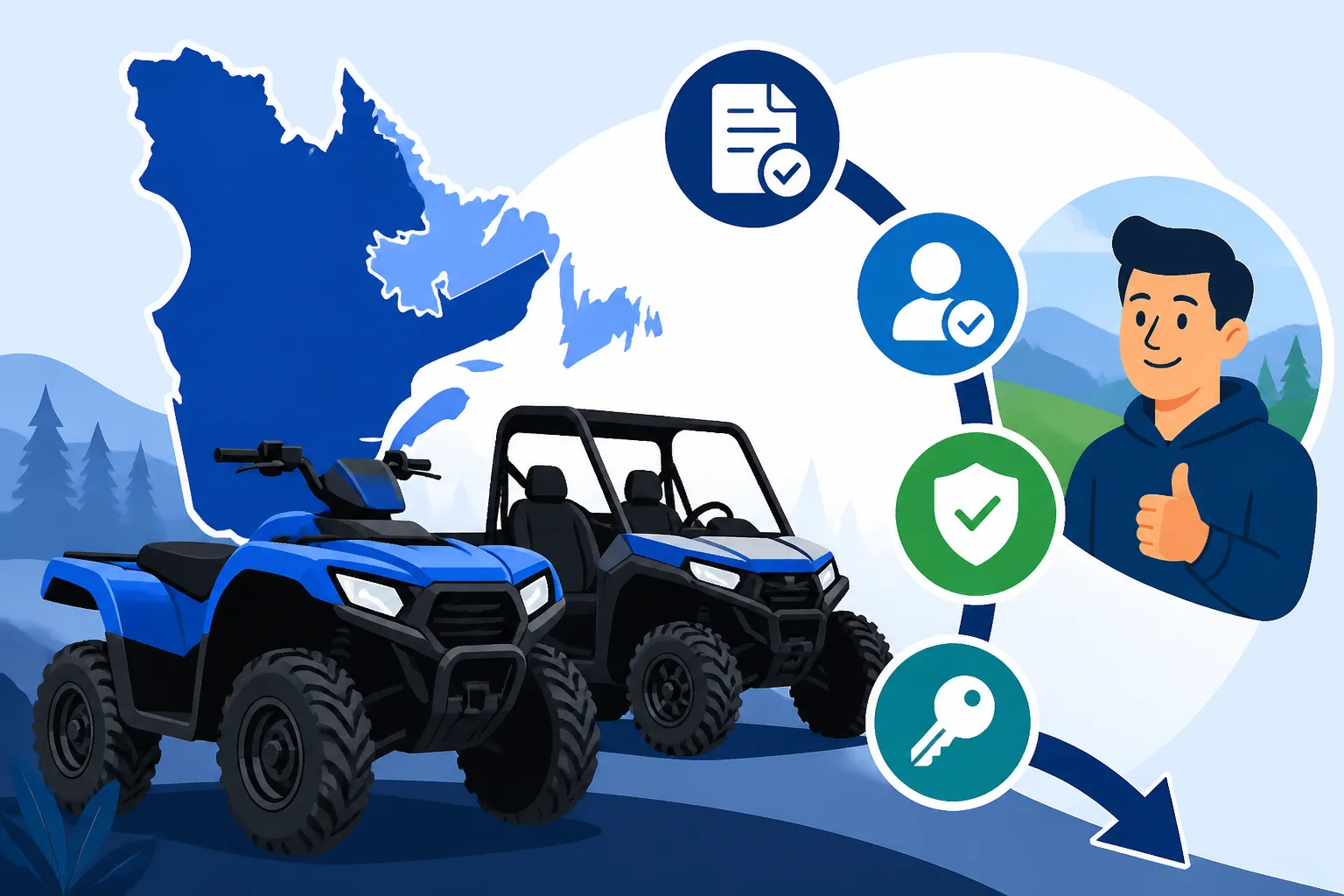
Quebec SAAQ Steps After a Dealer Purchase
Buying a new ATV or side-by-side from a dealer in Quebec is an exciting moment, but the administrative side of things can often feel like a bit of a mystery, leaving you wondering if you’ve actually crossed every 't' and dotted every 'i' with the SAAQ. It's easy to get caught up in the thrill of the purchase, only to be left scratching your head about what comes next for official registration. This guide will walk you through the essential steps you need to take after driving off the lot to ensure your new machine is properly registered and ready for Quebec's trails and roads.
The Initial Dealer Handover: What Happens at the Dealership?
When you're at the dealership, signing the papers, and admiring your shiny new off-road machine, it feels like the hard part is over. But it's really just the beginning of your journey toward full compliance. The dealer plays a significant role in preparing you for the SAAQ, but ultimately, the responsibility for final registration falls to you. Understanding what the dealer handles and what you're expected to do next is crucial for a smooth process. They're often busy moving machines, and sometimes the finer points of the SAAQ process can get lost in the excitement.
Signing the Purchase Agreement and Financing Documents
The purchase agreement is the foundational document of your new ownership. It outlines the machine's details, the agreed-upon price, any trade-in value, and the terms of sale. It’s important to read this thoroughly, even if you’re eager to get out on the trails. This document will include the make, model, year, and crucially, the Vehicle Identification Number (VIN) or serial number of your ATV or side-by-side. If you’re financing, you’ll sign additional paperwork detailing your loan terms, interest rates, and payment schedule. These documents are legally binding, and having a clear understanding of them is vital. While dealers usually use their own forms, tools like LawDepot can be helpful if you ever need to create or review similar legal documents for personal understanding or future private sales, though for a dealer purchase, you'll be using their standard agreements. Always ensure the VIN on your paperwork matches the VIN on your machine exactly; a single digit error can cause major headaches down the line at the SAAQ.
Every term and condition outlined in these initial documents will impact your ownership, from warranties to the final price. Don't be afraid to ask questions about anything unclear. It's your investment, and you have every right to understand the fine print. Ensure you receive copies of all signed documents before you leave, as you'll need them for your records and potentially for future reference, even if the dealer sends many documents directly to the SAAQ on your behalf. These papers are proof that the machine is now legally yours, pending the SAAQ's official recognition. For more on what the dealer hands over, check out [Quebec Dealer Paperwork at Delivery].
Understanding Dealer Fees and Charges
Beyond the price of the machine itself, you'll likely encounter a range of additional fees and charges when buying from a dealer. These can include preparation fees, freight charges, documentation fees, and of course, sales tax. While some fees are standard, others might be negotiable or vary significantly between dealerships. It’s always a good idea to inquire about a full breakdown of all costs before finalizing the purchase. Don't let these surprise you at the last minute; ask for an itemized list upfront. These fees contribute to the overall [Quebec ATV Registration Cost] you'll incur, even if they aren't directly SAAQ fees.
Knowing what you’re paying for is key. For example, a "preparation fee" typically covers the dealer's cost of assembling the machine, performing pre-delivery inspections, and ensuring it's ready to ride safely. Freight charges cover the cost of transporting the machine from the manufacturer to the dealership. Documentation fees might cover the administrative costs of preparing all the sales and registration paperwork. Always clarify what each fee entails. While the SAAQ charges its own registration fees later, these dealer charges are part of the initial outlay. You might want to review [Quebec Dealer Fees to Expect] to understand what's common in the market.
Temporary Plate and Proof of Sale
Once the purchase is complete, the dealer will often issue you a temporary transit plate or a temporary registration sticker, allowing you to legally transport your new off-road machine home. This temporary solution is essential because you cannot legally ride an unregistered machine, even if you just bought it. The dealer should also provide you with a detailed proof of sale, sometimes called a sales contract or bill of sale, which clearly states that you are the new owner. This document is your immediate proof of ownership before your official SAAQ registration is complete.
The temporary plate is just that—temporary. It usually has a limited validity period, typically a few days or weeks, giving you enough time to complete your full registration with the SAAQ. Make sure you understand its expiration date and plan your SAAQ visit accordingly. You don't want to be caught riding with an expired temporary plate! This proof of sale, combined with your financing documents (if applicable), will be critical when you interact with the SAAQ, as it confirms the transaction and your legal claim to the machine. Keep these documents safe and readily accessible.
Why the SAAQ Is Involved: Understanding Quebec's Unique System
Quebec's system for off-road vehicles (VHRs, or véhicules hors route) is quite distinct from many other jurisdictions. Instead of separate agencies for registration and insurance, the Société de l'assurance automobile du Québec (SAAQ) handles both. This integration means that when you register your ATV or side-by-side, you're also automatically enrolled in a basic liability insurance scheme managed by the SAAQ. This unique setup aims to simplify the process and ensure a minimum level of coverage for all registered off-road machines.
The SAAQ as Registrar and Insurer
For off-road vehicles in Quebec, the SAAQ serves a dual role: it's not only the registrar but also the primary insurer for basic civil liability. This means that when you complete your [Quebec ATV Registration With the SAAQ], you're simultaneously getting your machine recorded in the provincial system and securing the mandatory minimum liability coverage. This coverage is crucial because it protects you, up to a certain limit, if you cause injury or damage to others while operating your VHR. This integrated approach is a cornerstone of Quebec's off-road vehicle laws, ensuring that all registered machines carry fundamental protection.
Historically, the liability minimum was lower, but [Quebec Liability Minimum Rose to $1 Million] to provide more robust protection for riders and the public. This unified system streamlines the process for owners, eliminating the need to deal with a separate insurance provider for the basic liability component. However, it’s important to understand that the SAAQ’s coverage is basic; it doesn’t cover damage to your own machine or personal injuries beyond what’s included in their civil liability. For comprehensive protection, you’ll still need to consider private insurance options. You can read more about this in [What the SAAQ Actually Does for Quad Owners].
The Importance of the VHR Plate
Every registered off-road vehicle in Quebec receives a distinctive "VHR" plate. This plate isn't just a decorative item; it's tangible proof that your machine is legally registered with the SAAQ and carries the mandatory liability insurance. It's akin to a license plate for your car, signifying compliance with provincial regulations. The VHR plate is designed to be easily affixed to your ATV or side-by-side, typically on the rear fender, and must be visible at all times when riding on public trails or designated areas. Without it, you could face fines and penalties.
The plate itself comes with your registration certificate and must be properly mounted. It serves as an immediate visual indicator for trail patrols and law enforcement that your machine is legitimate. Neglecting to display it, or having it obscured by mud or debris, can lead to issues during inspections. The SAAQ specifically designed these plates to be practical for off-road use, considering where they'd need to go on the machine. For guidance on proper placement, refer to [Quebec Plate Placement on a Quad] or [Why a VHR Plate Fits on a Fender]. This little piece of metal is a big deal in Quebec off-road culture, symbolizing responsible ownership and access to the vast trail network.
Your Role After Leaving the Dealership: Gathering Your Paperwork
While your dealer handles some of the heavy lifting by often submitting initial sales information to the SAAQ electronically, the ultimate responsibility for ensuring your machine is fully registered rests with you, the new owner. It's like buying a new house; the real estate agent helps, but you still have to sign the mortgage papers. Ignoring this final step can lead to serious legal consequences, including fines and having your machine impounded. So, even after the excitement of the purchase, there's a bit more homework to do.
What the Dealer Provides for Your Records
When you leave the dealership, you should have a small stack of important documents. These typically include the original sales contract or bill of sale, any financing agreements, and possibly a temporary transit permit or plate. Some dealers might also provide a copy of the new vehicle information statement (NVIS) if it's a brand new machine, or proof of a prior registration transfer if it's a used machine they sold you. It’s absolutely critical that you keep these documents organized and safe, as they form the backbone of your ownership proof. Think of them as your ownership passport for the machine.
Even though the dealer likely transmits information to the SAAQ, having your own copies of these documents ensures you have a backup and a clear paper trail. This can be invaluable if there's ever a discrepancy or a question about your purchase. It's your evidence of who, what, when, and how your machine was acquired. When you finally head to the SAAQ (or go online), these documents will be what you present as proof of your recent purchase. Make sure the VIN on all documents matches the physical VIN on your machine perfectly.
Confirming Machine Details and Serial Numbers
Before you even think about registering, take a moment to double-check all the details of your new ATV or side-by-side against the paperwork. This means verifying the make, model, year, and most importantly, the Vehicle Identification Number (VIN) or serial number. The VIN is a unique identifier, much like a fingerprint for your machine, and it's essential for correct registration. You can usually find the VIN stamped on the frame, often near the front wheels, under the seat, or on a compliance plate. Make sure the VIN on the machine matches exactly what's printed on your sales contract and any other paperwork.
Even a single incorrect digit can cause significant delays and administrative headaches when trying to register. It's a small check that can save you a lot of frustration later on. If you notice any discrepancies, contact your dealer immediately to get them corrected before proceeding with registration. The SAAQ relies entirely on this information, and any inconsistency will raise a red flag. This meticulous check is a vital step in [Quebec Registration Paperwork Checklist] to avoid future problems.
Preparing for Your SAAQ Visit (or Online Process)
With your dealer paperwork in hand and your machine details verified, you're ready for the actual SAAQ registration step. You have two main avenues: visiting a SAAQ service outlet in person or, in some cases, completing the process online. For a new purchase from a dealer, often the initial registration can be started online if the dealer has already transmitted the sales data. However, for a first-time registration of a specific VIN in your name, an in-person visit might be required to verify identification or handle specific details.
Regardless of the method, you'll need to have certain documents ready. These typically include:
- Your driver’s license (proving your identity and address).
- The original sales contract or bill of sale from the dealer.
- Proof of Quebec residency (if your driver's license doesn't clearly show a Quebec address).
- Any financing agreements (if there's a lienholder).
- Payment for registration fees and sales tax.
Having everything organized will make the process much smoother, whether you're clicking through forms online or presenting them to a clerk. For more specific details on what to bring, consult [Documents to Bring to a Service Counter].
Navigating the SAAQ: Completing Your Registration
Now for the main event: getting your machine officially registered with the SAAQ. This is where your ATV or side-by-side officially enters the Quebec VHR system, allowing you to ride legally on designated trails and approved municipal roads. It can feel a bit like wading through bureaucracy, but with the right preparation, it’s a straightforward process.
Online Registration Versus In-Person at a Service Outlet
The SAAQ has been working to make many of its services available online, and for certain transactions, registering a machine purchased from a dealer might fall into this category, especially if the dealer has already forwarded all necessary sales information. The online portal offers convenience, allowing you to complete the steps from home without waiting in line. You'll typically need to log in with your SAAQClic account, which links to your driver's license and existing SAAQ records.
However, sometimes an in-person visit to a SAAQ service outlet is unavoidable, particularly if there are unique circumstances, if it's your very first registration as a new Quebec resident (see [Quebec ATV Registration for Newcomers]), or if the online system flags something that requires human verification. An in-person visit also allows you to ask questions directly to a SAAQ clerk, which can be invaluable if you're unsure about any aspect of the process. Always check the SAAQ website or call ahead to see if your specific situation allows for online registration for a new dealer purchase. This choice depends on your comfort level with online forms and the complexity of your registration.
The Required Documents for Registration
Whether online or in person, the SAAQ will require specific documents to process your registration. The core documents are typically:
- Proof of Identity and Residency: Your valid Quebec driver's license is usually sufficient. If you’re a new resident or your license is from another province, you might need additional proof of Quebec residency, like a utility bill or lease agreement.
- Proof of Ownership: This is your original sales contract or bill of sale from the dealer. It must clearly show the date of purchase, the seller's details (the dealer's name), your details as the buyer, and the complete VIN of the machine.
- Payment: You'll need to pay the applicable registration fees and the Quebec Sales Tax (QST). The QST is calculated on the purchase price of the machine. The SAAQ acts as a collection agent for this tax. For detailed information on this, you might look into [Quebec Sales Tax on an ATV Purchase].
Having all these documents neatly organized will speed up your process significantly. The SAAQ clerks appreciate when you're prepared! It helps them verify everything quickly and accurately. If you have any additional legal agreements related to your purchase, such as a co-ownership agreement that you might have drafted with a service like LawDepot, it's wise to have those on hand too, just in case.
Here's a quick checklist of what you'll typically need:
| Document Category | Specific Item | Purpose | Notes |
|---|---|---|---|
| Identity & Residency | Quebec Driver's License | Confirms who you are and where you live. | Ensure it's valid and shows your current address. |
| (Optional) Proof of Quebec Residency | If driver's license is new or from out-of-province. | Utility bill, lease, municipal tax bill, etc. | |
| Ownership | Original Sales Contract / Bill of Sale | Confirms your purchase from the dealer. | Must include VIN, date, dealer & buyer info. |
| (Optional) New Vehicle Information Statement (NVIS) | For brand new machines, confirms vehicle specs. | Dealer typically provides this if applicable. | |
| Financial | Payment Method | To pay registration fees and Quebec Sales Tax (QST). | Debit, credit card, or cash (check SAAQ payment methods). |
| (Optional) Financing Agreement | If a lien is placed on the machine. | The SAAQ will record the lienholder's information. |
Understanding Registration Costs and Payment
When you register your ATV or side-by-side, you'll be responsible for two main financial components: the SAAQ's annual registration fee and the Quebec Sales Tax (QST). The SAAQ registration fee covers the administrative costs of maintaining your vehicle's record and, importantly, includes your basic civil liability insurance. This fee varies depending on the type of machine and changes periodically, so it's always best to check the current rates directly on the SAAQ website or when you complete the registration process.
The Quebec Sales Tax (QST) is applied to the purchase price of your machine. When you buy from a dealer, the SAAQ collects this tax during the registration process, acting on behalf of the provincial government. It's a significant portion of the total cost, so be prepared for it. Some dealers might collect this at the point of sale, but generally, the SAAQ handles it at registration for off-road vehicles. Make sure you understand the exact amounts before you go to the SAAQ. The SAAQ accepts various payment methods, including debit cards, credit cards, and sometimes cash, but it's always wise to confirm their accepted payment types beforehand. Knowing these costs upfront helps you budget for your new acquisition. To get a better grasp of the financial aspects, you can look at [Quebec ATV Registration Costs Explained].
Post-Registration: What to Expect and What to Keep
Congratulations! You've navigated the dealer paperwork and the SAAQ process. Your ATV or side-by-side is now officially registered and insured in Quebec. But the journey isn't quite over. There are a few final steps and important habits to adopt to ensure you remain compliant and ready for all your adventures.
Receiving Your Official Registration Certificate
Once your registration is successfully processed by the SAAQ, you will receive your official registration certificate. This document is your proof of registration and liability insurance. It typically includes your name, your address, the details of your ATV or side-by-side (make, model, VIN), and the validity period of the registration. You'll also receive your VHR plate at this time, if you haven't already.
This certificate is absolutely vital. You must carry it with you whenever you're operating your off-road machine on trails or public lands. It's what trail patrols, police officers, or other authorities will ask to see if you are stopped. A photocopy or a digital image on your phone might be accepted in some situations, but the physical document is always the safest bet. Store it in a waterproof bag or container on your machine to protect it from the elements. Losing it means you'll need to contact the SAAQ for a replacement, which can be an inconvenience.
Sticking Your VHR Plate and Carrying Proof
With your registration certificate in hand, it's time to affix your VHR plate to your machine. As mentioned earlier, this plate is mandatory and must be clearly visible. Most ATVs have a designated spot on the rear fender for this purpose. Ensure it’s securely attached and not obscured by any accessories, mud, or snow. A properly mounted plate signals to everyone that you’re a responsible and compliant rider.
Beyond the plate, remember the registration certificate itself. Always have it with you when you ride. Think of it as your machine's identification card. Along with your valid driver's license (since [Quebec Requires a Driver's Licence Since 2021] for ATV operators), these are the two pieces of identification you absolutely need to carry. This is an important part of [Quebec's Off-Highway Vehicle Act and Your Papers]. Getting into the habit of always checking for your certificate before a ride will save you potential fines and hassle.
Annual Renewal and Staying Compliant
Your SAAQ registration isn't a one-and-done deal. It needs to be renewed annually. The SAAQ will send you a renewal notice in the mail, usually a few weeks before your current registration expires. This notice will detail the upcoming fees and provide instructions on how to renew, which can often be done online, by mail, or in person. It's crucial not to let your registration lapse, as riding with an expired registration can lead to significant fines and penalties.
The renewal process is generally simpler than the initial registration, as all your information is already on file. You're simply paying the annual fee to keep your machine's registration and basic liability insurance active. Even if you don't plan to ride much in a given year, if your machine is not officially declared "out of service" with the SAAQ, you are expected to renew it if you intend to ride at all. Understanding and adhering to the [Quebec ATV Registration Renewal Each Year] process is key to enjoying your machine without interruption or legal complications. Staying compliant means you can focus on the joy of riding, knowing all your paperwork is in order.
Disclaimer
This article is for general informational purposes only and does not constitute professional advice. Laws, prices and regulations vary by location and change over time. Consult a qualified professional for guidance on your specific situation.